Chapter 2
Humans in Universe
2BEFORE THE PICTORIALLY GRAPHIC RECORD of the presence of humanity aboard our planet began, there was no way for individuals to record their feelings and thoughts except as manifest in their tool-inventing. People must have been in critical life-sustaining need to have invented words. Words are tools, but their sounds could not be made to last under early history’s conditions. Individually identifiable humans had no line of communication reaching directly to us today, other than the evidence of humanity’s massive group work in carving, shaping, and building with stones, plus the nonidentifiable individual’s profuse handicrafting of small artifacts such as pottery, arrowheads, and beads.
3 From the beginning of the pictorially recorded history—on walls, vases, jewelry—we gain more and more information regarding general human experiences, capabilities, thoughts, and motivations. For instance, it is evidenced that throughout all earlier times until yesterday, the ruling social powers assumed the human masses to be universally ignorant and accredited them with having only muscle and dexterity value. The illiteracy of the masses was mistakenly interpreted as meaning that the commoner was inherently lacking in intellect—just a ‘‘poor wretch.’’ As ‘‘the exception that proved the rule,’’ once in a rare while—by command of some ‘‘god’’—a commoner apparently was endowed with creative powers and insights. The ease with which the erroneous assumption could be made that the masses are stupid is manifest when we realize how easily present-day humans, conditioned to speak only Americanese, could deceive themselves into mistaking for an ‘‘inherently illiterate Mongol’’ an ill-clothed, war-bruised, Chinese communist Ph.D. physicist, unable to speak Americanese or the local dialect.
4 During only the last few decades of the three and a half million years within which humans now are known to have been living aboard our planet Earth have the behavioral clues been increasingly sufficient to suggest that all humans, including the assumed-to-be ‘‘illiterates’’ and ‘‘spastics,’’ are born with a comprehensive and superb inventory of subjectively apprehending and synergetically comprehending faculties—as well as objectively articulating capabilities. This has not yet been formally acknowledged to be the case by the present educational establishments’ ‘‘capability accrediting boards.’’ Awareness of the foregoing has not as yet dawned amongst the politico-social pressure groups such as the labor unions, veterans’ organizations, or parent-teacher associations.
5 We may soon discover that all babies are born geniuses and only become degeniused by the erosive effects of unthinkingly maintained false assumptions of the grown-ups, with their conventional ways of ‘‘bringing up’’ and ‘‘educating’’ their young. We now know that schools are the least favorable environment for learning. The home TV is far more effective, but we are allowing the big money-making advertisers to poison the information children assimilate in their four to five hours a day of spontaneous turning-on, looking at and listening to the TV.
6 It is possible to identify some of the known faculties that we generally assumed to be coordinate in those whom society does concede to be adult geniuses. The publicly accredited characteristics of genius consist, for instance, of an actively self-attended intuition. The intuition, in turn, opens the conceptual and perceptual doors. With those doors self-opened, the innate faculties frequently combine and employ the individual’s scientific, artistic, philosophical, and idealistic imaginings in producing physically talented, logical, far-sighted, and practical articulations. Leonardo da Vinci, who fortunately weathered the genius-eroding susceptibilities of childhood, manifested and coordinatingly employed all and more of such conceptual faculties and articulative capabilities.
7 In the graphically recorded history of the last eight millennia, as well as in the dim twilight of pre-Inda-Chinese, Mesopotamian, Egyptian, and South and Central American graphic documentations of history, there have appeared, from time to time, individuals who grew to maturity without losing the full inventory of their innate, intuitive, and spontaneously coordinate faculties. These unscathed individuals inaugurated whole new eras of physical environmental transformation so important as, in due course, to affect the lives of all ensuing humanity. We shall hereafter identify such unscathed, comprehensively effective, and largely unidentified individual articulators as the artist-scientists of history.
8 Since the dawn of the most meagerly revealed human history there have been a number of importantly distinct periods of historical transformation of both the physical and cosmological environments of society. Each of these eras has been opened by the artist-scientist. The invisible power structures behind-the-visible-king first patronize and help to develop the artist-scientists’ advanced-environment breakthroughs, but always go on, ever more selfishly, to over-exploit the breakthroughs.
9 The environment—everything that is ‘‘not me’’—is sub-divisible into two parts, physical and metaphysical. The metaphysical environment consists of human thoughts, generalized principles and customs. The artist-scientist types seem to have avoided attempting to reform the metaphysical environment. They are documented only by their employment of the cosmic laws—generalized principles—to reorganize the physical constituents of the livingry and the scenery. The artist-scientists apparently assumed intuitively that a more man-favoring rearrangement of the environment would be conducive to humanity’s spontaneous self-realization of its higher potentials. Human travelers coming to a river and finding a bridge across it spontaneously use the bridge instead of hazarding themselves in the torrents.
10 Scientist-artists originally conceived and designed the bridges. The power-structure-behind-the-king, seeing great exploitability of the bridge for their own advantaging, accredited the workers and materials to build the bridges.
11 Physiology and biology make it clear that at the outset of graphically recorded history a universally illiterate—but probably not unintelligent—humanity was endowed with innate and spontaneously self-regenerative drives of hunger, thirst, and species regeneration. The a priori chemical, electromagnetic, atomistic, genetic, and synergetic designing of these innate drives apparently was instituted by a wisdom—a formulative capability inherent in Universe—higher than that possessed by any known living humans. These drives probably were designed into humans to ensure that human life and the human mind—long unacknowledged as humanity’s highest faculty—ultimately would discover its own significance and would become established and most importantly operative not only aboard planet Earth, but also in respect to vast, locally evidenced aspects of Universe. As such, mind may come not only to demonstrate supremacy over humanity’s physical muscle but also to render forevermore utterly innocuous and impotent the muscle-augmented weapons and the latter’s ballistic hitting powers. Mind possibly may serve as the essential, anti-entropic (syntropic) function for eternally conserving the omni-interaccommodative, nonsimultaneous, and only partially overlapping, omni-intertransforming, self-regenerating scenario—which we speak of as ‘‘Universe.’’
12 Mind, operative aboard our planet Earth and probably elsewhere in Universe in a myriad of effective circumstances, can and may perform the paramount function of conserving the scenario ‘‘Universe.’’ If so, it will have to be accomplished by apprehending, comprehending, and teleologically employing the metaphysical, weightless, omni-intercooperative generalized principles of Universe in strategically effective degree and within a critical time limit.
13 This can be accomplished in progressively more effective ways—for instance, by Earthians competently ‘‘fielding’’ all those physical energy increments entropically broadcast by the stars, which happen to impinge kinetically upon our Earth as it orbits the Sun. Employing the appropriate biological and physiological principles, these receipts must be collected, sorted, analyzed, synergetically comprehended, and symmetrically combined into complex but orderly, macro-and-micro-cohering aggregates. Therewith, they must be added into the Earth bio-sphere’s resource-conserving and -storing inventory. It is seemingly manifest by the comprehensively considered record that the task of metaphysical intellect is to cooperate with evolution as a major syntropic factor by collecting, sorting, and symmetrically combining information into ever more advantageous and orderly patterns, i.e., designs, to offset the physical Universe’s macrocosmic proclivities of becoming locally ever more dissynchronous, asymmetric, diffuse, and multiplyingly expansive.
14 The kinetic inter-complementarity of finite Universe requires that what disassociates here must associate there—and also there. High-pressure conditions at one point are balanced by low pressures elsewhere. The stars are all radiantly dissipating energy. The Earth, however, is a celestial center where energies from the stars are being collected and photosynthetically combined in an orderly molecular assembly as hydrocarbons, which are consumed by orderly designed species, and then self-multiply to make these biological species grow, undergo transformations, and eventually be buried deeply beneath the Earth’s surface. When, after many billions of years, enough orderly-molecule energy has been impounded aboard our spherical space vehicle Earth, the Earth itself will become a radiant star, as the discards of other burned-out and dissipated stars are concurrently aggregated in billions of local elsewheres—some trillions of years hence also to become stars.
15 No factor operative aboard our planet is so effective in aggregating, reorganizing, concentrating, and refining the disorderly, random resource receipts as is the human mind. Human mind has discovered a number of cosmic laws-generalized scientific principles. Objectively employing a plurality of the cosmic laws, human mind developed the computer, whose combined information storage and retrieval vastly augmented human brain’s information storing, retrieving, and formulative disclosings—ergo, magnificently augmenting human mind’s local Universe problem-solving task and rendering that cosmic functioning of human mind highly effective.
16 Mathematics constitutes human mind’s most cosmically powerful faculty. How did human mind develop progressively its mathematical functioning?
19 Trigonometry had to start with sea-people. It is the conclusion of British, German, and U.S.A. navies’ experts that celestial-offshore-navigation began with the South Pacific’s island peoples. Much has been published on this subject. What is not as well published is the fact that the navigators on all those islands live entirely apart from the other humans in their native groups.
20 When the supposedly God-ordained chieftain of those islands finds his prestige and popular credence declining, he can go to the navigator and ask him to produce a miracle. The chieftain does not know of the navigator as such. The chieftain knows naught of navigation. He thinks of the navigator as a magician or miracle-maker. All the chieftain knows is that his miracle-producer goes off to sea sailing his catamaran out of sight on the ocean. The navigator, using his well remembered, unique patternings of the stars and the ocean currents, water temperatures, and major ‘‘old-seas’’ patterns, goes to another far-off island where there exist shells or trees or stones or other items such as have never been and probably never will be found on the home island. The navigator brings this foreign item back to the island king-chieftain, who displays it before the people, who spontaneously assume that the chieftain has conjured the strange object into existence with his divine powers—and the chieftain’s accreditation as being divinely instituted is restored.
21 We can now comprehend the succession of events by which, generations later, prehistory’s successors of the ancient navigators eventually became the high priests of Egypt, Babylon, and other great civilizations. Both their evolutingly developed mathematical calculating capability and their navigational intuiting ultimately led to their discovery that the Earth is a circumnavigatable sphere. This knowledge made them more powerful than the physically powerful fighting kings.
22 Offshore, with no familiar landmarks to guide them, early water-peoples learned through necessity and invention how to sail their ships on courses running between any two well-recognized stars co-occurring diametrically opposite one another above the sky’s circular horizon at various given times of the night and reliably reappearing in the same pattern in any geographical area on any given day of the year. Any two prominent, easy-to-recognize stars in the sky gave the unique course for the ship to follow. The point on the mast, B, at which the bright star in the sky toward which they sailed occurred at any given time of observation, and the point C, at which the boom of their sail contacted the mast, and the point A, at which the stern-standing or -sitting helmsman’s eye occurs, gave the three corner points of a right triangle whose three angles, A, B, and C, always sum-totalled 180 degrees. This 180-degree sum-total angular constancy of any plane triangle formed the basis of all plane trigonometry.
23 If one of the three angles of a triangle is a right angle, then all the variation takes place only between the two other angles, whose angular sum will always equal that of the constant right angle (ninety degrees).
24 With their ship’s (or raft’s) masts mounted perpendicularly (at right angles, vertically) to their ship’s or hull’s waterline, they steered the ship at night by keeping the mast always lined on the approached star—as long as the Earth’s rotation allowed the sight of that star to remain in a usable line of sight. The angle of elevation of the approached star could be sightingly measured by the helms-man observing, from the stern, the star’s ever-changing height on the mast as sightingly identified, for instance, by the mast’s sail-luff rings, which elevation altered as the Earth revolved during the night within the spheric array of Universe stars. With days, months, years, and lifetimes of such observing, measuring, and calculating, the sea people gradually evolved trigonometry. (See Fig. 7. 1)
25 Their ten fingers and ten toes, the ankles of their two legs, the slender wrists of their two arms and their necks served as rods on which to slide bracelets or necklaces or rings of bone, rope, bent wood, or dried seaweed. The number of bracelets on their right-side ankles, wrists, and fingers could be made to correspond to the human-foot-length-spaced-apart vertical intervals on their masts occurring between the rings holding their sails to the mast, and the number of bracelets on their left-side ankles, wrists, and fingers could be made to correspond to the number of ribs of their ship, which also occurred horizontally a foot-length apart, between the foot of the mast and where the observing helmsman sat in the stern of the ship or raft. That’s one of the ways in which sailors learned how to calculate the relative lengths of the two right-angle-forming edges of their triangular sail. The right angle of their triangle occurred between the mast and the ship’s horizontal plane. The vertical and horizontal lines represented the two measurable sides a and b of the right triangle.
26 You and I learned at school that if we multiply a number by itself we obtain the second power of that number (N × N = N2). We also learned that the sum of the second power of sides a and b of our right triangle always equals the second power of the third side c—the hypotenuse of our right triangle.
27 With this information and the ankle, wrist, and finger rings with which to multiply and divide, the sailor-navigator could learn the exact lengths of all three edges of his right triangle, and he soon learned that the angles opposite each edge of the triangle were proportioned to the angles opposite them (A∕a = B∕b = C∕c). Thus, these sailor-navigators learned of the constancy of the angle above the horizon of any given observed star as seen from any given geographical position at any given time of any given night of the year. From these crude beginnings they gradually evolved formalized frames of shell beads mounted slid-ably on wooden rods with which to record their observed measurement numbers and to carry out the calculations. These devices eventually developed into the abacus, with which they could swiftly multiply and divide.
2829We are not suggesting that the craft herewith illustrated was an ancient rig. It is a fairly modern rig. What we say about B (some point aloft in the rigging), A (the position of the steering man’s eye), and C (the position on deck or foot of,a mast at the same level as the steering man’s eye) would apply to any rig of sailing ship or raft with a mast. We use this type of sailing craft because it is simple and easy to describe.
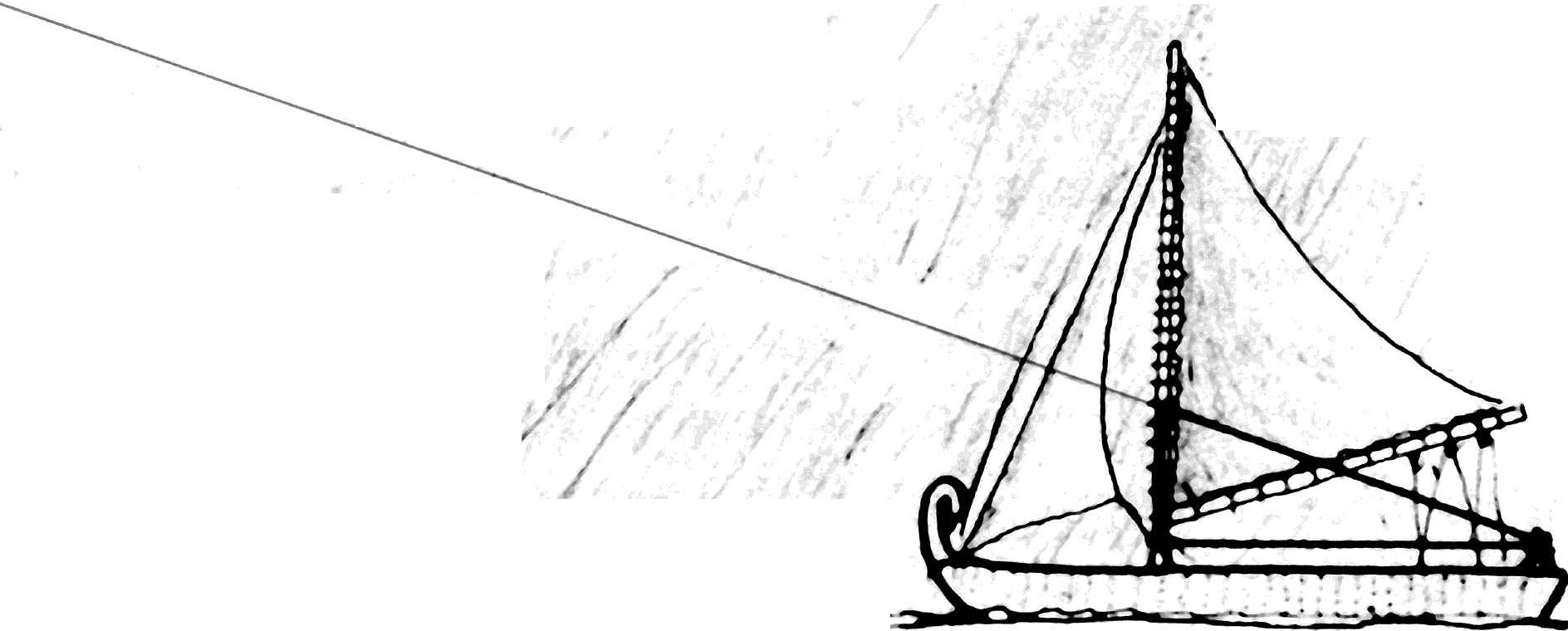
31 The earliest sailor-navigators also made complex ocean maps by superimposing straight bamboo sticks on one another, horizontally in a flat plane, each stick representing the North-Star-referenced ocean-course direction running between any two known geographical points as progressively referenced to the prominent star points visible at the beginning of their voyage. The complex of sticks showed the relative angular interrelationships of the different ocean courses running between the well-known stars sightable above the circular horizon and opposite one another.
32 In its westward voyaging-trendings from its South Pacific and Indian Ocean beginnings (among water-peoples) to overland traveling in India and caravaning in China and Southeast Asia, mathematics gradually lost much of its earlier natural cosmic grandeur and that grandeur’s intuition-inspiring discovery of relevant environment interrelationships.
33 Subsequently, the abacus provided a facile means of accumulating progressive products of multiplication by moving those products ever further leftward, column-by-column, as the operator filled the available bead spaces one by one and moved the excess over ten into the successive right-to-leftward columns.
34 Obviously, number products in even tens (such as the number 20) leave the first right-hand column empty. When the expert abacus-user lost his abacus overboard or by accidental burial in the desert sand, he could remember and visualize its operation so clearly that all he needed to know was the problem-developed content of each column in order to develop any multiplication or division. He then invented symbols for the content of each column to replace drawing a picture of the number of beads—the symbol 3 was quicker than making three pictures. Having developed symbols to express the contents of each column, he had to invent a symbol for the number-less content of the empty column-that symbol became known to the Arabs as the sifr; to the Romans as cifra; and to the English as cipher (our modern zero).
35 Prior to the appearance of the cipher, Roman numerals had been invented to enable completely illiterate servants to keep ‘‘scores’’ of one-by-one occurring events—for example, a man would stand by a gate and make a mark every time a lamb was driven through the lamb-size gate. The more complex Roman numerals were those used by the supervisors, keeping count by their fingers—a V for five (the angle between his thumb and the other four fingers) and X for ten (representing the supervisor’s crossed index fingers.) Since one cannot see ‘‘no sheep’’ and cannot eat ‘‘no sheep,’’ the Roman world seemingly had no need for a symbol for nothing. Only an abacus’s empty column could produce the human experience that called for the invention of the ciphra—the symbol for ‘‘nothing.’’
36 When I first attended school, the older tradespeople in my town—the drugstore man, the butcher, the hardware man—who had known me since my babyhood and were my natural friends, each asked me, ‘‘Have you learned to do your ciphers yet?’’ The discovery of the symbol for nothing became everything to humanity. The cipher alone made possible humanity’s escape from the 1700-year monopoly of all its calculating functions by the power structure operating invisibly behind the church’s ordained few.
37 The from-the-Indian-Ocean-landed navigator-priests’ 3000 B.C. Babylonian geometry is spherical-omnidirectional. Apparently seeking to discover nature’s time-inclusive, four-dimensionally comprehensive, mathematical coordinate system, the Babylonians failed only in their early attempt to correlate their 360-degree great circle’s central-angle-determined arcs’ subdivisions into degrees, minutes, and seconds with time’s hours, minutes, and seconds, but they did discover that the cosmically generalized, closed spherical-surface system was maximally divisible into 120 spherical right triangles, 60 positive and 60 negative. This greatest-common-denominator sixtyness probably occasioned the Babylonians’ adoption of 60 minutes and 60 seconds as the arithmetically absolute, numerically maximum common divisor of all finite systems and of their subsystems. It was factorable by all four of the first prime numbers, 1, 2, 3, 5.
38 For reasons unknown to us a retrogression in mathematical conceptioning emerges, possibly as a consequence of the navigator-priests foreseeing that their power would deteriorate if the kings or other people caught on to too much of their calculating capability.
39 Egypt’s artists visually portrayed all humans and animals only as one-plane, flat silhouettes. In a similar way the Greek and Egyptian geometers—as, for instance, Euclid in 300 B.C.--retrogressed into two-dimensional plane geometry from the Babylonians’ omnidimensional, finite-system, experience-invoked time dimension. The Greeks and Egyptians became concerned only with omnilaterally, infinitely extensible plane geometry and its ‘‘square’’-unit of areal subdivision. Superimposed upon this plane, two-dimensional base the Greek and Egyptian geometers subsequently developed a timeless, weightless, temperature-less, three-dimensional, cubical coordinate system whose squares and cubes were geometrically irreconcilable with a spherical Earth and all the other radiationally and gravitationally divergent-convergent, inherently nucleated, finite, spherical systems’ growths and shrinkages—electromanetic and acoustical, spherically gradient wave propagations.
40 All geometrical proofs of the Euclidean Greeks had to originate in the two-dimensional plane geometry and not in the three-dimensional configuration or four-dimensional temperatured, weighted, and lengthed reality.
41 While some individual scholars were evolving their geometry, others were evolving nongeometrical methods of communication.
42 The ability of humans to write in vertical or horizontal lines of symbolic forms—i.e., Tartarian picto-linguistic, hieroglyphics, cuneiform, Linear A, Linear B, and so on—required great expertise and was not commonly useful. In 1500 B.C. the Phoenicians invented letters for each known mouth-and-lungs-articulated sound. Having developed phonetic pronunciation of each letter, they there-from evolved combined pronunciation of each word. Five hundred years later, in 1000 B.C., the Greek language, employing the Phoenician phonetic spelling concept, developed the twenty-four pronounceable letters which are the same as those used in the Greek writing of present-day—late-twentieth-century-A.D.—Greece. This phonetic form made practical the individual scientists’ own recording of their own thoughts as well as the thoughts of others.
43 As yet convergently-divergently omniconsiderate, in the manner of the Babylonians, and thinking microcosmically, the Greek Democritus in 460 B.C. was the first known human to conceive of a smallest cosmic entity. He named it the ‘‘atom.’’
44 Thinking macrocosmically, the Greek Pythagorean scientists of 600 to 400 B.C., situated to the north of Athens, were the first people known and recorded to think of our world as a spherical entity. In 410 B.C. the Pythagorean Philolaeus was the first to describe the Earth as a spherical body in motion around a central cosmic fire. He also conceived of the stars, the Sun, the Moon, and five planets-Venus, Mercury, Mars, Jupiter, and Saturn—as spherical bodies. His Sun was not at the center of the planetary system’s motion. There is a possibility that he was thinking in galactic, rather than in solar-centered, terms.
45 In 350 B.C. the latter-day Pythagorean Heraclides was the first to conceive of the Earth sphere as spinning west to east. But Heraclides’ cosmos was as yet geocentric. His Earth spun at the center of the fixed-stars Universe.
46 Another Greek, Aristarchus, conceived around 200 B.C. of the spherical Sun as the center of the spherical planets’ orbital system as each planet revolved individually around its own axis at its own unique rate while also orbiting the Sun in greater orbital time periods. For him all the stars were fixed, and the Moon revolved around the Earth. His unprecedented thoughts almost got him killed.
47 Eratosthenes, in 200 B.C., measuringly calculated the circumference of Earth within 1.5-percent accuracy. He also made a map of the world running from clearly identifiable England on the northwest to the (not so convincingly identified) mouth of the Ganges in the southeast. His map included all of Africa on the south (with a reasonably accurate foreshortened profiling of South Africa, which outline could not have been included by him had not such an around-Africa-voyaging been already accomplished and reported).
48 It was also around 200 B.C.—as we learned authoritatively only five years ago—that the Phoenicians sailed from the Aegean Sea to both the east and west coasts of South America. Because of the prevailing winds the west coast of South America would be much more naturally reached from the Mediterranean by first sailing south-ward, rounding the southern tip of Africa, crossing the Indian Ocean northeastwardly on its main current to pass just north of Australia, then turning northward with the Japan Current and the prevailing winds to transit China, Japan, and the Aleutian Islands to Alaska, and then on the same current southwardly to the west coasts of both North and South America, where the most recent deciphering of the prephonetic Phoenician code makes clear that the Phoenicians had landed. Locally documented in stone carving, this occurred circa 200 B.C.—ergo, was contemporary with Eratosthenes’ map-making. Then, after stopping on the west coast of South America, the Phoenicians probably followed the coast southward until the ‘‘Roaring Forties’’ winds and current swept them around the Horn into the South Atlantic, whence the northerly current took them along South America’s east coast. Here they made another stone-carving-recorded stop. Thereafter the Atlantic Gulf Stream swept them northwardly, then westwardly, along the northern coast of South America, through the Lesser and Greater Antilles, all the way westward to the Panama Isthmus, then north from Yucatan into the Gulf of Mexico, then south ward north of Cuba around Florida, then with the Gulf Stream, diverted northward by the Virgin and Bahama islands into the swiftly flowing North Atlantic Gulf Stream, past Cape Hatteras, Nova Scotia, south of Greenland, Iceland, and Spitzbergen, where the ice forced them to go westward until they discovered their familiar Scandinavia, British Isles, etc., from which they returned home to the Mediterranean and to Carthage on the north coast of Africa or to their capital port of Biblos on the eastern Mediterranean shore.
49 I feel confident that Eratosthenes had knowledge of their circumnavigation. Without a magnetic compass, sextant, or chronometer the Phoenicians were guided only by their familiarity with star constellations and driven by prevailing ocean currents, trade winds, and angular-pattern-informative-following-of-coastlines. They kept recorded accounts of all changes in their course angularly as plotted against the star pattern and of the whole sky.
50 The Phoenicians obviously had to subsist on fish and rainwater.
51 As a sailor-navigator myself, I am confident that Eratosthenes would not have closed
his map along its top edge if he had no knowledge of the fact that the Earth had been
circumnavigated. The almost-closed, circular bay shown along the top edge of his map,
which showed that such an experience occurred midway on the trips, is probably
occasioned by the fact that the South and North Atlantic Gulf Stream sweeps deeply into
the Caribbean Sea all the way to the isthmus of Panama and then through the Gulf of
Mexico, as already recounted. (See Figs. 8 and 9.)  Change: Add ref
to Figs
Change: Add ref
to Figs
52 Around the same year, 200 B.C., the Stoic philosopher Crates developed the first terrestrial globe-celestial globes preceded it.
53 It is clear that a special chain of Greek scientist-philosopher-cosmologists consisting of Philolaeus (410 B.C.), Heraclides (350 B.C.), and Aristarchus (200 B.C.) had successively evolved a concept of the solar system that was in fair agreement with that of Copernicus and Kepler 1700 years later (1543 A.D.) and even with our late-twentieth-century conceptioning.
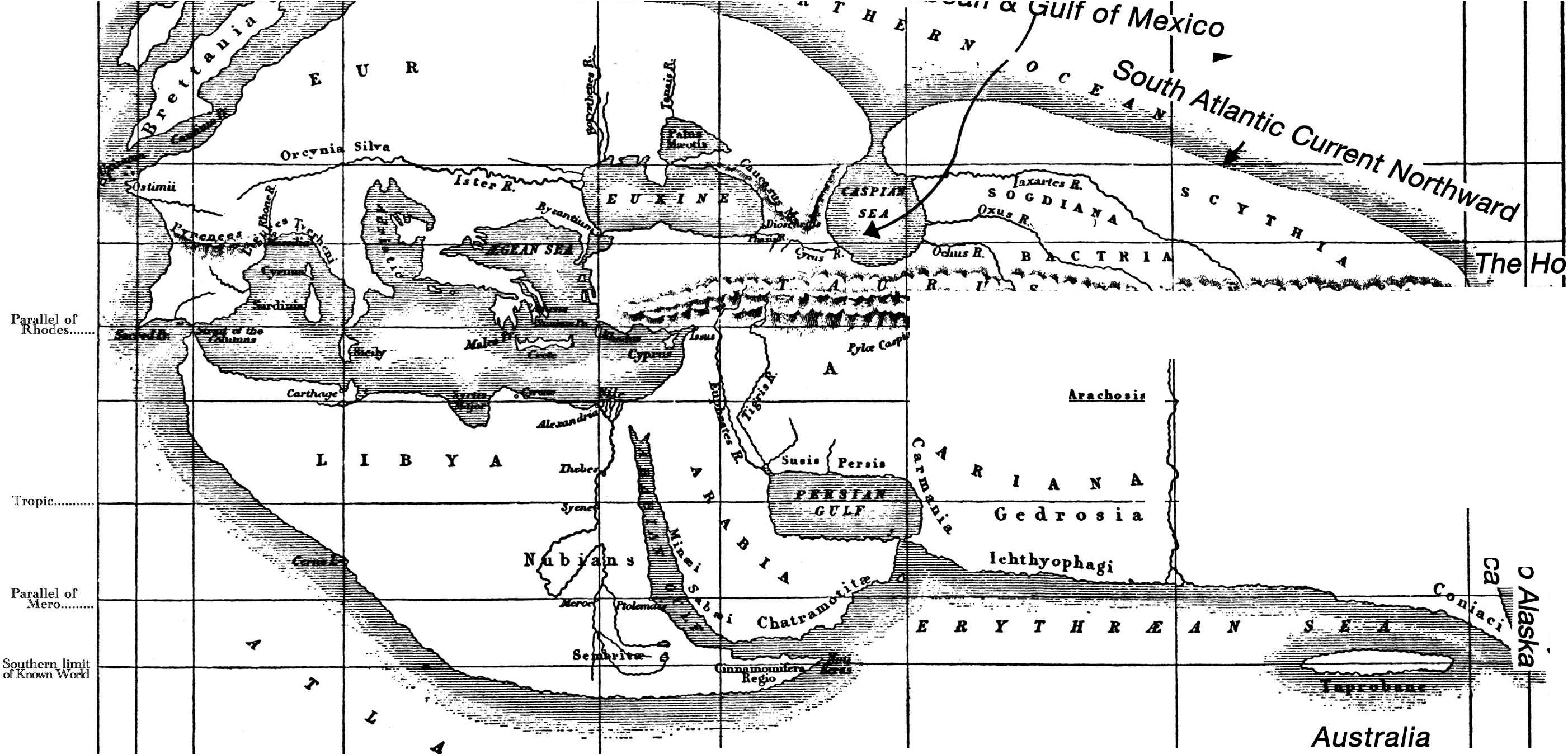

56 FIGURE 8.
57 It is also clear that beginning with Plato’s pupil Aristotle (384-322 B.C.) and the latter’s practical philosophy, the geocentric concept of the celestial system was, after 200 B.C., becoming more and more formally adopted by the ‘‘world’s’’ flat-minded power-structure ‘‘authorities,’’ despite contradictory complexities. The difficultly explained geocentric cosmic systems’ planetary behaviors and Sun motion was not considered by the authorities to be an objection since, as they rationalized it, these matters seemingly had no ‘‘practical’’ bearing on everyday affairs. It seems almost equally clear that between 200 B.C. and 200 A.D. a deliberately planned policy was adopted by the combined supreme political and religious power structure of that period, which undertook the conditioning of the human reflexes to misconceive and mis-see (or mostly not see at all) the macro-micro-cosmic systems in which we live. Their success drew the curtains on science for 1700 years-until 1500 A.D. That curtain would never again have been raised had it not been for the discovery of that something-called-nothing-the cipher. Because it was ‘‘nothing,’’ the information-monopolizing, physical-property coveting power structure had overlooked it.
58 Only the learned-from-others knowledge of the unlimited multiplying and dividing-and thereby ratioing-and the relative-experiences-evaluating capability provided exclusively by the cipher and its leftward positioning of num-bers in increments of ten integers, could make possible individual human’s knowledge of how to escape from the prison of ignorance successfully established by the church-state hierarchy. If you have never been taught about the cipher and its functioning, there is almost no possibility of your accidentally discovering the computationally operative functioning of ‘‘nothing’’—much less feel the necessity of inventing a symbol for that invisible, senseless nothingness. If the positioning of numbers and its computation-facilitating capability had been known by the Alexandrian Greeks, all chances that you might dis-cover this were seemingly banished when the emperors of the Roman Empire usurped and amalgamated the vast religious priesthood power with their already-established military supremacy.
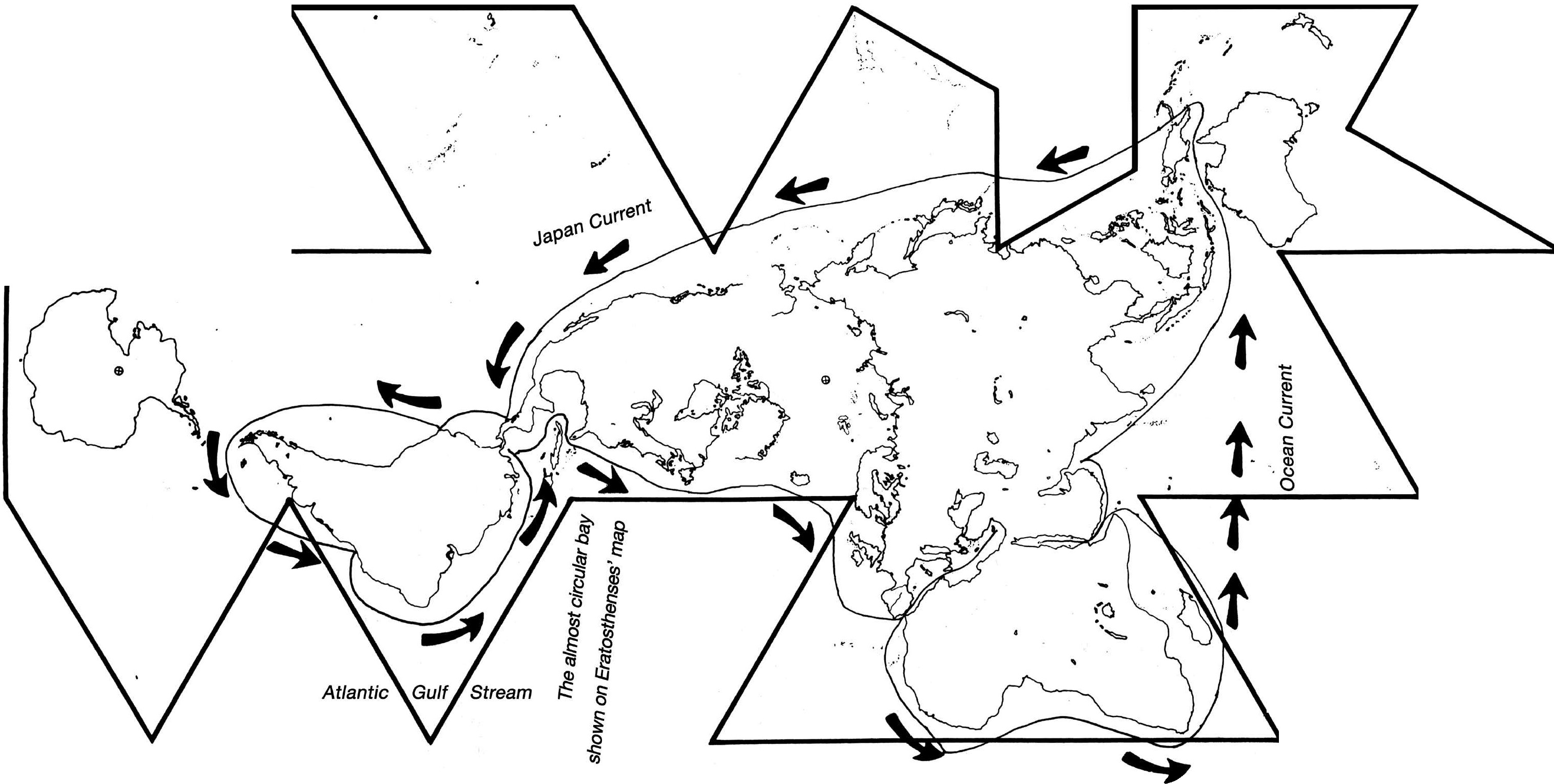
60 FIGURE 9.
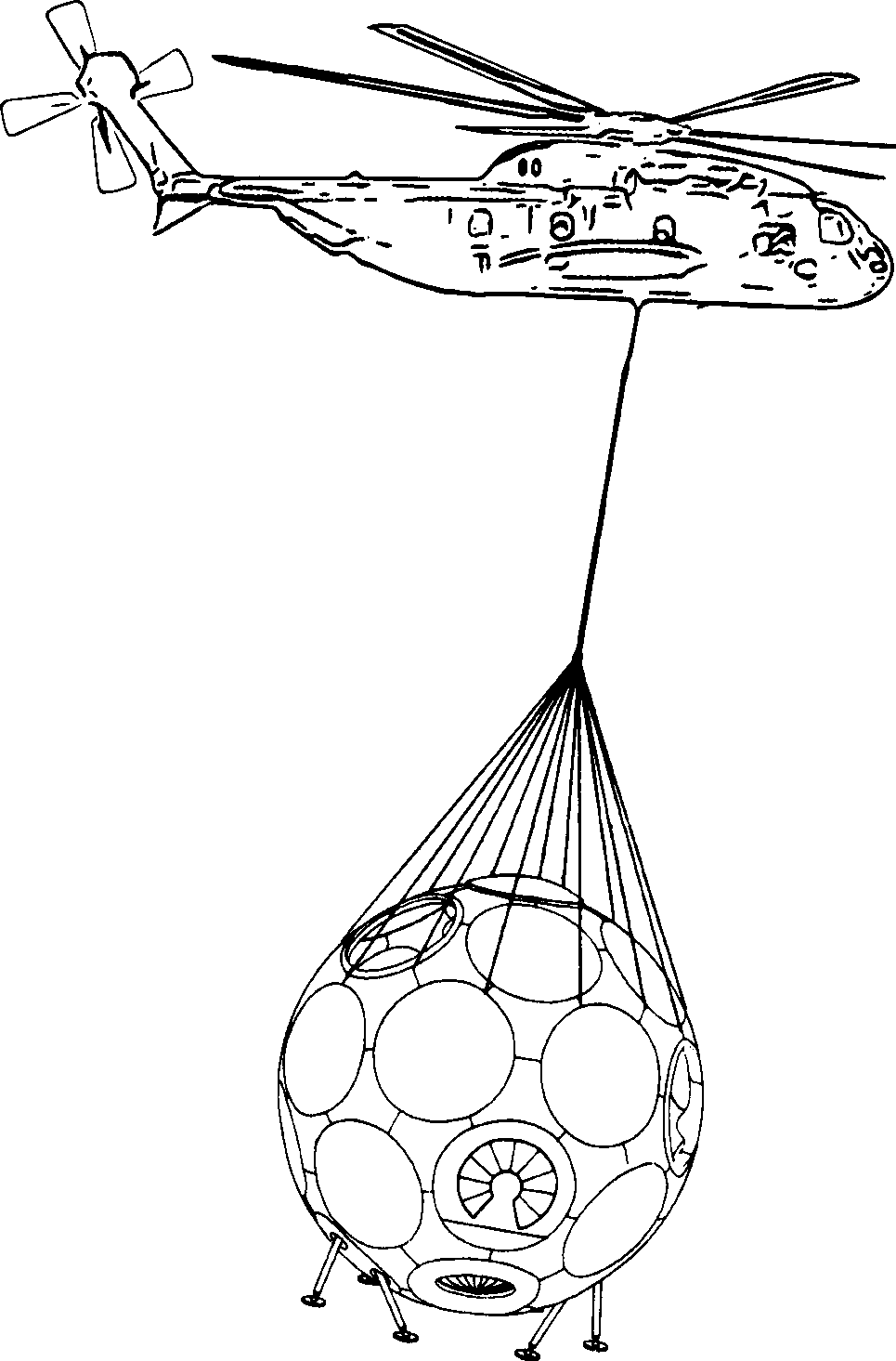
62 FIGURE 10.
63 It was the Asiatic, 800 A.D. publishing of the function of the cipher by al-Khwarizmi the Arab that ultimately saved the day when, in about 1200 A.D., knowledge of it reached northern Italy and southern Germany by way of Carthage in North Africa.
64 Following the death of Christ and the preaching by his disciples, the promised prospect of salvation for all believers raised the Christian priesthood to unprecedentedly powerful popularity. The combined religious and martial emperorship found its authoritarianly formulated credo (meaning ‘‘I believe’’) threatened by the B.C. Greek scientists’ ever-unorthodox thinking and discovering. ‘‘Science,’’ as Sir James Jeans said two millennia later, ‘‘is the earnest attempt to set in order the facts of experience.’’ Scientific thinking constantly discovered experimental evidence of the erroneous conceptioning of nonscientific authority. The emperor-pope did not want any of his subjects ‘‘attempting to set in order the facts of their own experiences.’’
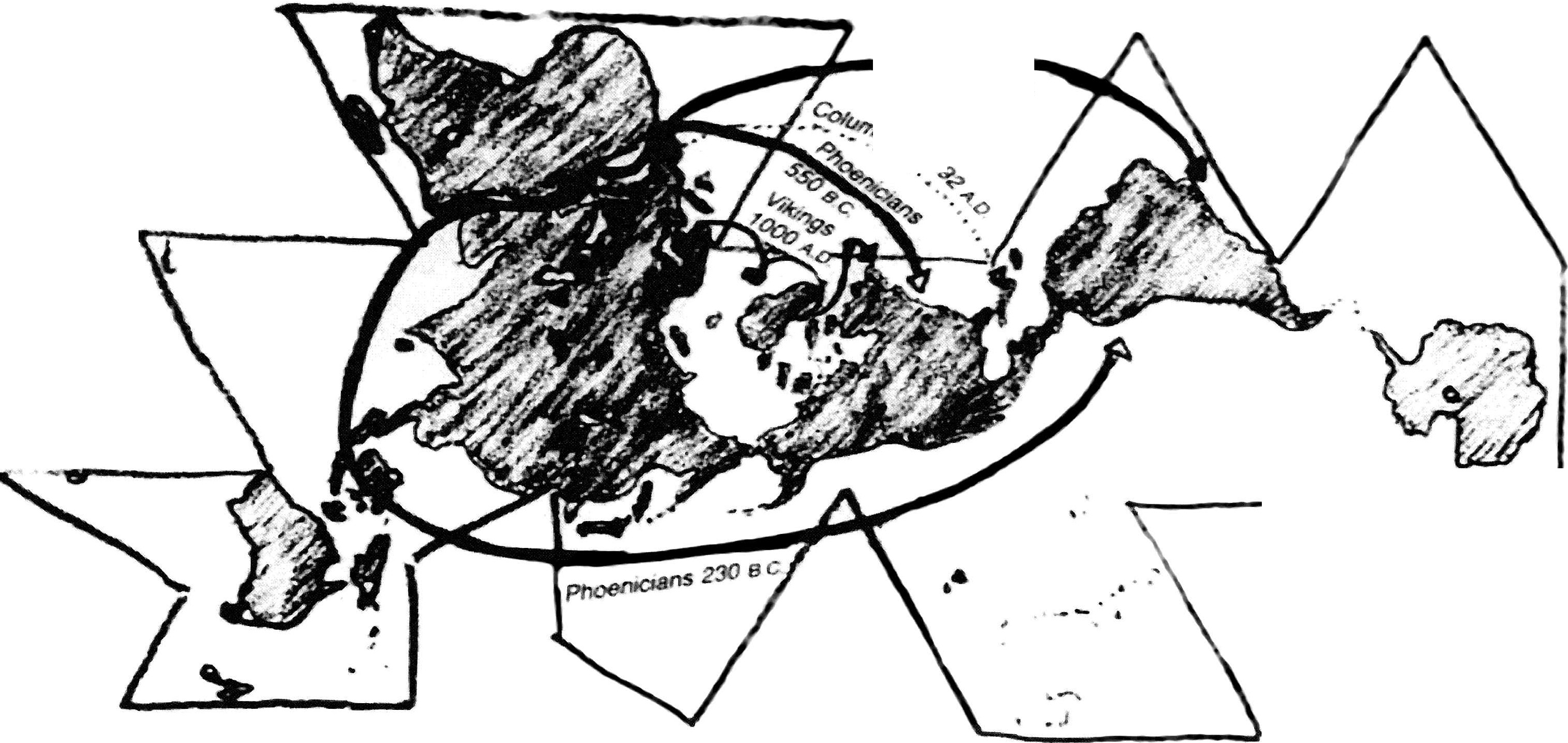
66 FIGURE 11 Early Circumnavigation
67 To cope with the scientists’ persuasive, experience-supported logic, the emperor needed popularly plausible divine authority. Though all acknowledged the emperor to be the unquestioned military leader, with absolute physical power, he needed also the only-by-God-to-be-given metaphysical dispensation assertedly relayed to the ordained priests by the succession of popes, an authority that was originally received from the disciples and by the disciples from the son of God and his direct authority from God. Thus ‘‘officially authorized,’’ the pope-emperor could require all believers to secretly confess their sins to his officials. He could also ordain universal adoption of the most-useful-to-him explanations of the causality of all human experiences. The emperor-pope could tell his people how to behave, how to gain God’s favor.
68 If the emperor-pope accredited the Alexandrian Greeks’ development of the Sun-centered planetary system, he obviously could not maintain the logic of the concept of a two-dimensional, flat-out world sandwiched in parallel between Heaven above and Hell below. The concept of God in Heaven above, with a seat beside Him to which Christ had ascended, could not be maintained except in a world of commonly parallel-to-one-another, up-and-down, perpendicular trees and people on an infinitely, omnilaterally extended, flat-world plane-around which the Sun and stars set and rose. This cosmology put the emperor-pope and his God at the center of Universe.
69 The total overall evolutionary events of 400 to 200 B.C. in the eastern Mediterranean world saw all the extraordinary Greek intellectual activity transpiring almost exclusively in the city of Alexandria-founded by Alexander the Great in 332 B.C. on the delta at the westernmost mouth of Egypt’s River Nile. In 100 B.C. the Alexandrian library was said to have contained 700,000 volumes, or manuscript scrolls. Fortunately some of those volumes in Alexandria were meticulously copied and distributed to libraries around the civilized world of that time, for over 40,000 volumes of the Alexandrian library were burned in 47 B.C. during a siege in the war between Caesar and Pompey.
70 In the second century A.D. Ptolemy conceived his conic, latitude-and-longitude world map, reading from the British Isles in the west to China in the east. His Almagest publication contained a storehouse of navigational data. In the Almagest Ptolemy published his catalog of over 1000 stars.
71 In 272 A.D. a Roman emperor burned the Alexandrian library for a second time. The third burning of the Alexandrian library was accomplished by a later Roman emperor in 391 A.D. In 529 A.D. all the Mediterranean universities were closed. In 642 A.D. occurred the final complete burning of the library of Alexandria by Muslims.
72 As we have already described, the earliest known world maps are Eratosthenes’ surprisingly informative 200 B.C. map and the 200 A.D., latitude-and-longitude-
73 divided, fan-like, cylindrical stretch-out of Ptolemy, which dropped out the south African territory of Eratosthenes but included China, Arabia, and India.
74 We have studied Eratosthenes’ world map of 200 B.C in connection with the fact that we now know reliably that the Phoenicians reached both coasts of South America at about that time and that the Phoenicians sailed from and returned to Carthage on the north coast of Africa, or to their sovereign’s eastern Mediterranean port just north of Beirut, Lebanon. From there cedars were shipped to Eratosthenes’ Alexandria in Egypt, to build the big-bellied, stoutly ribbed sailing ships. It is quite evident to us that Eratosthenes had great confidence that his world had been circumnavigated. He knew that we live on a spherical planet. Why else would he have been inspired to make his remarkably accurate measurement of the Earth’s circumference, etc.?
75 The 200 B.C. coincidence of Eratosthenes’ world map, Crates’ world globe, and the Phoenicians’ sky-star-globe-advantaged circumnavigation is highly visible only when using my Dymaxion world map. Using Mercator’s, the polyconics, or other world projections, it would never have been logically revealed. Of course, neither Eratosthenes nor the Phoenicians used the geographical names I employ.
76 With the exception of the B.C. Greek, spherically informed world mapping, all the post-Roman emperor-pope’s and pre-1500 A.D. comprehensive maps show the world as a flat-out system surrounded by an infinitely extendable, planar wilderness.
77 All the great pre-sixteenth-century empires—such as those of Genghis Khan, Alexander the Great, and Rome—employed that flat concept, with civilization centered around the Mediterranean, which means ‘‘sea in the mid-dle of the land.’’ The people, in the times of Alexander the Great or of Caesar or of Saladin, all thought in that flat way. As yet today ‘‘simple, elementary, plane geometry’’ is used by and taught to beginners; ‘‘solid’’ is considered more difficult, and ‘‘spherical trig’’ even more advanced and difficult.
78 The real consequences of that-psychologically, philosophically, and mathematically-are devastating. It means that ‘‘inside’’ the empire we have something we call civilization, while ‘‘outside’’ the empire begins the unknown wilderness peopled with brutes and worse, and outside of that, live dragons, and beyond the dragons, flat infinity.
79 What we have in flat-land is an only local definability, surrounded by flat-outward infinity-undefinability.
80 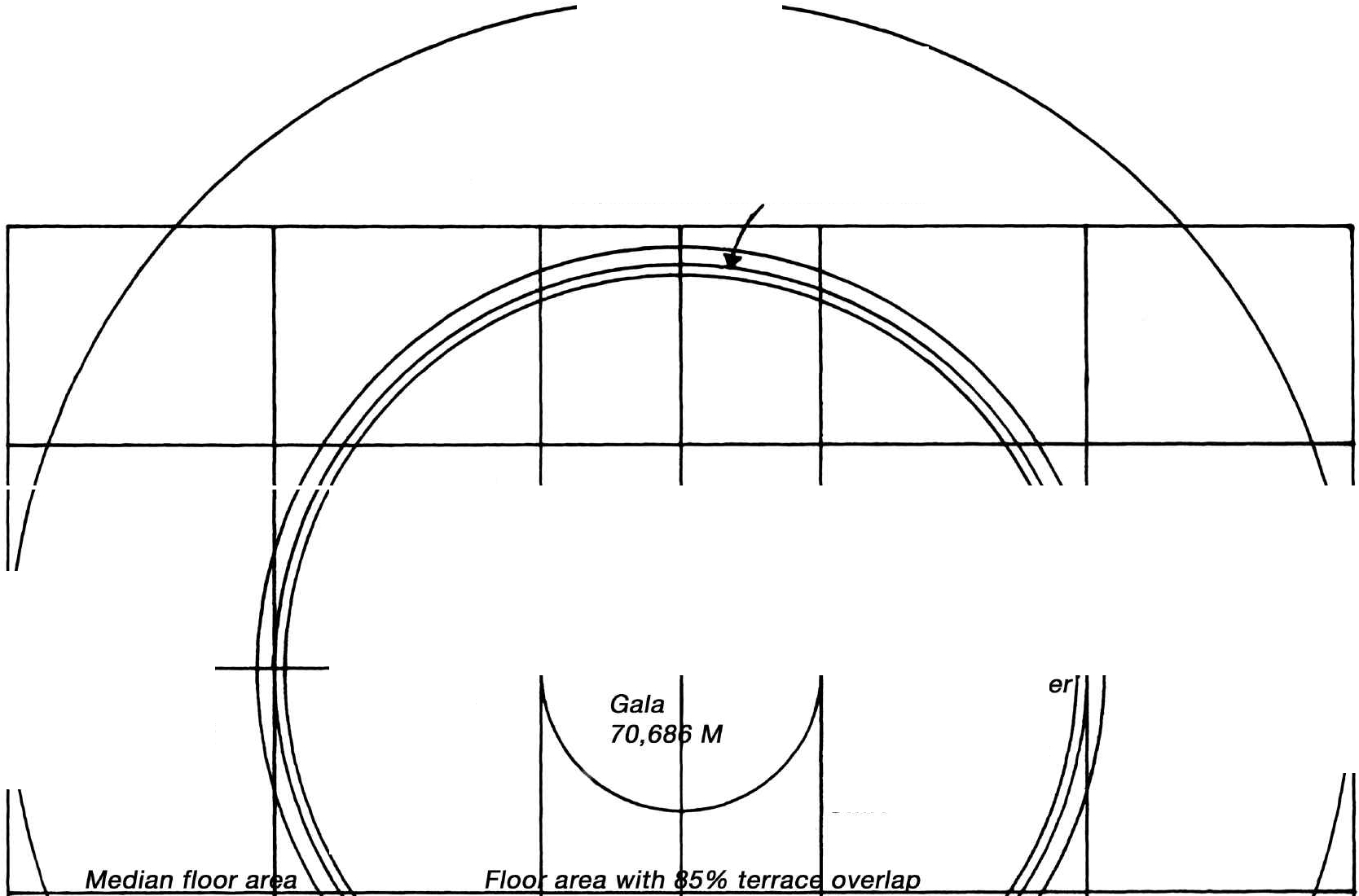 Ptolemy Map, 200 B.C.
81 FIGURE 12.
82 This meant, then, that the Greeks, in attempting to communicate their mathematical conceptioning, defined the circle as ‘‘an area bound by a closed line of equal radius from one point,’’ the triangle as ‘‘an area bound by a closed line of three angles, three edges, and three vertices.’’ The Greeks talked only of the area that was ‘‘bound’’ as having validity and identity, while outside (on the other side of the boundary) existed only treacherous terrain leading outward to boundless infinity-an unknown and unknowable wilderness. The feedback from this world-view has ingrained fundamental biases into our present-day thinking. We can conceive only of one side of a line as definable, organized, and valid. ‘‘Our side’’ is natural and right—‘‘God’s country’’—and vice versa. All humanity has thought of its own local area as being familiar, organized, and a priori, with all else remote and unthinkable.
83 The Greeks oversimplified conceptioning with their misassumption that geometry could begin with plane geometry which they said employed only three tools: the straight-edge, the scribe, and dividers. They failed altogether to include the surface on which they scribed as constituting an equally essential component of their otherwise experimentally demonstrated proofs of their various propositions. Because the earth of the Earth on which they scribed was so large and its limits were unknown to them, they concluded that it was an infinitely extended surface.
84 They failed altogether to recognize the fact that you cannot have a surface of nothing. Any surface on which they scribed had to be a topological feature of a system. They obviously knew naught of Euler’s topology nor of my systems geometry (see Chapter 4, Synergetics, vol. 1). systems always divide all Universe outside the system from all of the Universe inside the system. All systems are finite subdividers of macro-and micro-Universe. Not knowing that they were always scribing on a closed, finite system, the Greeks defined a plane geometrical polygon as ‘‘an area bound by a closed line of so many angles and edges.’’ They assumed that the area on the ‘‘outer’’ side of the line continued laterally to infinity and was therefore undefinable. What their closed lines always did was to divide all the finite surface area of the polyhedronal system on which they scribed into two finite areas both of which were exactly bound by the surface-drawn polygon’s perimeter. Draw a triangle on the sand of a beach. You inadvertently divide all the surface of planet Earth into two areas, A and B—‘‘A’’ the triangle which you consciously and visually drew and ‘‘B’’ the enormous area on the ‘‘outside’’ of the consciously drawn triangle, consisting of all the rest of the surface of our spherical planet Earth. All that remaining surface of our spherical-surface Earth is bound by the closed-perimeter figure of ‘‘three angles and three edges’’ which you scribed in the sand. Unbeknownst to them, the Greek Euclideans were always dealing in polyhedra of ‘‘system geometry.’’ Humans could not make a local Earth-surface triangle without inherently making a vast terrestrial-size triangle. The two terrestrial triangles, little A and vast B, in turn brought inherently into play the almost spherical, vastly high-frequency-triangulated polyhedronal system on whose surface they were scribing. This in turn and unbeknownst to them affected the rest of the Universe—the macro-Universe outside the system upon which they scribed and the micro-Universe inside the system upon which they scribed. Thus humans have always unknowingly affected all Universe by every act and thought they articulate or even consider.
85 Fortunately the unrealistic thinking of humans has had little effect on Universe and evolution whereas realistic thinking has cosmic effectiveness in pure principle. Realistic, comprehensively responsible, omnisystem-considerate, unselfish thinking on the part of humans does absolutely affect human destiny. If the realistic thinking can conceive of technically feasible options facilitating satisfactorily effective human fulfillment of its designed functioning as local Universe information inventorying and local Universe problem-solving in support of the integrity of eternally regenerative Universe, then the accomplishment of that realistic conceptioning is realistically effective in satisfying Universe that human mind is accomplishing its designed evolutionary role.
88 In our comprehensive reviewing of published, academically accepted history we continually explore for the invisible power structure behind the visible kings, prime ministers, czars, emperors, presidents, and other official head men, as well as for the underlying, hidden causes of individual wars and their long, drawn-out campaigns not disclosed by the widely published and popularly accepted causes of those wars.
89 There may be great significance in the fact that Pythagoras in Greece and Buddha in the Orient occur at the same time—in the sixth century B.C. Both are powerfully, perceptively thinking and acting human individuals who, coming out of a past in which only the mystically ordained kings counted and humans were omniexpendable pawns, produced mathematical tools and philosophic break-throughs for individual humans forever thereafter to employ. Their scientific and philosophic gifts to humanity were in marked contrast to the self-advantaging military conquests of kings. Pythagoras, in a little town north of Athens in the Near East, and Buddha, in the Far East, utterly unknown to one another, co-occur as a vast amount of moral and spiritual thinking is taking place in the Near East as recorded in the Old Testament of the ‘‘prophets.’’ Historical research indicates a succession of ‘‘Isaiahs’’ starting at about the same time as Pythagoras and Buddha and as the Greek school of scientists and scientific thinkers, running to 200 B.C. Isaiah the Second speaks of ‘‘turning the swords into plowshares and spears into pruning knives’’ and ‘‘leopard lying down with the lamb’’ and prophesies ‘‘a little child shall lead them.’’
90 Nonrural, nonmilitary humans had words and mathematical tools and writing ability with which to initiate a break-through toward ultimate emancipation of all humans.
91 Such individuals as Pythagoras and Buddha were unanticipated by the behind-the-scenes physical power structures. They were probably unnoticed at first. The ever-advancing scientific conceptioning of the Greeks between 600 B.C. and 200 B.C., as well as the comprehension and thoroughness of the scriptural writers, suggest that not until about 200 B.C. did the great power structures operating behind the official states’ officers begin to find ways of putting brakes on the individual’s metaphysical breakthrough. The power structure then began to enter into the cosmological formulations and began to cut the ramifications of human conceptioning and cope-with-able magnitude. Humans had found that each one had a private ‘‘hotline’’ to God. What the power structures needed was a way to put in a control switchboard so that the individuals would have to ‘‘call up’’ God only through officialdom’s censor-supervised switchboard.
92 For example, the Roman Catholic church, fortifying its proclaimed ‘‘divine mandate’’ as intermediary between the individual and God, attacked technology because it could eliminate the stresses of poverty, and much of Roman Catholic business and prosperity was founded on the exploitation of misery. The business strategists of the Vatican were inherently against abortion-pregnancy being the single greatest source of confessional and donation money to the Church. Herein lies the source of the Church’s persistent maintenance of its dogma and authority in the face of a technologically emergent and potentially powerful humanity.
95 As described, before recording graphically its presence aboard our planet, humanity had no line of communication reaching directly to us today other than the physical sea and land building arts and handicrafting of small artifacts, as well as their ‘‘designed’’ interrelationships to be read in the burial positions of the skeletons and their artifacts, etc.
96 Everyone ‘‘knows’’ that as one goes inland from the sea, one comes to ever-higher mountains. It was thought that if one went far enough inland, one would come to a mountain reaching to Heaven-and occupied at its highest point by God. More and more durable cosmological models of this world view were built—with living god-kings assumedly to occupy the lesser heights after their death. How strong the king might be would govern the height of his mountain as surmounted by ever-higher central ‘‘mountain’’ pinnacles. These square-based cosmological models are the gats and wats of Southeast Asia, the pyramids of Central American Mayas and Incas, the Babylonian ziggurats and Egyptian pyramids.
97 The design authority for the wats was probably that of the priest-navigators, whose architectural skills derived from their knowledge of the principles of boatbuilding. The world-around priest-navigator’s cosmological authority was responsible for the astronomical observatory structures as yet standing in India, Mesopotamia, Crete, Egypt, England, and Central America.
98 In the early dawning of graphically chronicled civilization the wats involve gods of the sea and gods of the sky as well as gods of the underground land. The fire, smoke, and lava of volcanoes, well known to men, indicated that ‘‘down’’ led through the horizontal plane of the world into a Hell of brimstone and fire, just as ‘‘up’’ led everywhere exclusively toward the serene blue Heaven of the highest God. These cosmological-symbol edifices—the wats and gats—had no interior spaces for religious or royal-court ceremonies or for occupation by any living human except as an astronomer. They were developed by designer-priests and constructed by slaves only for the convenience of the livingly visible god-king’s after-death physical reascension from Earth to become once more an invisible god of Heaven, capable of returning at any future time to resume human or any other convenient form. Like animals, ordinary humans (and human life) were absolutely expendable (either as slaves or as sacrifices).
99 As recorded in the stone carvings of Egypt and Mesopotamia, the history of world society begins with humanity at large knowing nothing of physics, chemistry, or biology. Humans recognized but few safe edibles. Humans had witnessed many lethal poisonings by superficially attractive items plucked from the mysterious scenery. Infection was rampant. Average survival was in the neighborhood of twenty-two years, or about one-third of the once-in-a-rare-while-demonstrated, biblically mentioned ‘‘three score and ten’’-year life-span. Life was so fundamentally awful that no logic could persuade humanity to believe that the living experience was intended by the great God of Universe to be desirable in its own right. The only tenable assumption was that life on Earth was suffered only in preparation for a life hereafter. It was reasoned that the worse life on Earth proved to be, the better would be the suffering-earned life hereafter. Experience seemed to show that adequate sustenance in general was so fundamentally scarce that even in the hereafter none could conceive of there being adequate life support for other than the pharaoh.
100 This being evident to all, it was commonly assumed that if the pharaoh—the people’s leader—could be safely delivered into the next world with all his sovereign equipment, thereafter he might be able to get all his people safely delivered to him in the afterlife paradise.
101 Because life in this world was so torturously devoid of life support, desperation drove humans to thievery and vandalism as a general way of life. To get the pharaoh and all his equipment and riches safely into the next world involved building a stone mountain on top of his burial chamber in the superstable form of the pyramid. This called for supreme engineering, designing, and large-scale building capability. Thus it came about that the economic-authority/patronage that employed and subsidized the pyramid-designing, architectural, engineering, and building efforts of the intuitive artist-scientist, poet, inventor, engineer, and initiator of the early Egyptian pyramid was exclusively the life hereafter of the pharaoh.
102 The authority—to employ whatever technological capabilities he could muster from the nonobvious but intellectually conceptual resources hidden in the scenery—went to the artist-scientist-inventor to support his reorganization of environmental potentials for the advantage of the life hereafter of the pharaoh—and his most faithful servants.
103 With all building there is a temporary, ‘‘make-ready,’’ structural scaffolding. The artist-scientist-inventors existing in the times of the earliest pharaoh needed to elevate and move gargantuan, rectilinearly chiseled stone blocks into place. They could readily see that the thousands of slaves available could shovel together great-approach hills of rock and sand, upon which they could first lay parallel tracks of delimbed tree trunks and thereafter, with other tree trunks, could pry forward the wood-roller-mounted blocks of stone. The pharaoh’s creative architect may have been the first human in history to conceive of the principle of the lever and its ability to move great rocks. Whoever he was, he proved that with ever longer and stouter levers he could vastly augment the muscle-work of whole armies of slaves; moreover, he discovered that the degree of work-advantage to be realized with various-size levers could be mathematically calculated. The pharaoh died. They entombed him, and he supposedly went to the world of eternal hereafter accompanied by all his riches. When the pharaoh died, his artist-scientist-inventor was rewarded by being entombed with the pharaoh (along with the other most faithful servants) so that they could be the first of the pharaoh’s people to enjoy the blessings of the ‘‘hereafter.’’ But knowledge of the levering effectiveness remained in this world.
104 The next architect-engineer genius for the next phar-aoh, using the levers, wood-log rollers, and wood-log tracks invented by his predecessors, discovered that many of his army of slave workers were dying or unable to work for lack of adequate food. To correct this condition he conceived of shunting the waters of the Nile into slave-produced irrigation ditches, which led the Nile into the potentially fertile floodlands bordering the river. The artist-scientist rearranged the living environment in ways that technologically increased the human advantage of the ‘‘antechamber,’’ make-ready for the hereafter world.
105 After each pharaoh’s entombment the principles first discovered and objectively employed by the succession of Leonardo-type architect-engineers of the pyramids, the ‘‘scaffold’’-phase tools such as the lever, were not forgotten amongst the as-yet-living people. The departed architect-engineers left behind the irrigation ditches, which continued to irrigate and grow more food in this ‘‘antechamber-to-Heaven’’ world. The irrigation ditches did not disappear by going over into the hereafter. Use of these physical ‘‘scaffolding’’ capabilities in this pre-Heaven world by the living society persisted and multiplied, pharaoh by pharaoh. The technological inventiveness of the pharaohs’ respective scientist-artist-architects became evolution’s comprehensive environment advancers.
106 Finally, the inventory of technological ‘‘scaffolding equipment’’ employed in this rearranged-environment world in the predeath days of the pharaoh altered the spontaneous thinking of the living. The work effectiveness of the living slaves, as inventively led by the era’s artist-scientists, became so prodigious that it became obviously possible not only to prepare magnificently for the most favorable afterlife of the living pharaoh but also to prepare magnificent, vandal-thwarting, stone-edifice-covered tombs for guarding the sub-pharaoh nobles’ entry into the afterlife. During the next succession of dynasties the progressively ever more prodigious inventory of environment-controlling technology, currently available in this world to serve as scaffolding for enshrinement of the eternal after-life of the pharaoh and nobles, multiplied to such accelerating degree that in due course it became spontaneously apparent to all concerned that the total of now-workable technology made possible accommodating the safe entry into the afterlife of the rich, middle-class society.
107 The afterlife enshrinement of the prosperous middle class that occurred in the Greek and early Roman B.C. period brought about the development of carved marble mausoleums and burial urns.
108 Eventually the environment-altering technological capability in this (for-99-percent-of-humanity-miserable) temporal activity, being conducted in this life to ensure the exclusive afterlife enjoyment only of kings, nobles, and middle-class-wealthy, became so vast that new human perception inspired the prophets Buddha, Christ, and Mohammed and probably vast numbers of other unknown, intelligent, and inspired humans to assume that there now existed adequate technical know-how and materials to build in-this-world-physical-‘‘scaffolding’’ structures that would provide for safe entry into the afterlife not only of the king, nobles, and middle class, but also of all humanity, including the most lowly commoners and slaves.
109 This did not occur in one day. There was a gradual dawning awareness on the part of a few that the changing technological capability vis-a-vis the environment promised a vast change in human affairs. This bred an era of prophets and thinkers heralding general human qualifications in this life for entry into the next life. The Old Testament is dramatic manifest of this period.
110 For millennia, the progeny of the South Pacific island navigators, the navigator-priests of the Persian Gulf, Mesopotamia and Egypt had only the pharaohs to ferry over into Heaven. For another millennium they had only the nobles and the rich middle class to prepare for safe entry into the afterlife. The priests’ beneficiaries constituted less than 1 percent of humanity. But, when everybody had potential entry into Heaven, we see the long-ago South Seas navigator-priests’ successors becoming very powerful popular authorities.
111 The by-word-of-mouth news swiftly went round that all humanity could now be accommodated in the next world and would be welcomed there if individually qualifying in this world through devout acts and thoughts. The officially accredited representatives of God in this world gained enormous power through their function of tutoring for and passing on the qualifications of individual humans in this world for passage into Heaven-the alternative being Hell. This power became swiftly annexed by the Holy Roman emperor-pope and, as we earlier described, gave rise to the vast European church-state empire and 1500 years of the Dark Ages.
112 During the Dark Ages those individuals endowed with creative powers and insights seem by and large to have carefully avoided attempting to reform the political, religious, or scientific status quo. The record shows the original thinkers and skilled artists to have employed only architecture, painting, sculpture, poetry, music, and dance to express their inspiration by their intuitively conceived, metaphysically generalized principles. The inventive individuals seem to have confined their inventiveness to technically facilitating the accepted customs-for instance, the development of movable type to augment the religious publishing.
113 The highly organized physical-resource capabilities—to house the priests’ activities of getting everyone worthy into the next world—witnessed the construction of chapels, churches, cathedrals, synagogues, mosques, temples, and vast monasteries in Europe and Asia Minor. Eventually the magnitude of in-this-life-physical-‘‘scaffolding’’’s technological development proliferated to such an extent that society began to realize that not only the afterlife of the king, the nobles, the rich middle class, and all the people, but also the living life of the king in this world, could be accommodated—and thus developed the divine-right-of-kings time.
114 Next, the accommodation of living-life enjoyment, as well as of a glorious afterlife, was extended to certain invisible behind-the-throne-power-structure individuals as well as the king.
115 Next, the bounteous this-life as well as guaranteed next-life glory was extended to the nobles—the Magna Carta time.
116 With ever-accelerating technological development in preparing for everyone’s next life as well as the king’s and nobles’ this-life enjoyment, the time arrived when it became evident and was spontaneously realized that in addition to attending to getting everyone but the unfortunate ‘‘to-Hell-bound sinners’’ into Heaven and providing the enjoyment of this life by both the king and the nobles, it was possible to take care of the enjoyment of this life by the rich middle-class society. This gave rise to the Victorian Age. Sometimes spoken of as the Industrial Revolution, this technological advantaging of the rich middle class was enormously advantaged by the circa-1500 A.D. introduction of the cipher-permitted-engineering-and-scientific calculation.
117 All the foregoing human-mind-invented scaffolding, technological advantaging, and the all-history recording of the total accumulated inventory of artifacts and scientific discoveries, led to the opening of the twentieth century, when a handful of perceptive individuals, such as Henry Ford, saw that the total environment-advantaging technology had become so effectively developed that it made possible the advantaging not only of the afterlives but also of the lives of all humanity. Through the use of inanimate-power-driven industrial tools and mass-production techniques, the end products of these perceptive individuals’ designing could be made to advantage all humanity.
118 Henry Ford, inspired by the farmer’s transportation needs, inaugurated the mass use of the invisible and ever-higher-performance-per-pound alloys and the invisible controls of ever-closer measuring of invisibly operating parts of the machinery, structure, and production tooling of his automobiles. Ford developed the use of moving assembly lines. He concerned himself directly as the prime designer not only of his end product—the automobile—but also of his evolving machinery and structural technology and all the other supporting activities of final pertinence to the success of the massively reproductive industry—factories, tools, mining, transporting of raw materials all around the world, his own railroads and ships, massive-objects-loading equipment, communications, and information handling.
119 All the foregoing physical-environmental rearrangements—advantaging both the afterlife and the living lives of all humanity—occurred under the conditions of humanity’s thinking of reality as consisting only of the phenomena that could be apprehended directly by humanity’s senses of sight, touch, hearing, smelling, and tasting. All invisible occurrences and phenomena were considered to be either mystical, magical, or trickery.
120 Then came man’s discovery of electromagnetics, atomic physics, metallurgy, and chemistry, and the whole new world of invisible, nonsensorially contactable—ergo, only instrumentally or only mathematically apprehensible—reality. Thereby, all of previous time’s mysteries were either logically explained or dismissed. Technology expanded reality 999-fold to include the whole range of the invisible events of Universe. These had been held previously by humans to be magical and superstitiously mystical. Now they had become the realities of everyday pure and applied science. With the inclusion of this 99-percent invisible world of reality, along with its as yet myriad of unsolved problems, into our everyday strictly sensual reality came the radio-introduced concepts of tuning-in and tuning-out. In yesterday’s two-universe—(1) life and (2) Heaven-thinking we had things and nothings. Things and space. ‘‘Life’’ and ‘‘Death.’’ Now we have tuned-in and tuned-out. ‘‘Tuned-out’’ does not mean dead. Without anyone saying so humanity’s need for two universes, ‘‘This Life’’ and ‘‘The Afterlife,’’ began to fade out as it realized that this life and its vast mysteries were all one.
123 In all the cosmological models of early civilizations, a wide, four-cornered planar Earth was surrounded by infinitely extensive waters, surmounted by ever-higher central ‘‘mountain’’ pinnacles. This discloses how the early humans explained to themselves the sum of their experiences regarding the structure and operating scheme of their real world from out of whose eastern watery extremity the Sun and stars rose, passed over, descended, plunged in under and out—then repeated. Because the Sun and stars quite obviously passed ‘‘over,’’ and returned ‘‘under,’’ it, the world was implied to be a thick but penetrable watery slab extending horizontally to infinity in all planar directions. All the perpendiculars then were extended in only two directions in relation to man’s erroneously conceived flat Earth. Those two exactly opposite, positive and negative, exclusively perpendicular directions in respect to the horizontal Earth plane were the seemingly obvious concepts of ‘‘up’’ and ‘‘down.’’
124 This flat conceptioning is manifest right up to the present in such everyday expressions as ‘‘the wide, wide world’’ and ‘‘the four comers of the Earth.’’ As mentioned before, ‘‘up’’ and ‘‘down’’ are the parallel perpendiculars impinging upon this flat-out world. Only a flat-out world could have a Heaven to which to ascend and a Hell into which to descend. Both Christ and Mohammed, their fol-lowers said, ascended into Heaven from Jerusalem. Scientifically speaking (which is truthfully speaking), there are no directions of ‘‘up’’ or ‘‘down’’ in Universe—there are only the angularly specifiable directions ‘‘in,’’ ‘‘out,’’ and ‘‘around.’’ Out from Earth and into the Moon—or into Mars. IN is always a specific direction—IN is point-to-able. OUT is any direction.
125 Don’t let these facts of comprehensive, human misorientation give you a personal inferiority complex. My own direct questioning of many large scientific audiences proves that all scientists as yet realistically ‘‘see’’ the Sun going ‘‘down’’ in the evening—though science has known for 500 years that this is untrue. Around the world nothing has ever been formally instituted in our educational systems to gear the human senses into spontaneous accord with our scientific knowledge. In fact, much has been done and much has been left undone by powerful world institutions that prevents such reorientation of our misconditioned reflexes. Our own misconditioned reflexes are powerful deterrents to our successful self-reorientation of our apprehending faculties to accord with the emerging truths. Though I have been trying for fifty-three years to rid myself of the words up and down, I find them popping out in my speech.
126 We now know that we do not live on a flat-slab Earth. We do live on board an 8000-mile-in-diameter spherical spaceship speeding around the Sun at 60,000 miles per hour, spinning axially as it orbits. None of the perpendiculars to a sphere are parallel to one another. The first aviators flying completely around the Earth within its atmospheric mantle and gravitationally cohered to the planet, having completed half their circuit, did not feel ‘‘up-side-down.’’ They had to employ other words to correctly explain their experiences. So, aviators evolved the terms ‘‘coming-in’’ for a landing and ‘‘going-out,’’ not ‘‘down’’ and ‘‘up.’’ Those are the scientifically accreditable words—in and out. We can go only in, out, and around.
127 The Astrodome of Houston has a spherical diameter of 800 feet. The planet Earth has a diameter of about 8000 miles. A nautical mile is approximately 6000 feet. So, the Earth’s diameter is forty-eight million feet, which is 60,000 times the diameter of the sphere of which the Astrodome’s spherical roof is a segment. The height of the Earth’s highest mountain, Mt. Everest, is only one sixteen-hundredths the diameter of the real Earth.
128 Houston’s Astrodome may be considered to be a one sixty-thousandth—1/60,000th—scale model of a corresponding spherical segment of the real Earth. Mount Everest at the same 1/60,000th scale would make only a six-inch-high mound on the Astrodome. At the same scale a human being standing on the Astrodome would be only one two-thousandths of an inch high—i.e., .002 inch. The smallest dimension you and I can see (with our naked eye) is one one-hundredth, .01, of an inch. So you and I are only one-fifth of the height necessary to be visible at the scale of the Astrodome, used as a 1/60,000 scale model of a corresponding central-angle spherical section of the planet Earth’s surface. It would require a dome five times the diameter of the Astrodome to make a scale model of the Earth on which you and I would appear as the smallest speck you and I can see. The Earth is so big in comparison to you and me that it is physically impossible for humans to see their Earth as other than flat.
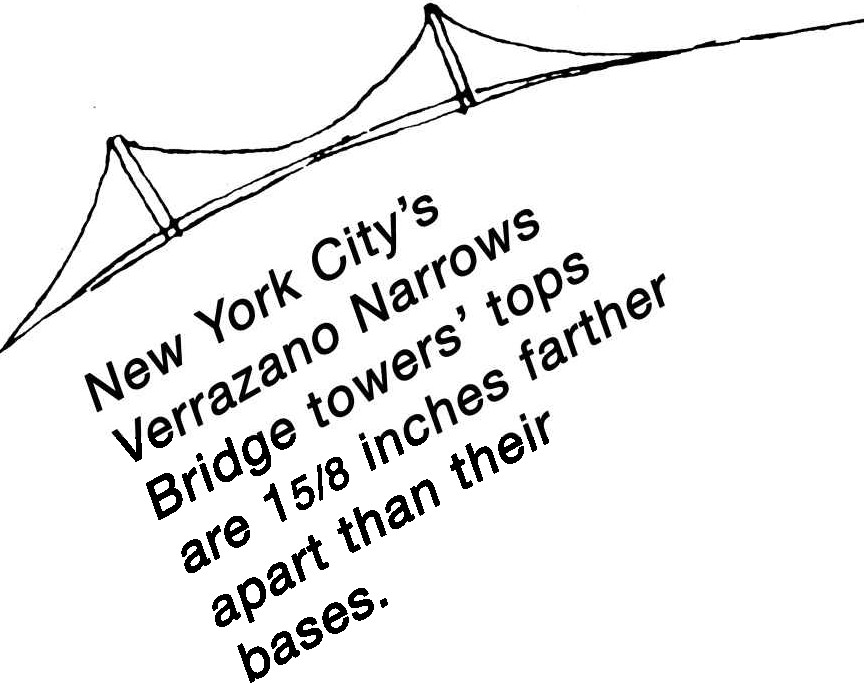
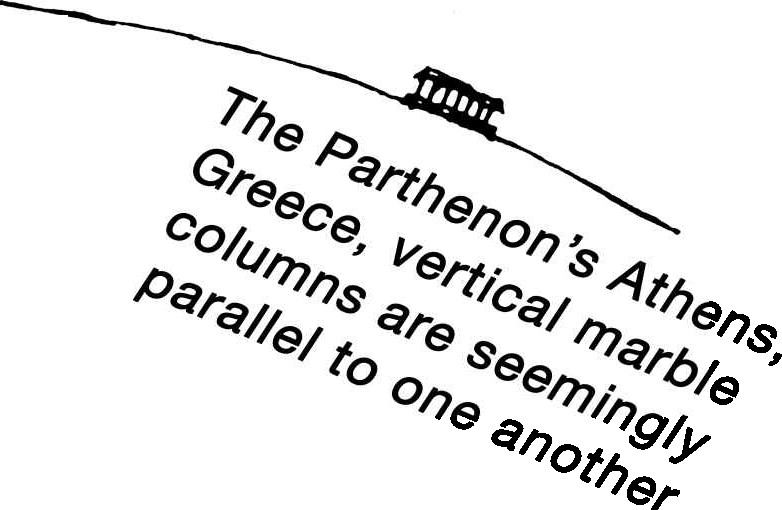

130 Bridge, Trade Center, Parthenon
131 FIGURE 13.
132 I have now flown entirely around the Earth forty-seven times by many different airline routes, and looking out the plane’s windows at the circular horizon and having never felt myself to be upside-down, I am beginning to realistically feel our Earth to be a sphere—but a very, very big sphere.
133  The around-the-world Hilton Hotels are clearly not parallel to one another.
134 FIGURE 14.
137 I clearly remember New Year’s Eve, December 31, 1899. I was four and a half. I had just received my eyeglasses and was deeply excited at all that I could now see. At 11:45 P.M. my father opened a window of our New England home to let in the twentieth century. I remember with what earnest thinking he tried to envision the coming years in which I would live beyond his time. The British Empire was at its height of power and splendor. The ‘‘world,’’ as we know of it in 1980 after two official world wars and a third much more prolonged and ruthlessly vicious, unofficial world war, was utterly inconceivable. H. G. Wells was writing about a war in the air but he did not conceive of automobiles or electrons. About 99 percent of humanity was illiterate. Few, if any, individuals thought in world terms because the conceptual world of humanity at large was ‘‘infinite’’—ergo, realistically unthink-about-able. Everyone ‘‘knew’’ that humans would never reach the Moon. Any who wasted their time thinking about doing so were dismissed as lunatics.
138 The British Empire was commanded from the British Isles by great business venturers—the world men who ruled the world’s oceans. The British Isles were found to be the most easily defendable shipbuilding bases and were conveniently positioned to rule the whole waterfront of all the European customers of the venturers’ Oriental booty. Observing so many ships loaded with so many British sailors (shanghaied out of the British pubs), the world came to identify history’s most successful world-outlaw organization as ‘‘the British Empire.’’
139 This was the first empire of man to occur after we knew that the Earth was a sphere.
A sphere is a mathematically finite, omnisymmetrical, closed system. A sphere is finite
unity. (See §§ 224.07 Synergetics, vol. 1.)  Change: Add bib
ref
Change: Add bib
ref
140 As we described in our Introduction, Thomas Malthus, professor of political economics of the East India Company College, was the first economist ever to receive all the vital statistics and economic data from a closed-system world. Once the world is conceived of as a sphere—a finitely closed system—there was no longer an infinite number of possibilities, such as accompanied the misconception of the infinitely extended flat-out world. In an infinite world, with its infinity of possibilities, praying was felt to be ‘‘worthwhile.’’
141 Because Earth had been discovered by its high-seas masters to be a closed and finite system, the great pirate venturers who controlled the seas took their scientists around the world to discover and disclose to them its exploitable resources. Only because the Earth constituted a closed system could the scientists inspect, in effect, all the species, and only thus was Charles Darwin able to develop the closed-system theory of ‘‘evolution of species.’’ Such a theory could not have existed before that. It would have had to include dragons and sea serpents. All the people in all the previous open-edged empires lived in a system within whose infinity anything could happen or exist. Paganism (or peasantism) wasn’t illogical. Geometrically speaking, the pagans could have an infinite number of gods. There were also an infinite number of chances of upsetting the local pattern, which was a most satisfying idea if it happened that the individual didn’t like the prevailing local pattern.
142 It seems strange that we were not taught about the historical, philosophical, and economic significance of the foregoing transition from an open-flat to a closed-sphere world system. Because the churches were strong and the great pirates wished to obscure both their monopoly of the riches of the now limited system and their grand world ocean strategy for its control, the significance of the concept of a closed world system was popularly unrealized. The power structure and its patronized educational systems ‘‘let well enough alone.’’