8 How to Maintain Man as a Success in Universe
6 I am advantaged in many ways in our day, because I deliberately set about in 1927 to discipline myself to be a comprehensivist; thus countering the almost overwhelming trend to specialization. I am quite certain that the most important reason for my having known some success is that I have had no competition.
7 As a comprehensivist, I have used as my guidelines the training that once went on at the U.S. Naval Academy. I attended Annapolis early in World War I. At that time in history, the radio was still so novel and open an affair that despite coding and ciphering it was not trusted for vitally strategic messages. This meant that the naval officers who would command the fleets of our nation’s ships had to operate autonomously. They were selectively promoted for comprehensive capability. They had to be entrusted with supreme authority when at sea—for the simple reason that there was no other authority present. Frequent decisions of vital nature had to be made, in a manifold of categories, with no greater authority than themselves within thousands of miles. Qualification for such supreme responsibility and initiative required magnificently comprehensive training. The midshipmen had to be prepared eventually to be masters under approximately any conditions. Inasmuch as three-quarters of the earth is water, the Navy is concerned with the whole world and the world’s relationship to America. The Navy is inherently a world organization and is frequently in operation halfway around the world—and one-half way around is the furthest away from home ports.
8 The Naval officers, particularly the flag officers, had to be trained to know, for instance, the aspirations and capabilities of all countries. There was no way that a secret message could get safely home and back, or vice versa, faster than one of the Navy’s ships could take it. There was not as yet ocean distance flying. For all these reasons, naval officers had to be prepared to make comprehensive, epochal, and solo decisions on behalf of their nation. They had to be extraordinarily familiar with world commerce and the broad ranges of technology. They had to know chemistry, physics, mathematics, logistics, ballistics, economics, biology, law, psychology, and engineering. They had to be able to set up powerful, industrially tooled naval bases in foreign parts.
9 After World War I, radio secrecy became dependably effective through scrambling techniques. As a consequence, the U.S. Congress and the administration at last dared to trust the air waves with secret strategy messages. This meant that the top authority for all grand strategy decisions could, without loss of tactical advantage, revert to the White House.
10 When the President says ‘‘Hello’’ on the radio telephone to the admiral halfway around the world and the admiral answers back, ‘‘Hello,’’ there is an unnoticeable lag of a seventh of a second. If the President says ‘‘Hello’’ to an astronaut on the moon, he will have to wait four seconds for the return ‘‘Hello’’ and may think the astronaut somewhat hesitant. If an astronaut gets to our nearest planet, Venus, the President will have to wait five minutes for the return ‘‘Hello’’ and may think the astronaut very hesitant. So also may the astronaut feel the President to be too slow in answering. Because of such lags under critical, even fatal conditions occurring remotely from earth, the astronaut may quite possibly have to exercise some autonomously supreme authority regarding surprise events occurring in his remote area of operation.
11 When communications are critically slow and vital decisions must be made, supreme authority and autonomy are mandatory and are spontaneously conceded by society as self-evidently necessary.
12 It is reported that when Thomas Jefferson was President of the United States, he said to his Secretary of State at a cabinet meeting, ‘‘Mr. Secretary, we have not heard from our Ambassador to France for two years. If he doesn’t write by Christmas, we might send him a letter.’’
13 Lincoln was the first U.S. President to be wired to the battlefront with telegraph wires. Up to that moment in history, heads of sovereign states had to be present at the battlefronts to make crucial decisions. Lincoln could, if he wished, make his high policy decisions remotely and get them instantly to the front by wire. He could, in effect, be present simultaneously on many fronts.
14 But Lincoln couldn’t communicate to the world-around-deployed ships of the Navy by wires. Therefore admirals, commodores, captains, and commanders had to be entrusted with supreme and autonomous authority.
15 For this reason, the training of officers for the world’s top navies, up to and during World War I, was the opposite of what went on in the land universities, where the bright ones were selected and whenever possible were persuaded to go into some graduate-school field of ‘‘mastered’’ or ‘‘endoctored’’ degrees of specialization.
16 At the Naval Academy the authorities also deliberately picked out the bright ones, but trained them for comprehensivity.
17 In 1927 as an ex-‘‘regular’’ naval officer, I decided to try to recall and reestablish those comprehensive disciplines learned a decade earlier. I did so because I felt that the great patterns that were developing in relation to an emergent world man would require comprehensive capabilities, but at the same time could easily be lost sight of—because men’s eyes were being focused only on special parts in special and exclusive places and were failing to see whole integrated systems of socioeconomic techno-evolution and the latter’s relationships to earth and universe.
18 Thus it happened that, for better or for worse, I am a professionally trained and persistently active, comprehensive viewer of patterns. I cannot for instance talk about manpower problems as an exclusively United States problem.
19 I have to start with what I think the human’s function in universe may probably be. Next, I explore the way humans and all other biological species subconsciously cooperate in the successful regenerative balance of nature. Next, I think about what is ‘‘happening to’’ only subconsciously functioning man on earth, and next about what is happening to the chemically, biologically, invisibly, and unselfconsciously-coordinated evolution of the little spaceship Earth, and lastly about whither that dynamically evolute earth and its passengers are trending and wending.
20 And next, I review the relationship of humans to other humans on earth, and their mutual relationship to the life-supporting biosphere of earth, and next and lastly the United States, the Illinois, the Chicago, etc., relationship to that larger pattern. Finally, I study the local problems of any one man and place them in respect to the larger-scale total information and its derived theory of life.
21 As a consequence of this method of tackling problems—proceeding always ‘‘from the whole to the particular’’—I am completely convinced, for instance, that all humanity is swiftly trending to discard national identities and instead to become Worldians—nothing less. I am convinced that all sovereign nations and all political theories and realized political systems, class warfaring, and charity are obsolete because they were all invented as ways for special groups of organized humans to survive a little bit better under the fundamental working assumption that there did not exist and never would exist enough metabolic sustenance to permit more than a minority of humanity to survive and live out its potential lifespan of years. For the last decade of man on earth it has become widely realized that this is not true. I am convinced that the United States is not a nation and that by the word ‘‘nations’’ we refer scientifically only to groups of human beings who have been isolated in remote parts of the earth for millenniumlong periods, and whose respectively unique characteristics—skin color, physiognomy, etc.—are all consequences of long inbreeding of those people under the powerful influence of the respectively unique environmental conditions of all those human-life-supporting geographical areas which have been historically isolated from the rest of the world.
22 Russia does consist of more than one hundred of such millenniums-isolated and inbred nations. Many of the U.S.S.R.’s most vexing problems relate to the fact that the constituent nations have different languages and very differently conditioned reflexes and appearances. The United States of America is today populated by people from all over the earth, who came together on the North American continent in an already highly blended degree of crossbreeding. This is because in Western Europe—from which America’s largest and most recent population migrated—during the past two millenniums there had been vastly complex and progressive westward migration and crossbreeding.
23 The British Isles were occupied over and over again by the westward- and northward-migrating Eurasian people who long ago displaced the Angles and Jutes. During the last millennium this great European crossbreeding began to jump westward over the Atlantic into North America, where a widely crossbreeding Mongolian-Polynesian-African-South American people already existed.
24 We are all on our way, I am quite confident, to what seems to me to be the completion of a second lap, or round, of westbound encirclement of the earth by universally crossbreeding humans.
25 Just to the south of us, in Mexico, we have the earlier world encirclement of highly crossbred people. These people probably came millenniums ago into the Central America area of Mexico, from all around the world, by drifting, paddling, and sailing across both the Atlantic and Pacific on rafts, and climbing mountains and crossing the Bering Straits.
26 You will find in Mexico every shape of face, eye, and lips, every shape of head, and you will find any and every one of these shapes and faces in every grade of color, from very dark to very light. The people of Mexico constitute a highly crossbred man of yesterday. He has no unique color identity. The new and second-degree stage of world-encircling crossbreeding is now taking place a little bit further to the north. As a consequence only of relative sun-radiation conditions this second-round man is a little bit pinker in average skin tone. This last encirclement probably began after the last ice age and has been in high acceleration only since the coming of the deep-seas sailing ships, steamships, and the air age.
27 It is possible to compare the distance covered within their total lifetimes by recent history’s people. We can also ascertain the average longevity of human beings in successive years and the average distances people walk. Walking-running was measured by pedometers a great deal before the automobile era. The annually walked distances in different vocations have been methodically measured by the world’s leading armies.
28 Up to my father’s time, the all-time average of the total distances covered by human beings in their total lifetimes was 30,000 miles. That represented their total local ‘‘to-and-froing.’’ I am much older than the average of my audience, and in my lifetime to date, I have covered three million miles. That is one hundredfold the average distance covered in their lifetimes by any of the people before us.
29 I am one among a class of several million who have made that much mileage. The average airline hostess, though only one-third my age, is piling up her mileage at three times my rate. When we get into the life of the extraterrestrial travelers we find, for instance, that the first two Gemini astronauts each equaled my lifetime’s three million miles in their one week’s orbiting.
30 The explosive rate of change of human life from a norm of failure to a norm of success is also manifest in the life-insurance companies’ betting odds. The life-insurance buyers bet that they are going to die earlier than expected and the life-insurance companies bet the other way and have had a miraculously ‘‘good thing’’ in the industrial evolution. The life-insurance companies’ ‘‘expectancy’’ tables are developed with mathematical precision from the total overall vital statistics of the national censuses. When my father was born, expectancy was fairly close to its history-long average of 27 years for a male. When I was born, expectancy for a U.S. male had improved to 42 years. I am now 70 and did not die as ‘‘expected’’ at 42—expectancy for a U.S. male born in 1965 has reached 72 years. Expectancy has rocketed ahead of me.
31 Quite clearly, man is coming into a completely new ecological relationship to his earth, and, quite clearly, we are accelerating into an utterly new relationship of man to the universe. In speaking to you I have to take that statement as my fundamental premise, not just as an interesting aside. The problems of our moment are as unprecedented as they are vast. The solutions will have to be unprecedented and vast.
32 I have already given several good reasons why I don’t think tha t we can learn anything or make any worthwhile decisions about our forward undertakings by looking at problems only as they are manifest locally, within the United States, and considering them as independent of the ever-more-vast picture of man as a normally successful inhabitant of universe at large. For all the yesterdays man was normally a failure economically and physically. Now we must abruptly assume that it is abnormal for him to be a failure.
33 In the big picture, I see man as the first living species to consciously participate in the alteration of his ecological patterning, and I see that he has done this by the development of tools. Industrial tools are complex and range from simple punch presses to complex skyscraper cities, to world-embracing weapons-delivery systems. I am not saying that man was conscious of the overall disturbance of the ecological balance of nature wrought by his conscious participation. I just mean conscious vs. subconscious, no matter how meager the range of the conscious conceptioning.
34 I find that many biological species produce tools. There is the bird’s nest, for instance, and the spider’s web. But I see that man has employed the tool capability in importantly greater degree.
35 I have observed that all tools represent the externalization of originally integral, metabolic-regeneration functions of the biological species. The bird develops a nest to deposit the egg-enclosing new life so as to lighten the mother bird’s weight to permit her to ‘‘fly’’ to reach her diet of worms and insects which regenerate her while sitting on the nested egg, to give off energy as heat, and to conserve the energy as heat to develop the new life. The nest is a heat-insulated extension of the womb’s energy-conservation function.
36 Retrospectively, as an inventor, I am quite sure that the reason that I invent and others invent is that we have discovered ourselves repeating a mechanical or structural function time and again. We suddenly realize that we are wasting our time in repeating unnecessarily complicated steps and that a tool as a mechanism or structure, separated and detached from our integral organic complex mechanisms and structures, could take care of this special function in a much neater and energetically efficient way. This externalization, or tooled-out function, could always reward us with increased increments of our allotted lifetime to reinvest in preferred and more effective survival and enjoyment patternings.
37 For example, early man didn’t have to invent being either thirsty or hungry: these were built-in, metabolic-regeneration ‘‘drives.’’ But he had to discover—randomly—or invent—methodically—ways of satisfying those metabolically regenerative drives. In order to find berries enough to live on, he often wandered, inadvertently, far away from water. By the time he accidentally found water again, his thirst was often excruciating. He found that he could scoop it up with his hands more rapidly than he could scoop it up with his tongue, and that he could do better with two hands than he could with one.
38 Having satisfied his thirst, and knowing by experience with his built-in hunger drive that he must go away again from the water to find more berries, he thought desperately of a means for taking the momentarily plentiful water with him. And so we find vessels—or an imitation pair of cupped-together hands—to be among the earliest artifacts or inventions of men.Vessels have played a very important part in our life—vessels as cups, vessels as bottles, vessels as ships of the sea, vessels of the air—carrying and moving substances from where man originally found them in nature to preferred operation points in time and space. Moving substances and later tools from here to there, man began to control the environmental conditions of his existence. All this inventing—of the environmental conditions altering controls—may be classified as ‘‘tooling.’’ Now then, I differentiate all tools into two main categories: craft tools and industrial tools.
39 By craft tools, I mean all of the tools that can be invented by one man, starting nakedly in the wilderness, with nobody telling him what to do.
40 The child accidentally kicks a stone, then realizes that the stone can be impelled incisively in preferred directions. So the child picks it up and throws it—thereby knocking down a banana—and learns that he can alter the conditions of his environment from a distance. The child finds that, operating with a tool, he has a longer arm than he thought he had.
41 Accidentally a man or boy steps on the long end of a log, lying across another log with its short end wedged under a very large fallen tree, and finds out all by himself—by direct physical experimenting—that a very large tree can be lifted and moved by him—and moreover, a tree so large that he knows it to be heavier and bulkier than he could pick up by his muscles alone. Thus, the human discovers the principle of the lever and thereafter under further emergency conditions invents diverse ways of using the leverage principles—for he does not need to use the same log as in his first experience. This is to say that man intellectually harvests or generalizes principles out of special-case experiences. The brain deals always and only with specialized case experiences. The intellect detects and employs the generalized principles common to all the special cases. And thus tools became the invented means for men’s increasing their physical-stature advantages over a priori environmental conditions. Humans began to work with invented craft tools multimillenniums before the beginning of written history and of necessity did so entirely on their own initiative.
42 By industrial tools, I meanall of the tools that could neither be produced nor operated exclusively by one man.
43 I will give you an exaggerated case, which would be the steamship Queen Elizabeth. It is preposterous to think of one man producing it, operating it, or even using it, as a passenger, to effect even greater pattern controls. We now have large oceangoing vessels which are almost entirely automated and may be operated by one man at a time and even by remote control. These automated ships are produced and operated, however, only as the result of the inventions of the progressively integrated experiences of multimillions of men. Automation involves a large population of producers operating in advance of, rather than subsequently to, its physical realization and operation. Tooled automation involves all the billions of men that have ever lived. Tooled automation is, in fact, our legacy of all the experience and dedication of all humanity before use. All men have always been organically and internally and subconsciously automated. Externalization of the automated metabolic regeneration of man is realized in the industrial-tool complex and its energy-distributing network, and their communications and transportation systems. Though we have not yet learned how to realize automation’s energy and time advantages, we soon will, and when we do we will learn that automation can produce wealth beyond all our needs and dreams.
44 Within my definition of industrial tools—as advantages that cannot be produced by one man—I find that the very first of the industrial tools must have been the invention of the spoken word, which one human could not invent without another human. And with the spoken word came the ability to relate and relay need and solution experiences from one human to another in ever-regeneratively-improving degrees of common advantage gaining, and thus industrial tools multiplied all men’s advantage in accelerating degree. The rate was swift and ever swifter—in contradistinction to the rate of advantage gaining by craft man, who by definition is inherently limited to his own local experience and to the availability of only those few resources which happen to occur within his leg-motion-limited exploratory area and within the amount of time that he can afford, or earn through tools, to invest in exploring.
45 By my definition the industrial tools represent the integrated experience of all humans, over all earth and over all history; while craft tools represent the experiences only of each very locally-restricted and isolatedly-operating human being, no matter how inspiringly ingenious he must always have been to succeed at all against such odds. It took more than a million years for craft-operating humans to make effective economic gains on earth. Those craft tools make up the mounds of billions of early artifacts found around earth.
46 The industrial tools are obviously more powerful tools and obviously are always gaining in advantage at an integratively accelerating rate. They start not only with two men, but they soon become extraordinarily complex and omni-interrelated.
47 At outset I spoke about man’s consciously participating in the conversion of his local conditions by the invention of tools and in turn I spoke of tools as externalizations of our integral bodily functions. Our integral functions—our organic functions—in turn comprise the metabolic- or energetic-regeneration process known as the biological regeneration of man, most of which has operated subconsciously or without the knowledge of man. But the regeneration of biological man has depended upon an ecologically-supporting environment wherein—and for long unknown to consciously-cerebrating man—the air required by man has been continually reprocessed by the vegetation to render it of chemical advantage to man, and all the mammals give off all the gases essential to the vegetation.
48 I see then that the complex and previously subconsciously-operating total ecological support of the metabolic regeneration of man has now been complexedly externalized into what we call the industrial system—the industrial complex. I see that the totally-interacting effects of the single inventions by men were as unpremeditated as the a priori ecological support balances of nature were maintained without man’s conscious knowledge. The industrial complex, however, now makes man progressively independent of the a priori ecological support but introduces progressively complex evolution in the development of tools to substitute for inadvertently-disturbed ecological-support functions. One of the major facts which we must now face is that the industrial complex relates inherently to total earth—because the resources of earth are very unevenly distributed—and relates always to the total intercommunicated experience of all men everywhere in all time.
49 What is unique about each of the 92 regenerative chemical elements is their unique behavioral—or energetical—characteristics. Through industrialization, the associable and disassociable behaviors of the elements under various conditions makes possible previously ‘‘impossible’’ tasks—doing increasingly more with increasingly less. For instance, we need something that is just a little harder, that can stand a little more heat, that is a little more reflective—or conductive, or nonconductive. One element is magnetic, while another is nonmagnetic, and so on. Industrialization employs these unique elemental capabilities or the myriad of their uniquely alloyed behaviors to effect uniquely new tool capabilities. But the environment alteration continually requires adjustments to inadvertently-disturbed earlier supports of humanity—frequently as a consequence of society’s overspecialized, shortsighted exploitations where comprehensive training would have permitted the discovery and anticipatory avoidance of many of today’s major dilemmas of world society.
50 In order to be able to develop the total complex of humanity’s ever-improvingly efficient capabilities, we must attain increasingly swift access to all of the resources of the planet and eventually of the universe at large of earth and of the solar system and of the universe beyond and within.
51 Most of the resources of universe are unevenly distributed. All but one of the 92 regenerative chemical elements are very randomly distributed over a confused geographical pattern on the surface of the planet earth.
52 Since the last ice age melted away, three-quarters of the earth’s surface has been covered by water. Ninety-nine point nine percent of humanity live on the dry-land quarter of the globe. Much of the dry-land quarter has been, and is as yet, undwellable. Man is physically minuscule and lives in scattered patches covering less than 5% of the earth’s surface. As of 1965—and despite the hullabaloo about a world population explosion—all of humanity could be brought indoors in the buildings of greater New York City, each with as much floor room as at a cocktail party. All the cities of our planet cover sum-totally less than 1% of the earth’s surface.
53 The localities in which industrialization has thus far been breeding are primarily centered around the North Atlantic basin but are now spreading to include first the western Pacific and next the south Atlantic shores, and will lastly occur around the Indian Ocean’s lands. Sum-totally these geographically minuscule industrial centers now bearing the formidable name of ‘‘megalopolises’’ cover less than one-half of 1% of the earth’s total surface.
54 The people who have worked industrially with the 91 chemical elements found on earth have started from a relatively few geographical points of highest initial advantage in respect to the integration of the supply of material, labor, power, distribution, capital, and other market factors.
55 Because of the relatively few geographical bases of high starting advantage, industrializing man has had to go—on an average—halfway around the world to find his original raw materials. He has then partially separated out the chemical-element resources from their original matrixes at the points of origin. He then forwards the wanted concentrates to preferred secondary points where tools have been established and energy focused whereby he progressively and conveniently takes the chemical elements apart. Finally ‘‘halfway around the world’’ again from the raw-resource origins—back at his industrial home base—he completes his ultimate degree of resource separation. He then starts reassociating the elements in preferred ways as alloys and compounds to do preferred tasks more effectively than in the past. Next the preferred alloys and compounds go into the production of a myriad of parts of complex machines which are progressively improved by design science to do more work more efficiently. In order to justify his halfway-around-the-world industrial-traffic pattern and its enormous foot-poundage processing and forwarding, and the time investment in constant overhead, as well as in variable new-project costs, and in order to realize the enormous ‘‘expectancy’’ of increased technical advantage and the economic effectiveness of the tooling that is speculated on, industrial man has to find, educate, and enlist a very large number of customer consumers to be benefited by the services and retail products—as uniquely permitted by the anticipatory establishment, operation, maintenance, and constant improvement of this industrial-complex tool network.
56 In order to find the most people to be benefited, industrially-organizing man must go halfway around the world again in all directions—for halfway around the world in any direction is the furthermost point from any global point. Halfway around the world in all directions will be found all the world’s customers.
57 Thus we find that industrialization is inherently involved in going halfway around the world twice—inward and outward bound. And the inbound-outbound industrial logistics are both characterized by vast vessel-borne tool complexes, both stationary and mobile. Thus, we discover that we can’t talk industrialization unless we talk world. Industrialization is world-embracing or it is nonexistent. The regenerative forces of world industrialization are the number one forces at work today. We are on our swift and ever-swifter way toward development of a completely industrialized total world population.
58 The United States has developed partial resource autonomy, but only with the help of the resources of Canada, Mexico, South and Central America, Africa, Indochina, Australia, and the Near East. Russia, though abounding in chemical elements and energy, also is not only dependent on its satellite countries but also on Africa, Indochina, Canada, and South and Central America.
59 At no other time has either the U.S.S.R. or the U.S.A. been completely independent and autonomous resourcewise. In the worst hours of the ‘‘cold warring,’’ both the U.S.A. and the U.S.S.R. have had to permit secretly-arranged trading, in order to be able to carry on. Despite the great political hazards to their respective ‘‘in’’ parties accruing to such trading, it nonetheless had to be accomplished. All political ‘‘bigs’’ have to get resources from foreign sources and often hide their economic predicaments under superficial political maneuvering.
60 To make it easy, instead of difficult, you must think always of the whole earth when discussing industrialization. So when I want to know what is going on in the United States of America, while recognizing that the most important factor operative in America is industrialization, it becomes clear that I must first look at the whole world to find adequate answers.
61 I find then that world industrialization is a self-regenerative evolutionary phenomenon which started in China at least 4,000 years ago. It traveled westward completely around the earth, and has now rereached China again in vastly advanced effectiveness.
62 We find quaternary alloys in China, produced by scientific-industrialization principles as early as 2000 B.C.—i.e., 4,000 years ago, industrialization separated out four metallic chemical elements and reassociated them in preferred and higher-performance ways as quaternary alloys. The original industrialization of the Orient produced a vast array of do-more-with-less, lightweight, segregated tension-compression products such as fans, lanterns, sailing rigs, weaving tools, mass-reproduction tools, and mathematics.
63 The industrialization and tooling worked westward around the world along the waterfronts of the Indian Ocean, Red Sea, and Gulf of Persia to the Mediterranean, to Europe and to America. By the time that it reached Europe, awareness of the essentiality of the chemical elements was so powerful that 81 of the potential 92 regenerative chemical elements are known to have been isolated in Europe. Of the 92, 9 may have been isolated first in Asia; only 2 were isolated by scientists in the United States. The U.S.A.’s phase of industrialization did not include the fundamental scientific harvesting of the basic resource controls. See Figure 1.
64 The U.S.A. did develop mass production, mass distribution, mass consumption, and mass buying and mass financing techniques as fundamental contributions to overall world industrial evolution.
65 In relation to the world embracement by industrialization, there are additional outstanding observations to be made. For instance, as areas of the world have graduated from isolated and simple craft, agrarian, fishing, mining, and trading activities into complex industrial-production economies, they have always commenced industrialization at the most advanced points achieved by the earlier industrial economies. They have never started back where the others started and repeated the earlier industrial development stages. You may say, ‘‘It is obvious that they would do so,’’ but it did not seem obvious even to ‘‘experts’’ in the immediate past, as the following will demonstrate.
66 During World War II (when I was with the Board of Economic Warfare of the United States) President Roosevelt offered President Vargas of Brazil approximately anything Brazil wanted—in exchange for the United States’ right to go militarily through Brazil on the way to North Africa, which was to serve as the Allied springboard to Italy. Vargas asked Roosevelt for a fundamental plan for the industrialization of Brazil.
67 The plans for the industrialization of Brazil, which were sent from the United States to Brazil, were predicated on U.S. leading engineers’ assumption that Brazil, in order to industrialize as the U.S.A. had, would have to repeat the U.S.A.’s development—primitive step by primitive step. The U.S. plan called for Brazil’s starting with railroads. This recommendation showed that the U.S. engineers were ignorant of, or were ignoring the fact that it had proven completely impractical to build and operate railroads in the major part of Brazil, which is the Amazon area—known as the Green Hell because the hard woods grew over the railway tracks faster than they could be cut away. No tools existed which could economically plow them away. The English and the Germans had both tried to introduce railway systems in Brazil and had failed years earlier. The American engineers’ erroneous assumption of a replication of the U.S.A.’s industrial patterning sequence as essential for Brazil proves that the error of such an assumption was not obvious up to a 20-year-ago ‘‘yesterday’’ and has become so today, to the specialist mind, only through the quick adjustments of hindsight.
68 Paradoxically, at the time that we were giving this worse-thanuseless advice to the Brazilians, the Brazilians had more licensed air pilots per capita than had the ‘‘down-its-nose-at-Brazil-looking’’ U.S.A. The Brazilians were already flying their goats and cows to preferred pastures. Brazil had already started in where we had left off.
69 When China began its first military flying in the days of the Korean War, they didn’t start out with the Wright brothers’ ‘‘Flying Jenny’’ of 1903, nor did they start off with the propeller-drawn American Mustang of World War II. They started out with post-World War II jets.
70 In the great 1929-born economic Depression, when the giant U.S. corporations were almost completely shut down, Russia found much gold in Siberia and purchased and imported the prototypes of the U.S.S.R.’s great industrial toolup, primarily from the big U.S. corporations. The biggest U.S. corporations of almost every industrial product category—glad to have any business—took contracts and put up factories for the Russians, and the Russians insisted that they be furnished the very latest machinery of which these corporations could conceive.
71 Thus Russia started its industrialization at the tool-design phase at which the United States had left off. As a consequence, in about 50 years the U.S.S.R. attained equivalent industrial-technique capability with the United States in respect to the production of scientifically-conceived weaponry.
72 China started in where Russia left off, and even though the Russians pulled out from helping them with their prototyping, China has adequate scientific capability to reestablish the Russian line of industrial-tooling strategy. Thus China started its industrializations at the automation level. It started with computers, fission, jets, and transistors, plus a three-to-five-millenniums-old philosophic sophistication which had originated the industrialization. It will probably accomplish its automated industrialization within 25 years. We must be realistic about that.
73 By 1975 you must expect China to be the most impressively modern industrial nation, highly automated, and with one of the greatest possible benefits of industrialization—which is that they will have very large numbers of customers right at home and at their southern doorstep in India. This is a fundamental advantage, because the more customers you have, the more you can spread the cost, and the lower your prices can be and the quicker you can amortize your last tool-investment costs to enable you to acquire new and improved tools. Those who have the most customers in massproduction industrialization can undersell those who have the lesser numbers of customers, granted the same standards of technology. India and Africa, starting later even than China, will industrialize in 15 years. China is after those African and Hindu customers.
74 The rate of conversion from an agricultural-craft to an industrial economy is directly related to both birthrates and lifespan increase of the converted economy. The original European colonists in North America had an average family of 13 children. Many died soon after birth. Average life expectancy was 27 years. As industrial tools such as community water works, electric-lighting systems, telegraph, and telephone came into use the birthrate went down and expectancy of lifespan increased. Today the birthrate in the U.S. is less than two children per family and average life expectancy is over 70 years. Though there are larger numbers of humans now alive in the U.S.A. the total number of babies born each year is decreasing. The population increases in all the industrialized countries in the world including Russia are now holding consistently to this same birthrate decline and expectancy increase—Japan has attained approximate population equilibrium.
75 Because the additional, annually arrived human beings are decreasing in the industrial countries their population increase is due exclusively to people living longer. Because the highest deathrate used to occur predominantly in the first four years of life, the decline of death in these years means that momentarily the big bulge in the population increase through not dying is in the under-20-year-old people but that bulge will grow progressively older so that by 1985 the average age of people in the industrial countries will be 30 years with the birthrate so lowered as to begin to show a total population decrease. The population expansion through birth is unique to the as yet nonindustrialized India. Africa, and the Central and South American countries. China, well on its way to industrialization, has already instituted rigorous birth controls. We can say quite clearly that the craftsman’s hold on life was poor and that his numbers multiplied slowly if at all. We can say that industrial man’s chances of living out his ‘‘fourscore and ten’’ years are high. We can say that the so-called ‘‘population explosion’’ was a misleading name. The increase in numbers alive was due primarily to cessation of deaths at an ever-increasing age. If man is to live only to 90 then the population increase will cease when the average age of people alive is 45 years. If man learns how to keep human life going on indefinitely at a good health, vigor, and agility level then man may also stop producing new babies.
76 Because of the tieup of population characteristics with industrialization and the acceleration of industrialization rates of the latest countries to adopt it we can foresee a world population top in 1990 and a 21st century in which world population is beginning to decline. As the world industrialization is advanced the numbers of babies born will decrease to rates matching the accidental deaths.
77 Stabilization of world population will probably occur at around five billion people when there will be as yet 5 acres of dry land and 17 acres of water averaging one-half mile deep per each human being on earth. With this condition life will as yet be sparse around the surface of our little spaceship Earth and the natural resources for supporting human life will as yet be abundant, provided the greedy race for sea foods does not exterminate such species as the whales.
78 These imminent world-industrialization events are all extremely important factors in considering modifications and new undertakings in manpower policy to be developed now and henceforth in the United States. In order to survive in this kind of economic race, the United States is going, sooner or later, to have to take on full-scale automation in order to realize its regenerative industrial energy setup while also achieving wealth, ever-lowering costs, and ever-increasing efficiency.
79 Foreign competition with its lower wages, permitting lower foreign prices, will finally force U.S. labor’s decision to promulgate full-scale automation as the only alternative to lowering U.S. wages and thus lowering U.S. standards of living. Far more than just a ‘‘great benefit,’’ automation will prove to be our actual lifesaver. We are illiterately and shortsightedly apprehensive about automation. We are afraid that it will mean full-scale unemployment and therewith lack of purchasing power for the American people. I think that we will be forced to make very logical and comprehensively-referenced decisions in relation to automation. We are going to be surprised to find the most idealistic and hopefully daring decisions turning out to be not only feasible but also extraordinarily practical. We will find that automation will produce such vast wealth as to permit us to grant everyone highlypaid research fellowships.
80 To fortify that prediction, we must introduce additional concepts and data.
81 All biological life has its built-in drives by virtue of which the various species make unwitting contributions to other species and thus to the total success of all biological life. Thus, for instance, do the bees, intent only upon their built-in drive for honey, inadvertently cross-fertilize vegetation by interdusting the vitalizing pollens with their carelessly bumbling tails. In somewhat the same relationship to the total success of a totally industrializing world man’s ecology, the trade-union organizers—intent only on getting better wages and shorter hours for their dues-paying members—have also inadvertently spread the guaranteed purchasing capability to such large numbers of the public as to justify the banking systems’ extending loans for multiyears which have altogether made possible mass production and mass distribution of ever larger and costlier and more-scientifically-prototyped end products and services. With automation able to produce more for less for this mass-consumption capability of industrialization, automation becomes an inexorable trend which seemingly must produce total national unemployment. As already noted, this disemployment would seem to force American labor to oppose automation. It will, however, also be seen in broader perspective by the labor leaders that a number of other trends are relevant to the problem. For instance, America’s big business is now outward bound around the world in its evolutionary expansion. Four out of five dollars of all the new-plant and tooling investments by the U.S.A.’s hundred largest corporations went, in 1964, into their foreign-operation expansion.
82 There is also an inexorable evolutionary trend which will ultimately require an entirely new accounting of world economics which will properly explain our ever-accelerating, burgeoning production of all manner of industrial products and services and enormous expansion of the numbers benefited by industrialization. The present wealth-accounting is unrealistic. It was adopted preindustrially only for appraising the economic health of yesterday’s handcraft, hand-agriculture, muscle-powered mining, hunting, and fishing trades. Our obsolete economic account is registering only swiftly-multiplying national deficits. The entirely obsolete world accounting systems fail to disclose the exclusively self-multiplying characteristic of industrialization’s wealth.
83 The old economics accounting, which as yet prevails in both the so-called ‘‘capitalist’’ and ‘‘communist’’ countries and in their integrated world trading and industrial expansion, starts with Malthus’ assumption that there is and always will be only enough of the essentials of life to support a minority of mankind. This view made failures normal. This concept is now acknowledged to be invalid. Secondly, the as-yet-employed—but now obsolete—accounting is based on the Newtonian assumption that ‘‘at rest’’ is normal for the universe, and that the universe will eventually ‘‘run out of juice’’ and ‘‘run down’’ or ‘‘stop.’’ This concept has been annihilated by Einstein’s continual evolution norm of an all-energetic physical universe with a normal speed of 186,000 m.p.s. Einstein’s norm proved to be true as it explained elegantly the amounts of energy released by fission from a given mass of chemical matter. The old static norm and its ‘‘bankruptcy,’’ ‘‘failure,’’ and ‘‘ mort-gaged’’ (death-gauged) accounting assumed that the Second Law of Thermodynamics imposed ultimate failures because entropy meant that energy was always escaping from any system, including the universe, and thus fortified Newton’s assumption that all systems would ultimately fail. This concept of the ultimate failure of life and universe was rendered completely erroneous and obsolete when 20th-century physics discovered that energy could escape from one system only by joining another system—that energy was therefore always 100% accountable. As a consequence, science pronounced the Law of Conservation of Energy by which it is recognized that universe’s energy may neither be increased or decreased. It behaves in the Einsteinian manner of continual transformations, which transforming or normal-change energy-flow patterns may be shunted to impinge on man-made ‘‘levers’’ and thus converted to man’s advantage.
84 The old economics assumed that metals mined and put to use would always ‘‘rust’’ or oxidize and eventually disintegrate and vanish from the cosmos. It has been discovered that all metals may be remelted and reused. The old economics assumed that ‘‘you can’t lift yourself by your own bootstraps,’’ ergo flying by man was impossible. It assumed that a given task would always require the same amount of material, hours, and energy. Through design science, 20th-century weapons technology has thousand-folded the performance magnitudes per ton, hour, and kilowatt invested in industrial tools and processes. The old economies knew nothing of modern chemistry’s and biology’s synergy which demonstrates ‘‘behaviors of wholes unpredicted by the behavior of their parts.’’ The synergetic tensile strength of chrome-nickel steel—350,000 pounds per square inch—is entirely unpredicted by even the sum of the tensile strengths of its constituent metals as commercially produced.
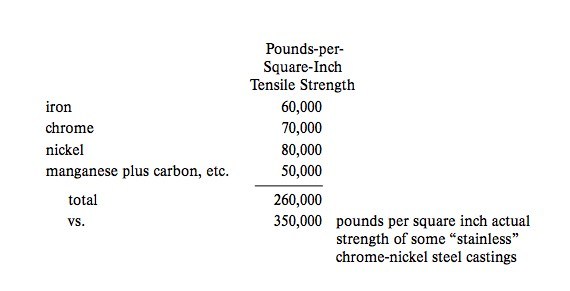
86 The going and obsolete economic accounting says, ‘‘A chain is no stronger than its weakest link,’’ therefore chrome-nickel steel by present economic accounting logic could not be greater than 50,000, or one-seventh of its actual strength.
87 The going economics fails to explain why the merger of a dozen economic ‘‘failures’’ produces a ‘‘success.’’ The American automobile industry was compounded out of many thousands of ‘‘failures’’ whose managements lost their credit authority but whose energy-processing real-wealth machinery assets had never failed. The accounting and the speculative funding, the promotional shortsightedness and the economic accrediting failed, but the evoluting machinery of industrialization did not. Industrialization consists of physical evolution and channeled-energy transformation which by the Law of Energy Conservation can never fail. Through traffic in interest-paying debt increases, present-day economics exploits the failure of debt crops to support the increasing numbers of humanity displaced as automatons by automation. We are in for a world of economic-accounting revision of first magnitude. We will switch from a negative to a positive world economic accounting.
88 In 1965 world-around industrialization produced about $2 trillion worth of ‘‘goods-and-services’’ wealth. This was 28 times the value of all the known gold mined and retained on earth and 50 times the value of all the world’s monetary gold. Assuming a 20% annual return on capital investment this indicates the total capital value of world’s industrialization plant and tooling to be $10 trillion which is 70 times the world’s known total gold supply in all gold-product use or monetary forms and 125 times the world’s total monetary gold. Gold is obviously inadequate, ergo obsolete, as either a monetary-exchange unit or as symbolic expression of the operative capital wealth now invested in the world’s industrial systems.
89 In 1933 as the New Deal came into office all the world’s monetary gold had been centralized in the U.S.A., not in the hands of bankers and individuals, but in the vaults of the U.S. government’s Kentucky mountains, from all the nations around the earth. Gold was economically ‘‘out.’’ All nations of the earth ‘‘went off’’ the gold standard. However, in 1944 the China Lobby in the U.S.A. persuaded a requisite quota of authorities that if $ 100 million of that gold bullion were released to them as private individuals they could corrupt China’s trend to communism. They failed and that gold which escaped Pandora’s Box—acting as a pump primer—began the processes of extracting that gold from the Kentucky hills and its progressive reemployment in the annual international trade balancing of the world’s accounts. This gold, augmented by Russian and African mining, now plagues and frustrates the natural expansion of the U.S.A.’s industrialization to establish a world-around means of regeneration of enough wealth to support all of humanity at an as-yet-undreamed-of advance in standard of living.
90 Because energy is wealth, the integrating world industrial networks promise ultimate access of all humanity everywhere to the total operative commonwealth of earth.
91 What do we know about wealth, stated rigorously and only in the experimental terms of science?
92 Answer: Wealth cannot alter yesterday. It can only alter today and tomorrow. Multiplication of craft wealth began, as we have noted earlier, when man discovered the lever. Multiplication of industrial wealth began when man fastened a set of levers radially round the hub of a wheel, put the wheel under a waterfall and connected the wheel with a grinding mill. Thus he learned to stand aside from the work and, gaining perspective, to use only his brain to rearrange the flows of inanimate energy-transformation patterns, external to his own integral bodily energies to do more and more fundamental man-advantaging work. He did so by shunting ever-greater amounts of previously unharnessed energy to impinge upon his machine levers.
93 Humans found that the vast dissociative (radiation) energy patternings of universe can be harnessed, shunted, and valved to impinge at preferred times and quantity rates upon the associative (gravity, matter) energy patternings; for instance, in the form of the long ends of levers the power of whose rotating shaft can be led through trains of gears to do preferred work for man.
94 Man is now learning, through the repeated lessons of experimental science, that wealth is explicitly the organized tool-articulated energy capability to sustain his forward hours and days of metabolic regeneration; to physically protect him; to increase his knowledge and degrees of freedom while decreasing his interfrustrations. Wealth, he finds, is inherently regenerative, but because of comprehensive synergies of the rate of regeneration of man’s solo wealth is to his commonwealth regeneration rate only as x is to x4. As experimentally demonstrated, wealth is energy compounded with intellect’s knowhow.
95 Science’s Law of Conservation of Energy states that ‘‘energy cannot be created or destroyed.’’ The first constituent of wealth—energy—is therefore irreducible. Science states that the entire physical universe is energy. E = Mc2. Some of the energy is operative in associative patterns—as matter. The associative energy as matter is organized in leverage systems to do work. The dissociative energy patterns, as radiation, are transformed into free energy to be directed to impinge on the levers.
96 Every time man uses the second constituent of wealth—his knowhow—this intellectual resource automatically increases.
97 Energy cannot decrease. Knowhow can only increase.
98 It is therefore scientifically clear that wealth which combines energy and intellect can only increase. Wealth can increase only with use and wealth increases as fast as it is used. The-faster-the-more! Those are the facts of science. Those are the facts of life. The proper accounting of wealth is scientifically feasible.
99 We have found that: (1) the metaphysical (weightless intellect) balances the weighable physical; for the physical universe is entropic, ever-expansive, ever-diffusive and increasingly disorderly while the metaphysical intellect concentrates in ever-more-orderly fashion; (2) the metaphysical universe embraces the physical—both being finite, for the metaphysical is mathematically demonstrable as being always one tetrahedron greater than any physical system; (3) the metaphysical’s generalized ‘‘capture’’ and identification of the physical is an irreversible condition—e.g., Einstein as intellect (metaphysical) apprehended and formulated the identification of the physical universe E = Mc2. This formulation is irreversible—for the physical which is ‘‘disorderly’’ cannot ‘‘think’’ and make orderly statements. Energy cannot write what Einstein’s intellect is. Therefore, we can say that the metaphysical is greater than, and reconcentrates and coheres, the physical.
100 The inherently escalating augmentation of real wealth is therefore inherently irreversible. Wealth can only gain and its gaining can only accelerate as in our proposition, Q.E.D.
101 The U.S. labor leaders will realize that automation can multiply man’s wealth far more rapidly than it is multiplying at present, and that automation will leave all men free to search and research for additional income energies to shunt onto the ends of the levers and for new greater and more incisive tasks to do with those energized levers. Realizing the direct competition with foreign industry on a straight labor basis would mean swiftly decreasing wages per hour and longer hours and decreasing buying power of the public, and compounding all the industrialization trends, American labor will realize that its function is not to increase jobs, but to multiply the wealth and to expand the numbers benefited by the wealth at the swiftest possible rate. U.S. labor will then recommend to U.S. Congress and the President that as fast as anyone becomes unemployed he be given a scholarship to go back into the educational system both as a routine discipline scholar and as a search and research student. The probability figures will show that for every x thousands occupied in study and experiment one will make a discovery or invention that will care for x thousands at higher standards of living than had previously been enjoyed.
102 Now I want to introduce another pattern to you, in order to provide maximum cogency for anything that I have to say to you.
103 The following observations relate to fundamental difference between the kinds of technologies that occur on the land and the kinds of technologies that occur on the sea and in the air. First (as we noted earlier) three-quarters of the earth is covered by water, and people have lived primarily on the dry lands, and the dry lands are very widely divided from one another.
104 There were men who discovered, in due course, that resources of various kinds existed in many places and that you could carry much more on a raft, or in a boat, than you could carry on your back or on the backs of animals, and that resources could be integrated between various places by means of commerce with waterborne vessels on canals, rivers, lakes, and oceans. The discoverers of the world ocean used the three-fourths of the earth covered by water to provide enormously increased advantage for everyone, everywhere, through the resources they obtained from foreign countries which, when combined with local resources that had previously seemed ‘‘of no account,’’ made them both locally successful.
105 The 1% of humanity that went voluntarily on the ‘‘high seas’’ learned that vast wealth was to be generated by virtue of this waterborne traffic, so there were great struggles of a very few men to control the high-sea trade routes. We might very accurately call them all pirates, and some were great pirates who came to master the sealanes. They were pirates because they were all ‘‘outlaws’’—simply because civil laws were local to different lands, and beyond the three-mile limit there were no man-made laws—only the physical laws of nature.
106 Men on the land, surviving through agriculture—as good farmers or local fishermen or miners or craftsmen—were protected by strong men who preferred just to be the strong men to protect the farmsite when on frequent occasions marauders came around to try to invade and usurp their local prosperity.
107 So, on the land, the strong men forced the prisoners and the shiftless to build their great fortresses behind which the people could retire while the battles with the marauders went on. And the kind of buildings that we have on the land were primarily great, strong fortress-castles of great width, weight, and stability, and the heavier and thicker and higher the walls the more secure the people felt. They were structurally ignorant. Thus, buildings on land have always been extraordinarily heavy make-do contrivances.
108 On the sea, contrariwise, security decreased with weight. Stone boats sank. In order, then, to have a successful ship, you had to pay attention to Archimedes’ law of displacement. But sailors long before Archimedes discovered that you could float only a certain amount of weight per each given volumetric unit.
109 The men who went to sea and mastered the important economic sea ‘‘lanes’’ didn’t go there for defense. They couldn’t afford defensive weights. They went to sea to win. They went offensively only. They built their ships for speed and seakeeping capabilities sufficient to mount a swift attack on land or sea and to carry away the booty. They needed good dry cargo space.
110 In the design of ships, they developed a list of essential functions to be performed. Next, they estimated how large and what shape ship would be required to mount x numbers of guns, the masts and their rigging—so much cargo, crew, and supplies to stay at sea for a given period. This finally gave them the ship’s size. They then figured its displacement in terms of cubic feet of water, the weight of which told them the total weight within which they must solve their total design problem. They then made a list of the functions and assigned so much weight to each. This brought ship designing into a severe discipline of performance ratios per given weight and time and power investments—so much to make the ship strong enough to withstand and exploit hurricanes, etc.
111 Whoever then could get a stronger mast, or whoever could get a stronger fiber in his sail for the same or less weight, could outperform the other man, and could outrun, outmaneuver, and displace him at sea.
112 So in the course of world history we find the great pirates and their respective powers developing a scientific search for doing-more-with-less, going around the earth, finding more effective resources and more effective technologies that gave them ever-higher capabilities. Those who knew the most about the earth by scientific discovery and experiment were able to get the strongest fibers for their sails and rigging and the strongest timber and fittings for their hulls and so forth, and could build the best ship to ultimately rule the other men of the sea.
113 In no time at all, this scientific exploring, skirmishing, and development brought the great pirates to steampower and steel ships and high-power guns. With the steel they could carry much more cargo and so forth and to meet that steelship requirement, whereby they could ‘‘run the world’’ and harvest the prime wealth, they had to have blast furnaces on the land; in developing this increasingly complex logistic capability they finally had all of the steel they needed for their battleships and cargo ships. The great pirates then looked around for more and new outlets for their steel, and other science won productive capabilities. Gradually the steel was insinuated into the walls and floors of stone buildings, which made it possible to make them bigger and taller. But the land people never thought of buildings in ‘‘performance-per-pound’’ terms and did not alter their ignorant viewpoint about land buildings. I have asked audiences of leading architects, all around the world, ‘‘What does this building we are meeting in weigh?’’ They cannot answer within millions-of-tons range. They do not think that way.
114 Finally the ship of the sea was displaced as the number one weapon by the ship of the air. The airplane became the ship of the air because the ‘‘lighter-than-air’’ balloons were too vulnerable to attack.
115 The nonair-floating, ‘‘heavier-than-air’’ airplane stayed in the sky only by virtue of forward motion at approximately hurricane speed, which developed the low-pressure ‘‘lift’’ on top of its wingfoils. To attain such speed the airplane had also to mount and support a heavy engine and heavy fuel. In the first airplane there was just enough additional lift to carry one pilot a few hundred yards in a few seconds.
116 But science was put to work by the world-mastering outlaw, and in the first 50 years of the airplanes the treasuries of the major nations of the earth appropriated $21 ⁄ 2 trillion in the direct and indirect subsidy and development of the airplane. Those sums went into hiring science and technology to do-more-with-less in respect to every function of the airplane as a weapon. Whoever could do the most with the least—could carry the greatest hitting power, the greatest distance, in the shortest time with the greatest accuracy and least effort—could and would rule the world!
117 In 1922 I went into the world of building, having been previously steeped in the Navy and its flying. When I had been in the building world for five years, and had taken part in 240 building operations, I saw that we were taking the oil burner off the battleships and into the home, so that we gave up having to stoke our home furnaces with coal. We also took the refrigerator off the battleship, and the radio and air conditioning, and brought them into our domestic buildings.
118 We brought item after item developed exclusively for a seaborne or airborne war technology into the home. This came about because the contractors who produced such advanced technology for the government found themselves ‘‘all dressed up’’ with the tools and the scientists and skilled workers, and suddenly ‘‘run out’’ of ‘‘defense’’ contracts, and the home market was an unexpected bonanza.
119 We have had desalinization in the Navy for half a century, and it is now about to come into our domestic economy. All the advanced technology starts under government weapons subsidy and gets into the home economy (on an average) about 25 years later.
120 In 1927, because of my experience with the Navy’s doing-more-with-less—in the war and weaponry technology—I saw that in the building world they were not trying to do-more-with-less, and that they had never thought of it.
121 The principles of doing-more-with-less which dominated the science and technology of weapons development were beginning in the 1920s to affect the domestic economy where they had never thought of such a strategy per se and have continued to think of economic security only in the terms of ‘‘bigger’’ and ‘‘more.’’ ‘‘Secure as the Rock of Gibraltar’’ is the landsman’s thought.
122 To my excitement I saw that the drift from sea and sky to the land of the more-with-less technology might inadvertently be amplifying the economic advantage of the 99% of humanity who live on the land in sufficient degree to promise doing so much more with what we have that we might prove Thomas Malthus and the economists wrong. This is and was possible because there was for the first time in history a dawning possibility through the more-with-lessing that we might be able to take care of all humanity at higher standards than any have ever known—this in turn would, if true, eliminate the war and the war technology which was predicated on the concept that there would never be enough for more than a minority to survive and live out their potential lifespan, wherefore war was intermittently recurrent.
123 I saw that Malthus could be fundamentally wrong because his thoughts were devoid of any sense of technology’s more-with-lessing.
124 He saw food in the field, and he said it was going to rot because there was no way to get it to the mouths around the world. He did not and could not think in terms of the as yet uninvented quick freezing and of refrigerated transportation.
125 So in 1927 I made many calculations, and it seemed increasingly clear that it was feasible for us to do so much with so little that we might be able to take care of everybody. In 1927 I called this whole process ‘‘ephemeralization.’’
126 Because of ephemeralization I saw that we could have an entirely new reason for supporting science, which would be ‘‘how to maintain man as a success in universe,’’ instead of ‘‘how to destroy the most men and the most of man’s facilities in the shortest time and with least effort in order to make the little sustenance go around.’’
127 Well all that philosophy which I have recounted for you I have pursued objectively since 1927. I objectivized it by searching and planning to make man a physical success by altering the behavior of the physical environment rather than by trying to persuade man by words or political reforms to ‘‘behave’’ in better ways. My philosophy is to employ the inductive principles of science’s exploratory disciplines. I saw that this could be done through competently comprehensive invention which would alter the physical environment to man’s physical advantage in such a manner as to induce non-interference of men with one another while inducing behaviors leading to man’s comprehensive physical success. For instance, we can design highways banked so that autos steer themselves safely around curves even if the drivers are drunk, or develop dams that catch rainwater to keep it until needed by man, rather than having it flash-flood him to destruction.
128 The foot-pounds of ‘‘work’’ that humans can produce per year at various age levels have been measured by the major world armies’ engineering divisions. From these figures it is easy to establish scientifically a unit of physical work known as a ‘‘one manpower year.’’
129 In comparison to it, I have taken the work that is being done by all machinery and energy consumed in our various industrial economies around the world and have found, as I published in Fortune magazine’s tenth anniversary, February 1940, issue, that in 1940 we had in the United States working for us 24 hours a day, every day of the year, the equivalent of 139 inanimate energy slaves for each U.S. animate human being—man, woman, and child.
130 But that figure was not arrived at by saying that all of the energy consumed by our U.S. machines was realizing 100% efficiency in its delivered work. It was predicated on the overall efficiency actually operating in our economy, which is only 4%. So I had to take the total energy, including food, being consumed by our respective economies and divide the total 100% potential energy as ‘‘consumed’’ by 25, which brought it down to the 4% actually realized. I divided the 4% net energy units per year by ‘‘manpower units per year’’ and found that we had 139 inanimate slaves per capita working for each one of us in the U.S.A.—but I also discovered that most of the energy slaves’ work was going into weaponry. The energy slaves were operating throughout the local industrial network economy. Not many of them operated inside your house. The majority operated throughout the whole of the energy-production, -distribution and tools-to-make-tools system. When I subtracted the amount of energy going into weaponry production, distribution, and maintenance from the amount of energy being consumed by our total economy—the total being 695 energy slaves per each family of five humans—it was disclosed that only 100 inanimate energy slaves could do all the work necessary to maintain each family of five humans peacefully in the United States—at the highest standard of living ever experienced by any people anywhere at anytime in history. This meant only 20 energy slaves per each person for peaceful existence vs. the 139 per person for living at the highest known standards while also getting ready for the next war. This meant that six out of every seven of the total inanimate energy slaves were working directly or indirectly on weapons-producing technology.
131 Using the foregoing criteria—20 energy slaves per each individual—or 100 slaves per each family of five—as sufficient to maintain humans at the highest known standard of living, I identified each family of five so maintained on earth as an industrial have family. Probing our technoeconomic history with this yardstick, I found that in the year 1900 less than 1% of all humanity anywhere around the world could be rated as industrial haves. However, the mechanization of World War I made such an advance in industrial technology and energy harnessing that, by the end of World War I, 6% of humanity had become industrial haves. At the beginning of World War II, despite a great increase in world population, 20% of world society were living as industrial haves; at the present moment 44% of all humanity have become and continue to be industrial haves.
132 It is to be particularly noted that this extraordinary increase in the percentage of all earthian humanity being supported at the highest standard of living—from less than 1% at the beginning of the century to 44% by the present moment (1965)—was all accomplished in spite of the great increase in the world population already noted, plus a constant decrease in the total amount of metals per each human being on earth. And when I say ‘‘total amount of metals,’’ I mean all the metals which have been mined as well as all the known and newly-discovered ore bodies. Quite clearly then, the upping—within only two-thirds of a century—of the standard of living of humanity from almost total havenotness to 44% enjoying a standard of living superior to that enjoyed by any sovereign previous to the 20th century cannot be accounted for by the exploiting of more resources, because the resources per capita were constantly decreasing. This sudden transition from the persistent historical over 99% havenotness to a 44% haveness—in the face of lessening resources per capita—within two-thirds of a century can therefore only be accounted for by the evoluting technology’s accomplishing ever more with ever-less resources per each essential or desirable function. Neither the massive corporations nor the massive sovereign states had ever set about deliberately and directly to make all of humanity successful by consciously undertaking to provide more peaceful living with ever-less resources per each accomplished task. In fact, both the corporations and the states—assuming the Malthus dictum that there were not and never would be enough resources on earth to support more than a small minority—had been intent or making themselves successful by acquiring constantly more of everything.
133 Obviously this utterly unexpected and unprecedented great world gain in standard of living has to be explained exclusively as an inadvertent by-product of the do-more-with-less sea- and air-warfare technology which had been secondhanded into the domestic economy from the military world. Around the three-fourths of the earth covered by water and the 100% enveloped by air, no civil law existed and warfaring has been governed only by the technological necessity to do-more-with-less because whoever could do the mostest with leastest could and did run the world.
134 I know that people everywhere around the world—still thinking of themselves as inherently rooted to their localities and preoccupied with their own local problems—are now noticing that technology has brought about an extraordinary and seemingly inexplicable change in their lives. I am sure, however, that they don’t think of the changes specifically in terms of industry’s having inadvertently done-more-with-less, that is as an unpremeditated benefaction accruing exclusively to our massive preoccupation with the negatively-inspired production of weapons and killingry.
135 What I am inferring in all the foregoing, however, is that it is unnecessary for us to depend upon the exclusively negative stimulus—of preparation for the next war—in order to accomplish the comprehensive attainment of so much to be done with so much less that within a decade we can readily and efficiently provide 100% of humanity with as-yet-undreamed-of physical and economic success.
136 At the present era of history, erstwhile democracy has not seen fit to give its political leaders a 100% mandate to deal centrally with all their wealth and all beings and resources—except in times of war, or in economic catastrophes, or in emergency-adopted preparation for the next war. Political leaders have been given war-emergency mandates only to get a nation out of trouble or to save it or protect it. During peacetime, we have never given political leaders a 100% mandate to make the entire national population physically and economically successful. We have never thought that this was possible. It was, therefore, a new political event when we gave peacetime emergency powers to the New Deal as it came into overwhelming political power in 1933, 31 ⁄ 2 years after the great financial crash of 1929. In 1933, we were in such a complete financial and economic mess that for the first time in peacetime history we gave a comprehensive economic-initiative mandate to the political leaders, praying that they get us all out of economic trouble. This was not given, however, as a permanent mandate. It was a mandate to get ourselves out of momentary and local economic trouble. It as interpreted by the New Deal as a mandate to get the old system going again with a few social improvements. It was not a mandate to make everyone successful. That 1933 mandate for getting us out of what it was hoped was only momentary trouble was immediately followed by the 100% mandate to our government to cope with World War II. Under this mandate the enormous number of industrial undertakings and the enormous amount of energy that was harnessed to impinge on the ends of the industrial levers to produce machines and tools which produced more tools, which in turn produced even more tools—and ultimately produced the hitting power to destroy the enemy—brought about the establishment of such enormous total industrial capability, under a centralized military authority for continuous and wholesale technical innovation, that an entirely new kind and magnitude of commonwealth and private wealth was established as we came out of World War II.
137 In preindustrial history the life-sustaining wealth consisted primarily of agriculturally-harnessed sun and chemical energy. Wars devastated the agricultural production by sending the farmers into the army and turning farmlands into battlefields. Wars have in the past been characterized by catastrophic impoverishment of the nations involved. It was, therefore, incomprehensible to society and economists that as we came out of World Wars I and II—and especially World War II—despite our having expended hundreds of billions of dollars, our economy was far richer than before the war—in fact far richer and more powerful than it had ever been. This was because science, technology, and industry financed by government had harnessed the flow of vast, heretofore uncapped energy sources and had shunted them to flow onto the ends of the industrial tools’ levers. The tooled means of producing goods which sustained life through this harnessing of wealth were approximately indestructible. In all the war countries, even in saturation-bombed Germany, though buildings were destroyed, the machinery was only superficially damaged and could be removed and put to work again. Therefore, much greater wealth in the form of capability of production existed than before the wars, and for the first time the working population of the United States found themselves receiving enormously increased real incomes. This point has not been clearly established in the public mind. From a few hundreds of dollars per capita in pre-World War II U.S.A., personal income multiplied fivefold after World War II.
138 It is essential to note that this new wealth had not been the objective of world warring. This vast peacetime wealth-generating capability had been only inadvertently established during the development of war production. The whole of this fabulous new wealth-producing setup had been geared in by a war mandate in which the government and its military leaders were empowered to undertake the prime initiative in extending, augmenting, or evolutionarily transforming the fundamental scientific and technological energy-harnessing capabilities of society. The military were the ones who were commissioned to use the accrued capital wealth to make airplanes fly faster, missiles go further, and so forth. The new capabilities of technology permitted realization of further inventions. Accelerated technological evolution occurred as a consequence of the new environment itself. These ventures of the government, as articulated by the military defense, were of an historically unprecedented order ‘‘light-years’’ beyond the organizing capability of private capital venture and accomplishment.
139 As we emerged from World War II we were so tied up with this extraordinary new centrally-initiated and -coordinated wealthmaking capability, and we were so personally impressed with the private wealth which had come to a very large number of our population, all unexpectedly through that war, that both industry and society at large were loath to give up such a proven profitable system. As a consequence, the President of the United States, after the theoretical ‘‘peace’’ following World War II, was given a mandate by the Congress to continue his powerful war powers and thus to extend the technological evolution by giving billions of dollars annually worth of orders to all the great prime contractors of the national weaponry. The President was given this mandate to carry on in peacetime on the basis that it was obvious that we were going to have a Third World War, and that we would be devastated if we did not anticipate and prepare for that third war. Assuming that the U.S.A. would never again have the time to prepare, as in the past, we undertook what we called ‘‘cold warring.’’ Thus, we continually improved the technology of war as the ‘‘other fellows’’—the assumed next enemy—improved their technology. This mutual improvement at parallel rates would discourage either side from undertaking a full-scale war. This became known as the strategy of deterrence. This meant extraordinary and continuous augmentation of the fundamental scientific and industrial capability. It meant the further harnessing of vast amounts of energy which had been flowing through nature in patterns that had not previously been shunted onto the ends of the levers of the man-operative technology. As a consequence, mankind, who for millions of years had struggled around on their feet, found themselves riding around in extraordinary automobiles finer than any vehicle of any previous monarch. They found themselves traveling around the world on ‘‘wings,’’ enjoying themselves in many extraordinary ways. Intent upon sustaining that kind of capability and recalling Malthus’ warning that there would never be enough wealth to go around for all, the new successful industrial world population decided that they had better be on the defensive.
140 However, with 60% of humanity as yet continuing as ‘‘havenots,’’ the newly successful have said to themselves, ‘‘Well, we can’t really enjoy ourselves too much unless we act in a rather friendly and logical way in relation to the havenots, so we will try to help them to help themselves by giving them pump-priming moneys and selling them weapons and giving them economic advice; but they are going to have to pull themselves up.’’
141 But society has not really understood the total industrial equation. We have not understood at all how we have come into proprietorship of this fabulous new wealth. Because we don’t even understand what wealth is, we revert to our fumbling understandings of the preworld-warring, preindustrial, exclusively agricultural-venture economic language. We set up a World Bank and revert to the employment of the pirates’ gold-bullion wealth. We have now found ourselves in a jam because in order to expand the industrial equation to the world’s comprehensive advantage—to harness more energy and produce more tools, we immediately withdraw too much gold from our U.S. gold reserves which had no technical value while stored in bank vaults. It has only a symbolic function. It does not represent the U.S.A.’s multi-trillion-dollars’ worth of coordinate, metabolic-regenerative capability. But because we do not have either an understanding of our wealth or a proper accounting of its regenerative employment, we shut down on the world development of industrialization by U.S. companies.
142 Powerful clichés have persisted for centuries which assured no important changes in the status quo, as for instance the statement, ‘‘You can’t pull yourself up by your bootstraps.’’ But we have suddenly realized a swift increase in the proportion of humanity who have become economically and physically successful. Man has pulled himself up by his own bootstraps, but the old accounting will not permit proper recognition of the fact and we keep piling up fundamentally contradictory national indebtedness.
143 In scientific development of their armaments, men inadvertently began to make economic sense by relying exclusively upon the laws of nature rather than upon the opinions and clichés of the ignorant, and thus inadvertently tapped the really great-capability wealth which is the development of organized-energy to deal with the metabolic regeneration of man.
144 Now our political leaders have gone so far as to see that we can take care of those who are in poverty within the United States. It is now also dawning upon industrial society that it could be even more successful while depending exclusively upon the potentially enormous energy income—in contradistinction to living almost exclusively by burning up our capital principal, that is our ‘‘savings-account’’ energy in the form of fossil fuels.
145 The natural energy income in, for instance, the harnessable ocean tides, wind, sunpower, and alcohol-producing vegetation, can be made to flow through the wires and pipes to bring adequate energy to bear on the levers, to step-up man’s physical advantage efficiently to take care of all humanity.
146 Possibly the greatest limitation with which we are faced is the fact that our political leaders have mandates to look out only for their own side. All the major political states are as yet operating on the Malthusian basis that there is not enough to go around and that each nation must maintain sovereign prerogatives and egocentricity. Thus, nations merge into a few massively opposed groups. The ‘‘ins’’ look out only for their side. The almost ‘‘ins’’ get ready to switch from alliance with the havenots to alliance with the haves.
147 The havenots point accusing fingers at the haves as though an inherently irrevocable political class condition existed which caused their havenotness. Neither the most recently successful nor the soon-to-become-haves realize that what has changed their lot came from the scientist-inventor’s discovering principles operative in nature and employing those physical laws to eventually raise the standards of all. They think their lot has improved because of their political ‘‘way of life.’’ However, none of the great changes have occurred as a consequence of political systems. All political systems—the most highly socialized, the most aristocratic, the most capitalistic, and the most communistic—prosper equally under the operation of the dynamos and the levers. The power-driven hammers and sickles just don’t belong exclusively to the socialists. The automated hammers and sickles are also being used by the capitalist to equal advantage. There is no question about the intensity of involvement in their respective ideologies of the political leaders everywhere around the world, but there is also no question about the fact that they are not inherently and irrevocably divided. Thinking of themselves, however, as irrevocably pitted against one another, they are prevented from reaching the one great solution which can be made today, which is that of making all of humanity successful. To do so would be to admit the fallacy of their claims that each of their opposed ideologies alone can solve man’s survival problems.
148 It is now scientifically clear that we have the ability to make all of humanity physically successful. But it can be done only on the basis of making all of humanity successful. We cannot remain just half successful or with just a minority successful. Industrialization itself relates to the resources of the entire earth, the entire universe, and the entire experience gained by all men in all time. The industrial system is a comprehensive system and if reversingly fractionated will fail.
149 No political leader has a mandate to make the whole world work. Consequently, we cannot look for political help in turning our wealth-making adequacy toward making all of humanity successful. You might say, ‘‘I think you are wrong. Some political leaders have a mandate to make the world work.’’ For instance, the communists say that what they are going to do is to make communism universal and then the world will work. They say, ‘‘This isn’t just for Russia, it is communism for all.’’ And the Chinese say, ‘‘This isn’t China, it is communism, and communism is the best system to make the whole world work.’’ But it is also very clear, if you listen to the communists explaining how they are going to make the world work, that they assume that there is enough to go around, so the exclusive survival means must go to the ‘‘workers’’ (despite the fact that automation is swiftly making the ‘‘worker’’ function extinct). The communists assert that they must kill off all the nonworkers in order to make their system work.
150 This is not a way of making the whole work. It is a way of making some people successful at the cost of others.
151 What is perfectly clear, as we look into the technological doing-more-with-less that I have been discussing, is that it is the scientific invention of the individual and the consequent industrial technology that produces telephones. Anyone can use the telephone. Any two can have any kind of telephone conversation they want. They can call each other communist, capitalist, or any other kind of name. The telephone works for either. But the telephone shrinks the world for both, and disasters can be averted by means of it, and when disasters occur it brings swift help from great distances. Without the telephone, the world could not be made to work for all; with the telephone, it could be made to work. It is the organized technological capability that counts and not the negative games that men are playing around the earth as to who has the best class-biased system. All political biases are now irrelevant.
152 In the 1950s Khrushchev and Eisenhower were both made aware by their respective militaries of the humanity-obliterating magnitude of their atomic striking capabilities, whereby the world would be left in a complete radiation mess for those few who were not killed. Eisenhower and Khrushchev determined to meet in Geneva. Both politicians knew that neither could yield politically. Neither could give up sovereignty. Neither could relax his military ‘‘preparation for the worst’’; neither would discard his ideology—his socialism or his free enterprise—which concepts incidentally are confused on both sides by their respective semantic game-playing. The U.S. is by far the most socialized of all countries in the world but has socialized only indirectly by socializing only the prime ‘‘hitting-power’’ corporations, instead of the individuals. Indirect socialization of the individual accomplished through corporate employment or dividend distribution to stockholders hides the fact of socialism. By socializing essential institutions—through research-and-development tax subsidies and through bank-negotiable billion-dollar government ‘‘orders’’—the U.S.A. has socialized ‘‘from the top down.’’ This is too elegant for those class-warfare champions of the underprivileged who, assuming fundamental inadequacy of world resources, would first ‘‘kill off’’ the half of the world that is now prospering.
153 Communism will never admit that socializing from the top down is faster than socializing from the bottom up. Both sides attempt to put everybody on the payroll to continually match the ever-increasing productive capability of industrialization. The Western world ideologists feel intuitively (but not consciously and officially) that it is more considerate of the dignity of man to play this indirect game, which avoids the rationing and ‘‘downgrading’’ concepts. So in effect we are gradually making everybody in the United States the vice president of a bank. As a consequence, we now have so many banks to store all the deposited wealth of the people that we have more banks in each city than we have ten-cent stores, butcher shops, drugstores, or supermarkets. Each one of the banks is becoming more elegant. Each is a great big ‘‘parlor’’ or ‘‘study,’’ with each vice president having a palatial residence-type library desk. But the vice president’s sole initiative and private prerogative—not covered by strict government rules—is to telephone somebody to try to take his deposit account away from some other bank. The banker, of course, is no longer dealing in his own money—the underlying safety of the bank deposits is now the government’s responsibility. This is a very dignified way of carrying on. Nobody realizes that he is being socialized. The idea of being socialized seems to hurt the ‘‘Western’’ ego and frustrates individual initiative. Those who are on the communist side say they must first level everybody. They then say everybody owns everything—theoretically—but has the use of anything or any service ‘‘according to his need’’ and according to availability. In the U.S.A., people pretend that they own their automobiles, but they in fact rent them as in fact they truly rent their 30-year-mortgage-‘‘purchased’’ houses which they occupy—on an average—for only four years. In the U.S.A. the government is carrying the $200 billion debt load of the dwellings and always has the ultimate right to take away. The U.S. trend is in fact one also of use of wealth—each ‘‘according to his needs’’—by discretion of the U.S.A.’s Internal Revenue agents and other executive agencies of the government, as empowered by the acts of the U.S. Congress operating under duress of powerful lobbying organizations in the ‘‘nation’s’’ capital. I say ‘‘nation’’ in quotes for as we noted earlier the U.S.A. is, at present, the most crossbred admixture of people from all nations of the earth. The U.S.A. is the breeding place of ‘‘world’’ and ‘‘universe’’ man.
154 All this confusion of identity and mutually obsolete ideologies blocks recognition of the number one big question, which is: How are we going to make all humanity successful despite the political impasse? Both Eisenhower and Khrushchev knew that they could not yield to one another politically—i.e., ideologically, militarily, economically, or geographically. Such an act of either would be repudiated by their respective political parties. Their parties—the ‘‘in’’ parties—would themselves never think of yielding because they knew if they were to yield ever so little the ‘‘out’’ party could effectively challenge them with treason—the most powerful accusation which the ‘‘out’’ party may use to displace the ‘‘in’’ party. Nothing could be a more important kind of yielding to the country’s adversaries than to give up any part of national sovereignty. Therefore, the two greatest world adversaries’ political leaders—Khrushchev and Eisenhower meeting in Geneva, knowing that neither could yield politically—sought mutually to say something to the world that had some kind of favorable promise despite the ominous existence of the great bombs. Both of them, as human beings, realized their mutual responsibility to humanity. They said, ‘‘At least we can bring our scientists together to talk to one another regarding the peaceful uses to be made of atomic power.’’ Both opposing leaders thought they might get the world in a better frame of mind through knowing that they could be alternatives to total human suicide. So they brought their scientists together in Geneva. The scientists did do a lot of exploratory talking about the peaceful uses of atomic energy. Little atomic reactors were brought along to demonstrate how at least to generate electricity and thus to produce a vast increase in the world population of inanimate energy slaves. As is often the case, the most important event at Geneva was entirely unplanned. It was a coincidence. The Food and Agriculture Organization of the United Nations also held its annual meeting in Geneva. The world’s food and agriculture scientists and administrators were assembled to take total inventory of total needs and capabilities of world man. This gave objectivity to both the U.S.S.R. and U.S. atomic scientists’ considerations. One reason why Malthus had said in 1815 that there would never be enough to go around was that Malthus had to assume that much food would rot in the field and that there would not be enough ice in the iceboxes to preserve the harvested foods. Most people lived in iceless areas. Though people in hot countries used spices, these did not keep food from spoiling. While Malthus knew that a great deal of food could be raised, he thought it would never reach all the mouths of those who needed it. The scientists meeting in Geneva, a century and a half later, saw of course that atomic energies could be used for the quick field freezing of foods and their refrigerated transport and marketing. They also cited the use of energies in chemical fertilizers, as well as various ways of using energies to increase the metabolic rates of production. It became obvious that humanity could produce adequate amounts of food, could preserve that food, could distribute it under refrigerated conditions, and could keep it in perfect condition until it reached the mouths of those who needed it. Gerard Piel, publisher of the Scientific American, who was present, was quoted as saying that it was in scientific evidence that there could be not only enough of the living essentials to take care of everybody around the world at high standards of living, but that there also could be enough to take care of the increasing populations at ever-improving standards of living. Though this Malthus-refuting potential became obvious to the scientists, they were not impolite enough to their political hosts to say that they didn’t see how this desirable potential could ever be realized in the face of fundamentally unyielding sovereignties. Though the scientists failed to make a formal statement that Malthus was wrong and that all of humanity could be both a physical and an economic success, their findings to that effect became generally known to many world scientists.
155 Thus, for the first time in the history of man, we have known for a little over a decade that there can be enough to go around, and that we are frustrated from realizing this epochal potential because of the one hundred or so political sovereignties which were set up for mutually-exclusive survival hopes under the Malthusian dictum.
156 Let us now consider what would happen if we were to take all the industrial machinery away from all the industrial countries around the earth. This means pulling down all the wires, taking up all the tracks, removing all dynamos and every motor. We take all industrial equipment away from all the countries in Europe. We take it away from Russia. We take away all the industrial machinery from China and Japan. We take it away from the United States and Canada. We dump all the world’s tools of industrialization in the ocean. Within six months, two billion human beings will starve to death, having suffered greatly on the way.
157 Now I am going to give you another picture. I am going to leave all the industrial machinery where it is. I am going to have all the waterfalls keep on flowing and keep all the inanimate resources available, and all who are in the industrial production as workers and administrators will stay at their jobs running all the machinery. Next we are going to take away from all the countries of the earth all the politicians, all the different political ideologies and all the political party workers of every kind, and we are going to send them all off in satellites for a trip around the sun. As long as the politicians are absent, everybody on earth who has been eating is going to keep right on eating, and with all political barriers down the prospects of arranging to take care of the needs of the rest will accelerate, and humanity everywhere on earth will prosper.
158 This is the first time in history that we can say this on a scientific basis, because all the political systems were of course organized on the basis that there wasn’t and never could be enough to go around. Because there was not going to be enough to go around for more than a small minority, political theories such as that of Marx developed to take care of a preferred group. Marx said, ‘‘Let it be the workers because they are the most deserving.’’ But the pirates said, ‘‘Darwin says it will always be survival only of the fittest and our rugged individualism and ruthless venturing makes us the fittest.’’ All other political systems were in between those extremes.
159 No one foresaw that the industrial system could make enough to take care of all. Assuming that Malthus was right, all of humanity up to a decade ago was forced to choose sides. This was and as yet is the basis for the assumption of an eternal class struggle for survival. All of the political theories have suddenly become utterly obsolete as exclusive survival systems. They are obsolete because the world-around potential abundance has not occurred by virtue of rugged individualism nor by any class warfare’s cutting off anybody’s head. The abundance can be accomplished without any mutually excluding interferences. We will gradually increase travel, dwelling, sustenance, and educational capacities so that whoever wants to travel can travel when he so wishes. The industrial system is getting more effective as more and more people are able to talk to more and more people. With more and more direct dialing there are less and less busy wires. We are in for completely automated success once we get over the idea that survival and enjoyment solutions must come through politics and recognize that they can come only through unbiased, intelligently organized competence and physical redesigning of the use of the world’s resources to do so much more with so much less as to be able to supply everybody with all that they need. Quite clearly it is only going to come through the development of a world consciousness of what constitutes the true problem. That world consciousness is now coming into high and swift manifestation amongst the world-around youth.
160 In Berkeley, California, at midwinter of 1964--1965, we have the students demonstrating a fundamental awakening to an intuitive but as yet unformulated awareness of the misconceived preoccupations of their elders in a futile shortsighted struggle leading only to utter despoiling of the earth and the end of man on earth. The young Berkeley students’ specific and immediate aggravations were happenstance. The reporters, exploring the Berkeley situation, found that students in other colleges felt the same comprehensive dismay for many entirely different catalytic reasons. Inquiring of individual students, the news reporters found a new kind of student attitude. The students were not inspired by loyalty to their particular family, to their particular college, to their particular town. They were not interested in their state. They felt no loyalty to their nation. Their elders were shocked. But the students had not lost their fundamental idealism. Their idealism had lost its debilitating bias. They felt it to be immoral to be chauvinistic and patriotic. The young people were and are only interested in the whole world and in the welfare of all humanity. The average age of the Berkeley student was that of the university junior.
161 Since I frequently visit universities in Africa, in our own country, and in Europe, I have talked over with the Berkeley-age students the environmental factors that have been operative in their lives. One of the first things we find out about this age of students is that they were born the year of the atomic bombing of Hiroshima and Nagasaki. This is quite a birthmark. They are the first generation in the history of man to be brought up by television, which came into popular use around the earth after World War II. Even the roofs of Hong Kong, Caracas, and Accra bristle with television antennae. TV communication everywhere reaches the world’s children—even the poorest.
162 The data of behavioral science sheds interesting new light on the significance of the TV influence. One of the important facts we have learned in the now-powerfully-exploring behavioral sciences is that the speech pattern of parents—their vocabulary, tone of voice, clarity of diction—plays one of the most important roles in the positive or negative development of their children’s brains and subsequently capacity to apprehend and coordinate abstract as well as sensorial concepts. If the parents have no real confidence in their own brains or minds, they talk in clichés. They talk in the phrases of others. They accept the dictums and opinions of others. If the child finds that the parents are not using their own minds and are relying only on the brain’s cunning and luck, the child relinquishes use of its thinking capabilities. Where the speech pattern of the parents indicates a desire to comprehend, to understand, and to formulate their own thoughts, to increase their vocabulary, then the child is inspired to do likewise. We have also learned that children can prosper equally with a foster parent whose speech and other behaviors favor the optimum development of the child’s innate capabilities. The men and women who work on television get and hold their jobs through their diction, good vocabularies, confident tone, and pleasing personality. It is their speech pattern which is primarily apprehended by the world’s listening children despite the fact that the TV actors are being hired to talk about or to sell beer, buttons, or hair tonic. The children understand games. They consider the selling as game playing. The children read through the commercials to sense the personal lives of the TV actors. The children know their television people as children of a century ago knew all the village characters. However, the children often see more of television characters than of their own parents, brothers, cousins, uncles, and aunts. I, therefore, wrap up all the television influence on children by calling the TV the ‘‘third parent.’’
163 Since World War II, the third parent has been talking to this group of young people who are now the university juniors. For 20 years the third parent has been telling all the children the news of the world every hour on the hour. And the parents come home from the shoe store or from some other equally unstimulating occupation and say, ‘‘Oh, I had a terrible day. Let’s have a cocktail!’’ So the children run back to the TV to get the third parent’s more exciting world news. Through the years, the third parents have been telling the children and youths about a fantastic avalanche of invention feats of men and showing them on screen. A submarine goes under the polar ice from Pacific to Atlantic driven by atomic power. Next an atomic submarine goes completely around the world submerged. Men master the virus diseases—penetrate the nucleus of the atom. Men climb to the top of Mount Everest and they go five miles in to photograph the bottom of the Pacific. Men orbit the earth—photograph the far side of the moon. Men find the DNA genetic code governing the design of all biological life, and it becomes evident to the young people that man can accomplish any physical task. So the young people say, ‘‘We see that there could be enough of all the essentials of life plus many luxuries to supply all of humanity on earth. Our scientists and engineers make that clear to us. Though we can invent and do anything we want technically, we are not making the world work. The world should be made to work, and we just haven’t confidence in yesterday’s negative solutions of survival as, for instance, saying that there is not enough for more than a few so ‘Let’s kill off the excess.’,’’ They can understand yesterday’s men fighting for survival, but they think it is obsolete now that there could be enough for all. They don’t like the war concept. They want peace. But the young people have not worked out an adequate understanding of the comprehensive factors involved. They don’t have enough data to put together the kind of comprehensive picture that I am attempting to put together for you here today.
164 The young people, thinking that the world should work, demand of their group parent that it be made to work. The group parent is the nearest local politician. They keep challenging the local politicians by marching in front of them in one way or another saying, ‘‘Make the World Work’’—‘‘Let’s Have Peace’’—‘‘Stop the War.’’ Of course the young people are easy for the politicians and their professional subverters to exploit. All the different and opposing political parties around the world fog up, confuse and try to divert to their respective bias accounts the idealistic demands of the young that the world be made to work satisfactorily for all. Most of the young idealists are naive, so they fall for many suggestions as to the way in which they may realize their dreams of a satisfactory world for all. Though their idealism is greatly exploited, it is increasingly manifest everywhere. Gradually it becomes clear that there is only one way in which we are going to be able to make the world work. We cannot have warlessness—i.e., we cannot have peace—unless we get rid of the whole reason for war, which has been occasioned always throughout the ages by the fact that there is not enough to go around.
165 Even now there is only enough for 44%—as the resources are presently used. This means that 56% are going to die far short of their potential lifespan and they are going to go through great pains and privation. If you are going to die without food, you have everything to win and nothing to lose if you take up a gun and fight for it. We are going to have wars just as long as there is not enough to go around. This is fundamental. The young people of today are not going to get anywhere by just saying, ‘‘Let Us Have Peace.’’ The politician is not able to do anything about it because he is not a scientist, engineer, inventor, designer. War is the ultimate recourse of the politician, undertaken to fulfill or defend his political bias. There is nothing anywhere in politics per se, political mandates, political activity, that can in any way up the performance per pound of the world’s resources and thereby make the resources take care of 100% instead of only 44%. This can be done only by furthering the doing-of-more-with-less in the same way as that technological augmentation which has occurred almost exclusively within the great weaponry programs. Ships had to float. The limit weight of floatability, as Archimedes showed, was the weight of a volume of water equal to that of the submerged portion of the ship’s hull, i.e., the portion below waterline. The more you load onto and into a ship the lower it sinks and the more water it displaces. With enough load it will sink altogether. To make the ship go faster and carry more hitting power meant adding to the ship’s functional inventory. To do so without sinking the ship required that the ship designer do even more with less. Those who became the masters of the world ocean did so by becoming masters of doing-more-with-less. The design scientists had to do even more with less in the air. In the space technology we have to do even more with even less again.
166 A fantastic degree of doing more with less occurred when one Telstar satellite weighing only one-quarter of a ton, orbiting around earth, outperformed the transocean communications capability of 75,000 tons of ocean-bottomed copper cabling—a 300,000-fold increase of performance per pound. This is typical of the acceleration in doing-more-with-less now occurring invisibly everywhere which can be brought into play effectively enough to render the world’s resources capable of taking care of all humanity.
167 The engineers say; ‘‘Yes, it is clear that the overall efficiency of the kind of structures and machinery we are now using is very, very low.’’ We are operating at an overall mechanical efficiency of only 4%—as I mentioned to you a little earlier. Therefore, we find that if we increase the overall mechanical efficiency to only 12% we can take care of everybody. That threefold increase in the overall efficiency can only be accomplished by redesign. You don’t do it by whipping the motor. You don’t whip the inanimate slave. You make him obsolete by design—inventing a more efficient mechanical slave. You melt up the old inefficient slave and turn the same metal into two or more new and more efficient inanimate slaves. You take one of the great two-ton automobiles off the road and make two little ones that park in a much smaller space and go faster more safely on less fuel.
168 What we see here is that the mechanical efficiency can be comprehensively multiplied to take care of all of humanity’s ever-expanding requirements. I will give you a quick meaning of ‘‘mechanical efficiency,’’ as you may not be familiar with this engineering concept. Mechanical efficiency is stated in terms of a percentage of physical work done by a machine as ratioed to the amount of energy consumed by it in doing that work. We state the resultant relative efficiency in terms of realized work. We say that an automobile’s reciprocating engine is approximately 15% efficient. That is all it is going to be able to give you because it is inherent in the reciprocating principle. After we have an explosion on top of the engine’s piston, it is propelled in a cylinder. The piston is connected to a crankshaft by a connecting rod. After the connecting rod has turned the crankshaft the linkage frustrates the further motion of the piston in the direction on which it was impelled and sends it right back where it came from. This is called a 180° restraint in the mechanical linkage system. We have the same kind of piston held and restrained by a connecting rod in turbines. In the turbines, however, we have pre-explosion and the expanding gases impel the blades of the turbine being introduced tangentially to the turbine rotor so that the restraint of the impelled linkage is at 90°. The rotor keeps going around in the same circumferential direction. It doesn’t have to stop to come back at 180°. It is restrained at 90°. As a consequence the turbine is approximately 30% efficient—that is, it is about twice as efficient as the reciprocating engine.
169 In the jet engine, we have a direct thrust without any linkage restraints, so that we get about 60% efficiency. There are 12 fundamental energy directions of freedom in universe: 6 positive and 6 negative. Every time we reduce those fundamental restraints, we increase the efficiencies. All that we have to do to make the world physically successful for all humanity is to raise the overall efficiency of world mechanisms from 4% to 12%.
170 This obviously means a design revolution. Nothing else will do the trick—all that political revolution can do is to take from one and give to the other, with much physical energy lost in the doing. But the design revolution can’t be accomplished exclusively within just one country. It has to be a total world revolution because industrialization, as we have seen, consists inherently in world-around integration of all resources—both physical and metaphysical. The resources occur randomly around the world. The only way we can operate an inherently regenerative industrial system is to hook into the universe’s comprehensive evolutionary system—for the universe is the minimum and only perpetual-motion machine. Entropy frustrates perpetual autonomy of all local systems. To hook man into the universally-transforming evolutionary system involves a complete earth-around hookup. Such vast production capability involves vast investment of our already organized capabilities to deal with energy efficiencies of transformations and translations. The more people benefited by the industrial system, the more efficiently does it operate. The more rapidly you amortize the equipment, the more rapidly you can improve and buy new equipment. So industrialization, to be regenerative, must be world-around or not at all. Industrialization will only function at highest momentarily-realizable efficiency when it is world-around.
171 In order to be able to take care of 100% of humanity in the shortest possible time, we are going to have to stop getting our technical advantage gains only as a secondhand event realized inadvertently from the preoccupation of highest-priority science and merged resources in the production of ever-more-devastating weaponry. As the weapons contractors find their respective contracts running out because their particular product no longer is needed—a new weapons-system item having made their product obsolete—they look around in the home market for logical application of their unique research and production capabilities.
172 This way of gaining technical-advantage advance for societies’ peaceful activities takes 221 ⁄ 2 years, that being the average elapsed time for inventions to traverse the weapons system and fall-out into the domestic economy. We could reduce this lag to a minimum of a very few years—probably five years—by setting about directly to make all humanity both a physical and economic success. This solution is going to come ultimately through the young world’s idealism and drive. That very drive is getting more and more marked because of youth’s gradual realization that the solution of mankind’s primary survival problems cannot occur through political means and can only occur through a design revolution.
173 The students—more of whom now go to the universities and stay in the universities longer and longer—going on to higher and higher levels of education—are gradually discovering that what is needed and will work is a design revolution. They are going to initiate the invention-and-design revolution in their schools. They will discover that inventors do not need licenses to invent. The Wright brothers did not have a license from society to invent an airplane. They went out to Kitty Hawk, where there were no human beings, in order to test-fly their airplane in order to avoid society’s frustration of their efforts. Despite society’s inertias and ignorant opposition to their salvation, inventions are gradually conveying humanity from failure to success.
176 There is already a world-around movement of students who have taken the initiative in scientific design search and research for the technical means of increasing the performance of the world’s resources. They call their project the ‘‘Design Science Decade.’’ They have inventoried the world resources—its human trends and needs. They understand that upping the performance per pound is not accomplished by reducing safety factors, but by invention of entirely new ways of doing tasks as, for instance, when we went from wire to wireless communication, thus releasing vast metallic tonnages for other tasks.
177 The students’ design revolution relates directly to our own manpower and automation problem. It also relates to educational developments and to the behavioral sciences which I have already mentioned.
178 There is a professor of education at the University of Chicago—Dr. Benjamin Bloom. He is the head of the Department of Education and head of the Curricula Committee at the university. He has written a book called Stability and Change in Human Characteristics, published by John Wiley & Sons. It is a very good one for you to buy. He has in it the detailed year-by-year environmental case histories—from birth up to university-graduate level—of an adequate number of human beings to constitute a scientifically-controlled research.
179 Each and all of the case histories include identical periodic IQ tests. Whether you happen to think well of the IQ test or whether you say that it shows intelligence or not is irrelevant. These tests were designed to find out how many new apprehending and comprehending faculties had come into play in the tested brain since previous examinations and how many of the previously recorded new brain capabilities were as yet in operation.
180 Dr. Bloom’s book is an extraordinary recording of environmental conditions characterizing specific young lives.
181 I am going to jump you to another scientist, Dr. Wilder Penfield, who is head of the Neurological Institute at McGill University. He is a neurophysiologist, and he is one of the most important spokesmen for the explorers of the brain with electrodes.
182 That electrode probing of the brain has been going forward rapidly—more than most of us tend to realize. The electroneurologists now know what part of the brain remembers names, et cetera. In the summer of 1964 Dr. Penfield wrote a very important article in the Atlantic Monthly on what he called the ‘‘uncommitted cortex,’’ that part of the brain that does not get used. He shows that an enormous amount of the brain just doesn’t get used or goes into disuse.
183 He points out that we each have approximately the same number of cells in our brain at birth. We don’t get more. These cells are brought into play by a series of chromosomically-set-off alarm clocks. The chromosomic ticker-tape schedule of each human is unique. You put your finger in the hand of a newborn child and the child closes its hand on your finger. If you pull your finger away the child releases your finger with deft sensitivity. The child has been in tactile communication with its mother for many months.
184 Thousands of capabilities are brought successively into play in the brain at specific moments.
185 Eyes of children and animals have been bandaged before they came into play for various reasons and were covered at the time that the sight was supposed to commence. They were unable to see through the bandages at the critical ‘‘self-starter’’ moment. When the bandages were later removed the human or other animal baby could not see—the faculty, not having been used at the starting point, lost its brain-coordinated capability to function. At the time that the successive capabilities come into brain-inaugurated functioning, they must be put into immediate use. They must be put into and kept in use even though the use frequency and magnitude are low. They must also be kept in use to some minimum degree in order to remain usable.
186 Dr. Bloom’s book shows that between the ages of zero and four years old, 50% of the capability to apprehend, comprehend, and organically coordinate come into play—that is to say ‘‘to improve the IQ.’’ An additional 30% of the capacity to learn and improve the IQ has become operational at seven years of age—that is, at seven, 80% of the capability to learn has been brought into use. But if any of the myriad of capabilities that add up to this 80% of total capability are not properly employed, they become nonoperative. Only under extraordinary self-disciplining can such disused capabilities be reinstated, but this reinstatement is not easy and is rarely attained.
187 Between seven and thirteen, 12% more capability comes in—adding up to 92%. And at seventeen the final 8% of total capability to learn has been brought into operation. Paradoxically it is primarily for students of seventeen years and more that the U.S. government now appropriates $3 billion a year in aid for education.
188 And we are doing approximately nothing to aid in the primary school. For zero-to-seven-year-olds we are not giving any federal educational aid in the way of money.
189 Dr. Bloom is able to tell us a great deal about the factors which determine whether the children will keep in use their learning capabilities after they come into play. Factor number one in the zero-to-four-year-olds is trust. Human lives are born utterly helpless and stay helpless longer than the newborn of any other living species. The biological invention of the utterly helpless depends upon the instinctive urge of the parents to take care of the child. The child has instinctive and complete trust in the parents.
190 The children up to four years old have to trust their parents completely. But at four they are as yet unable to go out and get their own food and are as yet dependent to a major degree on the parents. They are as yet in trust.
191 The trust may be easily fractured. If the child hears the parents in drunkenness speaking in ways that indicate deep irresponsibility—a mother threatening to walk out on her husband—you have a certified dropout!
192 There are two other main factors affecting the IQ which have been identified as operative in the first four years of human existence. One is known as ‘‘autonomy’’ and the other as ‘‘initiative.’’
193 Initiative relates to the fact that every child during its awake hours is a busy laboratory testing the environment resources. When the chromosomic ‘‘alarm clock’’ calls for it, the child has to coordinate the complex nerve and muscle capability to stand and walk. He has also to find out in advance what he may rely upon to hold onto in an emergency or to pull him up against gravity. To find out what he can trust tensilely when the chromosomic ticker tape says ‘‘go,’’ the child has to tear things apart all over the house. This is tearing research. Often the uncomprehending parents decide to slap the children for tearing things up. This frustrates and discourages the research work in coherence.
194 Autonomy relates to the child’s innate sense of how much space it needs for its best development. If several children are put into the same bed, their IQ suffers. If they have their own rooms, as well as their own beds, their IQ is most favored. From ages four to seven the number one environmental factor most affecting the children is the speech pattern of the parents. We noted this in relation to the effect of the TV on children.
195 If good books are around the home—though the child cannot as yet read them—he senses that those are the kind of books leading to greater understanding. Having confidence in his parent’s determination to learn more, the child also so aspires.
196 All in all, we have learned that education is not inseminated by the old into the young. It is a process that takes place within the individual, which prospers or is frustrated by environment. Environment, of course, includes the people who surround the individual. Give Dr. Bloom the basic environment data regarding each of an individual’s first 17 years, and he can tell you what a 17-year-old’s average IQ will be to within one point. So we see that upgrading the environment is the focus of the world-around young people’s design-science revolution.
197 Not all the TV-bristling slums are in foreign countries. East St. Louis—on the Illinois side of the Mississippi River, across from the major city of St. Louis, Missouri—has some slums worse than those of Calcutta, India. It is a place where gangsters and exploiters in general—as in Harlem, New York—keep the people poverty-captive. Their only hope is education.
198 They can only get out through the development of their brains by their mind. They are not going to get out through muscle. Thus there has arisen a strong representation in the Illinois State Legislature to try to get those East St. Louis people an education.
199 Southern Illinois University, at which I am a professor, is just a hundred miles away. It has been given the job of setting up a second campus just outside East St. Louis. We have been given 1,500 acres, $32 million, and a brand-new chance at advancing educational capabilities. It became immediately evident to the S.I.U. second campus planning group that if they didn’t do a very good job under these optimum conditions, with no old building or staff holding them back, future generations would not think well of them, wherefore they had and as yet have a great responsibility. They called in many advisers. They were thorough in their searching. As one of their research professors, I, too, was called upon for advice. I told them that I thought the only way they could fulfill their responsibility was to develop a powerful forecast of human needs and developments on earth to see what is coming and to set their course on such a study. The Southern Illinois University Press published my advice as a book. It is called Education Automation. It examines factors very comprehensively and how they impinge finally upon the new campus of Southern Illinois. This book’s content is similar to my discourse to you today, but considers many points more thoroughly than we have time for on this occasion.
200 In it I found that we would be forced to let automation come rapidly forward in every department of our lives and most importantly in educational facilities. I would like to call your attention to the fact that we have always had automation. You are unaware of what is going on inside you in the conversion to the energy capabilities of your lunch, for the process is completely automated.
201 You are not consciously making chemical differentiations and sending energies to various glands. You are not consciously making each of the hairs rise out of your head at preferred rates, colors, and curves. You do not know why you have hair. In fact you do not know how or why you go from 7 to 70 pounds and then to a 170 pounds. From time to time, humans ‘‘push the right buttons’’ and human babies begin to grow but they do not know how to make babies. It is all automated. We have always had automation.
202 All tools are externalization of originally internal organisms. What is going on in modern technology is that we are externalizing that internal organic automation of the metabolic regeneration of man into what we might call a group or a continuous man where the tools are interchangeably usable. Anyone can use the hammer or pencil or airplane. This industrial, externalized, automated metabolic regeneration will work just as well for you as for me. It is an increasingly automated functioning of comprehensive man.
203 In Education Automation I noted that the automation of industrialization was evoluting into existence automatically, and that there was nothing we could do to stop it. This eventuality was implicit in the automated process of the brain and the antientropy of biology. I said, therefore, that we would go through a design revolution which would progressively multiply the performances per pound of the world’s metallic resources which are now totally preoccupied in machinery and structures which, operating at full capacity, can take care of only 44% of humanity. We will increase that percentage rapidly until the resources of the earth take care of all humanity at a level of living superior to that of any man’s experience. In that process the crossbreeding world people on the North American continent happen to have reached a partially improved standard of living a little earlier than others within the comprehensive relay-and-regeneration process of total world industrialization.
204 This total evolution marks the beginning of world man demonstrating the capability to cope successfully with his environment on a conscious basis in contrast to your subconsciously experienced adjustments to environment.
205 We are now beginning to deal with the concept of all humanity as born to be a physical and economic success in contradistinction to the Malthusian assumption of a majority failure. There were, yesterday, three alternatives in what society could do in view of Malthus’ discovery that there apparently was not enough to go around. You could either decimate all the excess people or you could divide up the inadequacies evenly, which was called socialism, and all would die slowly together. This seemed boring to those who knew about Malthus. To those ignorant of Malthus, it seemed ideal.
206 The third alternative was to let all the vast numbers of humans who did not know of Malthus and Darwin’s ‘‘survival only of the fittest’’ just remain in ignorance to go on with their beliefs that their gods would take care of their salvation. This latter alternative prevailed. What we call the underprivileged countries today are those who were left out of the ‘‘informed’’ people’s armament race.
207 But the potential success of all of humanity which we have now is a new challenge utterly unforeseen by Malthus or Marx, any economists, any capitalists, or any socialists.
208 We now have to divide up the success to be produced by the automated augmentation of wealth. We will have to abandon the negative accounting of yesterday. We will have to give up the ‘‘mortgage’’—i.e., death measure—of people who were not able to demonstrate their right to live. What we will do as I prophesied in 1961 in Education Automation is to invest escalatingly in the successful potential of all human beings. We will start that investing by sending almost everybody back to school.
209 We will accomplish this by giving everybody fellowships to go back into the educational system. We have already started this by sending technically displaced persons back to school to learn new skills. But by the time each man learns a new skill; that process, too, has been automated. So he goes from one school to another. He never gets out of school.
210 So we might as well make up our minds to the fact that we are, all of us, about to go back to school. For the first time mankind does not have to say, ‘‘How do I earn a living? How do I prove my right to live? How may I keep my family going?’’
211 For the first time in the history of man we are going to ask, ‘‘What would you like to do? In what direction do you have some spontaneous urge to develop or to make social contributions?’’ If some people say, ‘‘Well, I would just like to go fishing’’—very good.
212 If you go fishing it is a good place to do some thinking about what else you would like to do. You don’t expect a man to come up with his best long-distance thoughts right away.
213 As we noted before, it is possible that, for every 100,000 we send back to school free, one in that 100,000 will make a technological breakthrough that will produce the forwardly organized capability wealth for the other 99,999.
214 At the present moment there is something going on that the public is not too well aware of which is of great importance and affects the general evolution toward comprehensive success. In 1900 America started to make important capital investments in countries around the world.
215 Before 1900, in America’s early prosperity, people from around the world began to make capital investments in America. But in 1922, right after World War I, this trend changed. It changed in several ways. Up to that time more people had been coming into America than those who went out. In 1922 and thereafter more have been going out than are coming in. This was also typical of many of our import-export patterns.
216 In 1900 America began to go into something called ‘‘direct foreign investments.’’ Indirect foreign investment means buying shares in foreign enterprises. Direct foreign investment means building of structures and outright production of goods.
217 Our direct foreign investment starting in 1900 went up to a few billions and then at the time of the 1929 Depression wavered and became depressed and remained depressed until World War II. Then in 1940 it started to increase and the rate of increase has accelerated ever since.
218 The U.S. economy now has $70 billion in direct foreign investments to produce goods in foreign countries for foreign consumption. That figure of $70 billion is taken after considerable amortization. That $70 billion of direct wealth-produced capability is more than all the world’s gold. Gold does not produce more gold. But these foreign investments in the tools of production industry do produce goods which are not only to provide higher standards of living to millions of people but also to produce a profit to the investors and increasing wages and salaries. The additional wealth in profits produced by this foreign investment in 1964 amounted to $41 ⁄ 2 billion.
219 The world’s big corporations are outward bound from their sovereign identity to irrevocable world identity. Of General Motors’ $11 ⁄ 2 billion net profit after taxes for 1964 one-third, or $500 million, accrued from its foreign operations. Despite the fact that only about 10% of General Motors’ total holdings are as yet in foreign lands, one-third of its earnings were from the foreign operation.
220 When Conway spoke to you he talked about the grand-strategy data processing of General Motors as a big corporation intelligence system that is not available to the public sector. But G.M. are unquestionably using their computers in a very big way. Their computerized strategy is taking them out of the U.S.A. to take world-around positions.
221 Out of every five dollars that the hundred largest U.S. corporations spent last year (1964) in new plants and equipment, four of those dollars went to expand their foreign establishments.
222 American corporations are outward bound. Their evolution is, however, the evolutionary prototype for all of society. All of humanity are soon to become worldians.
223 Arthur Watson of IBM says that the old way of talking about ‘‘Germany trading with England’’ and so forth is about to come to an end. Such ‘‘nationalism’’ or ‘‘internationalism’’ is just as obsolete as talking about New York trading with Jersey City and having an annual balance of trade to be paid in gold by one city to the other after both have processed through customs and audited all the traffic between these two adjacent cities. Watson says that we are getting to the point where corporations are becoming ‘‘world’’ and are accounting as ‘‘world.’’ Our annual payment in gold between ‘‘sovereign’’ nations is not only obsolete but is frustrating the attainment of physical and economic success for all world humanity.
224 In the same way all local or geographical identifications are now obsolete. People ask me, ‘‘Where do you live?’’ Inasmuch as I travel around the world every few months I answer that ‘‘I live on a little spaceship called Earth.’’
225 So I would say then in your deliberation on manpower you are in the condition where the largest of our industrial organizations are administratively outward bound. Standard Oil represents yesterday’s pattern of a U.S. corporation going to foreign countries to take resources away from those countries. Mexico and other countries resented this and put a stop to it.
226 But in the outbound industrialization of which I now speak it is not a matter of exploiting resources, but it is of actually bringing into each country a technology—of a mass-production technique to produce more and higher performance goods and a higher standard of living for the people in those countries. For instance, foreign corporations cannot export automobiles into Mexico. However, the Mexicans want automobiles, so they invite the foreign corporations to build factories to produce the Mercedes car or the General Motors cars or the Fords. The Mexicans (and many others) want a Mercedes car and the Mercedes research work has been done all over the world. What Mexico wants is the capability and the prestige of producing that highly-evolved car in Mexico. They are not interested in starting a new ‘‘Mayan Six’’ on their own. This bringing of production capability to a country is very different from draining a country of its mineral or other nonself-replenishing resources.
227 And as the great corporations expand supranationally without diminishing their domestic operations, their exports of end products from any one country to another of end products will decrease. The production in foreign countries at lower labor rates will affect the U.S. economy and tend to bring about either lower U.S. wages or more automation at lower costs and concomitant unemployment. U.S. labor will have to choose between lowered wages and automation which later, while disemploying men as workers, produces so much more wealth as to permit their comprehensive emancipation from physical-muscle or automation functioning and the economic support of whatever research-and-development vocation or educational undertaking most pleases each individual. U.S. labor is intelligently led and its rank and file are learning ‘‘what it is all about.’’ Labor will support automation and will be rewarded with epochal wealth advantage.
228 In your deliberations here in Washington on the upheavals being wrought by accelerating industrialization you must be realistic about the U.S. people fast becoming world people. We now have three million passport-carrying Americans who are out of the country at any given time, and this number is increasing rapidly. All the other countries of the world have an increasing number of their people graduating to a spaceship Earth’s first-class passenger list.
229 We are going to have to invest that approximately inexhaustible wealth I spoke to you about on a world basis. The more we can produce the more rapidly we can increase our wealth.
230 So I say then that what we have to counsel for and do is to prepare American man to be world man and to begin to act and think of ourselves as world men. And with this concept comes many new kinds of understandings in relation to total world problems of mankind. Spinning through universe on his spaceship Earth, world man is now beginning to make sorties into greater realms of universe. In his electronic, microscopic, and telescopic probing he has already reached out billions of billion magnitudes beyond yesterday’s intelligence reach. World man is already scouting the approaches to universe man.