6 Cosmic Conceptioning
2PRIOR TO THE TWENTIETH CENTURY, great scientific discoverers were prone to be comprehensivists rather than specialists. They identified themselves as ‘‘natural philosophers’’. Less scientifically informed leaders, who tended to integrate their total experiences into explanations of universal beginnings and endings and governance, became religionists. Navigators, as people who learned to steer by the stars and who became expert in how to get from here to there, became the guides to the next world.
3 It was in this way that specialization induced by prehistoric circumstance brought humanity eventually to the brink of chaos and utter destruction at the very dawn of Einstein’s Universe. Humanity is now maintaining an unstable collection of local holding patterns, awaiting a physical or metaphysical integrity to give structure to the future and to show the way out of the darkness. The twentieth century’s leap into a realm with a million times greater range of reality, produced by the sudden visibility and employability of the total electromagnetic spectrum, has brought humans to the edge of self-extinction for lack of adequate guiding forces. Big business and big religion’s inclination for moneymaking and power has served only to foster the continuance of a millennium of isolation, inhumanity, misinformation, and ignorance.
4 We now have available to each of us the comprehensive information that can lead us out of the Dark Ages, which continue to hold us down with physical and moral barriers to the free flow of the information and materials that would spontaneously liberate us. The old structures were prejudicial human physical-power structures. The adamantine new structure is metaphysical, pristine, eternal, a generalized system of pure principle. The experimentally founded mathematics that I call Synergetics will disclose the geometry that we ought to be teaching our children. Synergetic geometry is the earliest systemization of the emerging information about nature’s own most-economical coordinate system and the universal design principles that govern it.
5 All seven wonders of the ancient world were physical. A new set of seven wonders has acquired prominence with human entry into the twentieth-century realm of metaphysical reality. A list of these metaphysical wonders, some of which predate our current era, would have to include the following:
- 1.
- The invention of the cipher and concomitant positioning of numbers
- 2.
- The algebra
- 3.
- The amazingly accomplished Keplerian, Galilean, and Newtonian evolved mathematical laws of gravity and variable cosmic coherence
- 4.
- The Einstein cosmic radiation; Roemer’s discovery that light has speed, and his accurate estimate of the uniform speed of all radiation, further amplified by Millikan and Einstein; Einstein’s equation E = mc2
- 5.
- Avogadro’s law, stating that under identical conditions of heat and pressure, all gases will disclose the same number of molecules per unit volume
- 6.
- Euler’s topology and Gibbs’s phase rule
- 7.
- Synergetic geometry and tensegrity geodesics—vectorial coordinate system of nature—including the Einstein-initiated conceptioning, discovery, and proof of an eternally regenerative, nonsimultaneously episoded scenario Universe in which all local events are only omnitensegrity cohered, pulsatively convergent and divergent.
6 Many Ph.D.-bearing mathematicians busy themselves with nonexistent objects—for example, quasitopological ‘‘surfaces’’ of nothing—pretending that they exist. They intensively study other fantastic phenomena: physically nondemonstrable ‘‘things’’ with one, two, or three dimensions, which supposed objects are ageless, weightless, colorless and temperatureless, with no inside distinguishable from outside.
7 They somehow base their theories on these nonexistent, nongeometrical nonentities. For instance, all geometricians, both old-fashioned and post-Euclidean, assume that a plurality of lines can go through the same point at the same time.
8 What cannot be experimentally proven is called axiomatic by geometricians and by mathematicians in general. Axiomatic means to them ‘‘obvious’’ or ‘‘it has always been taken for granted to be thus and so.’’
9 Synergetics, on the other hand, deals only with experientially demonstrable phenomena.
10 Specifically because no two events can transit the same point at the same time—we come to have radiation interference, which, when it reflects back to our optical system, provides human sight or, as with radar, bounces back invisibly to inform us of remote macro-otherness bodies (see Fig. 6.1). In such a manner, the electron and field-emission microscopes provide us with true microcosmic photographs of the atom.
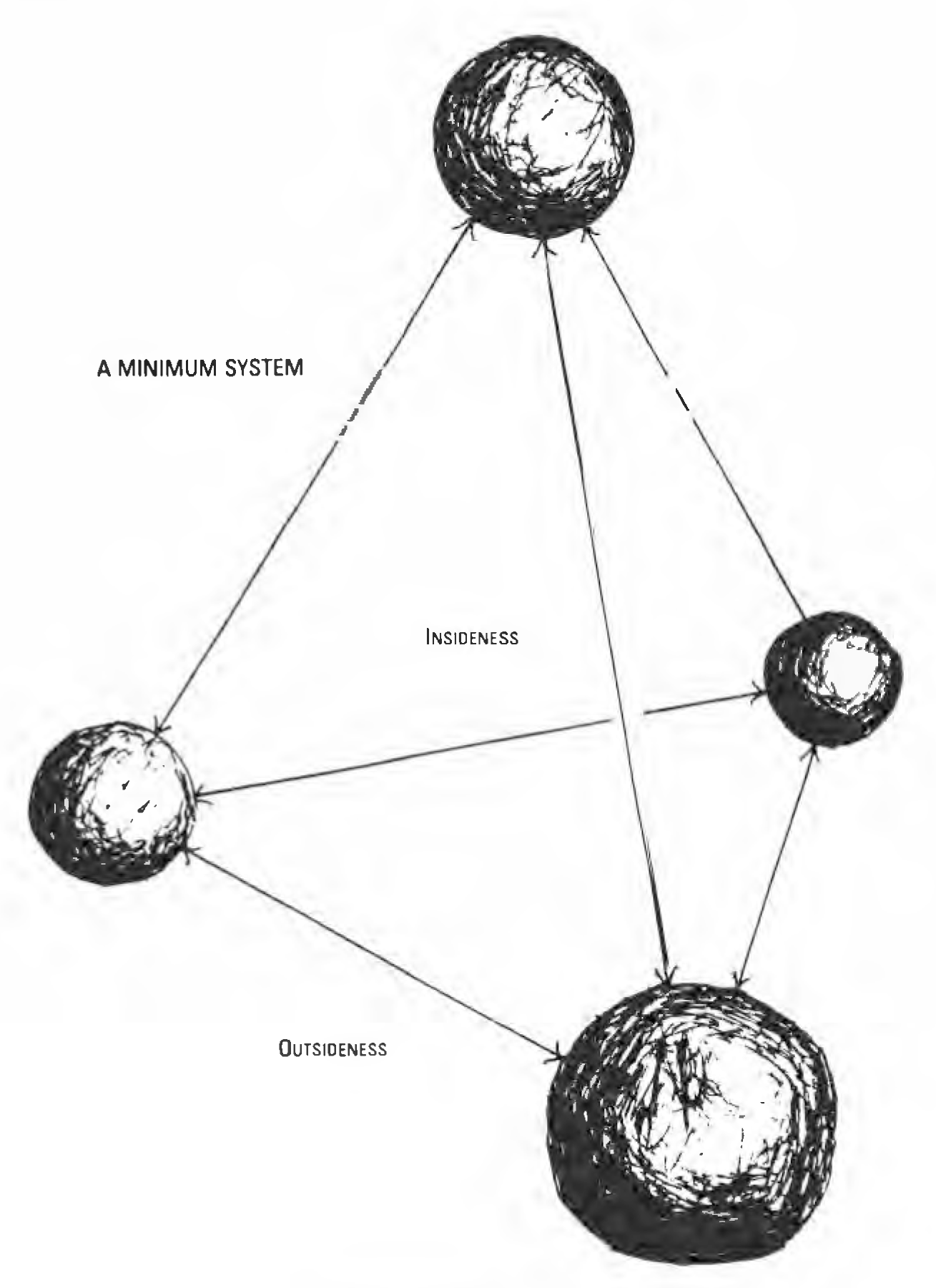
11 A conceivable otherness requires a surface. Light bouncing off that surface provides the observer with optical information acknowledging its presence for relay to the brain. We cannot have a surface enclosing nothing. A surface is an outside, which inherently requires an inside. To produce an experiential model with an insideness and outsideness requires four vertexes; that is, the model must be at minimum a tetrahedron. Such a division of insideness and outsideness constitutes a system. Anything less is inconceivable.
12 The mathematician’s purely imaginative points, lines, and planes are nonexperienceable. They cannot be modeled, having no thickness, no breadth, and ergo neither insideness nor outsideness. All imaging derives from experience. Conceptually imaginable point, line, and plane experiences are systemic; that is, they have insideness, outsideness, and angular constancy independent of size.
13 Size is always special-case realizability. The mathematician’s undemonstrable assumption that three points define a plane of no thickness—no radial depth—is therefore subsystem, unthinkable, not operationally evidencible, unimaginable and ergo unemployable as a constituent of a proof.
14 Contrary to conventional mathematical dogma, three points do not define a nonexistent and ergo nondemonstrable, no-thickness plane, nor do they define an altitudeless triangle, because there can be naught to do the defining systematically. No-thickness is neither experimentally evincible nor conceptually feasible. System is conceptual independent of size.
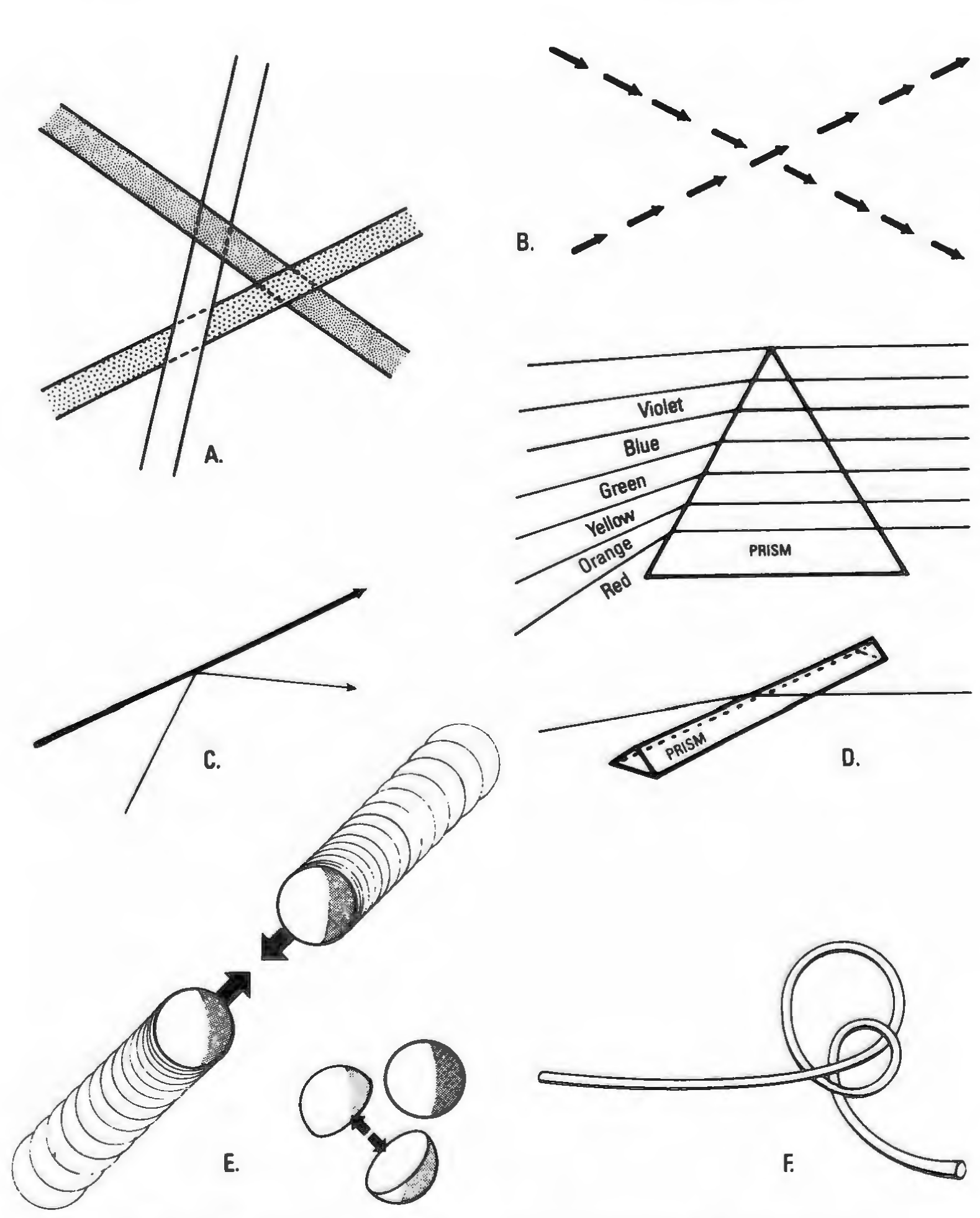
A. Tangential avoidance (as with knitting needles)
B. Modulated noninterference
C. Reflection
D. Refraction
E. Smash-up
F. The minimum knot or critical proximity interference pattern
16 Recently I was asked by a publisher to comment on the writer Annie Dillard’s book teachastone [teachastone]. It got me to thinking about how I do not have any friends who can tell me so much with so few words as do the stones. In their own way, they are eloquent.
17 How convenient are stones for throwing into the water to watch once again the perfect circular waves concentrically emanating from even the most carelessly tossed-in, highly asymmetric stone.
18 To demonstrate a unit something, all we need is a single stone.
19 Three quarters of a century ago, my brother Wolcott and I spent day after day exploring the fascinating beaches of our Bear Island wilderness home on Penobscot Bay, Maine. I frequently reminded Wolcott of his inability to find a throwable-with-one-arm stone of any given shape that I could not make skip gracefully atop the water surface.
20 Taking each of his successive ‘‘challenger’’ stones, I would first roll it around between my two hands and toss it between them. Then I would toss it in my throwing hand, confidently determining its center of gravity and natural axis of spin. Next I would observe which of the poles of the stone’s spin-axis was the flattest—most like a boomerang’s undersurface.
21 Holding the flattest pole of the stone toward the ground, and with the index finger of my right hand curled around the stone’s spin girth, I would go to the water’s edge. There, half crouching, with my left foot toward the water, I would bend my throwing arm as far backward as was comfortable. Using all my strength, I would swing my arm parallel to the water’s surface, just high enough above the beach to avoid touching it. I would throw the stone horizontally, inches above the still water, simultaneously imparting an accelerated spin with my elliptically curved index finger, aided by a final, jai-alai-technique wrist whip. The stone would accelerate into a precessional gyration, its flat underside spinning like a discus. The challenger stone developed a 90∘, precessionally repellent force which, combined with its predominant horizontal acceleration, produced a delicate succession of concentrically circled, skim-skip, skim-skip touchdown and run-out spots.
22 In all my testing by Wolcott, no stone ever failed to produce that multi-skip-along path. A natural athlete, excellent engineer, and champion sailor and celestial navigator, Wolcott did not concede excellence to me in any other department than stone-skipping on water.
23 Stone-skipping is not an Olympic Games event, but it would make a spectacular one, requiring slow-motion television replays to verify distance and number of touchdowns.
24 Because rounded stones of different sizes interroll one upon another, like ball bearings of differing radii, beaches of surf-smoothed stones are difficult to walk on. They allow our feet to sink deeply into them. To produce firm roadways, stones are crushed into sharp-edged pieces, which pack ever more tightly and fixedly together.
25 One way to get started understanding what stones are saying is to walk over such a path or roadway made of stones that have recently been crushed into smaller pieces.
26 Picking stones at random and inspecting them carefully, you will soon discover that no matter how many times they are broken into smaller stones, none are ever produced with fewer than four corners or with fewer than three faces around each corner or with fewer than three edges around each face. This mathematical limit condition is descriptive of a tetrahedron. In a regular tetrahedron, all the angles are the same. You will most frequently encounter stones with an overall asymmetric form—that of an irregular tetrahedron. You are learning that nature has mathematically elegant pattern aspects that are only superficially hidden.
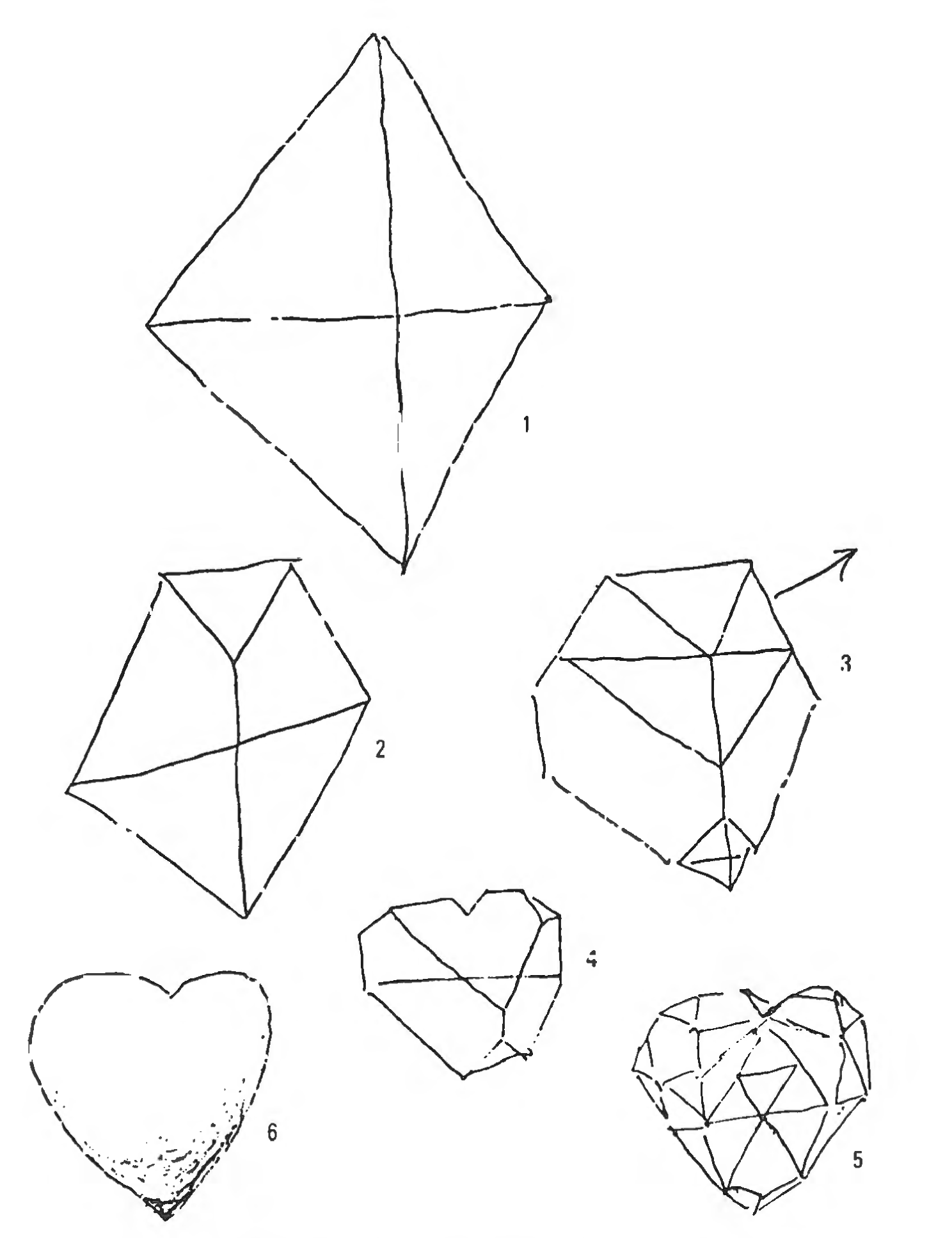
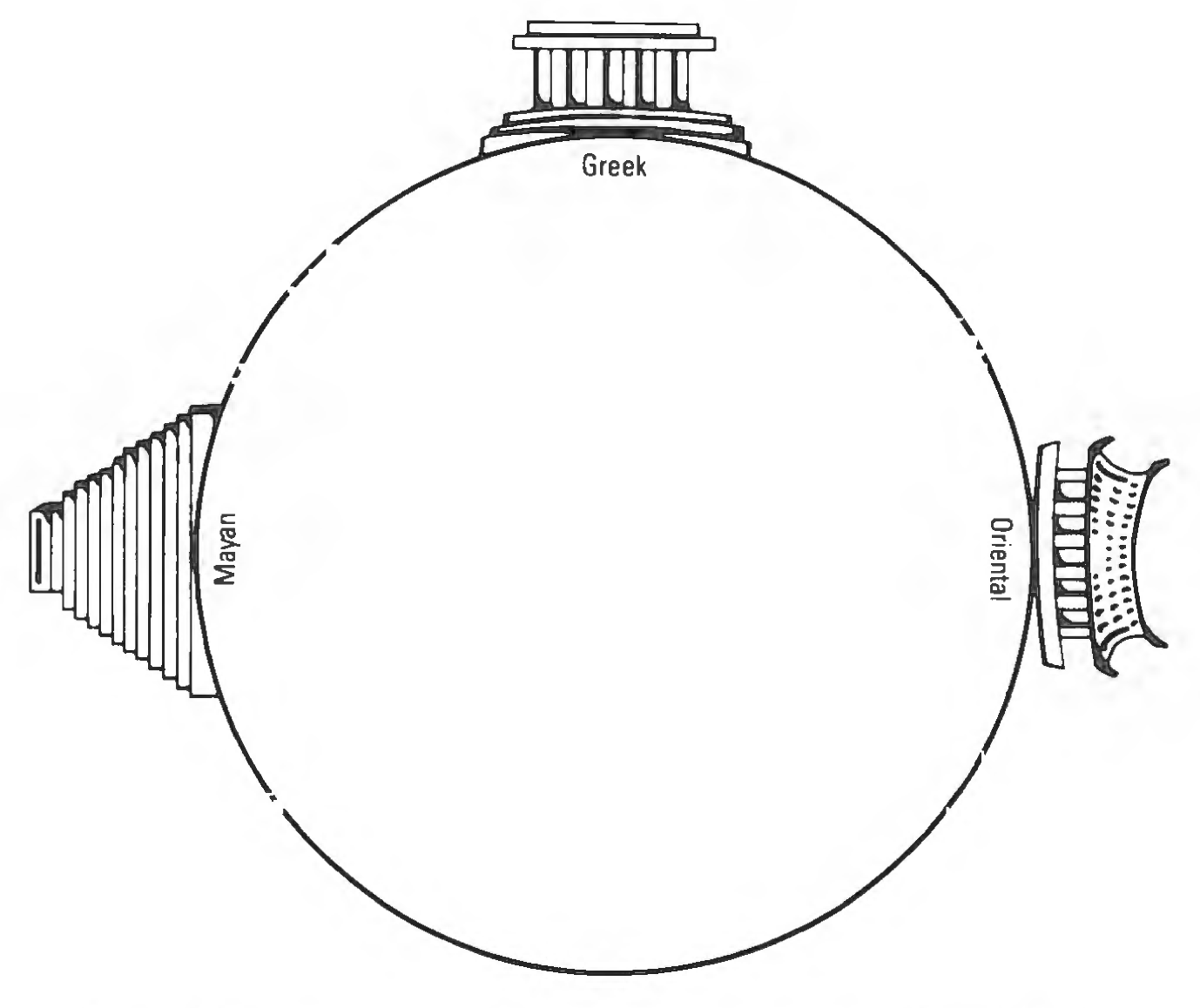
27 Stones are always polyhedra (many-sided) even when they appear to be polished spheroids (see Fig. 6.2). Looking through a lens of sufficient magnifying power will always reveal many mini-mountain peaks, sharp ridges, and angular plateaus. There are no perfect spheres, only polyhedra with many, many sides.
29 In an epochal breakthrough for both mathematics and humanity, the great eighteenth-century Swiss mathematician Leonard Euler discovered certain unique geometrical patterning rules that were later gathered together under the general rubric ‘‘topology.’’
30 He demonstrated that all visual picturing experiences are resolvable into only three unique aspects: (1) lines, (2) crossings of lines (also called points, fixes, vertexes, or corners), and (3) areas delimited by lines (also called faces or windows).
31 Euler further demonstrated a universal law that the number of vertexes (V ) of all polyhedra plus the number of faces (F) will always equal the number of edges (E) of that polyhedron plus the number 2. Euler’s formula is written V + F = E + 2.
32 To elucidate Euler further, I shall next reiterate in detail my own (not Euler’s or anyone else’s) unique system concept—unique in that it differs greatly from Ludwig von Bertalanffy’s General System Theory and its many derivatives.
6.1 System
33A system is the simplest physical or metaphysical experience we humans can have. A system must always have insideness and outsideness. Recognition of a system begins with the initial discovery of either self or otherness. We recall life begins with awareness of otherness: no co-occurrent otherness, no awareness. If there is no insideness and outsideness, there is no otherness and ergo neither life nor thought.
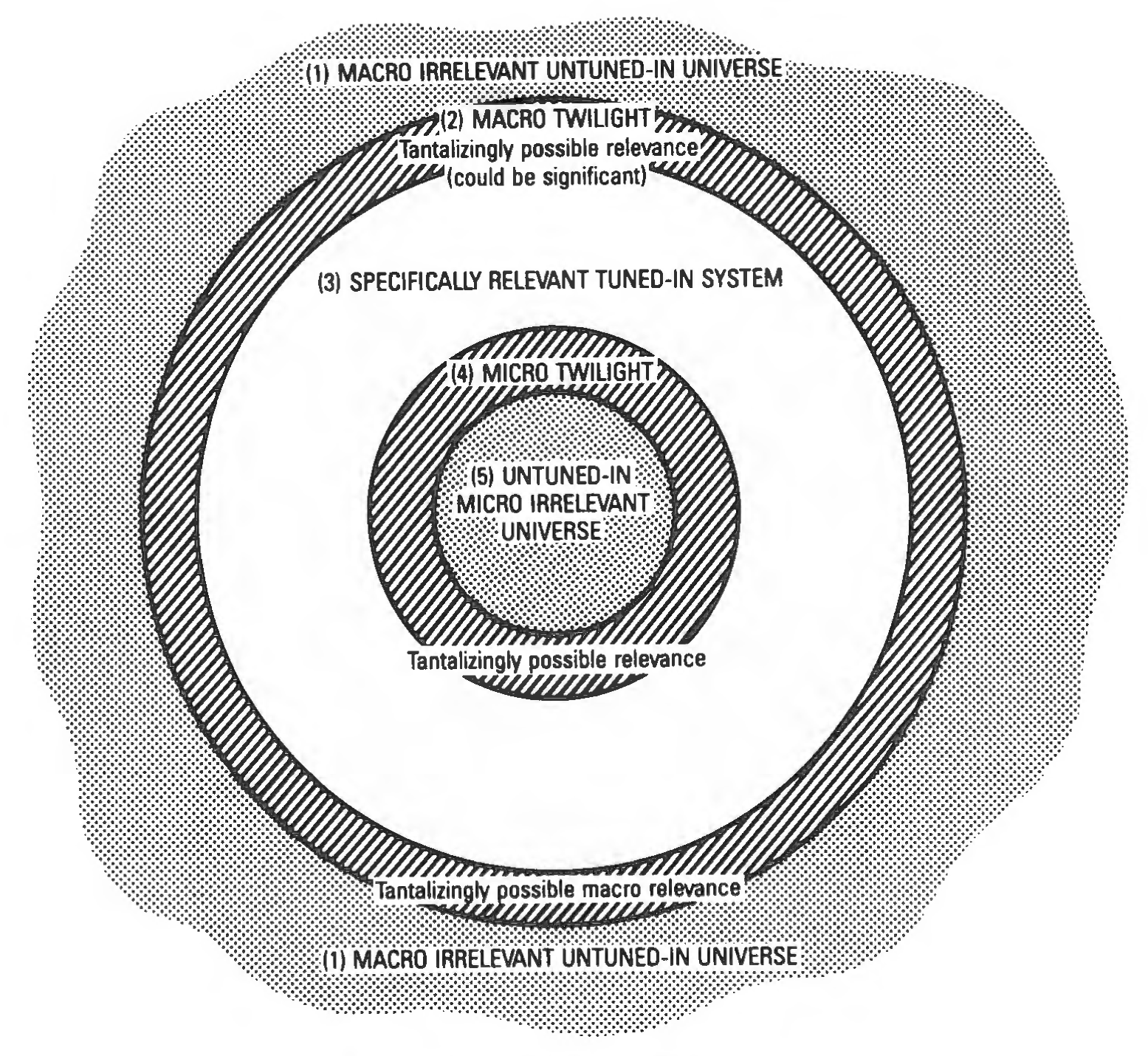
34 As we have seen, systems always divide all Universe into three principal parts: the system itself; all Universe outside the system (the macrocosm); and all Universe inside the system (the microcosm).
35 More incisively, the foregoing three-way division can be expanded into five zones. All Universe outside the system considered is divided into (1) the clearly irrelevant macrocosm zone and (2) the twilight macrocosm zone of tantalizingly possible relevance. The next zone is (3) the system itself; clearly relevant and tuned-in, it convergently-divergently divides all Universe into its macro-outsideness and its micro-insideness irrelevancies. The microcosmic insideness is divided into (4) the twilight microcosm zone of tantalizingly possible relevance and (5) the clearly irrelevant microcosm zone.
36 In synergetic geometry we are able to consider the geometry of thought systems.
37 Thought systems encompass macro and micro twilight zones of contiguously recallable information that is intuitively considerable as being of possible relevance or even as being of significant relevance. The difference between geniuses and nongeniuses is that in addition to attending to the clearly relevant tuned-in system, the genius also pays intuitive attention to tantalizing, could-be-relevant zones of information.
38 All children are born geniuses, but are swiftly ‘‘degeniused’’ by their elders’ harsh or dull dismissal of the child’s intuitive sense of what could be relevant. Children spontaneously weigh all information from their immediate experience and try to relate it to other experiences of some time before. The incipient geniuses must somehow weather, year after year, the barrage of admonitions to ignore what they spontaneously think, instead only paying attention to what others think and are trying to teach. Human mind inherently seeks comprehension of the topological interrelationships of all experiences. Geniuses discover, speak out on, and mathematically formulate the generalized principles they find underlying all experience.
39 A system divides all Universe, convergently and divergently separating all the outwardness from all the inwardness and from the system itself, which does the dividing. A system is unthinkaboutable. It considers all experience-generated information, spontaneously tuned-in, as relevant, dismissing all experience considerations that are too large and too low in frequency to alter in any way the clearly tuned-in conceptioning’s magnitude of any one system’s significance-assessing and also dismissing spontaneously all experience-considerations that are too small and too high in frequency to be of discernible significance at the tuned-in magnitude of the considered system’s wavelengths and frequencies (Fig. 6.3).
41 In synergetics, the always and only experientially based geometry of conceptualizing and thinking, I discover first that all experienceable somethings—be they apples, cows, thoughts, clouds—are systems.
42 The minimum something in Universe is a system (Fig. 6.4).
44 There are no parts (or elements) independent of systems. A system always divides all Universe into these ten intercomplementary but distinctly different component categories:
- 1.
- All the tuned-in Universe outside the system; the relevant macrocosm or macroenvironment outside the system
- 2.
- All the tuned-in Universe inside the system; the relevant microcosm or microenvironment within the system
- 3.
- The polyhedral constellation of Universe events defining the system itself, which divides the macrocosm from the microcosm
- 4.
- All the at-present non-tuned-in, irrelevant macroenvironment of the system
- 5.
- All the at-present non-tuned-in, irrelevant microenvironment of the system
- 6.
- All the at-present macro-Universe, large-wave, low-frequency, tuned-out (not tuned-in) programs irrelevant to the for-the-moment considered—tuned-in, felt, or thought about—system
- 7.
- All the at-present micro-Universe, short-wavelength, high-frequency programs irrelevant to the for-the-moment, tuned-in, felt, or thoughtfully considered system
- 8.
- All the recallable systems of past experience that can in no way be altered
- 9.
- All the as-yet-not-happened thinkaboutable systems of experiencing, many of which are subject to design by the individual
- 10.
- All the happening-right-now experience events, some of which are unalterable by the individual and some of which are designedly controllable by the system-concerned individual
45 When scientists say that they are seeking to establish the parameters of a problem, they are in fact seeking to establish all the macro-and microrelevant aspects of the system. Scientists attempt to solve problems on a flat piece of paper (two-dimensionally), seeking to establish their parameters with circumferential lines used like fences. Fences do not embrace flying birds. Systems—and ergo system parameters—are inwardly-outwardly inherently omnidimensional.
46 Universe is ever intensively and intertensionally pulsing and resonating, convergently-divergently, explosively-implosively, in a vast range of system frequencies, magnitudes, and chords. If we have the usual human equipment, we may be intensively tuned into, and even intertuned with, other individual, special-case human systems.
47 With my system law, all systems are always polyhedra, and by Euler’s law, all polyhedra must consist only of corners, faces, and edges. We have here, therefore, a topologically and systemically considerate method of thinking. Systemic thinking may be fine-tuned, like a computer program, to reject or correct any topological inharmonies or faulty parameters. The computer, despite the popular misconception, can answer only specifically relevant system questions. It cannot answer the question What shall I do? It can, however, answer, Of my various options, which is logically and physically most economic?
52 Systems powerfully and spontaneously brain-employ our inward-outward, convergent-divergent, concave-convex, size-determining, general sorting-out and concepts-differentiating capabilities. Each and every thought is a tuned-in system of uniquely interrelevant experience recalls. The images of our image-I-nation are systems and necessarily concepts as well.
53 Thought systems consist of all clearly relevant considerations. Consideration means literally bringing together and has its origins in stargazers’ discovery of constellations, the interrelating of neighboring stars—sidus means ‘‘star’’, as in the word sidereal.
54 Thought systems have their spontaneously conceived macro-and microrelevant limits. There are events obviously too large and infrequent spontaneously to come under consideration, and there are events too small and/or of too high frequency of occurrence to be encompassed within our range of macro-micro parameters.
55 Thoughts, like television programs, have their tuned-in, always discrete, special wavelengths and frequencies. These tuned-in frequencies inherently exclude the multitude of neighboring, concurrently broadcast, but spurious signals. At the present time, irrelevant advertising commercials frequently and unfortunately do intrude upon our chosen tuned-in TV shows, but that is another matter.
56 WE NOTE NOW THE FACT THAT THE Greeks—with the possible exception of Democritus —mistakenly assumed that the phenomenon ‘‘solid’’ existed, citing the solidity of marble as an example. Through instrumentally verified experiment, we know now that the electron is relatively as remote from its nucleus as the Earth is from the Moon, given their respective diameters and spherical activity domains. We now know that there are no true solids in existence. Further, we know of nothing in Universe touching anything else.
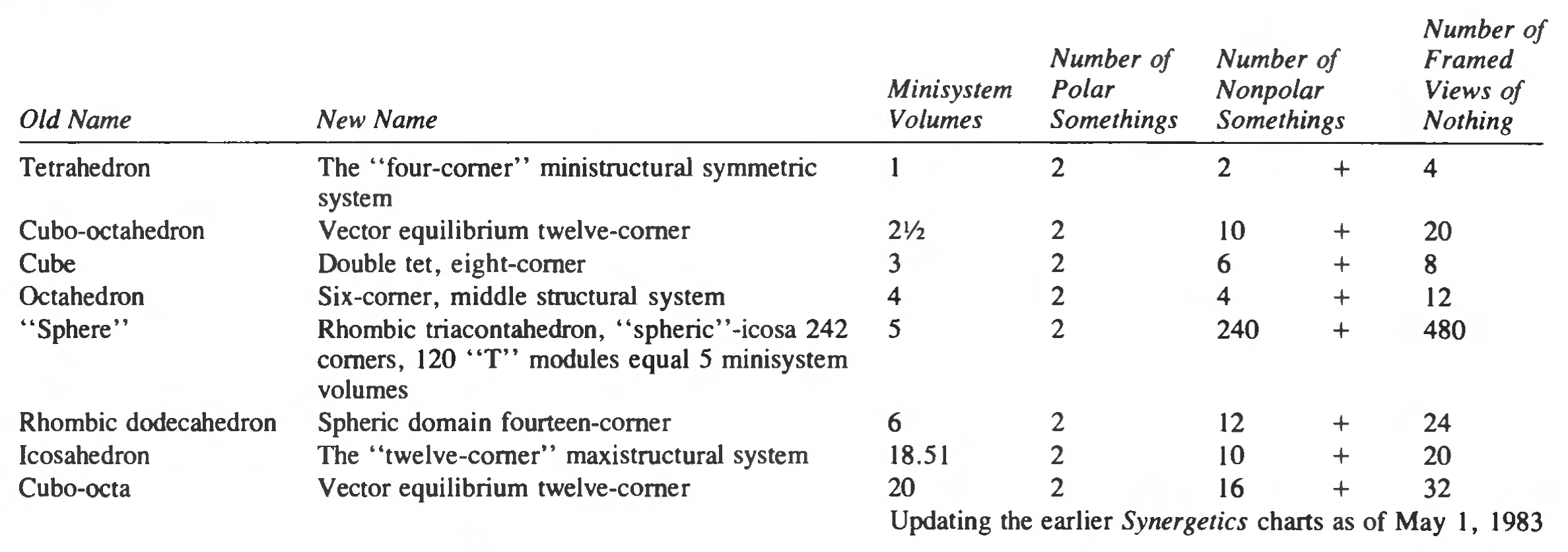
57 The incorrect Greek viewpoint led Plato to offer for consideration his geometrical ‘‘solids,’’ thinking of them as being carved from marble or wood into the shapes of cubes, octahedra, tetrahedra, icosahedra, and dodecahedra and as therefore having solid sides, which the Greeks termed hedra. Thus, all multifaceted objects of solid geometry became known inappropriately as polyhedra. Because we now know that no solids exist, we must start identifying geometrical systems more logically by the number of vertexes, for which I have developed the term polyvertexia (see Fig. 6.5).
| 59 Prime | ||
| 60number |
61New name |
62Old name |
| 6422 |
|
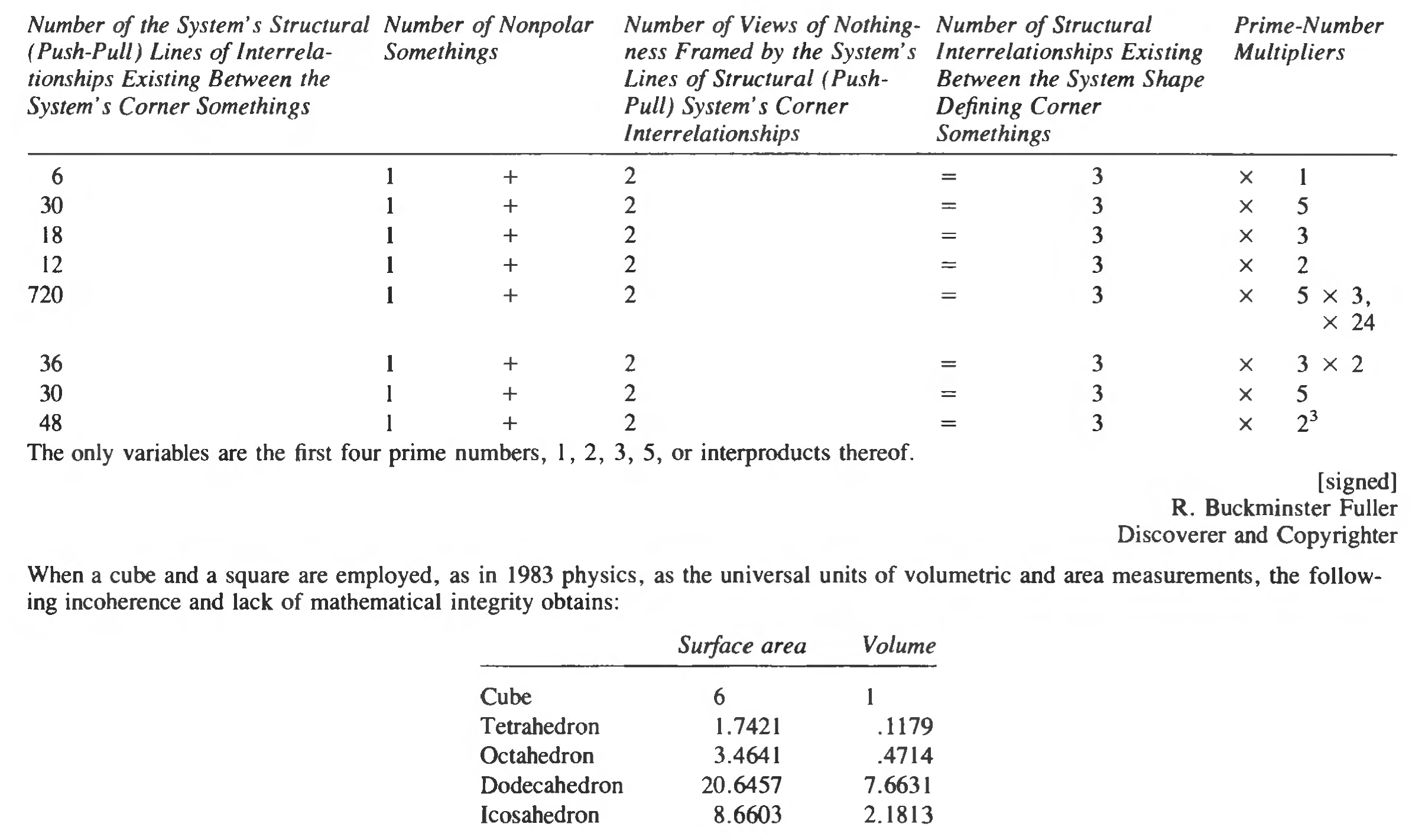
67tetrahedron |
| 683 × 2 |
69six-vertexion |
70octahedron |
| 7122 × 2 | 72eight-vertexion | 732 tetrahedron (cube) |
| 7422 × 3 | 75twelve-vertexion | 76icosahedron or VE |
| 777 × 2 |
78fourteen-vertexion |
79rhombic dodecahedron |
| 805 × 22 |
81twenty-vertexion |
82pentagonal dodecahedron |
| 8325 |
84thirty-two-vertexion |
85rhombic triacontahedron |
| 8631 × 2 |
87sixty-two-vertexion |
88120 (60 + 60 -) spherical 15 great circles |
| 89112 × 2 |
90two-hundred-and-forty-two-vertexion |
9131 great-circles sphere 480 spherical right triangles |
92 Sir James Jeans pronounced what is to me the most sensitively inclusive and accurate definition of science when he said, ‘‘Science is the sincere and consistent attempt to set in order the facts of experience.’’ Ernst Mach, the Viennese physicist whose name is celebrated in the measurement of supersonic speed, spontaneously and specifically elaborated on the Jeans generalization as follows: ‘‘The special case of science known as physics is the attempt to set the facts of experience in their most economical order.’’
93 Jeans’s comprehensive science considered all types of order, such as size or color or weight. Mach’s physics had found that nature always accomplished her tasks in the most economic energy-employing and -expending manner. His definition, which I paraphrase here, indicates much about scientific methodology: Seeking to set in most energy-efficient (economic) order the facts of experience.
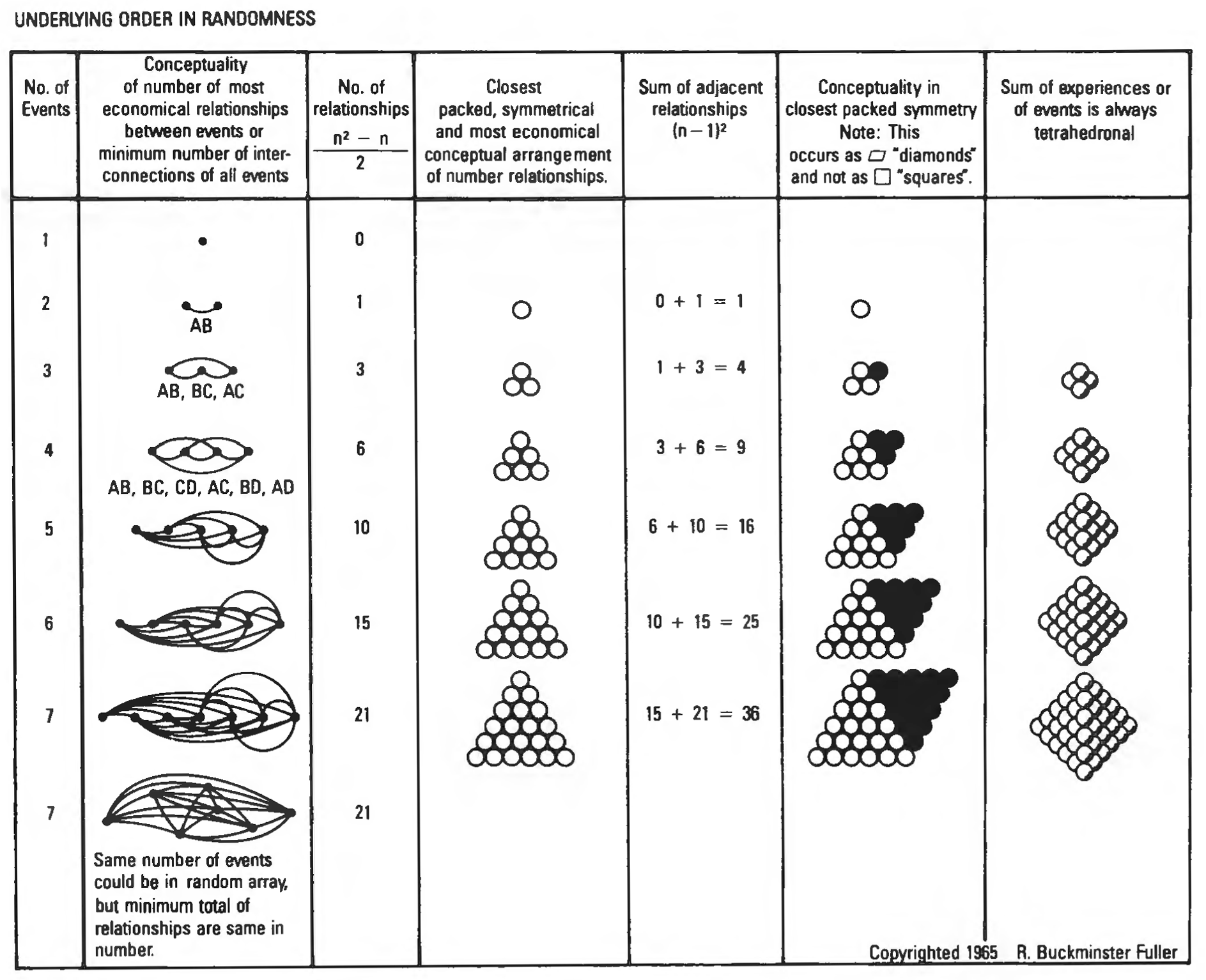
94 There is no identifiable experience that is less than a system. Systems must have insideness and outsideness. Two events have only betweenness. Three events have only betweennesses. To inclusively differentiate and identify insideness and outsideness takes a minimum of four events to define a tune-in-able wavelength and frequency system (see Fig. 6.7).
95 Since I am intent upon comprehending what all experience is trying to communicate to us and since I am intent upon being consistently scientific, I have, in my sorting-out and rearranging of facts in systemic order of relevancy, reworded for clarity Euler’s topological characteristics.
96 Since what I have learned is that all experiences are systems; that the vertexes which geometrically identify systems can be, and often are, only microtunable to nondifferentiable wavelengths and frequencies; and that the subtunable limit condition may be heard and located but not as yet identified as a discrete signal—what is known as static or spurious or background radiation—I will therefore identify micro corner ‘‘somethings’’ as ‘‘static events’’ and speak of these system corner events as ‘‘somethings,’’ represented by the letter S. I will also henceforth reidentify the system faces (the old ‘‘hedra’’) as triangular window-framed views of nothingness to be mathematically identified by the symbol Δ.
97 I will now identify the six most economical lines of interrelatedness of the four static somethings as the minimally six-part set of push-pull energy vectors structurally integrating the tetrahedron. These vectors are the twelve (six positive, six negative) degrees of freedom coping with the structural integrity of all independently existent systems—for instance, the minimum twelve spokes necessary to stabilize the hub of a wire wheel. These twelve domains of freedom of all individual systems are those of the electromagnetic and gravitational tension and compression forces operative within each of the twelve unit-radius spheric domains that are intertangentially closest packed around any one spheric something in an aggregate of unit-radius spheres, a ‘‘sphere’’ being a high-frequency complex of approximately equimagnitude energy events operating at approximately equiradius distance from a center event.
| (6.1) |
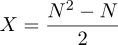
99 Thus, scientifically corrected, Euler’s equation now reads:
100101The number of corner events plus the number of triangular window-framed views of nothingnesses always equals the number of linear (vectorial) interrelationships of the system plus two.
102This definition can, however, be improved further.
103 Since the most unique aspect of a system is its cosmic independence of existence derived from its twelve degrees of freedom and since all independent systems have independent rotatability, they necessarily have uniquely identifiable axes of spinnability or all-around, overall view ability and considerability.
104 Axes of spinnability always have two poles. We may now most economically restate Euler’s topological formula of constant interrelative abundance of primitive aspects of all systems as follows:
105106In all polyvertexia, the two vertexially operative poles of axial spin plus the number of nonpolar vertexia plus the number of triangularly framed window views of internal nothingnesses will always equal the total number of uniquely most economical, vectorial, linear interrelationships of the system’s corner vertexia ‘‘somethings.’’
107 As already noted several times, but very worth recalling, life begins with awareness. No co-occurrent otherness, no awareness. No co-occurrent otherness, no life. One small something—too small to be described as being other than point-to-able-can be seen by another something.
108 One something by itself, however, has no external relationships, and with no external relationships there is no life.
109 Note here that synergetic geometry, unlike other systems of geometry, deals with most-economical relationships (which can be called geodesics), not with shortest distances between two points—that is to say, with lines.
110 The only interrelatedness of two overlappingly occurrent somethings is betweenness: AB or BA. Three simultaneously occurrent somethings have only three betweennesses: AB,AC,BC. (See Fig. 6.7)
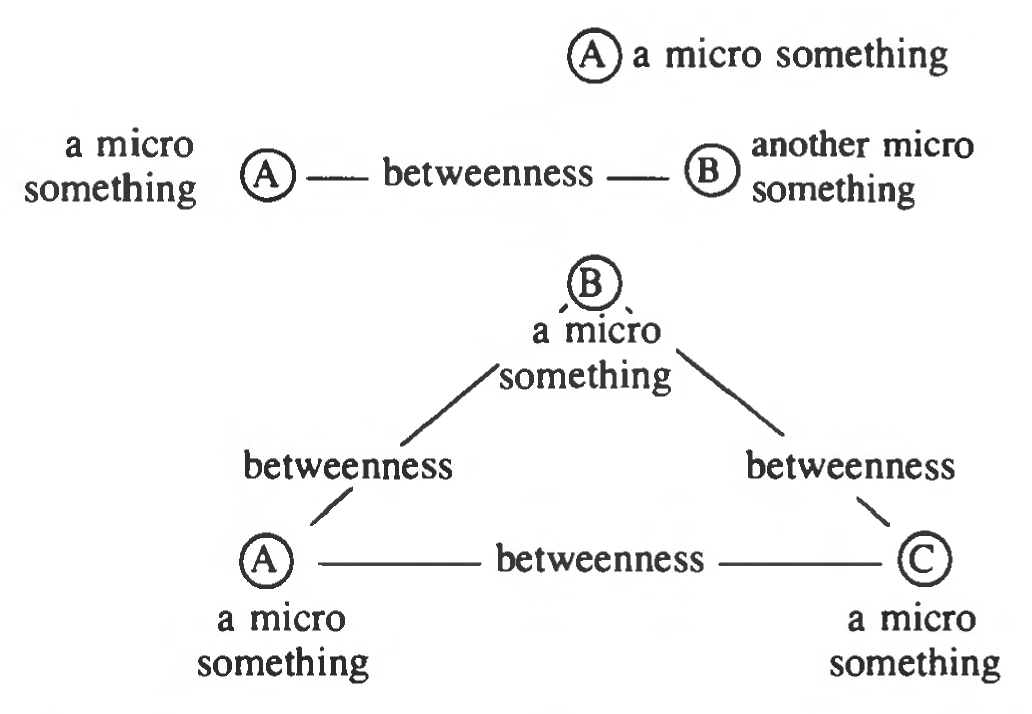
112 Four simultaneously, overlapping occurrent somethings—A,B,C,D—have six betweennesses : AB,AC,AD,BC,BD,CD. They have an only mutually differentiated insideness and outsideness. Four somethings produce a system: a tetrahedron, the minimum differentiable something.
113 A microsystem has six degrees of freedom articulating a subtunable, subdifferentiable, complex event. A microsystem may be spoken of as a point, a blip, a static event, a spheric microsystem, or a tetrahedron so small as to make it impossible to distinguish its parts. A microsystem is an inadvertently located but not as yet discretely tuned-in static encounter.
114 A minisystem is a high-frequency, short-wavelength, discretely tuned-in, topologically identifiable system.
115 A point is a microsystem. A microsystem is a locatable but as yet noncomponently differentiable complex tuned in by hearing or seeing or smelling or statically touching an event.
116 A point A in our model in Fig. 6.8 is a ‘‘point-to-able’’ something. It is momentarily subdifferentiable, which we can also describe as the direction ‘‘in’’.
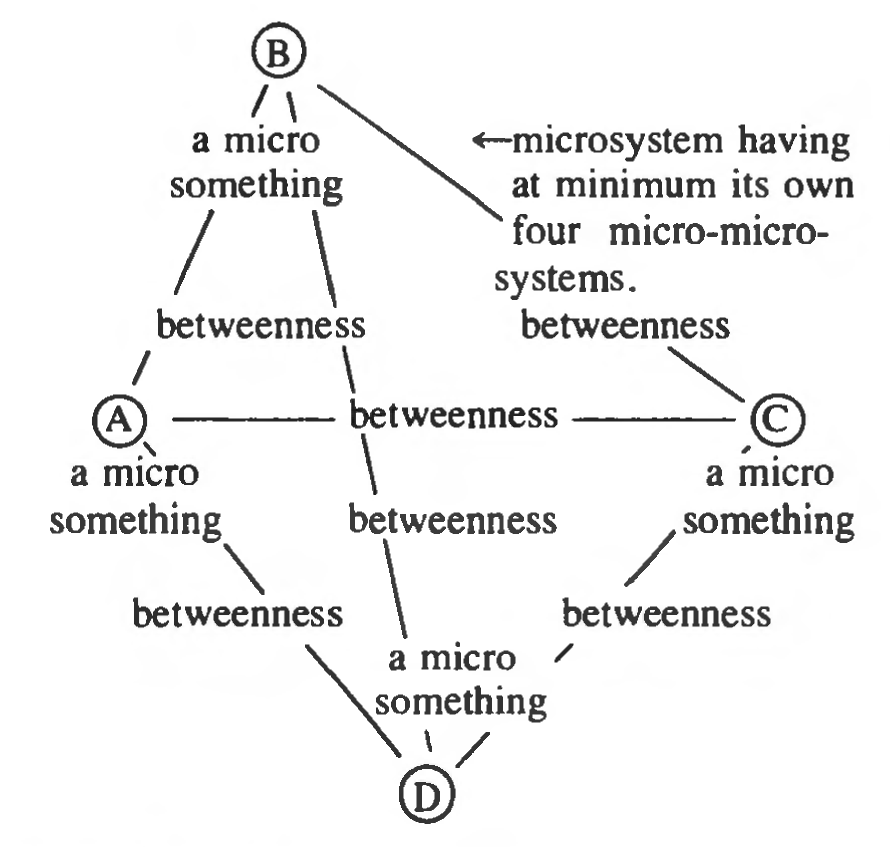
118 This static blip A is a something having the inherent but as yet nonsensorially differentiable insideness and outsideness of an inframicro system enclosed by a nonidentifiable number of somethings; it is therefore not demonstrable as a simplest minimum componented system in Universe, but it nonetheless has to be a system. It has to be a subdifferentiable tetrahedron.
119 Unity-as-twoness is dichotomically realized in time-sequencing as the discovering of the withoutness by withinness, of the outside of self by the brain inside self, even though no humans have ever ‘‘seen’’ outside themselves. Humans see and realize their seeing only inside their brains (i.e., within their skulls). The information humans receive from the outside through the sense of touch has proven so consistently reliable over a period of time that the sensorial leap is made to the assumption that they are seeing the outside world, whereas in reality it is only images inside the brain that they work with. With complete accuracy, we could say to one another, ‘‘I imagine I see you sitting over there.’’
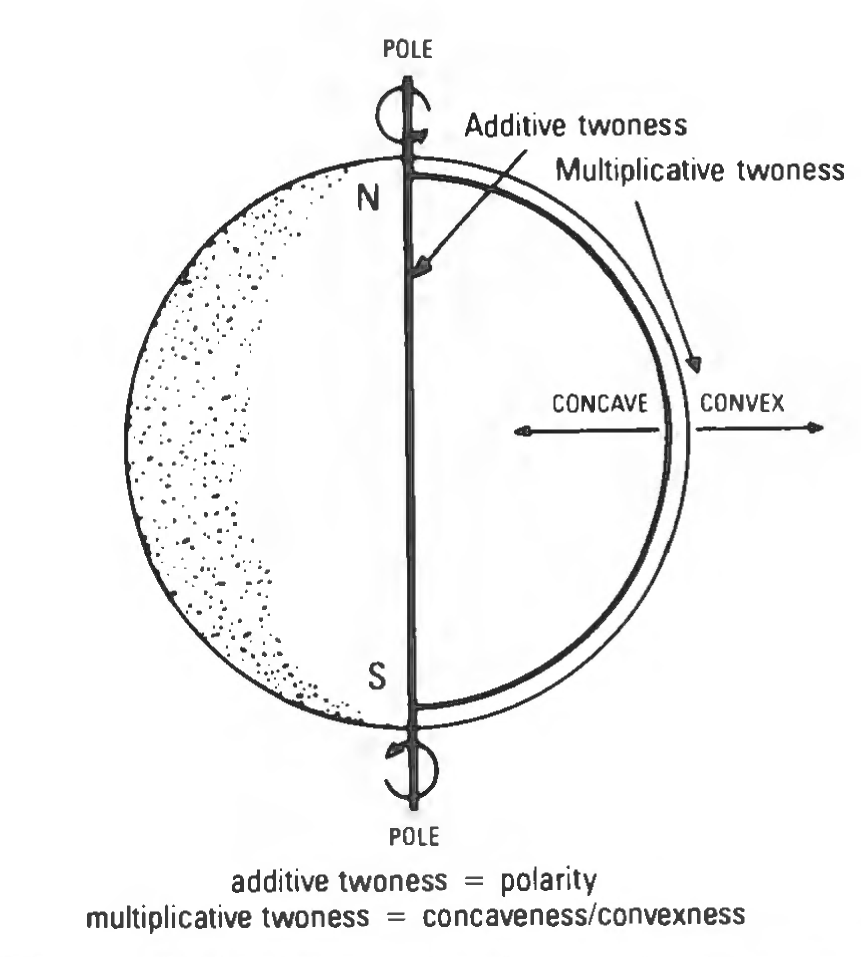
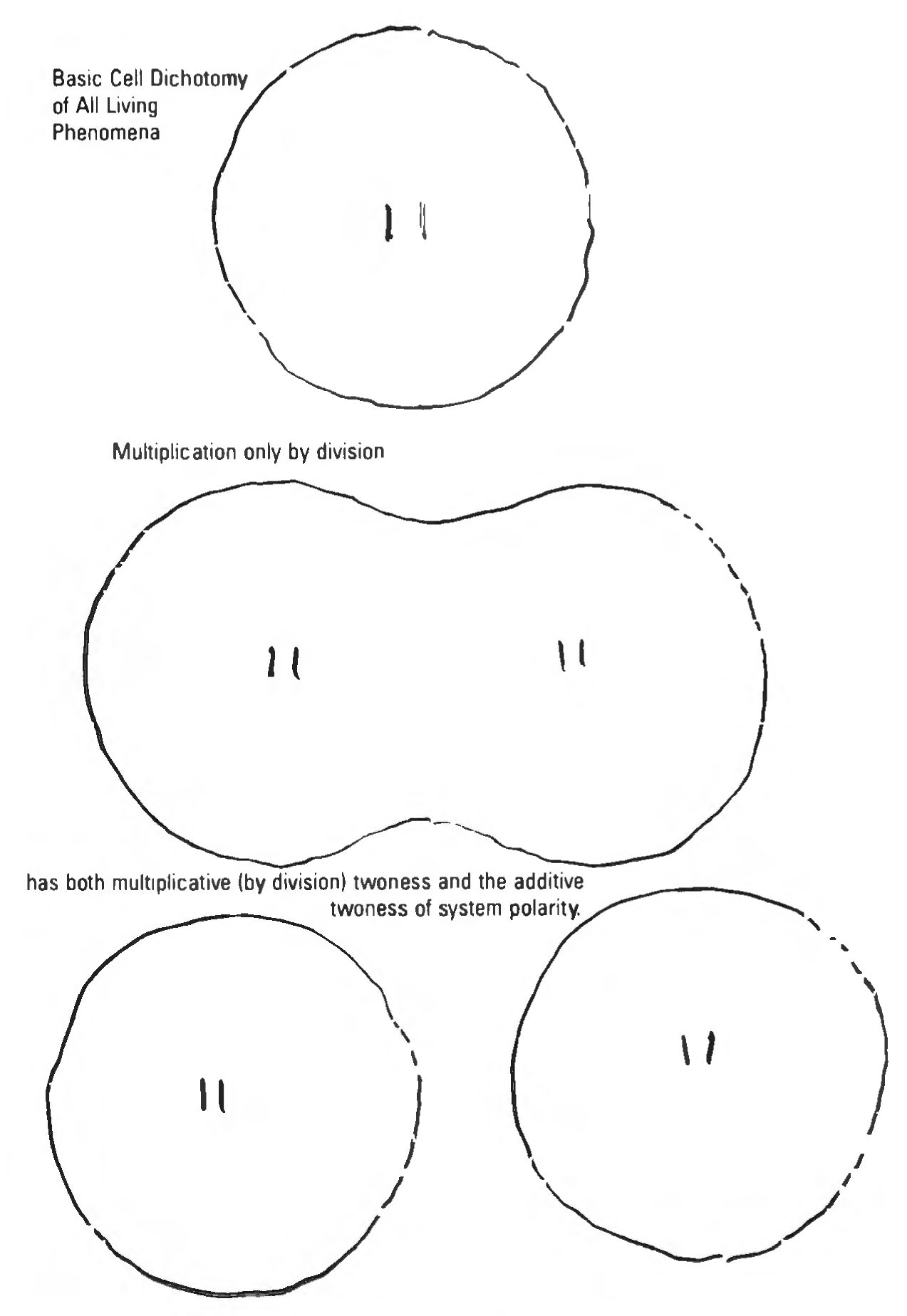
120 Inherently, there are two kinds of twoness of indivisible unit: (a) multiplicative twoness, (b) additive twoness (Fig. 6.9).
6.2 Omnidivergent or Convergent
122The insideness-outsideness twoness we call the multiplicative twoness. To the inside-outside twoness, the additive twoness is indeed ‘‘added’’. It is the twoness of the poles of the inherent spin axis of all inherently independent in-Universe systems. The additive twoness is the inherent polarity of our imagination’s head-foot dichotomy or obverse-reverse dichotomy or of the inherent divisibility of system differentiating.
123 The two poles of the spin axis of observation provide all systems with time-cycling and the latter’s inherent twoness of from-moment-to-moment cyclic differentiation.
124 Each and every thing—and ergo all things—are unique systems. The word—the communication of an idea—is a systemic conception. The idea of greater work effectiveness through inventive-mind-elucidated cooperation made possible by speech, picture, or gesture is the initial tool of human evolution. ‘‘In the beginning was the word,’’ and the word was God—good, G-OO-D—i.e., two cooperative, completely individual, independent humans joined together.
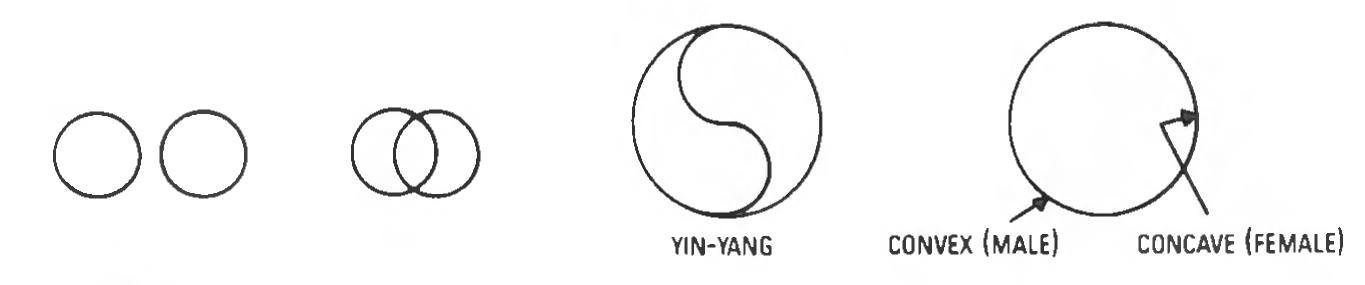
125 Unity is plural and at minimum two. Concave and convex always and only coexist (Fig. 6.10 ). Concave reflectively concentrates impinging radiation; convex reflectively and contraction, divergent and convergent, and the minimum two poles of system spinnability. If unity was not inherently plural, it could not be divided to accommodate multiplication only by division into progressively larger numbers of progressively smaller systems and whole-system components. The minimum system has a minimum of twenty-eight topological components. Since multiplication is only by division, division is also accomplished only by multiplication. (See Fig. 6.11)
127 In electromagnetics—for instance, radio systems—there are tuned-in programs of unique wavelength and frequency, plus non-tuned in, long-wave, low-frequency macroset programs of broadcast tunabilities and non-tuned-in shortwave, high-frequency microsets of broadcast programs.
128 Each for-the-moment thought has its for-the-moment relevant, tuned-in thoughts, and those tuned-in thoughts have macroirrelevant aspects that are too large and too infrequent to be considered and microirrelevant aspects that are too frequent and too short in wavelength to be conceivably relevant to the thought system considered.
129 All thoughts are unique systems. All thoughtful consideration and reconsideration looks for some orderly pattern to be remembered and relied upon, e.g., ‘‘Most clover has three leaves, a rare few have four leaves.’’
130 The tetrahedron, with its four corners, four faces, and six edges, is the minimum something in Universe. We have seen that we cannot break a rock into pieces that have fewer than four corners or fewer than three faces around a corner or fewer than three edges around a face. The tetrahedron confirms Euler’s formula, which, we recall, states that the number of corners plus the number of faces of all polyhedra equals the number of edges plus the number 2.
131 For a few instances:
| Corners | + | Faces | = | Edges | + | 2 | |
| Cubes | 8 | + | 6 | = | 12 | + | 2 |
| Octahedra | 6 | + | 8 | = | 12 | + | 2 |
| Dodecahedra | 20 | + | 12 | = | 30 | + | 2 |
| Icosahedra | 12 | + | 20 | = | 30 | + | 2 |
134 Edges always occur in sets of six. Edges do not exist by themselves: there cannot be an edge to nothing. Neither insideness nor outsideness exist by themselves, nor do corners.
135 Erstwhile ‘‘modern physics’’ persists in operating modellessly—and ergo blindly—with the mathematical tools of complex imaginary numbers, probability, calculus, and XY Z-coordinate frames of reference for plotting codiffering rates of change of experimentally evidenced statistics, in hope thereby of discovering an equation-expressible, generalizable interrelationship (a principle).
136 Physicists and other scientists still misassume that an XY Z perpendicular-parallel, three-dimensional coordinate system provides a framework of dimensional reference that can accommodate and satisfactorily express experimentally gained information interrelationships.
137 Experience has disclosed no solids, no straight lines, no continua, no parallels, no Greek spheres, no up and down, no absolute state of rest. Experience only discloses waves of divergent events and interference-knotted amassing of convergent events, producing only angles and frequency of angular interrelationship alterations.
138 All design consists entirely and solely of angle and frequency modulation. Universe operates convergently-divergently, expansively-contractively, radiantly-gravitationally, integratingly-disintegratingly, everywhere and everywhen intertransforming. Convergent-divergent Universe operates systemically, successively tuning in its overlapping scenario episodes operating between its extremes of tuned-in microcosmic-macrocosmic regional events.
139 Universe does not—in fact, cannot—operate as a one-dimensional, straight-line phenomenon. One-dimensionality, having neither insideness nor outsideness, cannot be conceptually embraced or experimentally evidenced. Unveering linear straightness cannot be physically demonstrated.
140 Nor does Universe operate as a two-dimensional, planar phenomenon having no insideness or outsideness. No such phenomenon can be experienced, conceptualized, or experimentally reproduced.
141 Nor does Universe operate as exclusively three-dimensional, mutually interperpendicular XY Z, straight-line delimited, three-way cross of parallel referencing, which, having neither insideness nor outsideness, cannot be experimentally—which is to say, experientially—demonstrated.
142 Demonstrable local Universe always and only operates as a convergent-divergent, nucleated, or vacantly centered insideness and outsideness system; a growable or shrinkable, spherically expandable or contractible, radiant-wave-propagatable system; a gravitational, spherically embracing, pulsatively expanding and contracting, simultaneous, four-and six-dimensional synergetic system. There are no experientially demonstrable non-systems, nor are there experientially demonstrable parts independent of systems.
143 Teaching that a system can be built of parts—as is done in all schools—overlooks the fact that the parts are each systems in themselves, each dividing all Universe into everything outside the system, everything inside the system, and the system itself. We can only start experientially with system and thereafter discover the constituent parts. A system has inherently irreducible minimum aspects: its convergent aspects, which we know as vertexes; its divergent opposite-to-vertex openings, which we know as faces; and the vectors, which demonstrate most-economical energy and time interrelationships, which we know as lines (geodesics), and which also delineate and enclose. Synergetics’ study of these unique aspects and their interrelationship constancies overlaps, and in many cases advances, some areas of what is known to mathematicians as topology.2 The three prime topological aspects can be individually emphasized while obscuring the geometrical multivertexia (formerly polyhedra) (see Fig. 6.12).
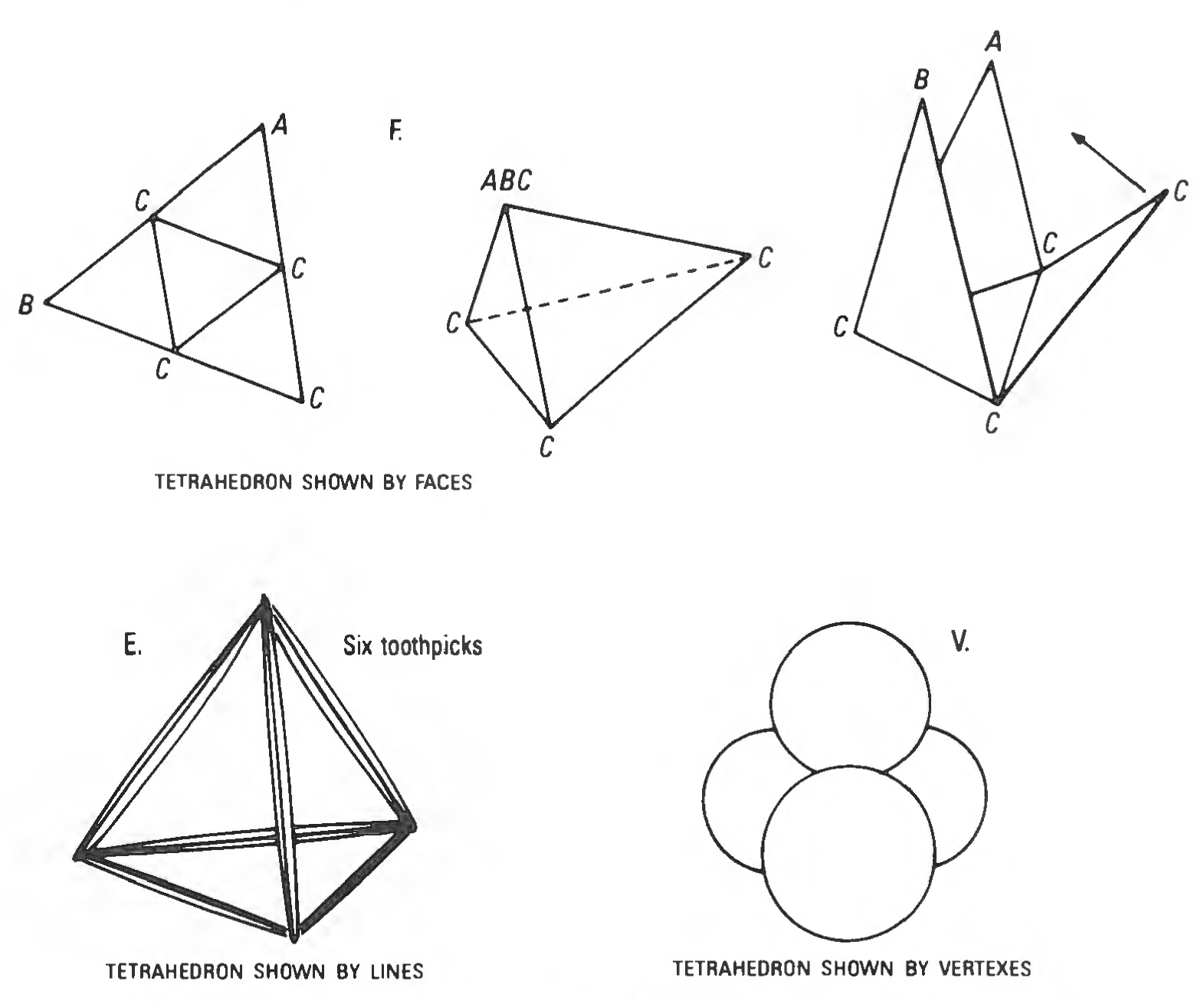
- 1.
- The Platonic ‘‘solid’’ emphasizing the four ‘‘faces,’’ which alternatively are known in synergetics as divergent openings.
- 2.
- The six ‘‘lines’’ or ‘‘edges,’’ which alternatively are known in synergetics as vectors.
- 3.
- The vertex domains, which alternatively are known in synergetics as closest packing of spheres.
146 The only topological aspect clearly shown in each model is that of the vertex.
147 Mathematical law is eternal—exceptionlessly constant.
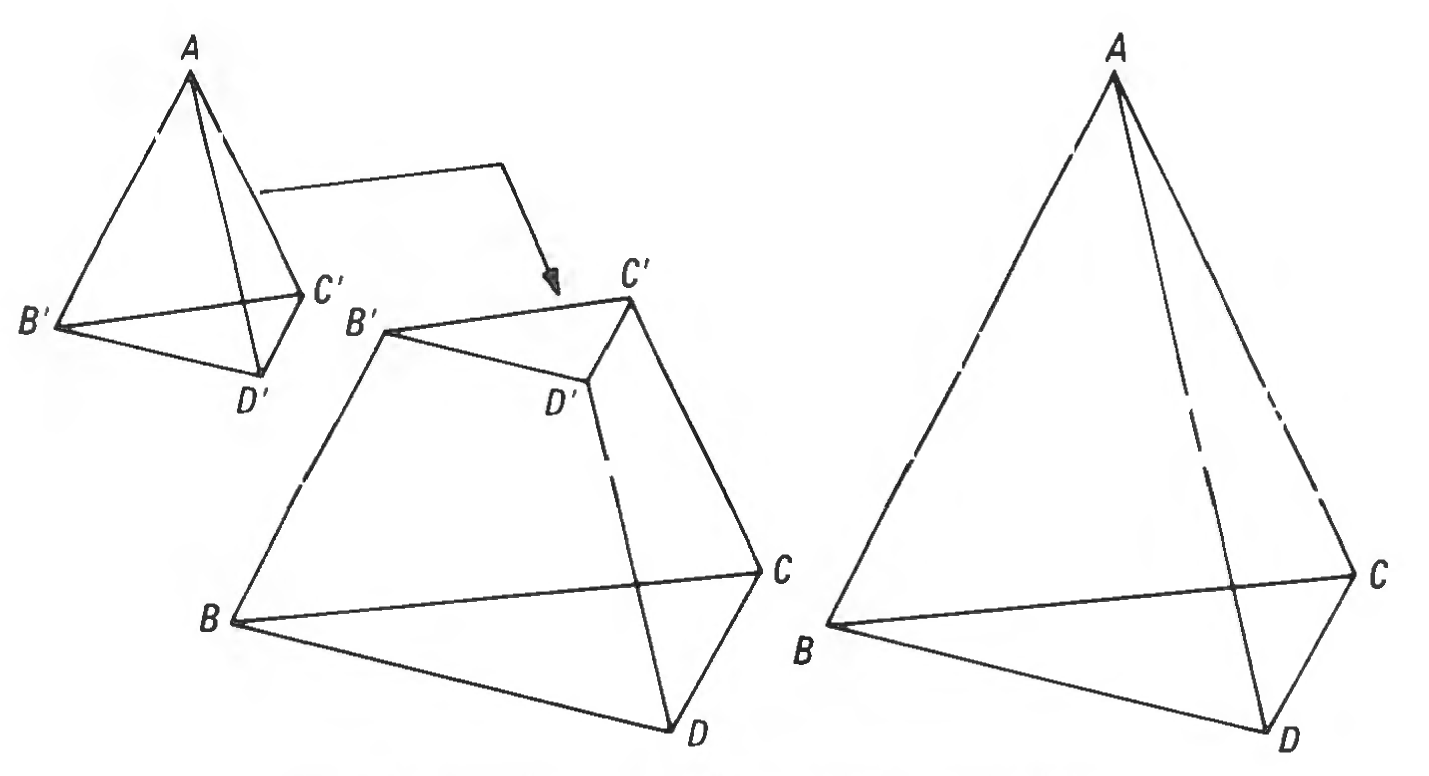
148 If I knock off one corner from any one of the regular symmetrical polyvertexia, making it irregular, the law persists.
149 For instance, in Fig. 6.13 one corner of the tetrahedron (four-vertexion, or tetravertexion) is knocked off, leaving in its place a small triangular facet. We have now lost one old corner (a small tetravertexial system) and have gained three new corners B′,C′,D′ (net gain of considered system: two corners). We have also gained one additional triangular face C′D′B′ and three additional new edges B′C′,C′D′, and D′B′. The three areas B′C′CB, C′D′DC, and B′D′DB are trapezoids, which are structurally unstable; to correct this, we install triangulating vectors BC′, CD′, DB′. After removing the small tetravertexion AB′C′D′, our total topological score of the remaining big truncated tetravertexion is 6V + SF = 12E + 2, or the total twelve structural interrelationships vectors existing between six corner somethings plus 2.
151 In our topological consideration, it matters not if our original tetrahedron, octahedron, or icosahedron—or thought or stone—is irregular in its angular, linear, or facial dimensions.
152 Euler had discovered that his topology embraced all viewable features of any system.
153 Whether it is a Rembrandt or a child’s freely ranging—so-called two-dimensional—pencil drawing, you will find that the whole picture scheme always can be sorted into lines (edges), areas (faces), and crossings (vertexes, corners, or points), leaving no unaccounted features of the picture.
154 The points, lines, and areas may be of any color; where different colored areas abut, a line occurs. No matter how you choose to classify any feature of a Rembrandt, the formula of relative abundance of line, points, and areas will hold.
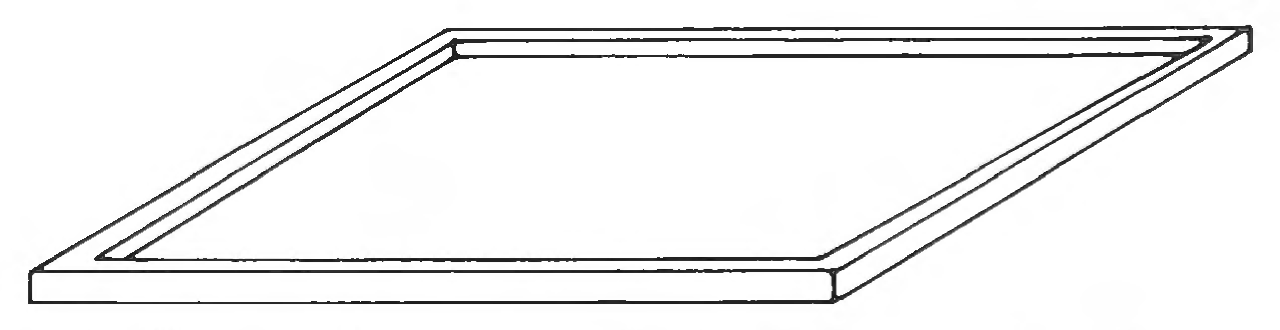
155 If you are considering only the painted-on front face of a wood-frame-mounted canvas (Fig. 6.14), you are dealing exclusively with only one face of an always-polyhedral system.
157 Pretend as you will—and as schools encourage you to do—that you are dealing only with a two-dimensional plane, but in reality (i.e., the four-dimensional Universe), planes always and only exist as facets (faces) of polyhedral systems. Euler himself was still ensnared on academia’s supposition of parts and separate dimensions having an independent existence from whole systems.
158 Euler played his topological game in plane geometry as with children’s linear sketching, in which the number of crossings plus the number of divided-off areas always equals the number of line segments plus one. Euler himself was subject to the self-deception of an independently existent two-dimensionality reality. He, like August Möbius of Möbius-strip fame, saw the paper as having no insideness.
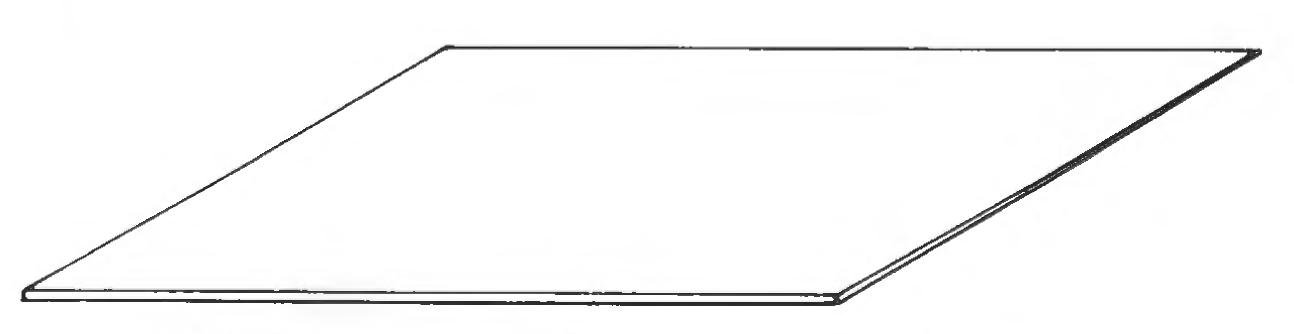
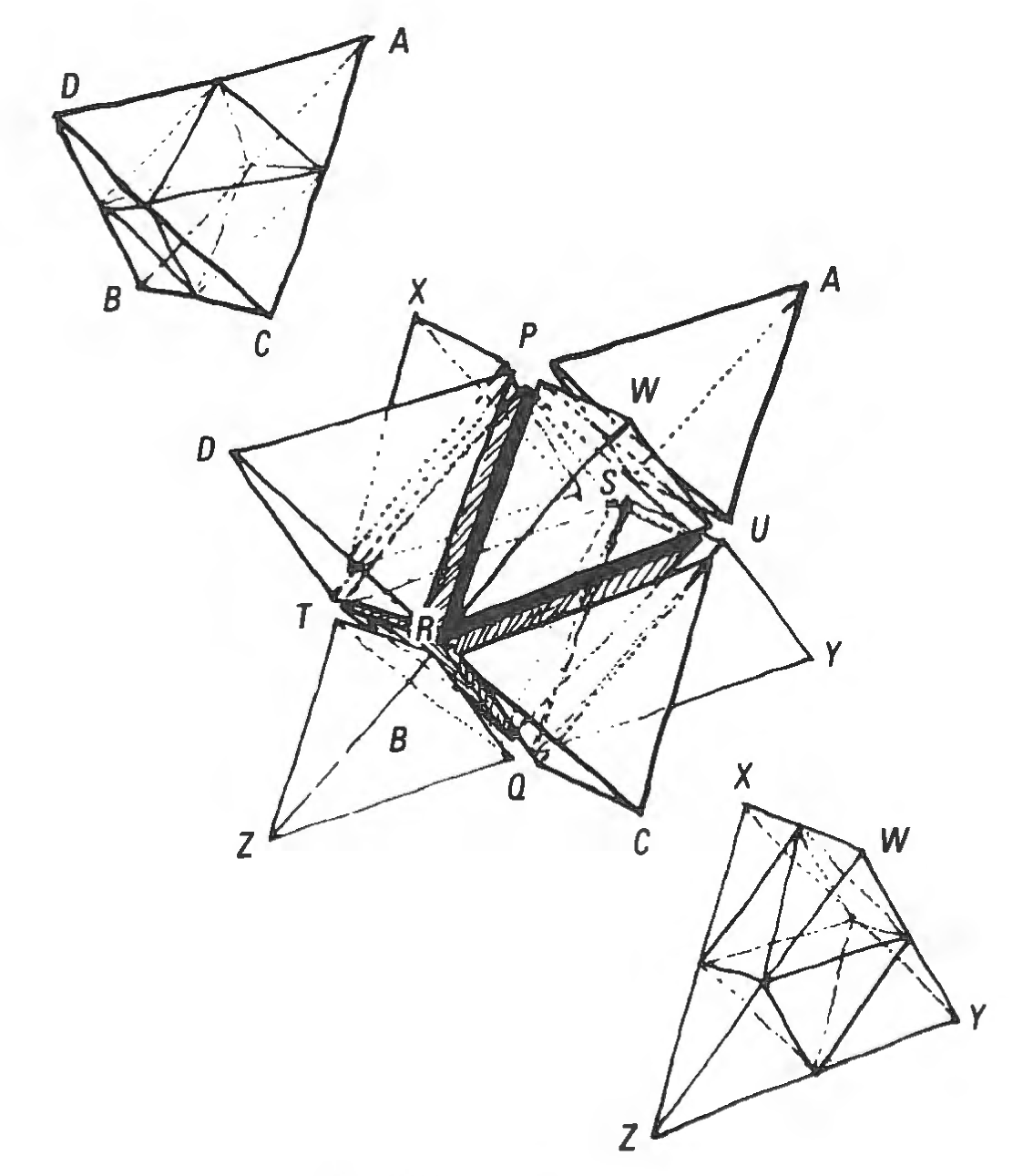
159 We know that a flat sheet of paper is always a very thin polyvertexion with two large faces, front and back, and four extremely narrow side faces, with eight corners and twelve edges (see Fig. 6.15).
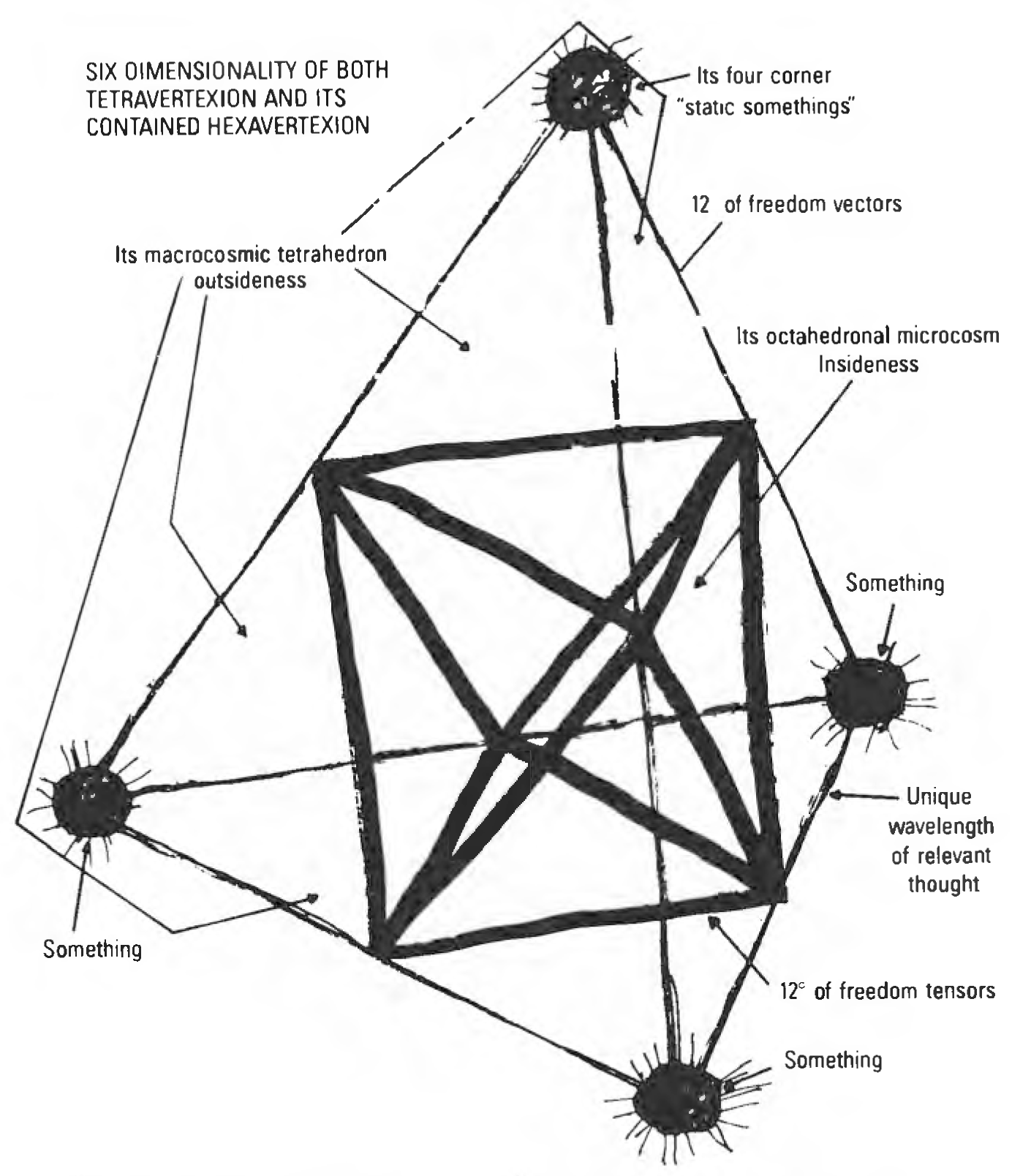
161 All existent and thinkaboutable otherness systems are always four-dimensional, facetwise, with the four planes of symmetry of the minimum system in Universe, the tetra- or four-vertexion (the old tetrahedron) and its contained hexavertexion (formerly octahedron). The hexavertexion (or six-vertexion) is also six-dimensional edgewise, as is the tetravertexion, with its six edges and the hexavertexion’s twelve-edge systems (see Fig. 6.16).
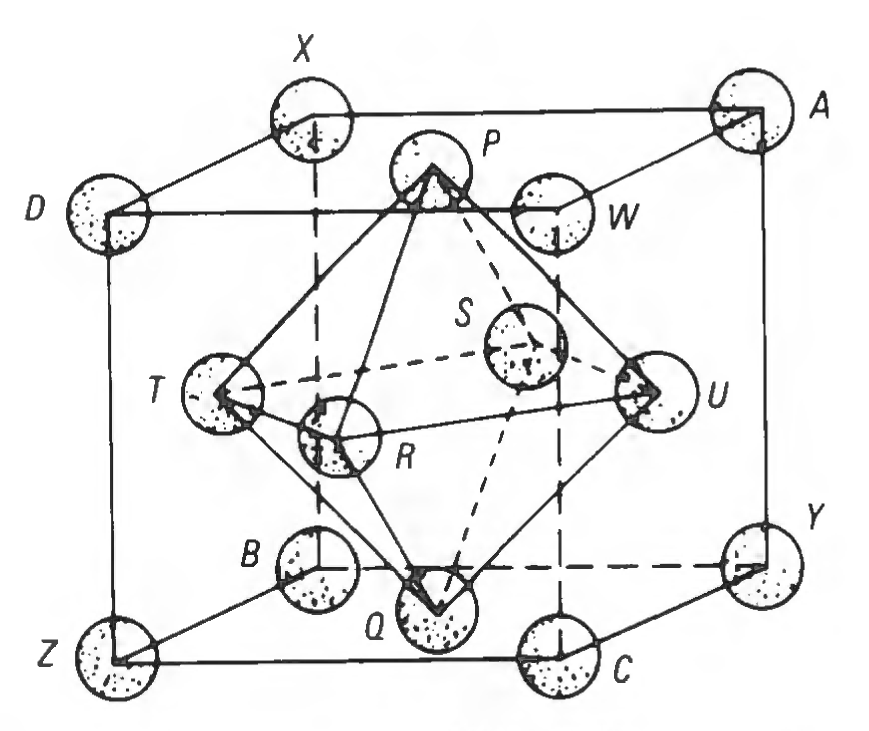
163 If our originally broken-off (symmetrical or asymmetrical polyhedral system) rocks or stones are thrown or fall off a sea cliff, they will become progressively rolled, smitten, crushed, or nicked by local landslides or by the surf. Under such conditions their corners and edges get progressively lopped or worn off, leaving them with a progressively greater number of facets, corners, and edges. Despite irregular, asymmetrical fractionation, the constant relative topological abundance of corners, facets, and edges will be rigorously maintained as these independently evoluting polyhedral systems progressively get rounded off and approach a seeming smoothness.
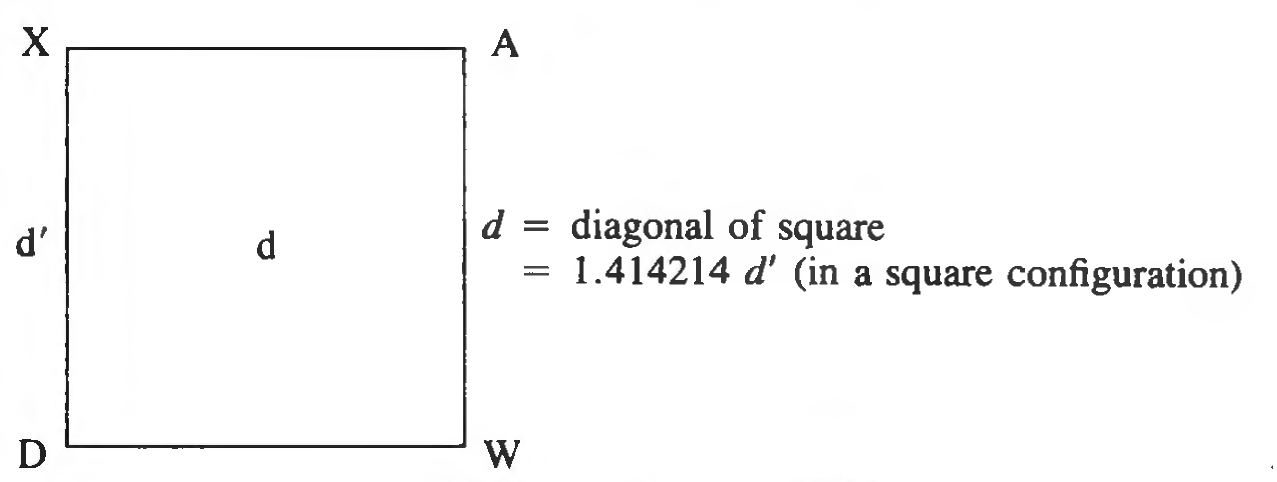
164 If viewed with a microscope of adequate magnitude, rocks will always be found to be polyhedral systems. Even polishing them to superficial shininess will not prevent a microscope of sufficient magnification from revealing more and more sets of Euler’s constant relative abundance of corners (points), edges (lines), and faces (areas) as given by his formula V + F = E + 2.
165 Finally, using electron microscopes, we see individual crystals and their separate, unique molecules and those molecules’ separate, unique atoms. The relative interabundance of those electron, proton, and other systemic interstructurings must also always conform to Euler’s relative abundance of corners, faces, and edges.
166 As we explore physical systems ever more inwardly (microcosmically), we observe again that the electron is as remote from its nucleus as the Earth is from the Moon, considered in respect to their relative diameters.
167 We go on to discover that nothing in Universe is touching anything else in either the macro-or microomniintertensioned (tuned-in) systems.
168 The system component intertensioning always conforms to Newton’s gravitational law, which states that the relative degree of interattractiveness of any two bodies in the macro- or microcosmos always varies inversely as the second powering (n2) of the respective arithmetical distances intervening. Halve the distance and increase the interattractiveness fourfold.
6.3 Alloying
169I have introduced all the foregoing regarding primitive conceptualizing in order to elucidate the invisible microcosmic metallic alloying and the surprising increases in structural and mechanical function performances per ounce of material, erg of energy, and second of time invested in any given technological task.
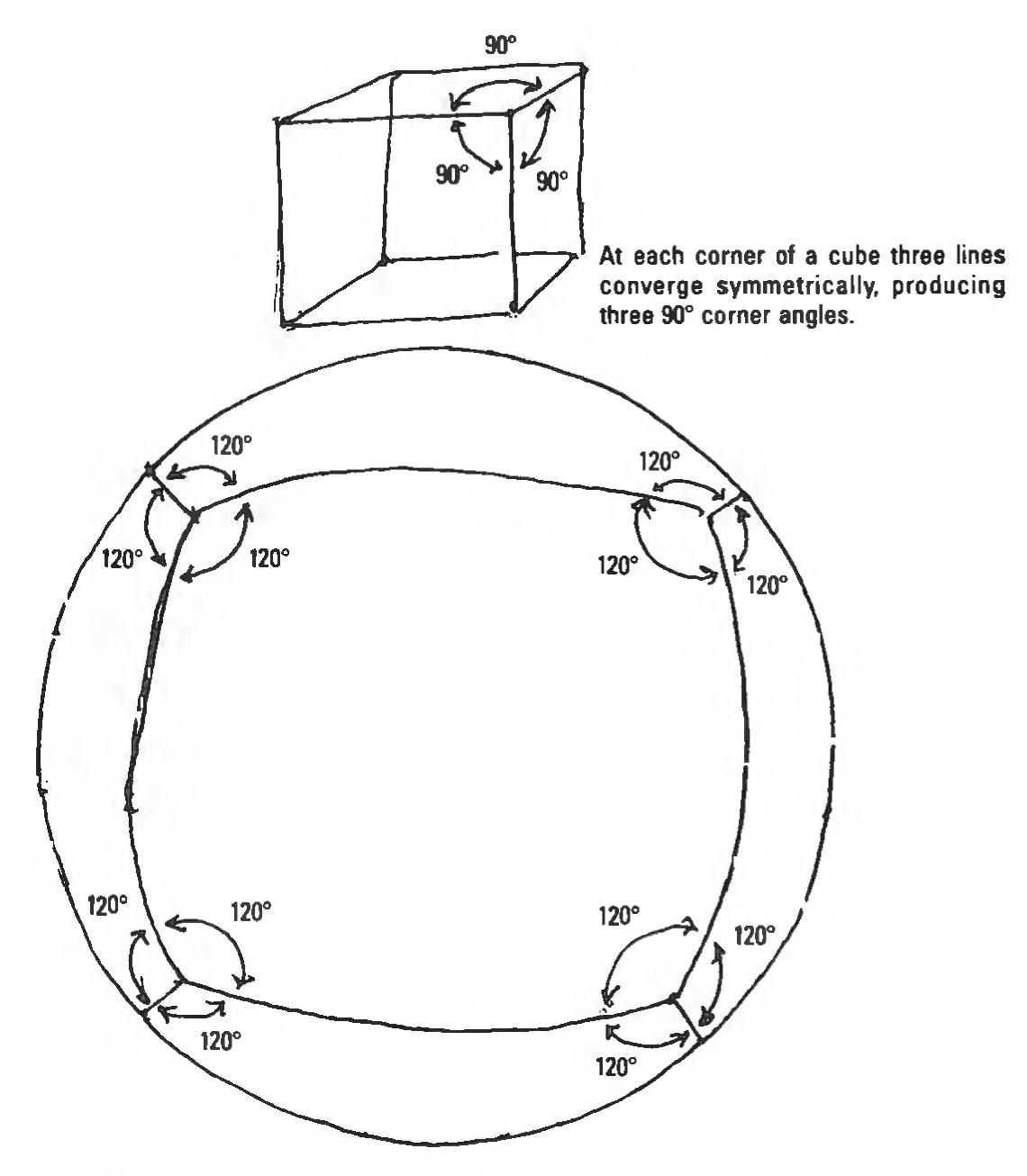
170 We discover that the cube, which is given such structural importance by the academic and corporate world, can be proven to be nonstructural.
171 Twelve equilength tubes strung together with two separate and parallelly led strings, each of which emerges from a tube and is led to the ends of two different tubes, will produce a cube with eight flexible corners (Fig. 6.17).
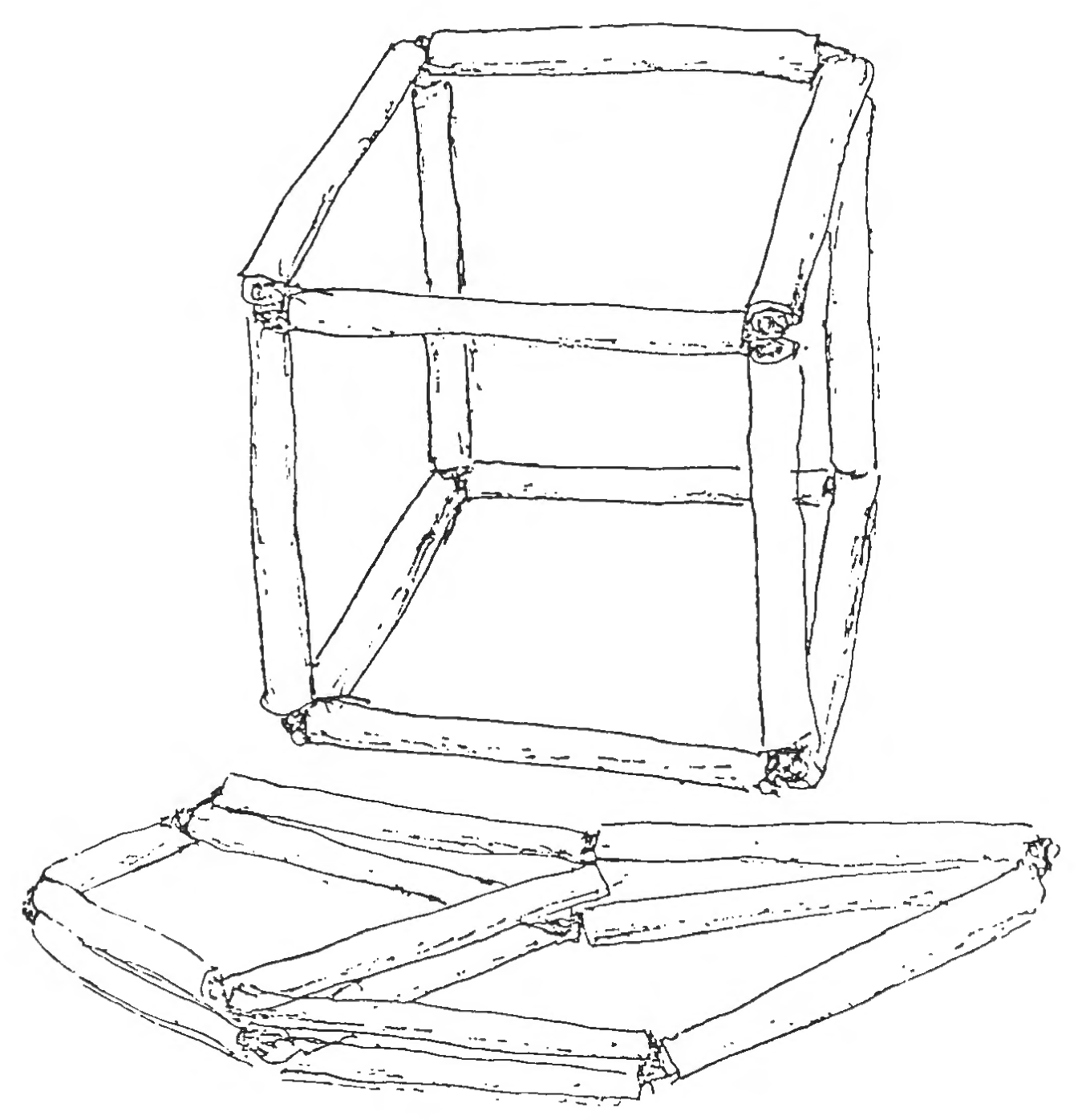
173 If we take the midtube points of any two parallel opposite tubes A and B, hold those tubes as far apart as the assembly will allow and parallel to the ground, and let the rest of the assembly hang from those two tubes, the assembly will take the shape known as the cube.
174 Gravity gives the flexible-corner cube the shape of its four square curtain walls. The assembly, however, will not stand vertically on its own structural stability. Cubical shapes in architecture require corner gussets or triangular braces to prevent the shape from sagging or distorting.
175 There is no inherently self-forming cubical structure occurring as a primitive polyhedron in nature. Two symmetrical tetrahedra of the same size can be interposed, however, to form a structure whose four corners can be integrated to produce a symmetrical system whose eight corners form the corners of an implied cube, but the cube’s twelve edges will be lacking.
176 There are no solid cubes. Cubical building blocks are figments of the imagination. There do exist complex aggregates of systemic events that employ eight-corner symmetries which may be spoken of as cubical, but they are not primitive structures in their own right.
177 Newton’s law of relative interattractiveness of any two separately paired bodies relative to the interattractiveness of any other two separately paired bodies equidistantly apart with the first pair of bodies would be manifest as the relative magnitude of the products of the masses of each pair of bodies.
178 To give an example, if the first equidistant pair’s individual masses are 5 and 7, and if the second equiinterdistanced pair’s are 12 and 20, the respective pair’s initial relative interattractivenesses would be as 35 is to 240, or 35∕240.
179 Newton’s physically, consistently proven law shows that the interattractiveness of any two bodies varies inversely as the second power of the varying arithmetical distance intervening. That is, to halve the arithmetical distance between them is to fourfold the interattractiveness. Doubling this arithmetical distance reduces the interattractiveness to one-quarter of its initial force.
180 In employing Newton’s law to explain the tensile strengths of various nonmetallic materials, and especially the intercoherence forces of metallic alloys, we have to consider, and mathematically cope with, the convergent-divergent, four-dimensional interspacing of the system’s constituent atoms.
181 Any of the metallic elements’ symmetrical constellations of atoms may be concentrically integrated—alloyed with one or more other metallic elements’ symmetrical constellations of atoms—only when they all together combine in a configuration of greater complexity which is overall an omnisymmetrical, gravitationally or electromagnetically interattractively cohered constellation.
182 The simplest of omnisymmetrical elemental constellations is that of the regular tetravertexion—formerly known as the tetrahedron. Assuming the individual atom to be conceptually illustratable as a superficially spherical, resonantly purring, pulsating, occulting complex of great-circle whirring events operative in pure principle, Fig. 6.18 illustrates what we mean by the minimum omnisymmetrical constellation—the tetrastellar or tetravertexial constellation.
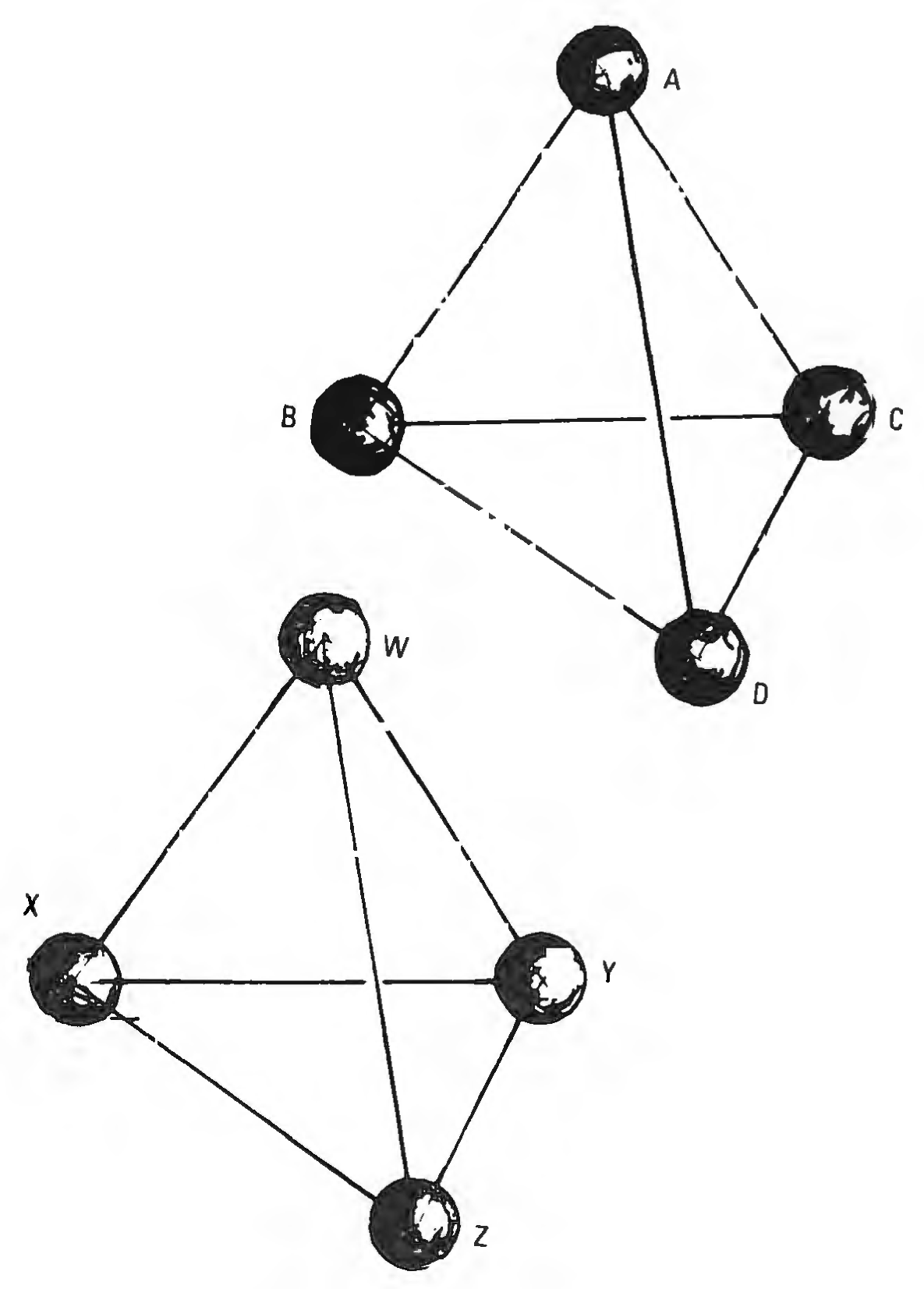
184 To illustrate alloying, I employ two tetravertexia, the simplest of all symmetrical atomic constellations. I designate these two tetravertexia ‘‘red’’ and ‘‘blue.’’ To produce the red tetravertexion, we take four balls of equal radius A, B, C, and D, each representing an atom (a complexedly interbalanced, microconvergent energy locus). The six edges of this tetravertexion represent vector-tensors of equal length. Because each of the six edges is a push-pull vector (or energy-force magnitude) of equal length, the forces balance and together produce the structural integrity of the system. The blue tetravertexion is designated W, X, Y , and Z (see Fig. 6.18).
185 These two four-ball tetravertexion systems can now be brought together in such a symmetrical manner that their centers of volume are congruent and the centers of their eight balls will coincide with the eight corners of what was formerly thought of as a regular cube.
186 We take the midpoints of each edge of the red and the blue tetravertexia and interpose the two tetravertexia in such a way that the midpoints of each tetravertexion are congruent with the six midpoints of the other (see Fig. 6.22). (These midpoints may be interconnected to form an octahedron, which we call a sexvertexion.)
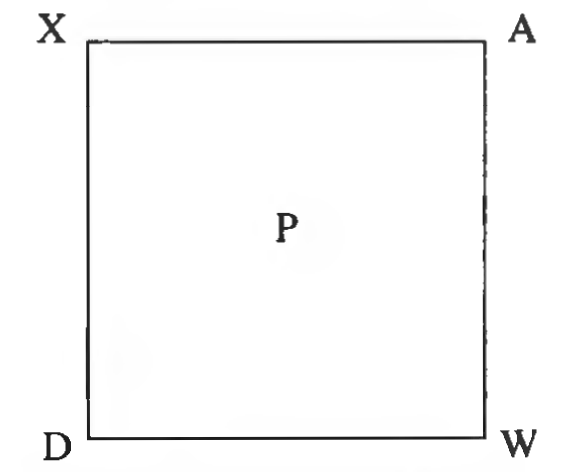
187 Looking at one square face AWDX of the cube in Fig. 6.22, we have a condition where the original distance between any two corner balls of red tetravertexion ABCD would all be the same as AD, and the original distance between any two corner balls of blue tetravertexion XWY Z would all be identical not only with one another but with the distances between any two of the four diagonally opposite corner balls of the positive tetravertexion ABCD. In the square AWDX, the uniform interdistancing of either of the two tetravertexion’s red balls or blue balls is seen to be that of either of the diagonals AD or XW.
188 Now, however, we note that in Fig. 6.22 A′s nearest neighboring ball is no longer D but
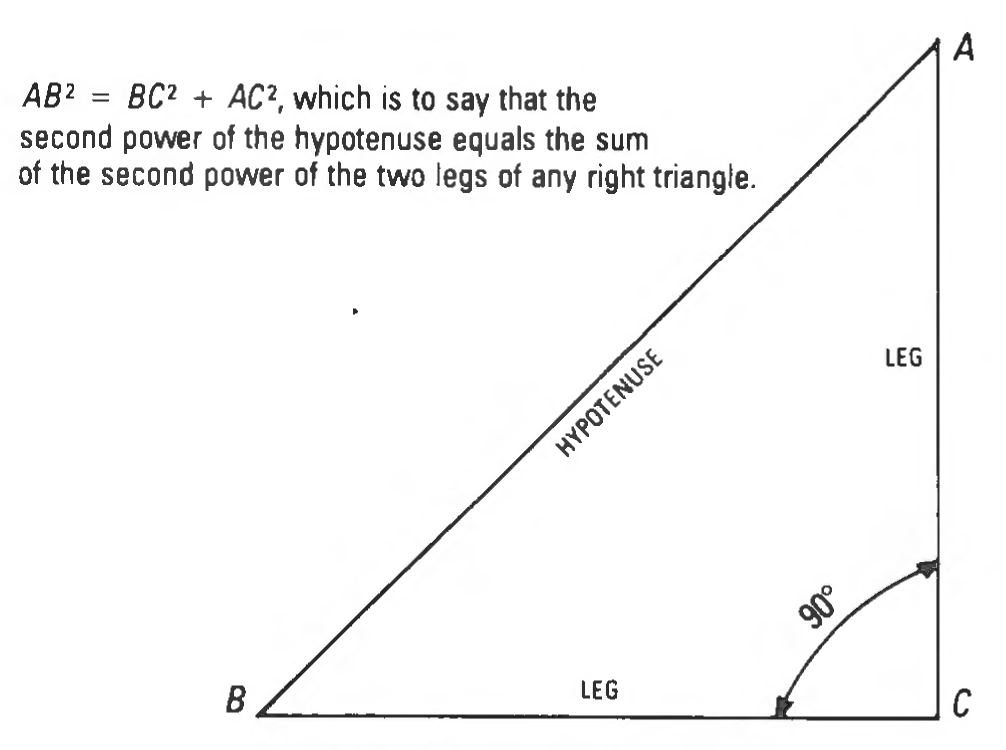
instead X or W or Y . AD is the hypotenuse of the right-angled triangle AWD, and AW and
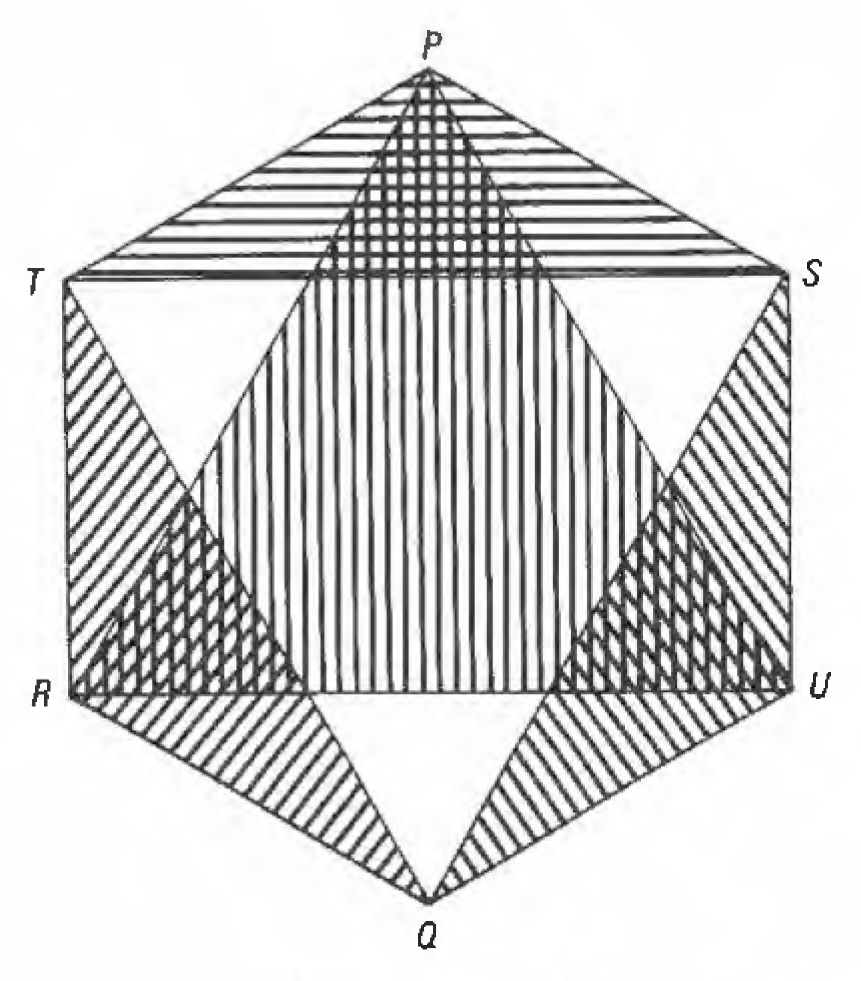
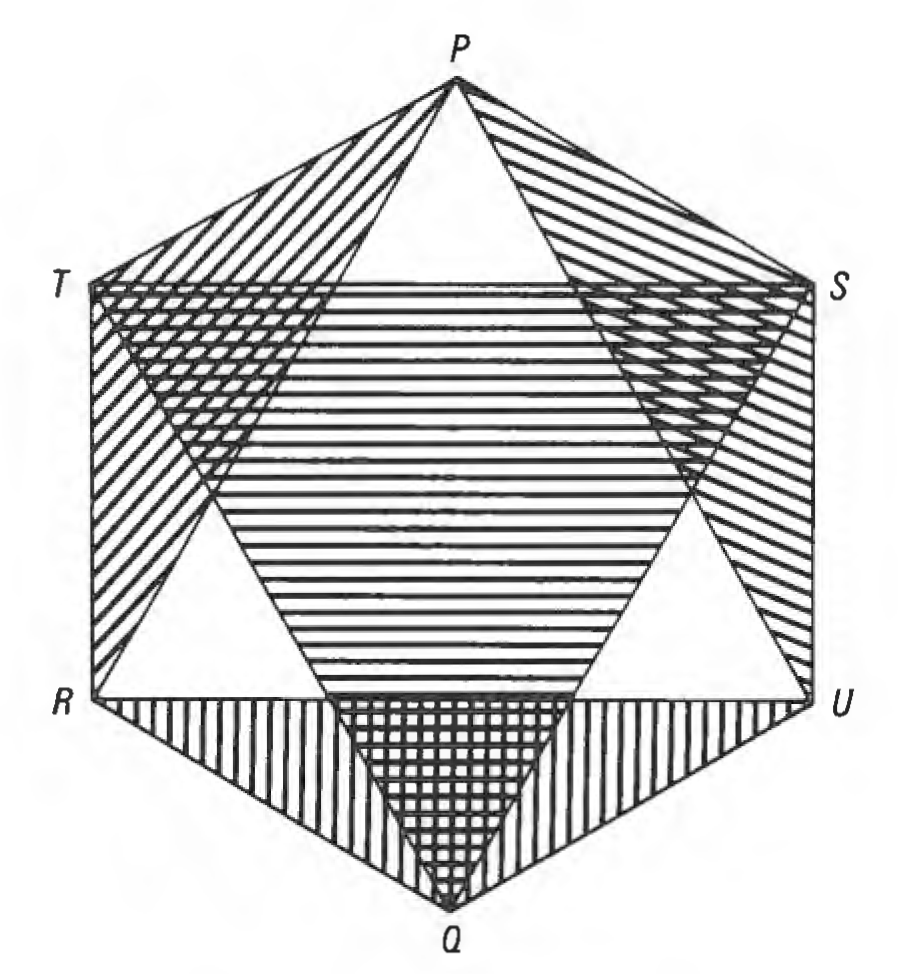
DW are the equilengthed legs of the isosceles right triangle AWD. Recalling the oft-proven
geometrical proposition that the sum of the second powers of the two sides of a right
triangle equal the second power of the hypotenuse (see Fig. 6.19), we assume the
distance AD =  = 1.414214, and then the distances AW or DW each equal 1,
wherefore A and D in their tetravertexion relationship are 1.414214 apart from one
another. In this cubical arrangement, A′s nearest neighbors are only a distance of 1
away.
= 1.414214, and then the distances AW or DW each equal 1,
wherefore A and D in their tetravertexion relationship are 1.414214 apart from one
another. In this cubical arrangement, A′s nearest neighbors are only a distance of 1
away.
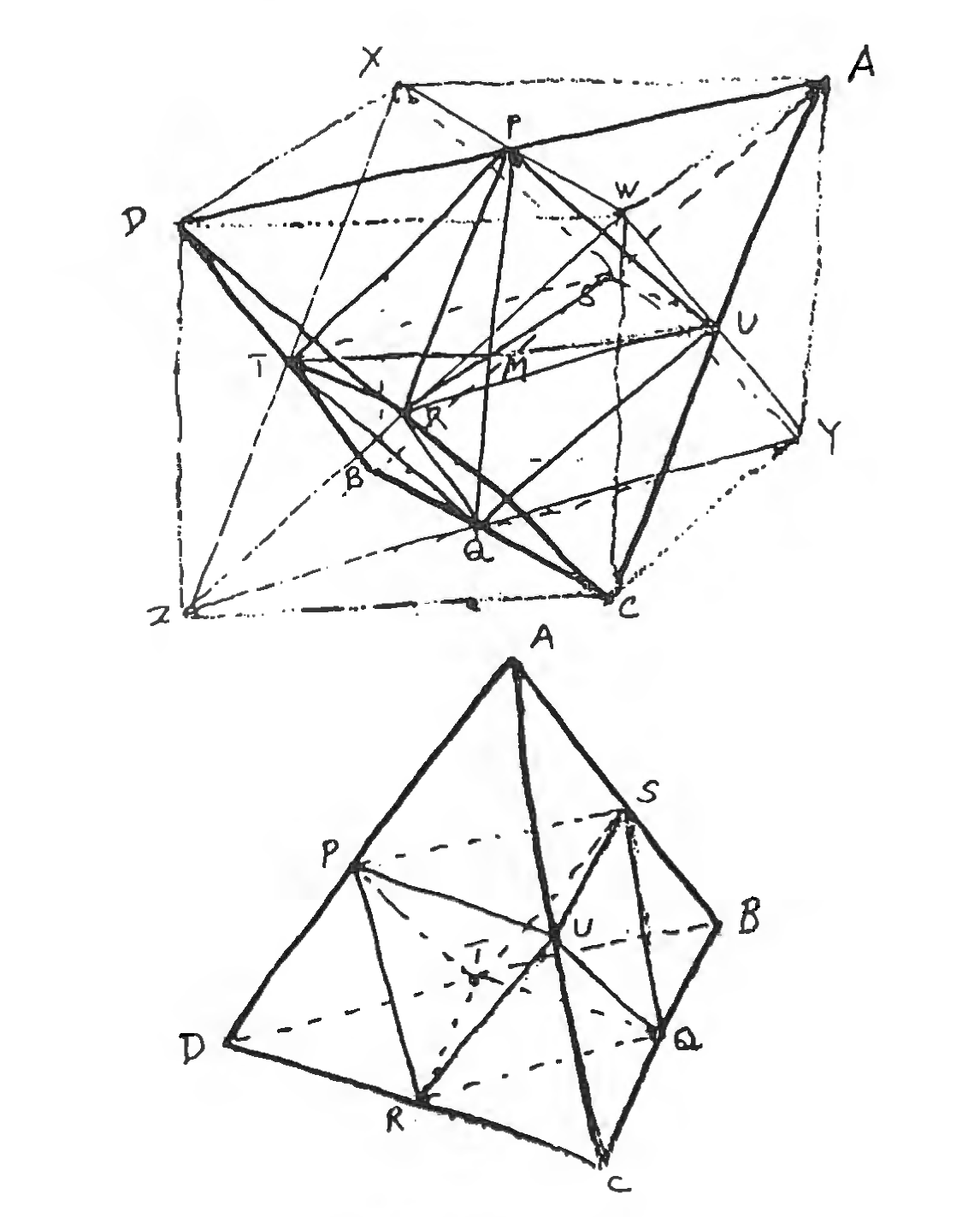
190 In respect to our two separate red and blue tetravertexia ABCD and WXY Z, let us assume
that each of their corner-ball masses equals 1, the relative integral interattractiveness magnitude
of any two of the ABCD′s red balls or of the WXY Z′s blue balls would also be exactly the  ,
which is 1.414214.
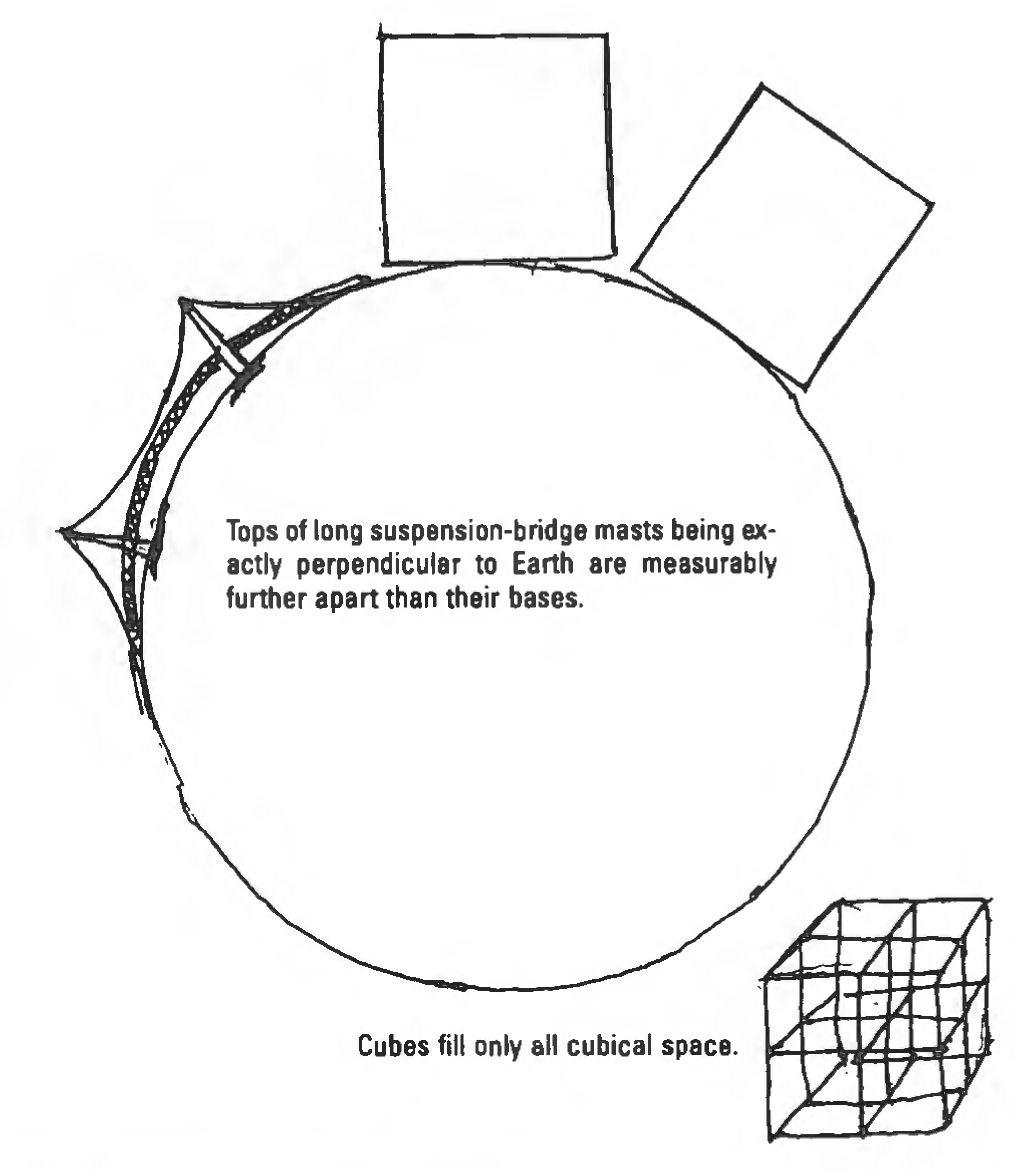
,
which is 1.414214.
191 When we push the red and blue tetrahedra together in the manner previously described, we now find that the distance between the complex eight-corner-ball system’s nearest neighbors has been reduced from 1.414214 to 1. (See Figs. 6.20 and 6.21)
192 Now we show below the general mathematical expression of Newton’s law and the substitution in it of the special case of our ‘‘star cube’’ of paired red and blue identical tetravertexial constellations of four equimass vertexial balls.
193 With reference to Fig. 6.22, our special case can be reduced to the following statement: Force between A and D we will call f; force between X and D we will call f′.
194 Thus:
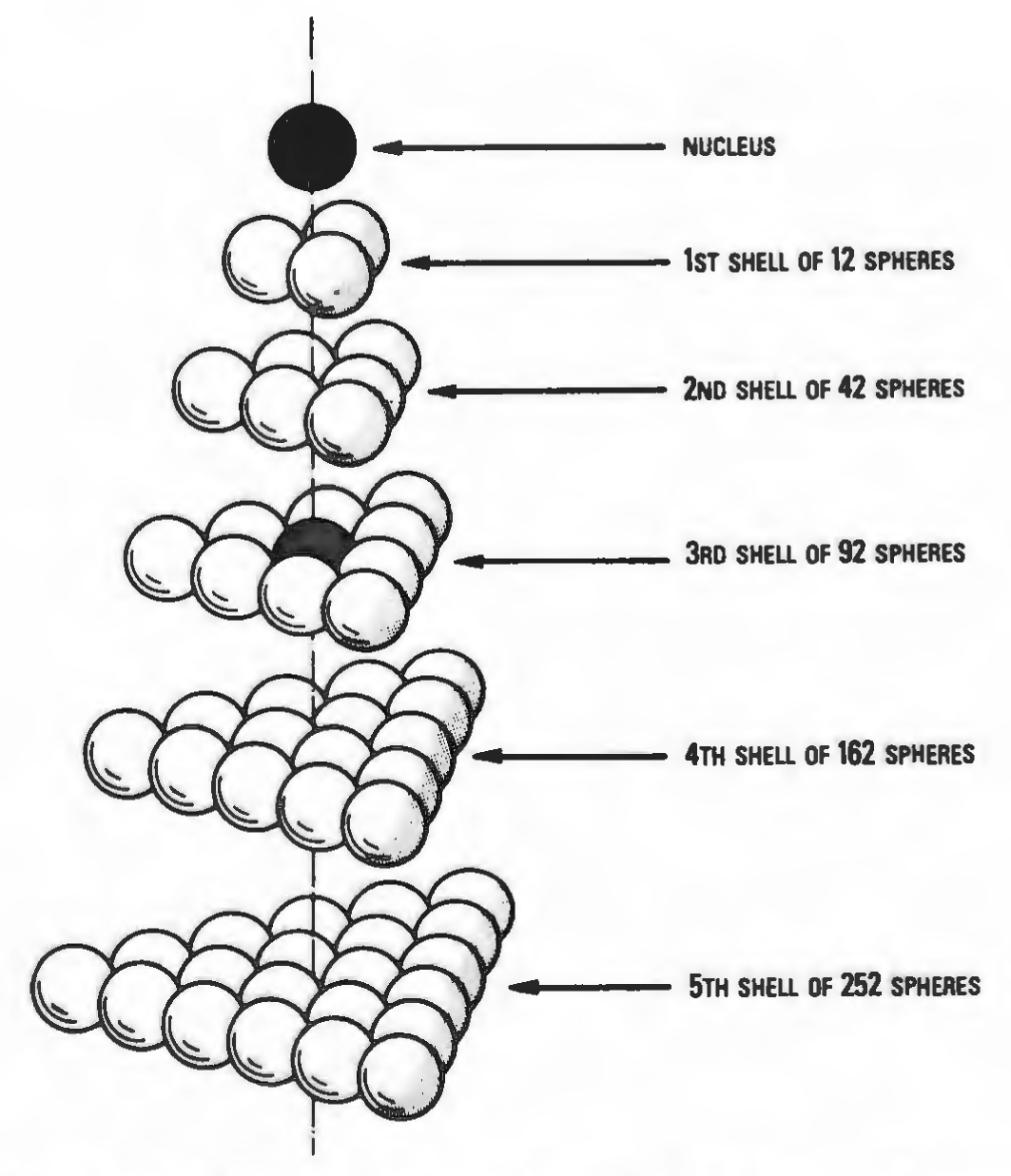
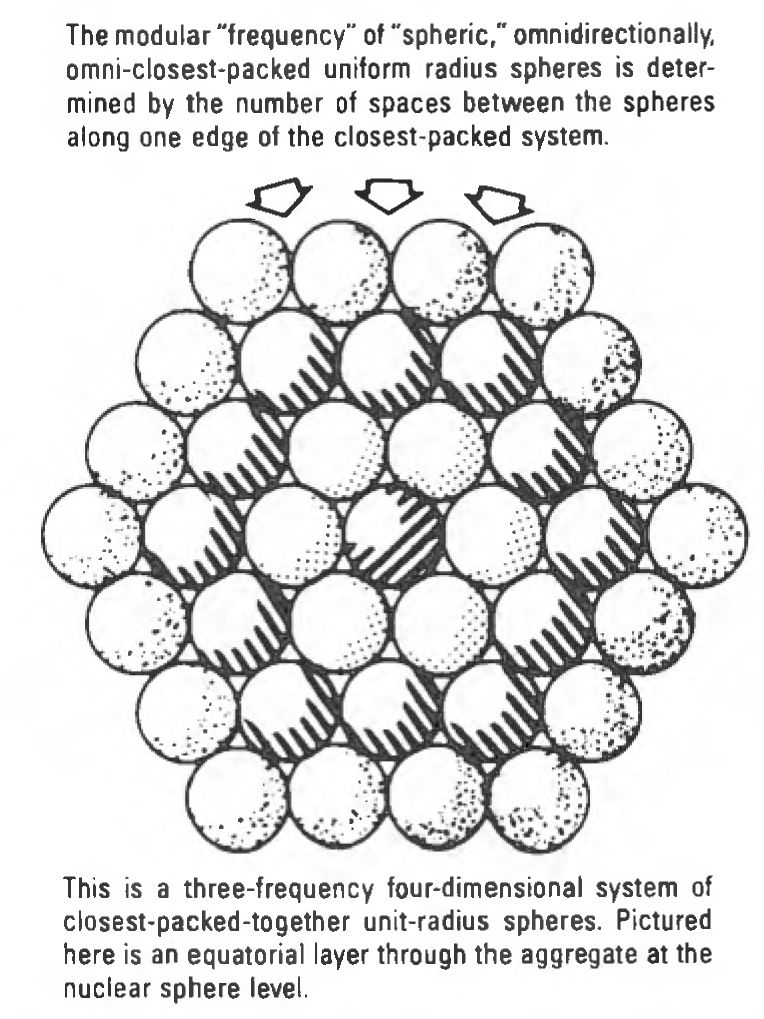
| (6.2) |

| (6.3) |

| (6.4) |

| (6.5) |

| (6.6) |
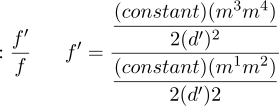
200 if masses equal
| (6.7) |
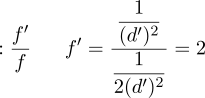
202 A simple version follows:
| (6.13) |

204 then the ratio of force diagonal to force of edge
| (6.14) |

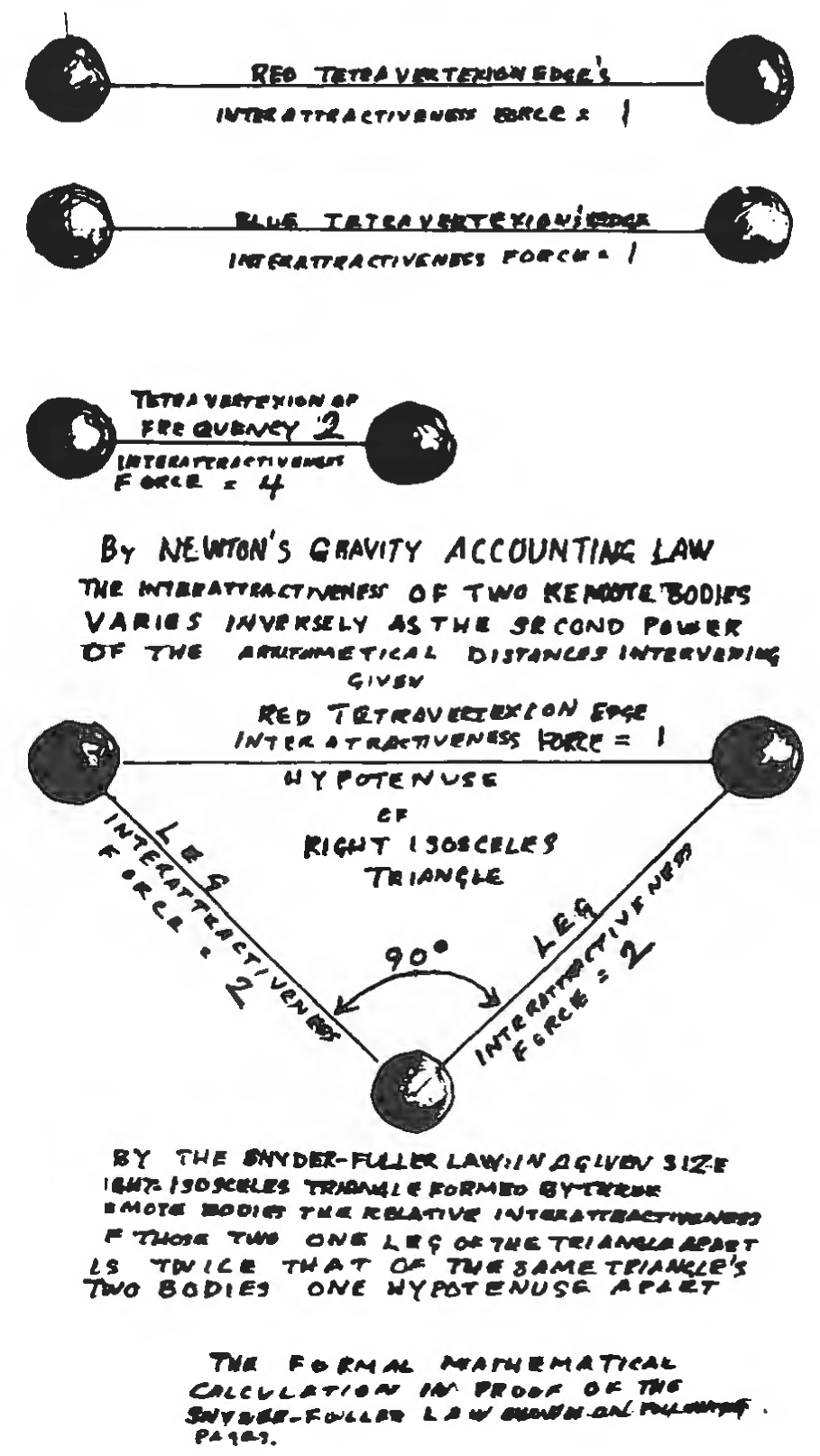
208 From the foregoing, it is learned that in the special case of an isosceles right triangle with three equal-mass balls centered at each of the triangle’s three vertexes, the interattractiveness of the pair of balls (one leg of the right triangle apart) is twice that of the pair of balls (one hypotenuse of the right triangle apart).
209 In our special-case consideration of triangle AWD of square face AWDX of cubical intermarriage of red tetravertexion ABCD with blue tetravertexion WXY Z, we find that the intermarriage produces a doubling of the interattractiveness between the eight balls’ nearest cube-edge neighbors while still maintaining all their original greater-distance tetra-edge (hypotenuse) interattractiveness.
210 We may now consider an additional interallowable aspect of our red and blue tetravertexion systems: by interconnecting their mid-vector-edge crossing points, which interconnection lines describe the six-vertexion (octahedron) PQRSTU (Fig. 6.22).
212 The six-vertexion (octahedra) PQRSTU has six vertexes P,Q,R,S,T,U. The six-vertexion system PQRSTU has eight triangular openings or windows, which we alternately color red and blue (Figs. 6.23 and 6.24). This yields four red windows PTR, RUQ, STQ, PSU, and four blue windows PUR, SUQ, TRQ, PST. The six-vertexion PQRSTU has twelve vector edges PR,PS,RT,RU,QR,QS,QT,QU,TP,TS,SU,UP.
215 We may now assume that we have another six-vertexed atomic constellation PQRSTU, whose six vertexially centered balls are of equimass with those balls of the red and blue tetravertex constellations, and that six-vertex octahedron PQRSTU is concentric with the star cube.
216 The square face XAWD (Fig. 6.25) will now have ball P at its center; ergo, balls X, A, W, and D′s nearest neighbor will now be P of face XAWD and ball V of cube face WAY C and ball R of cube face DWZC and ball S of cube face XAY B.
218 Each of these new nearest neighbors is one leg of the isosceles right triangle APX away from them, whereas their former nearest neighbors had been the right triangle APX′s hypotenuse AX apart, wherefore their newer neighbors attract them twice as powerfully as had their previous neighbors, which previous neighbors had been interattracting themselves twice as powerfully as had their original neighbors. All of this double-doubling of interattractiveness did not cancel out the previous interattractiveness forces of the more remote sets of balls.
219 We can now appreciate how swiftly the interalloying symmetry of various atomic constellations intermultiplies their overall coherence.
220 In this manner alone can we understand that metallurgical alloying is not at all like the melting-together of components to make candy. In this manner alone can we understand the invisible and unexpected behavior of more performance with fewer pounds of material, ergs of energy, and seconds of time invested that now altogether have altered humanity’s survival circumstances.
221 Only in this way can we come to comprehend why chrome-nickel-steel, whose components’ tensile strengths, respectively, are 60,000, 70,000, and 80,000 pounds per square inch, produce an alloyed-together tensile strength of 350,000 psi, which is 140,000 psi greater tensile strength than the sum of those component tensile strengths, which is only 210,000 psi.
222 We will now mount the red triwindow PUS of the red tetravertex system APUS on the six-vertexion’s red triwindow PUS, and the red triwindow QRU of the six-vertexion, and red triwindow QTS, and finally the red triwindow TRP of the six-vertexion, and we will now have the ‘‘star cube’’ marriage of the large red four-vertexion ABCD with the large blue four-vertexion WXY Z and both concentric with the six-vertexion PQRSTU.
223 Because all the interrelationship vectorial edge lines of both the large and small four-vertexia and the six-vertexion are all constructed of equal lengths, the eight vertices A, B, C, D, W, X, Y , Z are all equidistant from one another and are ommnisymmetrically interarrayed with all their angles equal, and the eight points A, B, C, D, W, X, Y , Z describe the corners of a quasicube (Fig. 6.26). We say quasicube because there is no vectorially triangulated stable cubical structure. The cube is a superficial shape resultant upon a complex of a priori structural events.
225 With the foregoing alloying interaugmentation of omnisymmetrical vectorial ornniintertriangulated constellar system structuring, we can well appreciate the multifold increase in system cohesiveness that is occasioned by the introduction of only one more atomic sphere M at the center of our quasicubical, comprehensive, alloyed system, as can be seen in Fig. 6.27.
227 Cubes have long been thought of as allspace fillers, because the Greeks found that a large cube could be subdivided into smaller cubes to reconstitute the original cube. It also seemed roughly provable that if similar-sized cubes were stacked on a true plane surface, they would fill all cubical space. But, having proven centuries ago that we live on the surface of a sphere, how is a true plane surface to be achieved?
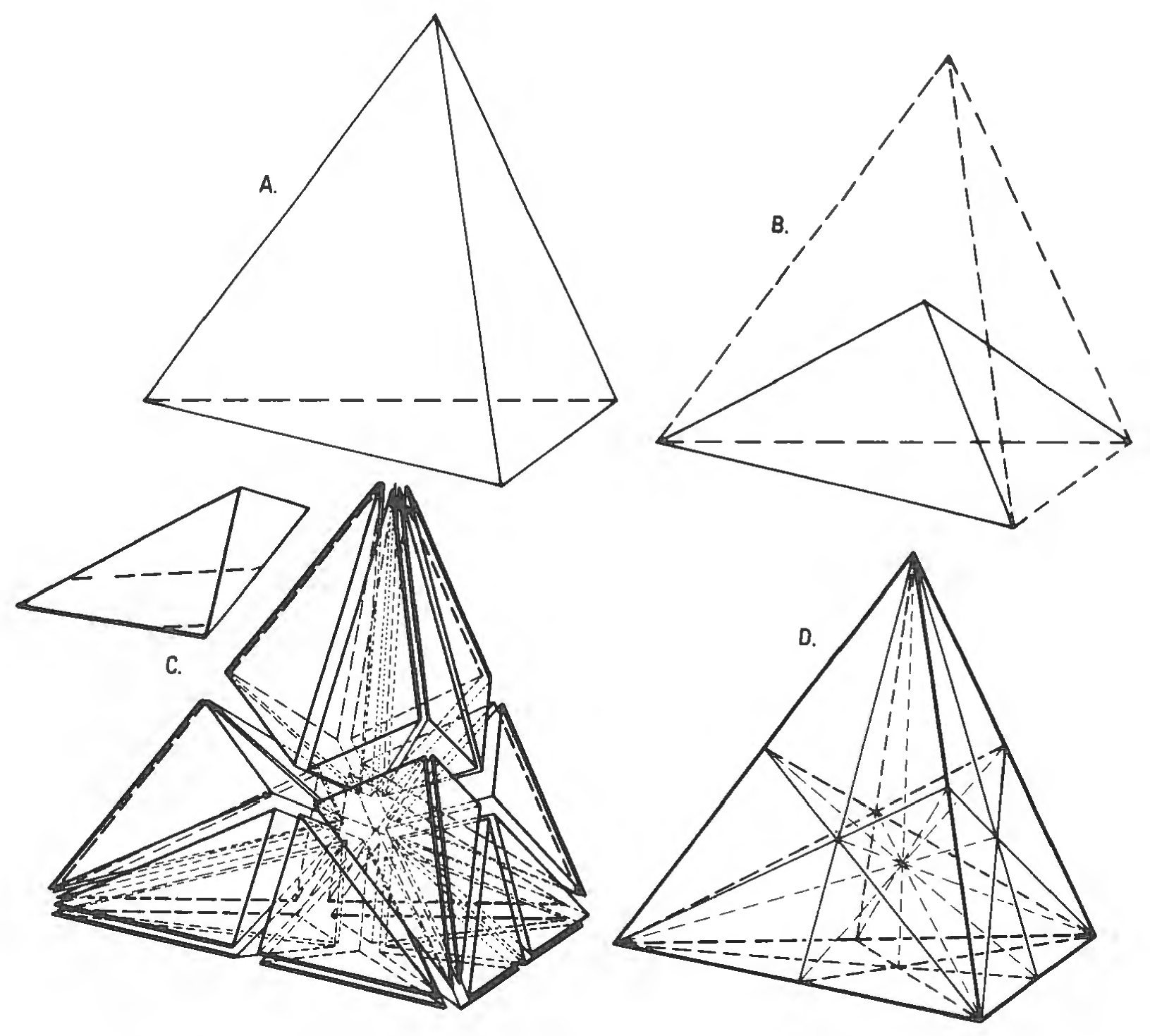
228 It has been found in everyday practice that when rectilinear boxes are stacked vertically, the upper boxes have an irrepressible tendency to lean apart or fall away from one another. This has been explained, and wrongly so, as being caused by the friction and inertia of the bottom boxes, the cumulative weight of the pile, the springiness of the box materials, and sundry other spurious reasons.
229 The real reason the tops of stacks of vertically stacked cubes come apart is because the Earth on which we live and vertically stack our cubes is a ‘‘spheric’’ system surface, and no two perpendiculars to a sphere are ever parallel to one another. Stacked vertically outwardly from the Earth’s surface, the cubes are inherently, if minutely, radially divergent. Suspended inwardly in a well, they are radially convergent (see Fig. 6.28).
231 When builders’ bubble-centered spirit levels are used to produce cement floors, those floor surfaces, as with large, smooth ice ponds, become inherently local segments of the planet Earth’s spherical surface. That is why the tops of floor-stacked vertical columns of rectilinear containers tend to rock apart. (See Fig. 6.30)
6.4 Twelve Around One
232Because there are no solids in Universe, there cannot exist any solid spheres—which solidity the Greek definition of a sphere necessitated. We now know that the seeming spheric experience is always that of experiencing a polyvertexion of very high frequency. Further use of the word sphere in this discourse will always refer to a high-frequency polyvertexion.
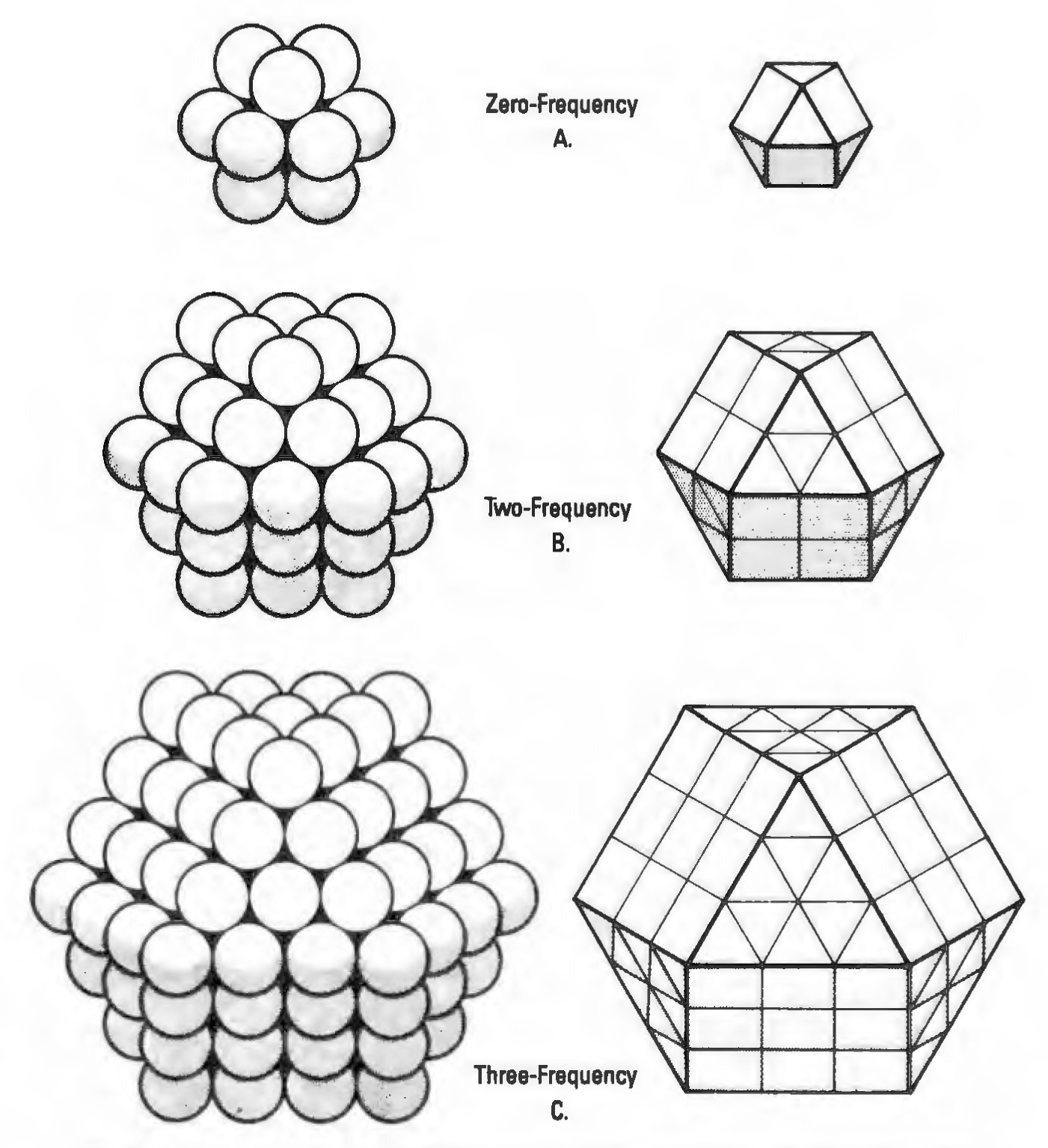
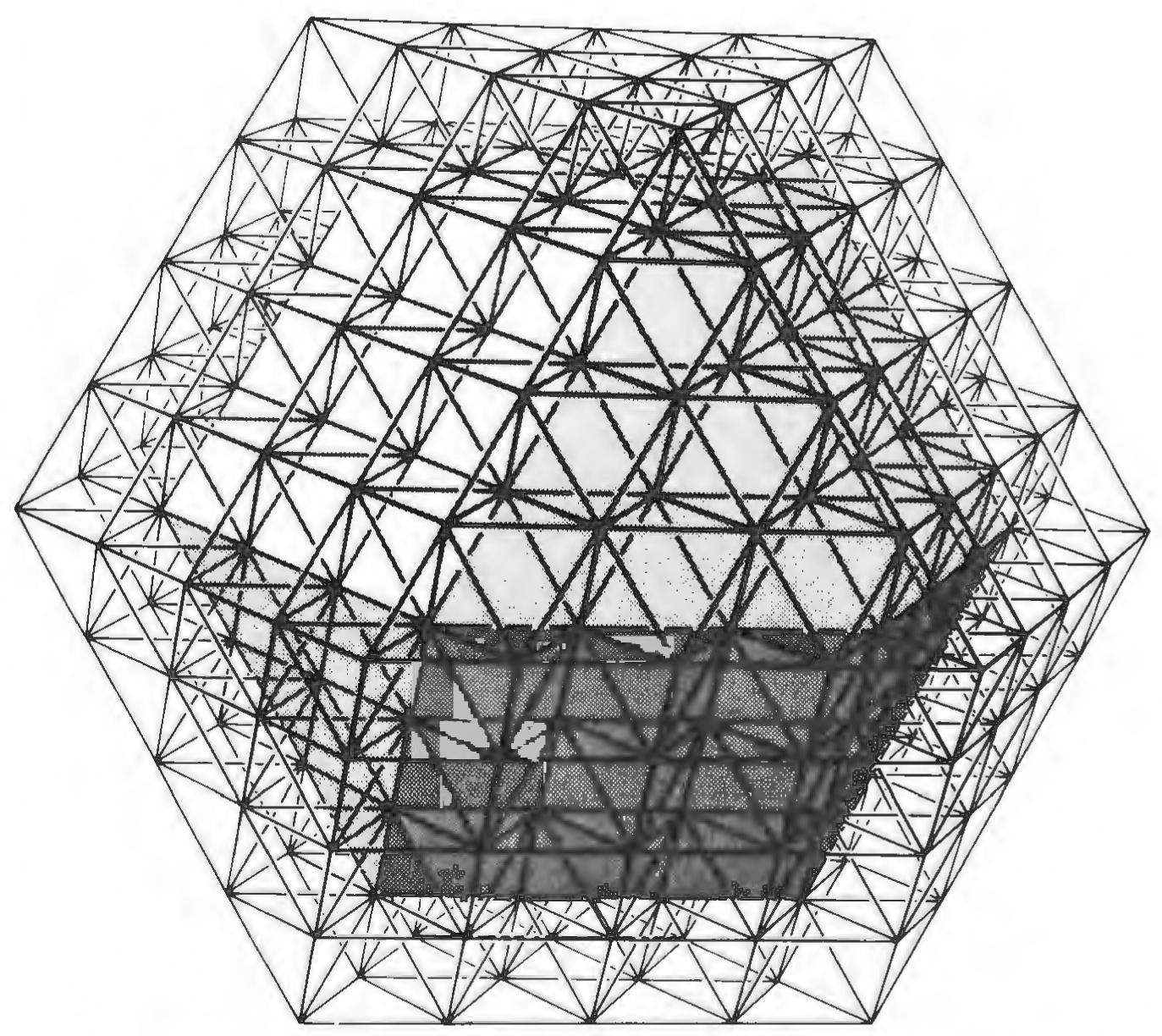
233 Twelve spheres of uniform radius can be closest packed around 1 sphere. Spheres can be closest packed around 1 sphere in layer after layer outward ad infinitum. Each layer will always consist of six square and eight triangular facetings. The first layer has 12 spheres; the second layer, 42; the third layer, 92; the fourth layer, 163; and the fifth layer, 252. The number of each successive outwardly closest-packed surroundment will always be modular frequency to the second power multiplied by 10 plus the number 2, which is written as 10F2 + 2.
236 A spheric is not a sphere. A spheric is a high-frequency polyhedron whose corners are at approximately the same radius from the polyhedron’s center (Fig. 6.31). Thus:
- 1.
- A single spheric microsystem (a six-degrees-of-freedom event complex microsystem) is free to rotate in any direction.
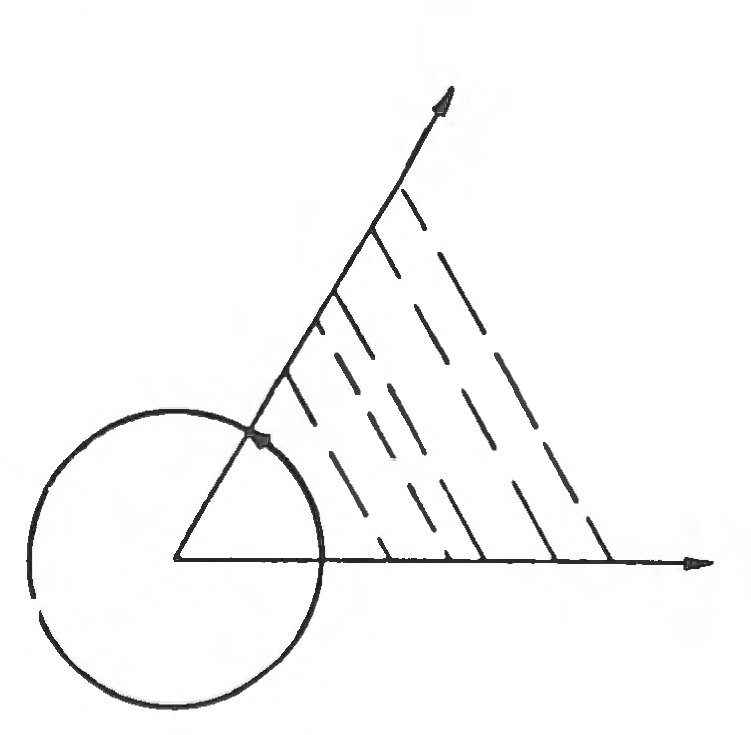
- 2.
- Two tangent spherics are free to rotate in any direction, but must do so cooperatively. They are friction-geared together.
- 3.
- Three omniintertangent spherics can rotate cooperatively only about their three intertangent axes, which are parallel to the edges of the equiangled triangle defined by joining the sphere centers. Thus, if the top of each spheric rotates inwardly toward the center of the triangle, then the bottoms of all three spherics rotate outwardly. This produces a top involuting and bottom evoluting pattern.
- 4.
- Four inter-closest-packed spherics block any turns or other motion of any of the four, and their interstabilized pattern produces a structurally stable system. Taken together the four spherics have insideness and outsideness. Each corner spheric is a complex microsystem. The four together constitute a minimum system. No rotation is possible, making it the minimum stable closest-packed spheric system: the tetrahedron.
- 5.
- The four spherics can be of different radii and will interarrest one another’s motions, provided the smallest sphere’s radius is such that it is too large to permit it to roll through the opening between the three largest spherics.
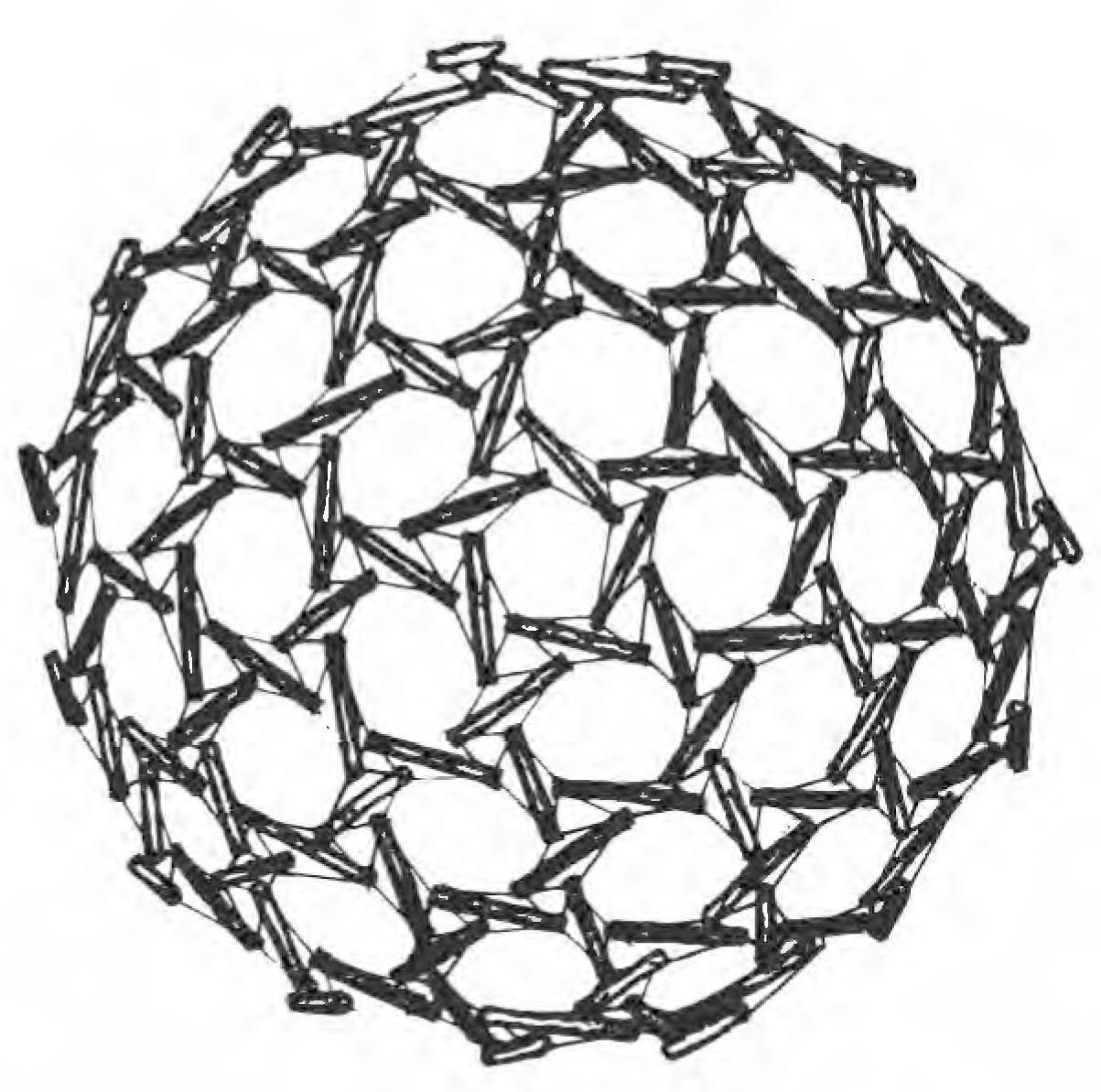
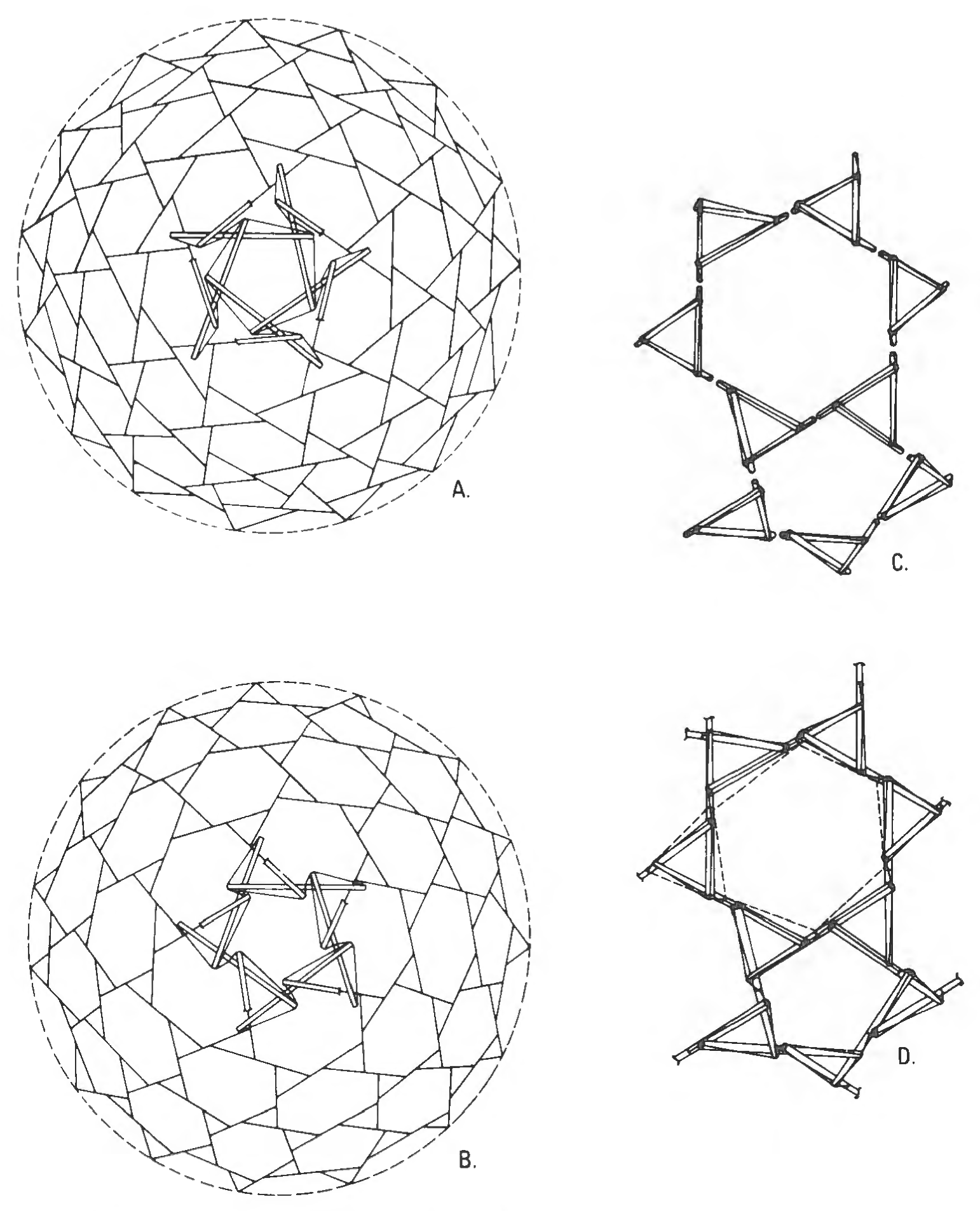
- 6.
- All systems have their unique wavelengths of the radii of the system.
- 7.
- Every system has an inherent (a) center of volume, (b) axis of spin, and (c) average radius, at whose center of volume occurs the turn-around from convergence to divergence, from contraction to expansion, from implosion to explosion, from incasting to outcasting, from tuning in to tuning out.
- 8.
- A vector is a line representing an operative energy. Its length equals the product of the mass and velocity involved in a given direction.
- 9.
- Every system has six positive and six negative vectors. These twelve, half of them positive and half of them negative, can be paired into six interstabilized, push-pull, structural components.
- 10.
- The push-pull, paired vector structural system shapers are also the system ‘‘edges’’ or ‘‘lines’’ of the mathematician Euler’s three basic conceptual, topological components in his ‘‘polyhedral’’ formula V + F = E + 2. The paired push-pull vectors are the E′s.
237 It is this principle of omniembracing, omnidirectional, twelve-unit radius spheric systems around one spheric system that governs all convergent-divergent experience and thinking and accounts for the inherent twelve degrees of freedom that must be coped with in all independent-system internal structuring and the separating-out of an individual system within a more complex system. (See Figs. 6.32--6.35.)
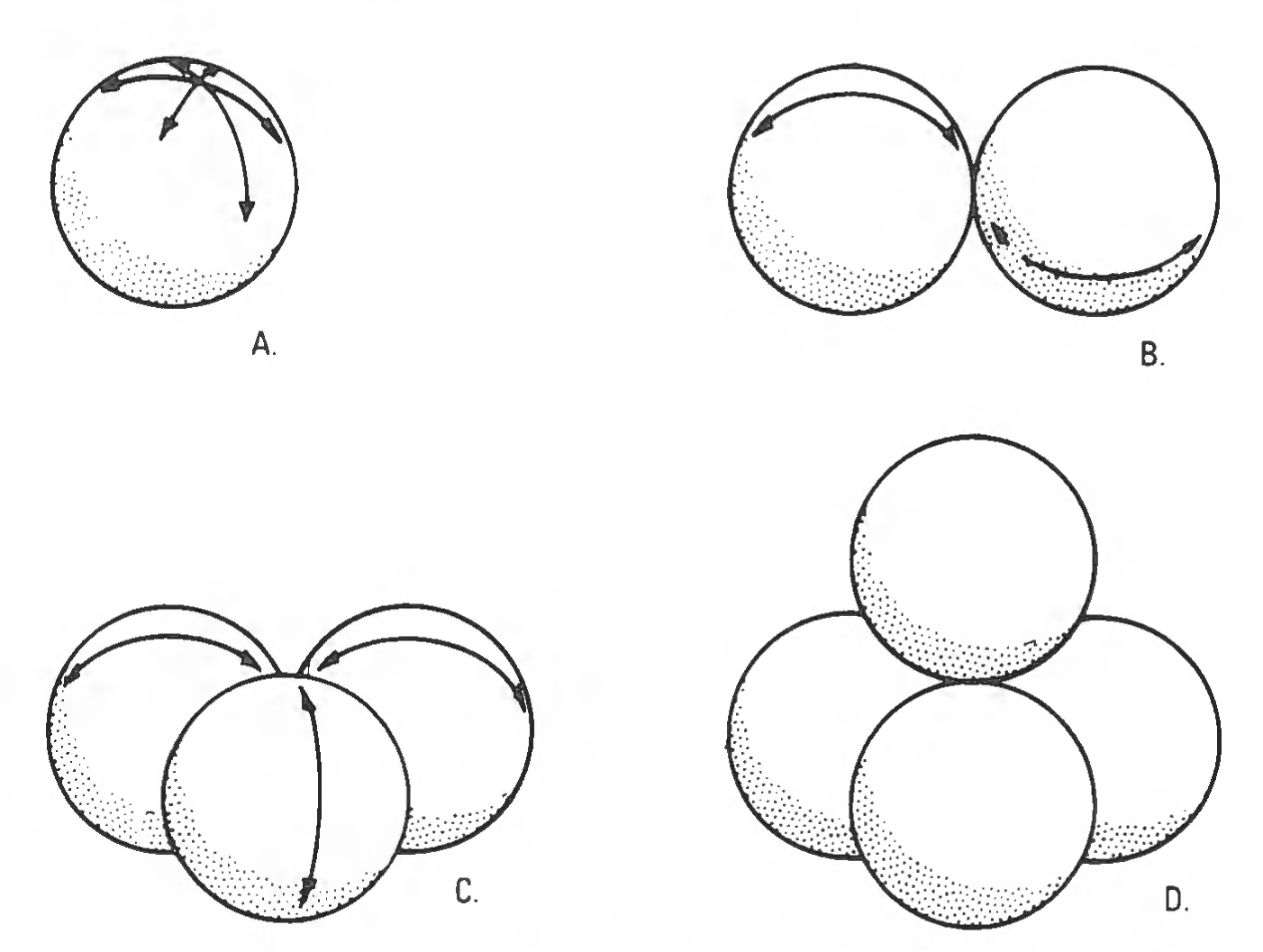
239B. Two tangent spherics are free to rotate in any direction, but must do so cooperatively. They are friction-geared together.
240C. Three omniintertangent spherics can rotate cooperatively only about their three intertangent axes, which are parallel to the edges of the equiangled triangle defined by joining the sphere centers. Thus, if the top of each spheric rotates inwardly toward the center of the triangle, then the bottoms of all three spherics rotate outwardly. This produces a top involuting and bottom evoluting pattern.
241D. Four inter-closest-packed spherics block any turns or other motion of any of the four, and their interstabilized pattern produces a structurally stable system. Altogether, the four spherics have insideness and outsideness. Each corner spheric is a complex microsystem. The four together constitute a minimum system. No rotation is possible, making it the minimum stable closest-packed spheric system: the tetrahedron.
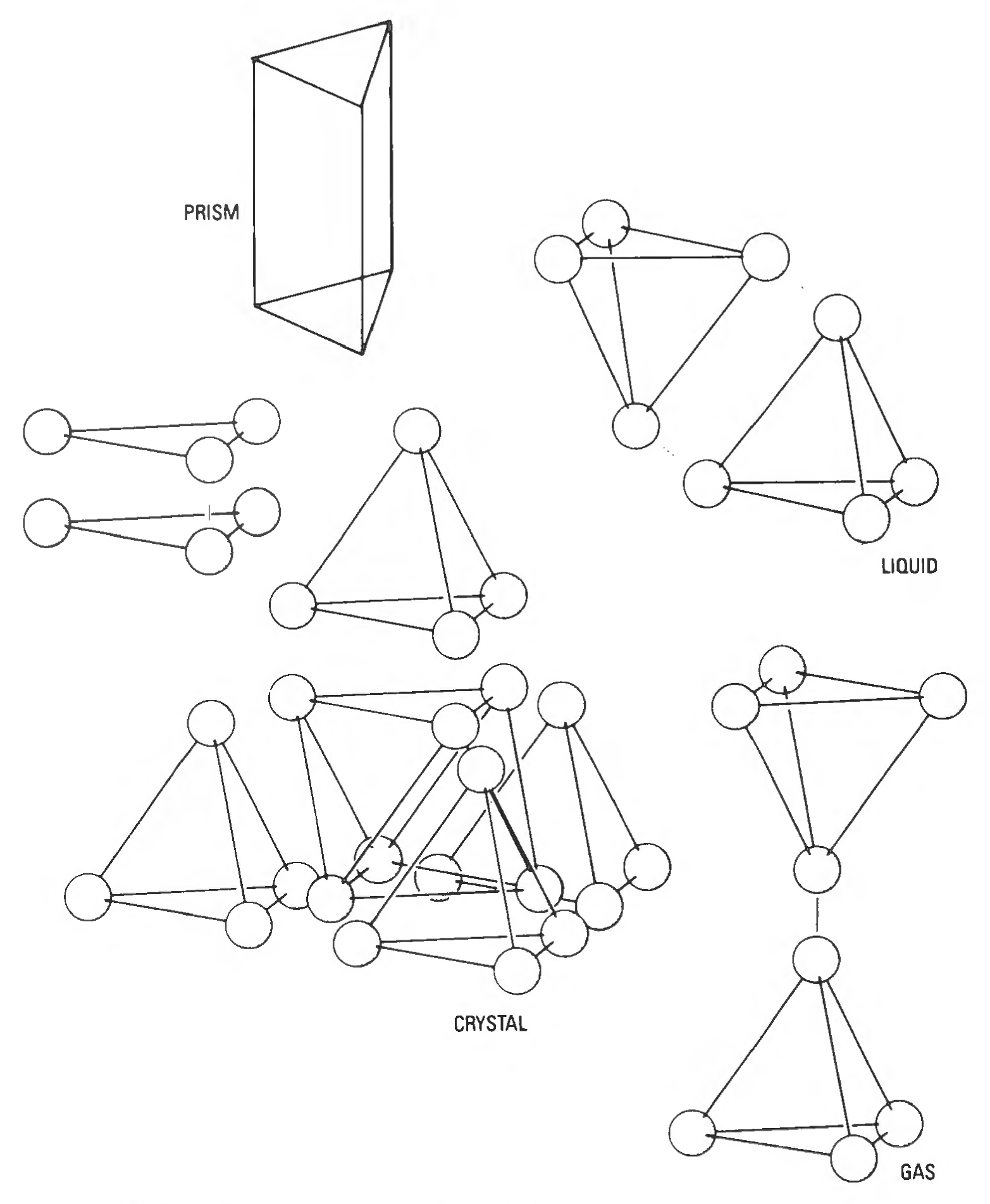
242 ‘‘Spheric experiences’’ can be of three kinds: (1) polyvertexia single bounded vertex to vertex as gases occupying maximum space; (2) double-bonded as liquids edge to edge, occupying less space than the single-bonded gases; and (3) triple-bonded as crystals occupying the least space. Since nothing in Universe touches anything else and is remotely cohered as single-bonded gases are only gravitationally, tensegrity intercohered.
243 [Adjuvant’s note: The following passage, written six weeks before his death, is Fuller’s last known writing, and as such, and also because of its revelatory nature, it is quoted in its entirety.]
244 The discovery today, Sunday, May 15, at the Good Samaritan Hospital in Los Angeles [while attending to his wife], between 3 P.M. and 4 P.M., of the necessity to think realistically and structurally only in terms of the nonexistence of spheres and therefore to think only in terms of polyvertexia. This brought about the necessity of realizing that ‘‘closest-packed unit-radius spheres’’ of the isotropic vector matrix are always polyvertexia in different orientations with their system centers congruent with the isotropic vector matrices’ vertexes but with their external structures not touching each other. These different system states (Willard Gibbs’s gases, liquids, and crystallines) had different orientations, ergo three different system radii, i.e., (a) when situate closest to one another but not touching vertex-to-vertex, they are single-bonded as gases; (b) anywhen next most remotely intersituate they are edge-to-edge double-bonded as liquids; and (c) most remotely and as yet evenly intersituated they are face-to-face, i.e., triple-bonded as the crystalline phase of physical state (see Fig. 6.36).
245 Ergo, since two polyvertexia’s vertexial events cannot occupy the same space at the same time, the two outermost vertexes of each of the two single-vertex-interbonding polyvertexia are not congruent but are at critical proximity distance from one another to accommodate their respective gaseous system integrity states. The single-bonded gaseous phase of ‘‘spherics’’ are not congruent and must be spaces apart, and are only intercohered by Newton’s law [see tensegrity discussion in section on Fuller-Snyder law, Fig. 6.20].
246 This brings us to Boyle’s [Avogadro’s] law: ‘‘Under identical conditions of heat and pressure, the same number of molecules of all gases of all elements will always occupy the same volume.’’ But Boyle’s [Avogadro’s] law does not say how closely to one another the molecules must be situate within the given volume.
250 This brings us also to Willard Gibbs’s phase rule governing the number of degrees of freedom or energy behavior permissions necessary for its glass of ice water’s water vapor, its water, and its ice to come together as the same phase and thus to occupy the same volume or space in Universe.
251 Gibbs’s phase rule reminds us that the present-day physicist’s unit of volumetric measure is that of the cube of water one centimeter to the edge at a given temperature (due to the expansion and contraction between gaseous, liquid, and crystalline phases of matter).
252 All foregoing discoveries, thoughts, and accounting lead to the intuitive holding on to the volumetric relationship of the spherical ‘‘five-ness’’ relative to the rhombic dodecahedron’s sixness within which our yesterday’s ‘‘unit-radius spheres’’ were misconceptioned to be tangentially situated and which ‘‘spheres’’ were wrongly thought of only as solids.
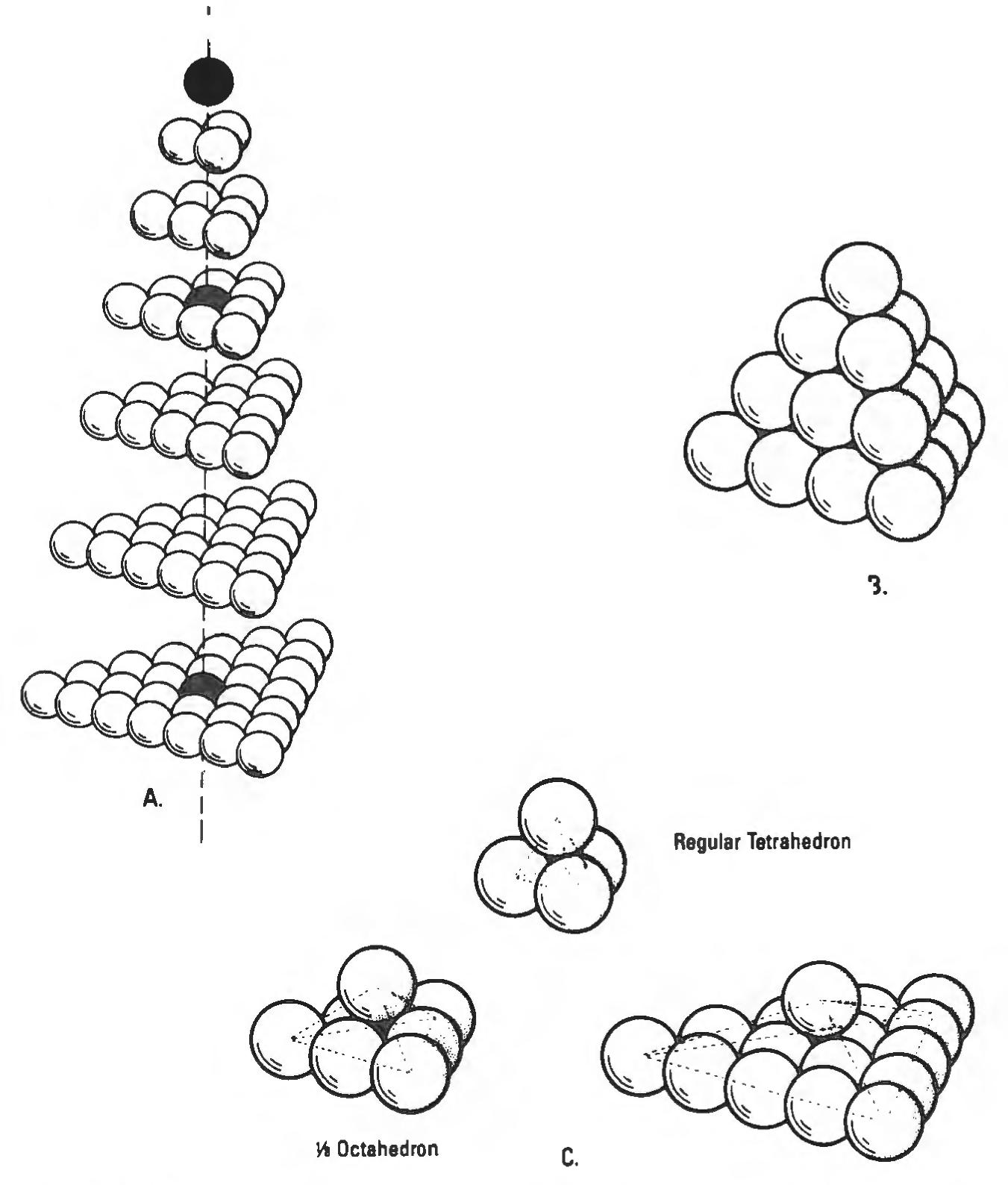
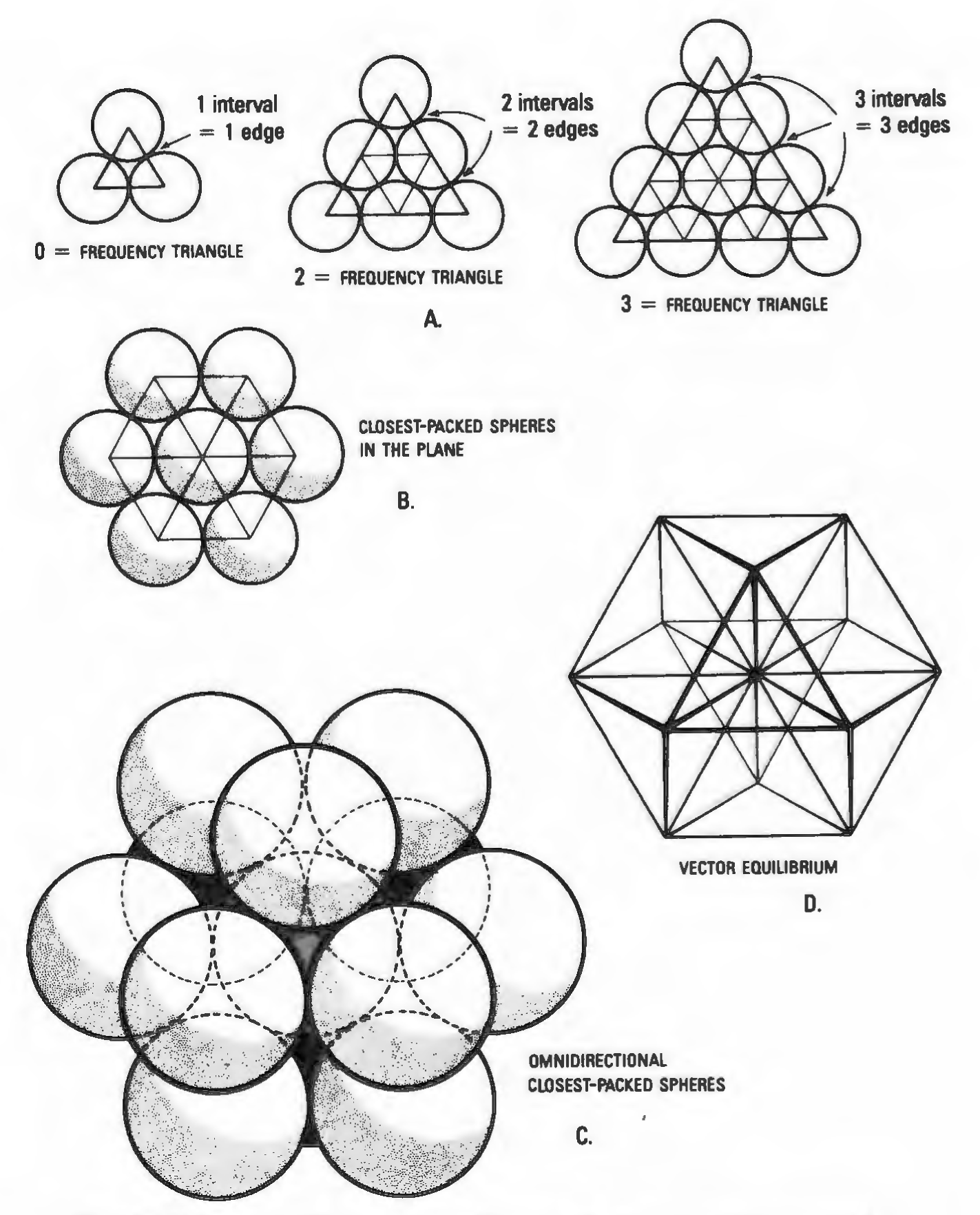
- A.
- In any number of successive planar layers of tetrahedrally organized sphere packings, every third triangular layer has a sphere, at its centroid (a nucleus). The 36 − sphere tetrahedron with 5 spheres on an edge (four-frequency tetrahedron) is the lowest-frequency tetrahedron system with a central nuclear sphere.
- B.
- The three-frequency tetrahedron is the highest frequency without a nucleus sphere.
- C.
- Basic ‘‘nestable’’ possibilities show how the regular tetrahedron, the 1 ⁄ 4-tetrahedron and the 1 ⁄ 8-octahedron may be defined with sets of closest-packed spheres. Note that this ‘‘nesting’’ is only possible on triangular arrays which have no sphere at their respective centroids.
255 We now realize that the polyvertexia are single-bonded as gases, and in fact are remote from one another, and only tensegrity intercoherence has greater possible radius and lesser radiuses when double-bonded as liquid and is of lesser radius again when crystallinely phased (which explains why Planck’s constant is 6.625+ rather than 6.2666… to correct for the cube being threefold the unit volume of the tetravertexion). And all of the foregoing make clear that all isotropic vector matrices as the framework of reference of all energy phenomena must be considered only in their greatest radius phase, i.e., its gaseous, single-bonded, vertex-to-vertex cohered tensegrity state. Since the sphere does not exist, 3.14159… does not exist and the special-case ‘‘atom’’ and ‘‘molecule’’ spheric polyvertexion occupant of each rhombic dodecahedron of isotropic vector matrix referencing volume of 6 can be alternate ‘‘phase’’ and operatively reoriented within the volume 5 domain as its convergent-divergent average of its interphase ‘‘state.’’
256
[signed] Buckminster Fuller
at the 15th hour of 5/15/83, with thanks to God,
the eternal sum of all truths.
257 What yesterday’s nonscientific mathematicians have thought of as a one-dimensional line is in fact a greatly elongated system of minuscule base. What nonscientific mathematicians have thought of as two-dimensional is in fact a very thin, large-based system. What the nonscientific mathematicians have heretofore thought of as three-dimensional, having width, breadth, and height, has no inherent insideness and outsideness; ergo, it does not separate Universe into an inside and an outside, and thus is nonsystemic and therefore nonexistent. The tetrahedron is the minimum conceptual or physical system.
258 In the language of geometry, regular means ‘‘omnisymmetrical.’’ The regular tetravertexion (formerly misidentified as the tetrahedron) has fourfold symmetry: four corner vertexes opposite four equiangular windows. Therefore, the regular tetrahedron can be readily divided into four equal parts. This is done by first finding the center of volume of the regular tetravertexion. Since the volume of a tetravertexion is the product of the base times its altitude, we can take the center of volume as being one-quarter of the altitude. This one-quarter-altitude point becomes the common apex of four one-quarter tetravertexia (see Fig. 6.39).
259 As we have demonstrated, in contradistinction to cubes, unit-radius spheres always close pack omniradially and omniintertangentially as twelve around each single sphere. Unit-radius spheres being closest packed together do not fill all the spaces (allspace). A uniformly shaped, complexedly concave, curvilinear space bounded by the spheric surface nestles between the only tangentially closest-packed aggregates of unit-radius spheres.
261 There is a symmetric, primitive geometrical system known as the rhombic dodecahedron (see Fig. 2.10). It has twelve uniformly dimensioned diamond-shaped facets. The geometrical centers of each of the rhombic dodecahedron’s twelve diamond faces are exactly congruent with the twelve points of tangency of any unit-radius sphere, with its twelve uniformly radiused, closest-packed tangent neighbors in any such closest-packed aggregate of uniform-radius spheres.
263 Each uniform-size rhombic dodecahedron contains within it a uniform-radius sphere internally tangent to each of the twelve mid-diamond faces of the rhombic dodecahedron. Uniform-size rhombic dodecahedra do closest pack, twelve around one, with one another’s diamond faces exactly congruent. They interpack radially, with twelve omnidirectionally and symmetrically closest-packed around each rhombic dodecahedron in the aggregate, filling allspace. Each rhombic dodecahedron thus closest packed and filling allspace is the total domain of each of the tangentially closest-packed-together unit-radius spheres, in addition to containing the sphere.
6.5 Angle
265The trails of two lines, one pre-and one post-crossing a point, or one only visibly superimposed at a distance apart from one another or a line reflectively redirected or a linear wire deliberately bent, produce an angle (V ). An angle is a visual experience—an awareness of two other-event somethings, history lines, interrelating as an angular overlay interrelationship. An angle is a conceptually imaginable interrelationship quite independent of the relative length of the angle’s lines.
266 An angle V is the simplest, minimal-conceptual, attention-securing fix—ergo the mark ✓ .
267 It takes time to measure length. Time is measured cyclically by numbers of interim completed cycles (circles). The angle is a fraction of a circle (○). Angles are subcyclic. Angles are pretime and -size conceptuality. Angles are imaginatively conceptual patterns independent of size or time (Fig. 6.40). A tetravertexion is an imaginatively conceptual structural system independent of size or time. All systemic conceptuality that is independent of time and size we call primitive. All systems and their topological characteristics are eternally true independent of size.
6.6 Tensegrity
269We find that all our tune-in-able experiences are consequences of the absolute integrity of a complex family of eternal principles.
270 The Universe, both macro and micro, is always and only a continuously intertensioned, discontinuously compressioned structural system. It is what I call a tensional integrity. So often did I use that phrase that I contracted its expression to tensegrity, a term which has now made its way into the language. Tensegrity represents a phenomenon so universal that it may eventually be the key to modeling a unified field theory, a tantalizing goal of the scientific community for centuries.4 Since nothing touches anything else in tensegrity Universe, there are no solids. What occasioned his contemporaries’ conceptual acceptance of Plato’s geometric ‘‘solids’’ was the fact that evolution had not as yet introduced humanity to exclusively tensional technology experiences and their philosophic evolutionary derivation or to the subsequently discovered electron’s four-and six-dimensional gravitational integrity of interpatterning symmetries whose kinetic interstructuring behaviors produced electron microscope (non-solid) lenses; these kinetic structuring principles in turn produced the field-emission microscope, whose lenses of abstract-principle electromagnetic integrity make possible the direct photography of one isolated atom, which single atom is in itself a complex, systemic, vector-equilibrium-referenced kinetic entity topologically omniconsistent with the eternal tensegrity principle.
272 When NASA was making its first rocketry experiments dealing with the problem of atmospheric reentry heat, two General Dynamics Corporation scientists were experimenting with the light, high-strength metal titanium. They made two thin-wall hemispheres of titanium sheet. One of the hemispheres had a 36-inch inside diameter and the other had a 34-inch outside diameter. They centered the 34-inch dome inside the 36-inch dome, with a 1-inch space between them, and welded a 1-inch-high titanium base ring to both the outside and inside domes. They then vacuum-pumped the air from between the two domes. Atmospheric pressure pushed the inside dome skin outward, but atmospheric pressure on the outside of the outside dome dimpled the outside dome skin inward in a pattern of hexagons and pentagons; a triangular undimpled area remained in the exact pattern of the tensegrity-geodesic icosahedron’s four-frequency network. This was a least-effort-of-nature event and proved that nature was employing the same mathematical geometrical logic we have been developing and considering here, showing that the icosahedron provides cosmically the most structurally enclosed volume per quantum of structural energy provided.
273 A balloon is an example of a high-frequency tensegrity sphere.
274 The balloon is a net with holes so small that the molecules of gas inside the balloon cannot escape. The next thing we discover is the pressure of the gases, explained by their kinetics; that is, molecules are in motion, not rigid. Nothing at all static pushes against the net. Gas molecules are hitting it like projectiles. All of the molecules of gas pressure loaded into the system are trying to get out: this is what gives the basketball its firmness. If we pump in more molecules, they become not only more crowded together but also more accelerated, producing increased heat and pressure.
275 The middle of the chord of an arc is always nearer to the center of the sphere than the ends of the chord. Chord ends are always pushing the net outward from the system’s spherical center. Gas molecules are stretching the net outward. All outward-thrusting gas molecules have an-equal-and-opposite-thrusting-reaction molecular partner. In the tensegrity-sphere model (Fig. 6.41), each of the wooden sticks or struts represents a pair of action-reaction forces. As the gas molecules’ outward caroming blows act as a total spherical enlargement network, stretching the skin, at the same time the skin (network stringing) acts to resist the outward motion (stretch). The skin is finite, closing back upon itself in all circumferential directions. All its force arrows are bound inward, balancing all the outward-bound molecules hitting the net and caroming around. Every molecular action has its equal and oppositely accelerative gas-molecule reaction mate. The paired action and reaction gas molecules produce glancing-blow, chordal-pair outward forces of the tensegrity sphere.
278 This is quite a different picture from that of molecules huddling together at spherical center and then simultaneously exploding outward to hit the balloon skin in an omnidirectionally outbound wave. Instead, the paired oppositely accelerated gas molecules carom around in the largest, most comfortable circles (the great circles).
279 All great circles cross other great circles twice in each circuit. When a third great circle crosses two others, it inherently produces six vertex crossings and eight asymmetric spherical triangles. This is the spherical octahedron. The opposite-direction-reaction molecule makes another spherical octahedron. The two spherical octahedra’s twelve vertexes produce the icosahedron’s twelve vertexes. Millions of these molecular events in an asymmetric icosahedral patterning average out to produce the regular icosahedral sphere.
280 Not only are there critical proximities that show up physically, but there are also critical proximities tensionally and critical proximities compressionally—that is, there are repellings.
281 What makes the net take the shape that it does is simply the molecules that happen to hit it at any one moment. Molecules that are not hitting at the moment considered have nothing to do with the balloon’s or the basketball’s shape. There is the certainty that other molecules might hit the network at other moments, but that is not what we are concerned with—the shape it takes at a given moment is only by virtue of the molecules that are hitting it at that moment.
282 Molecules near the surface of the net are coursing in chordally ricocheting great-circle patterns around the net’s inner surface. Because every action has its reaction, it would be possible to pair all the molecules so that they would behave like two swimmers do who dive into a swimming tank from opposite ends, meet in the middle, and then, employing each other’s inertia, bend tight their knees and bodies and shove off from each other’s feet in opposite directions. This produces an acceleration effectiveness equal to what the swimmers experience when shoving off from the tank’s solid wall.
283 This pattern indicates that if each of the paired molecules bounces off its partner and darts away in opposite directions, with each hitting the balloon net and pushing it outward with an angling blow, then to travel in a new direction but always toward the net at another point, where at critical repelling proximities each pairs off nonsimultaneously at high frequency for another repellment shove-off to ricochet off the net again, and to do so at a high event-frequency, the net will be kept stretched outwardly in all directions.
284 This represents what the confined gas molecules of a balloon or basketball or football or tennis ball or Ping-Pong ball are doing. With discontinuous compression and continuous tension, we make geodesic structures function in the same way.
285 Water always intervenes between the feet of the swimmers shoving off from one another. This water produces between the swimmers a critical proximity of their energy interpatterning.
286 The spaces between the energy-action-net components are smaller than are the internally captivated and mutually interrepelled gas molecules, wherefore the gas molecules, which are complex, low-frequency energy events, interfere with the higher-frequency, omnienclosing, netwebbing energy events. The pattern is similar to that of fish crowded in a spherical net and therefore running tangentially outward into the net in approximately all directions. Fish caught in nets produce an enclosure-frustrated would-be escape pattern. In tensegrities, you have gravity or electromagnetism producing the ultimate tension forces, but you do not have any strings or ultimately smallest solid threads. The more we think about it and the more we experiment, the less reliable becomes our academic concept of ‘‘solid.’’ The balloon is indeed not only full of holes but utterly discontinuous. It is an energy network and not a bag. In fact, it is a spherical neighborhood composed of critically proximate interattractions among ultra-high-frequency energy events.
287 In a gas balloon, we do not have a continuous membrane of film. There is no such thing as a continuous ‘‘solid’’ skin or, indeed, a ‘‘solid’’ or a ‘‘continuous’’ anything in Universe. What we do have is a network pattern, a network of energy actions interspersed with vast spaces, or a lack of energy events. The mass-interattracted atomic components not only are not touching each other, but they are as relatively remote from one another as the Sun is from its planets.
288 People think spontaneously of a basketball as a continuous skin or a solidly impervious unitary and spherically enclosed membrane holding the gas. They say that because the gas cannot get out and because it is under pressure, the pressure makes the balloon spheroidal. This means that the gas is pushing the skin outward in all directions. People think of a solid mass of air jammed into a pneumatic bag. But if we look at this skin through a powerful microscope, we find that it is not a continuous film at all: it is full of holes. It is made up of molecules that are fairly remote from one another. It is in reality a great energy aggregate of Milky Way-like atomic constellations, cohering only gravitationally to act as the invisible, tensional integrities of the energetic, high-frequency-event ‘‘fibers’’ with which the webbing of the pneumatic balloon’s net is woven.
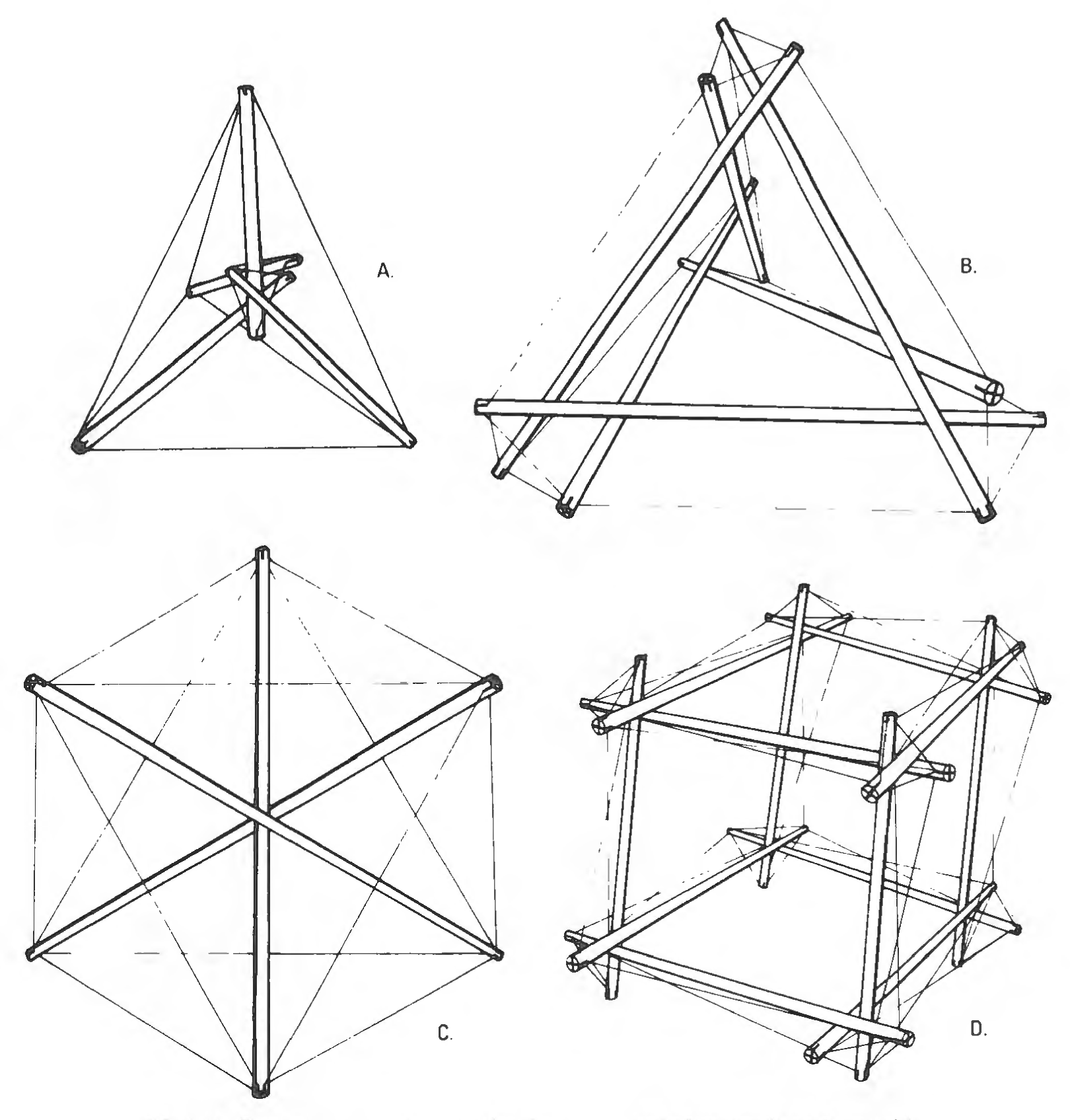
290 We now comprehend that geodesic tensegrity structuring provides the first true and visualizable model of pneumatic structures in which the relative thickness of the enclosing films, in proportion to diameter, rapidly decreases with the increasing size of the balloons or spheric networks.
291 In the case of geodesic tensegrity structures, no overcrowding of interior gas molecules, imprisoned within a submolecular mesh net, is necessary to thrust the net’s structure outward from its spherical geometric center, because the compressional struts, locally islanded as outward-thrusting struts at both their ends, push the spherical net outward at every vertexial advantage of network convergence. Geodesic tensegrities are ‘‘hollowed-out’’ balloons that have discarded their redundantly ‘‘solid’’ air core. The larger the sphere, the greater the number of molecules, the lower the pressure, and the more surface on which to distribute the load or pressure impinging upon the pneumatic system. Doubling the size of the pneumatic or tensegrity sphere reduces to one-quarter the surface enclosure stress occasioned by an external force impingement of a given magnitude (see Fig. 6.44).
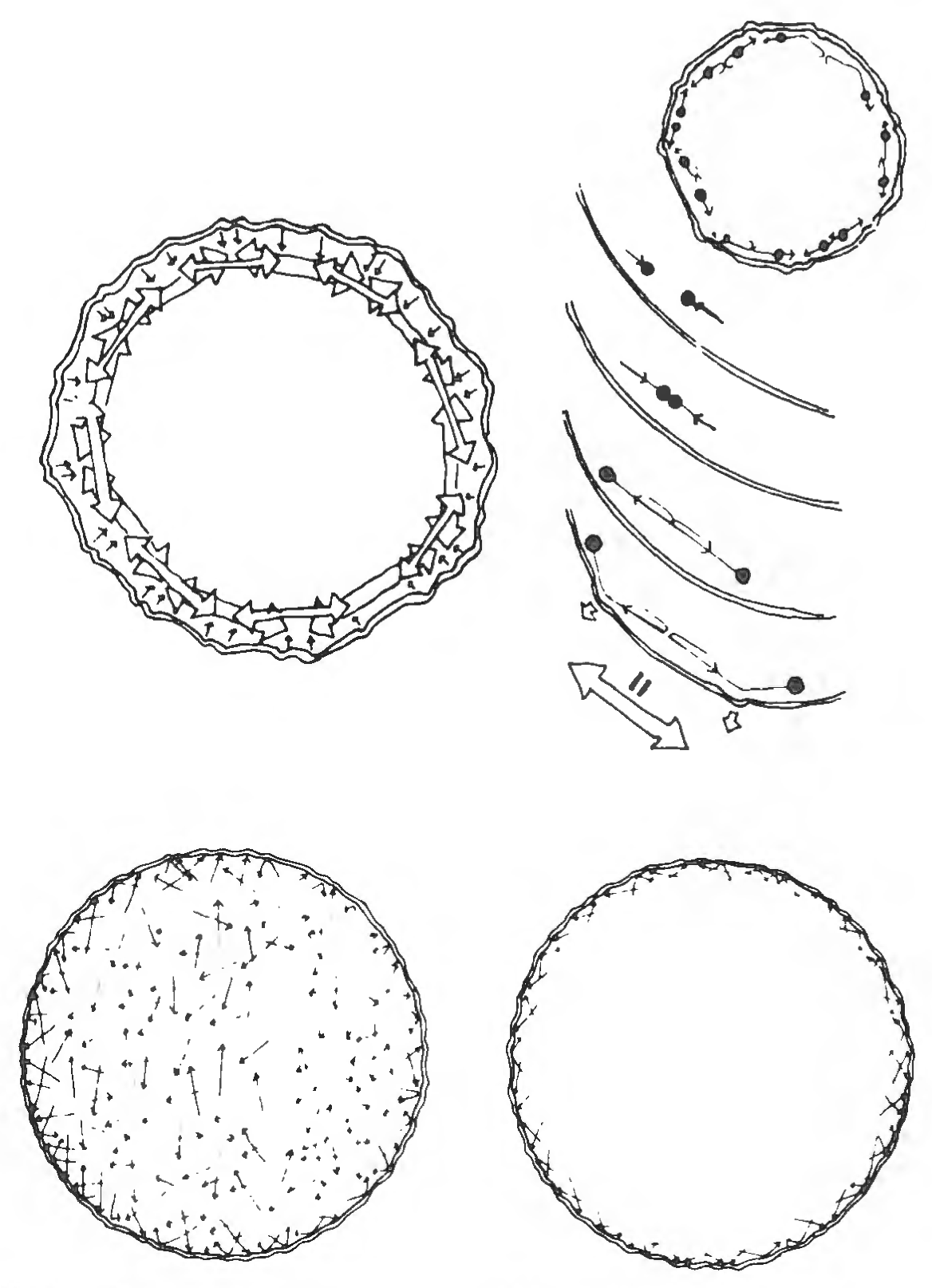
293 Geodesic tensegrities are true pneumatic structures in purest design frequency principle. They obviate the randomness and redundance characterizing the work of designers dealing only with pneumatics, who happen to be successful in blowing air into a bladder while being utterly dependent upon the subvisible behaviors of chemical phenomena. Geodesic tensegrity engineering enables discrete separation of all the structural events into two diametrically opposed magnitude classes: on the one hand, all the outward-bound phenomena, which are too large to pass through all the interstices of, on the other hand, all the inward-bound events in the too-small class. This is the same kind of redundancy that occurs in reinforced concrete, which, if drilled out wherever redundant components exist, would disclose an orderly four-prime-magnitude complex octahedron-tetrahedron truss network, disencumbered of more than 50 percent of its weight.
294 The geodesic tensegrity is a balloon out of which have been removed all the molecules of gas not at the moment hitting the skin and in which those specific molecules of gas that happen to be impinging from within against the skin at any one moment (thus pushing it outward) are replaced by the islanded geodesic struts; in addition, all other redundant molecules are discarded. It is possible to sew pockets on the inside surface of a balloon skin corresponding in pattern to the islanded tensegrity geodesic strut-end positions and then to insert into those pockets stiff battens that cause the otherwise limp balloon bag to take spherical shape, as it would if filled with a pressured-in gas.
295 If we employ hydraulic pressure within the local islands of compression for dimensional stability and if we employ gas molecules between the liquid molecules for local shock-load compressibility (ergo, flexibility), we will find that our geodesic tensegrity structures will in every way have taken advantage of the same structural-strategy principles employed by nature in all her sizes of biological formulations.
6.7 Twelve Degrees of Freedom
296I formed a tetrahedron of six 2-foot-long thin-walled steel tubes with an outside diameter of 1 inch, welded to four 3-inch-diameter steel balls at the tetrahedron’s four corners (see Fig. 6.45).
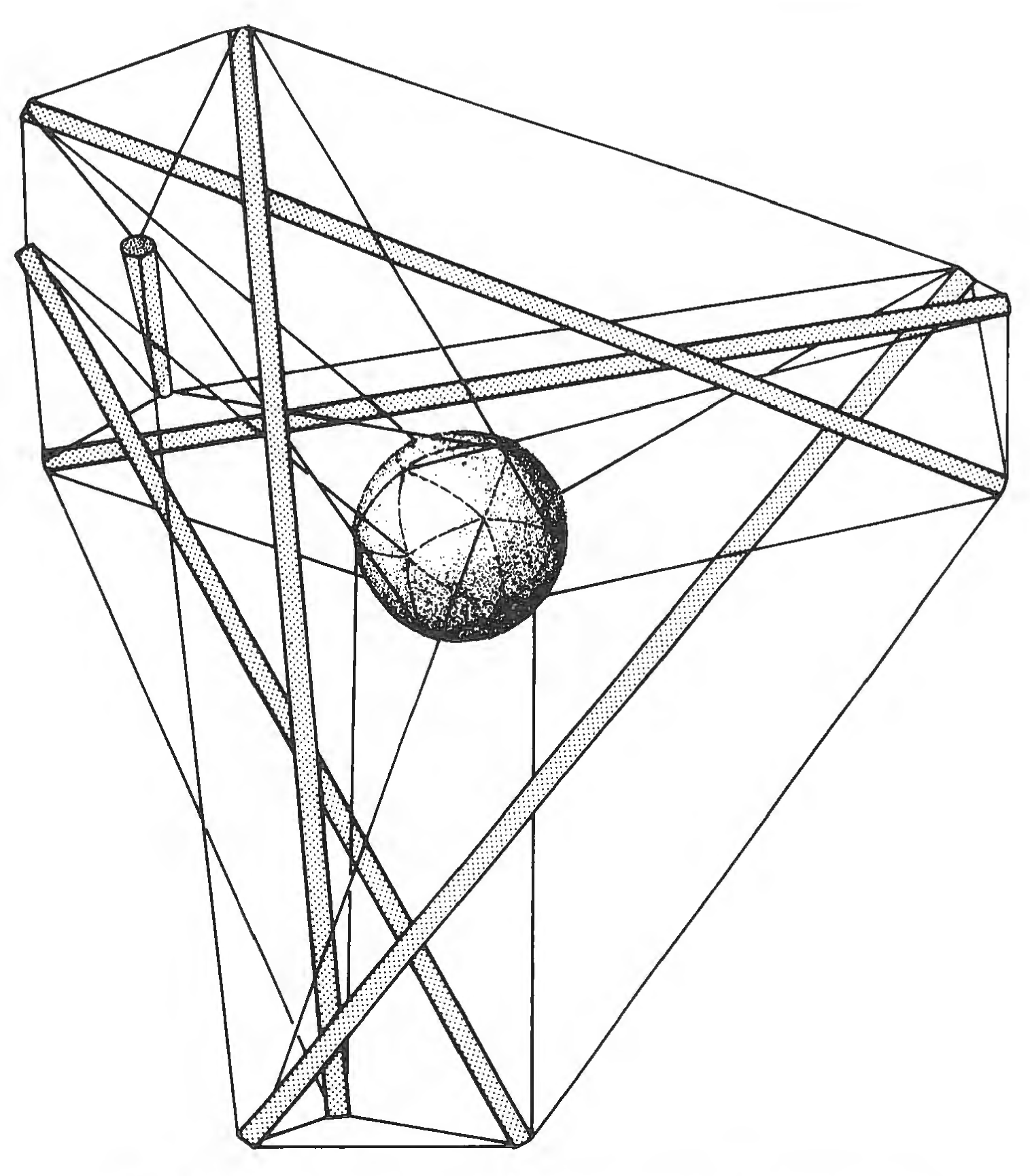
298 I drilled and tapped (threaded) four holes on the inside of the four corner balls. I then connected those four corner balls perpendicularly to a single 3-inch-diameter steel ball located at the center of volume of the tetrahedron, that center ball itself having four drilled and reverse tap-threaded holes. I made the connection of the center ball with the four corner balls by means of four 1 ⁄ 8-inch steel rods, each threaded oppositely at their respective two ends. Then I inserted the positive- and negative-threaded rods between the corner balls and the center ball and tightened them together by rotating the rods with a wrench to shorten the distance between the pulled-together end balls, as with turnbuckles. The center ball could not be dislocated from the tetrahedron’s exact center of volume. I then took a stillson wrench and found that without displacing the center ball from the exact center of the tetrahedron, I could rotate the ball mildly in six different positive and six different negative directions. To counteract these in-place rotatabilities required twelve rods in four sets of three tangential rods, with each rod’s outer end independently fixed tangentially to each of the four outer corner balls of the enclosing tetrahedral frames and with each rod’s inner end fastened only tangentially to the center ball. This produced twelve prime restraints on the center ball, which could no longer either be dislocated from the tetrahedron’s center or be locally twisted in place.
299 Recognizing that the center ball and all of the corner balls are themselves complex microsystems, I discovered that the twelve restraints proved to be the always and only twelve restraints necessary to cope structurally with the twelve degrees of freedom of all independent systems in Universe. If a complex of systems is to act as one system, it is the twelve degrees of freedom and their twelve restraints that must always be structurally (push-pullingly) coped with. As previously noted, they are the same twelve restraints we found to be necessary to stabilize the wire wheel.
300 They disclosed the method by which the twelve degrees of freedom must be coped with to structurally associate systems within systems and to produce the interior rigidity of all superficially misidentified ‘‘solid’’ systems.
301 The four sets of three each, which all together compose the twelve-system structuring and/or intersystem structuring, are four unique additional dimensions of conventional three-dimensional phenomena: 4 × 3 = 12 = 6 positive + 6 negative degrees of freedom.
6.8 Tensegrity Masts
302The minimum structural system in Universe—the tetrahedron—can be tensegrity-structured. A linear growth of the tensegrity tetrahedron becomes a tensegrity column. Because carbon fiber is most probably constructed in exactly this way as a tensegrity tetrahedron column, it is demonstrably the strongest and lightest column structurally producible. This column and its method of assembly are shown in Fig. 6.46.
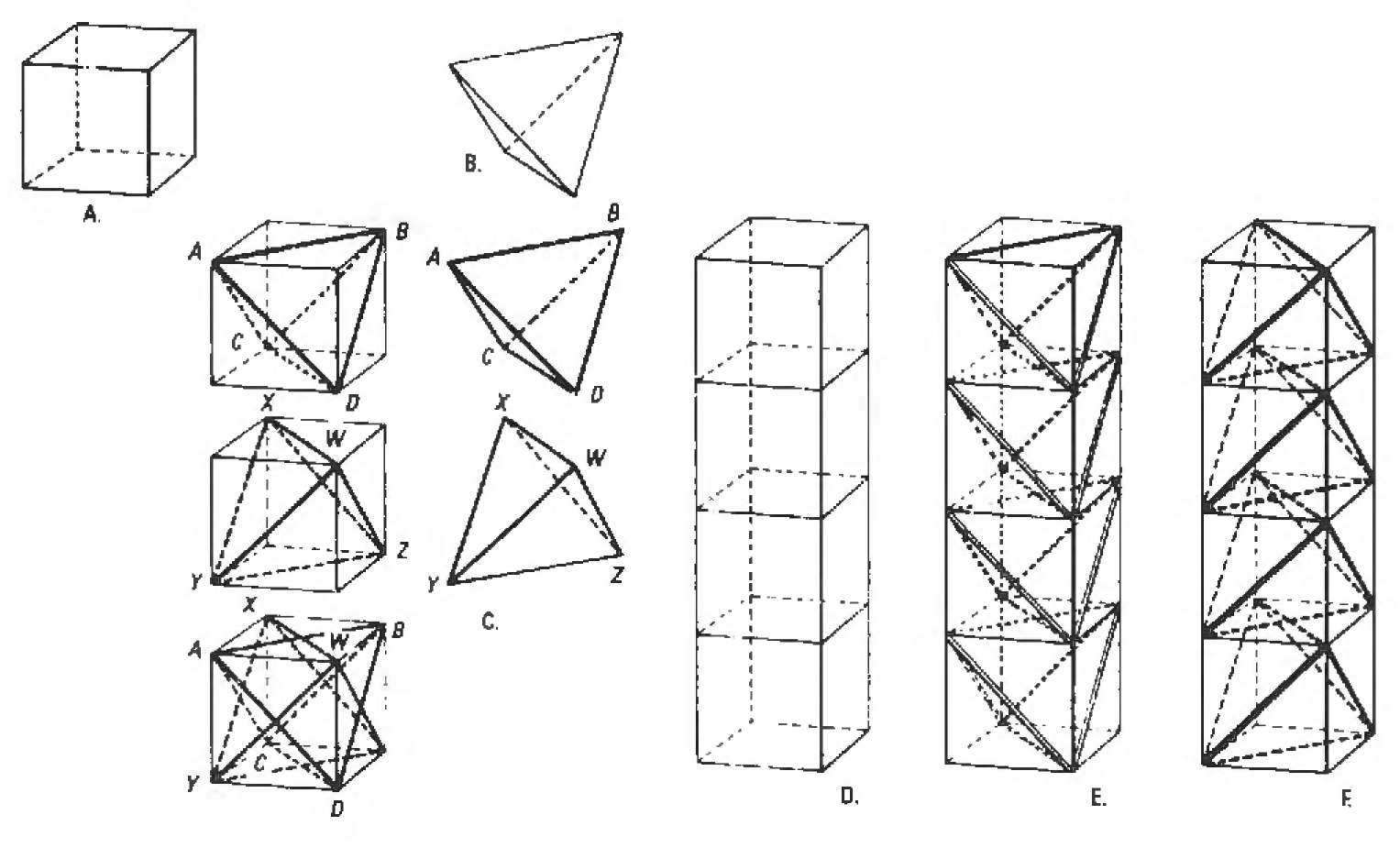
304 Figures 6.46, 6.47, and 6.48 show my omnitetrahedra-comprised tensegrity mast, each of whose struts in turn comprises tetrahedral tensegrity masts, each of whose micromast struts in turn consists of tetratensegrity masts…until we reach the minitude of the atoms, whose internal structuring is discontinuous compression-continuous tension. The tensegrity mast demonstrates why carbon fibers have twelve times the strength per pound of structural steel with minor carbon content and four times the strength per pound of the strongest aluminum alloy.
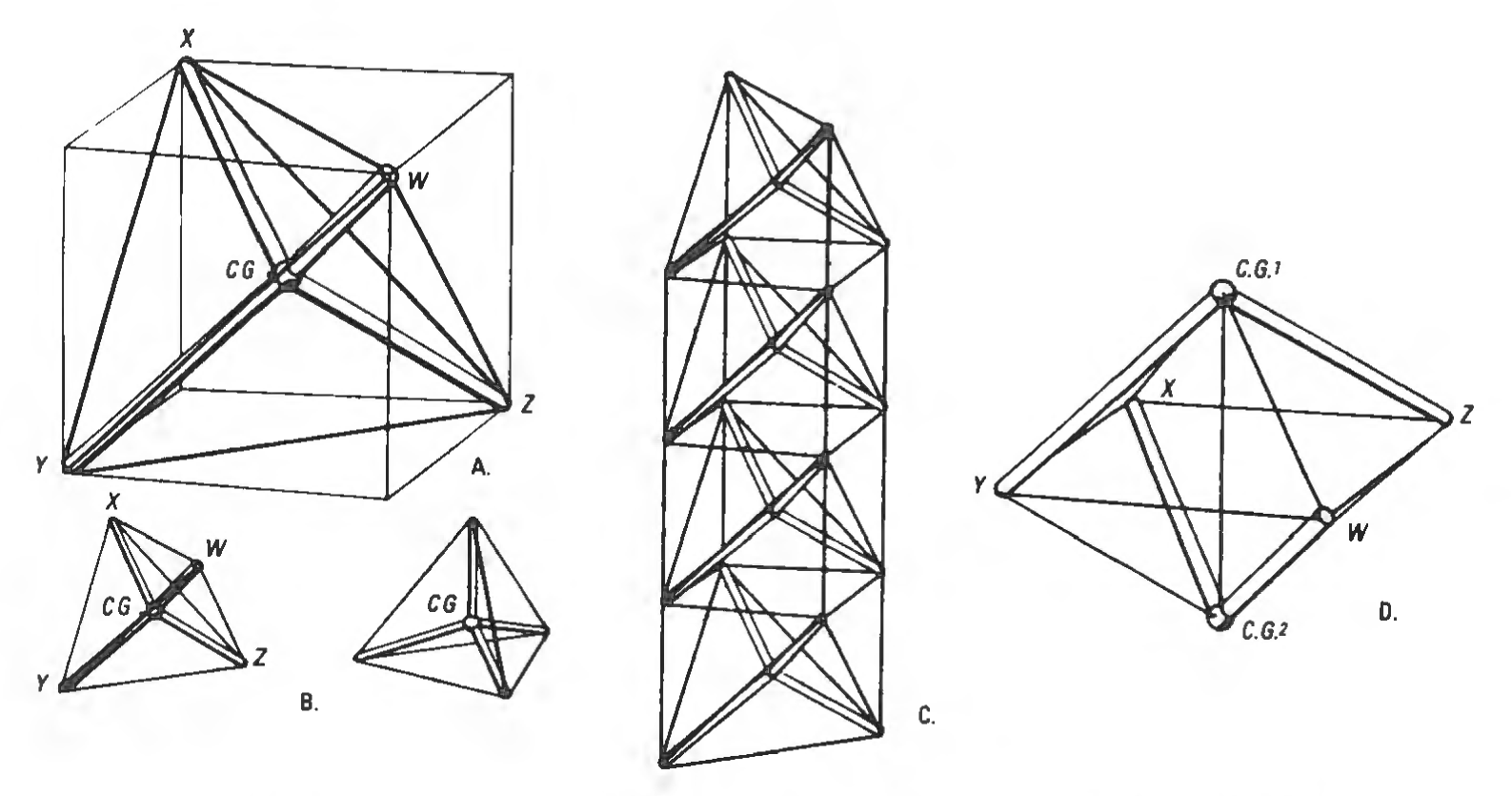
306 In 1983 Boeing Aerospace invited me to conduct a workshop on synergetics for their space station engineers. In delivering payloads into space and in other situations where weight, structural strength, and compactness are critical considerations, the principle of tensegrity will play an important role. The tensegrity mast has the additional property of being able to be delivered entirely collapsed, ready to be explosively expanded into a lightweight, structurally stable construction member upon arrival in space. This exposure of space station engineers to the principle of tensegrity could conceivably advance the space station program by many years. Following nature’s own design principles, humans may be able to produce most-economic designs while at the same time solving formerly insoluble design problems.
307 To realize the significance of tensegrity in understanding nature’s own designs and in implementing the new design science, we turn to cell biology. Don Ingber of the Yale School of Medicine, in a paper entitled Ingber1982 [Ingber1982], describes the role of tensegrity structure in cell architecture:
308309An epithelial structure can be regarded as a tensile or tensegrity system, that is, an architectural unit of the highest efficiency which consists of discontinuous compression-resistant members (e.g., microtubules, cytoskeletal microfilaments, fibrillar collagen) interconnected directly or indirectly by a continuous series of tension elements (e.g., plasma lemma, contractile microfilaments, basal lamina). An epithelial structure can be regarded as a tensile or tensegrity system, that is, an architectural unit of the highest efficiency which consists of discontinuous compression-resistant members (e.g., microtubules, cytoskeletal microfilaments, fibrillar collagen) interconnected directly or indirectly by a continuous series of tension elements (e.g., plasma lemma, contractile microfilaments, basal lamina). The term ‘‘tensegrity’’ derives from the concept of ‘‘tensional integrity’’ and is a most efficient and economical architectural system in which all loads are distributed equally over all elements. As dynamic tensile structures, cells alter their shape until an equilibrium configuration is attained which most efficiently and evenly distributes the load given the characteristic architectural distribution of anchors within the substratum. Thus, cells within a tissue might respond to physical alterations in their environment as a coordinated unit due to the equal and simultaneous distribution of forces to all of the elements of this organic tensegrity system.
310 Finally, we discover that every geometrical structure is a tensegrity. We determine that all geometrical structural systems can be encompassingly realized by only the isolated, omniislanded, discontinuous compression (repulsive) force components omniintegrated by the always-closed-back-into-itself, continuous tensional network of interattraction. This is to say that for every geometrical structural system, simple or complex, there is always a tensegrity structure (see Fig. 6.43).
6.9 Spherical Trigonometry: The Greek Sphere
311As defined by the Greeks, a sphere is a surface equidistant in all directions from a point. But a surface equidistant in all directions requires the existence of the phenomenon known as ‘‘solid.’’ Physics has found no solids, no absolute continua. An absolute continuum could have no discontinuities and ergo no beginning or ending surface. As defined, a Greek sphere could have no holes in it, since the curvature at the edges of the rims of the holes would be at differing distances from the sphere’s center. Having no holes in its perfectly solid continuum, the Greek sphere could not accommodate any inbound or outbound traffic, thus being unable either to import or to export energy and ergo defying the second law of thermodynamics, by which all systems are always losing energy. It would therefore become the first local perpetually regenerative system in Universe. If that were so, the remainder of the complex, everywhere and everywhen, intertransforming, nonsimultaneous, regenerative events of Universe would be excessive and redundant. Since nature always accomplishes her events in the most economical way, she would be the solid perpetually regenerative sphere system, but no solids are in experiential evidence.
312 Since physics has discovered no absolutely solid continua, we find it necessary to redefine the spheric experience. Our definition of the spheric experience is ‘‘an aggregate of events approximately equidistant in approximately all directions from one small, central, minimum-system locus.’’ ‘‘Approximately all directions’’ involves a vast number of measurements that would require a vast amount of time to complete, within an ever-transforming Universe that accounts for that only ‘‘approximate’’ equidistance. This means that the spheric experience is an aggregate of minisystem points, approximately equidistant in almost all directions from one central minisystem point. Each of the spheric aggregate of points (microsystems) will have its nearest neighboring points (systems). Most economically interconnecting those points with their nearest neighbors involves omniintertriangulating the whole spheric array, which means producing high-frequency geodesic spheres in whose surface aggregation of points it will be found that the sums of the angles around all the surface points will always be a number that is 720∘ less than the total number of spheric points multiplied by 360∘.
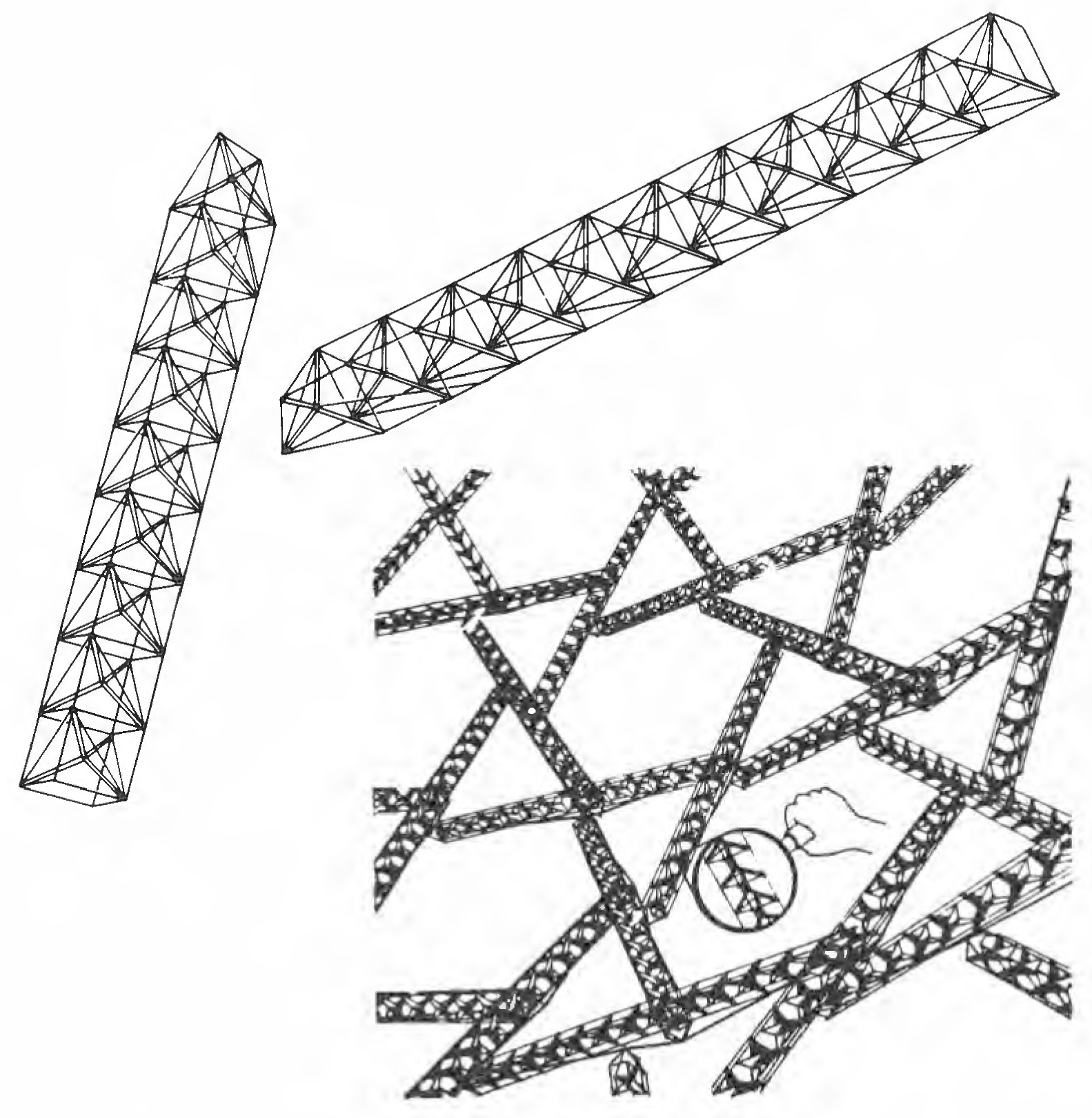
314 I recently made a triangle out of six stainless-steel straps, all of the same length (18 inches). These straps were fastened together three at each corner so that two of them make two sides of the triangle and the third member becomes the perpendicular bisector of the triangle (see Fig. 6.49). There are therefore three such perpendicular bisectors. The perpendicular stainless-steel straps are made to slide by each other in the center of the triangle. Their ends go through slots on the edge to which they are perpendicular. There are both in and out slots. The perpendicularly impinging ends of the stainless-steel perpendicular bisector straps jut out several inches. They can be pushed or pulled through the slot. You can slide-push the strap end inwardly through the slot. Pushing all three perpendicularly impinging ends inwardly an equal amount humps the crossing straps spherically in the middle and forces the outer triangle to go into sphericity.
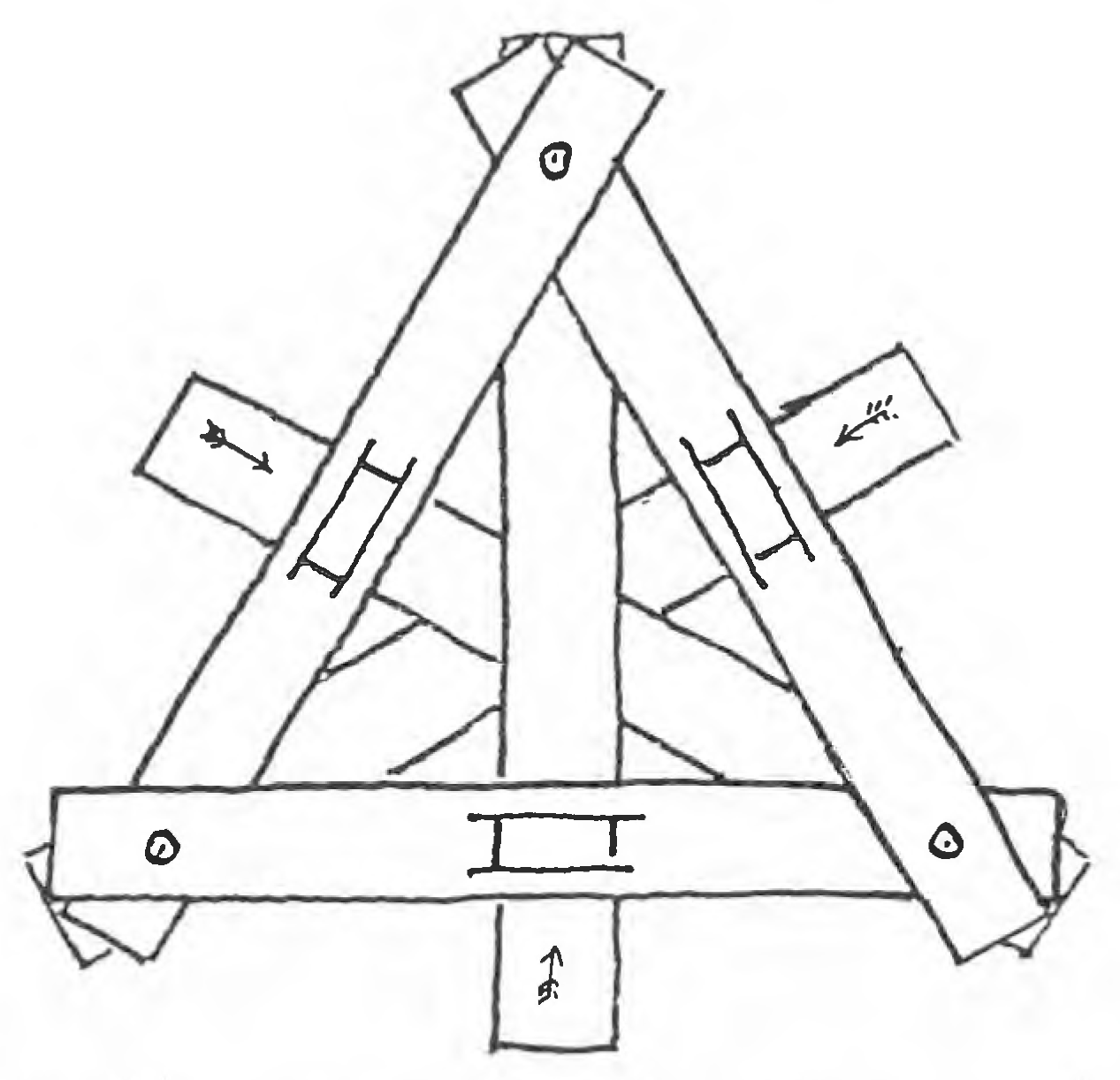
316 There is a hole in the middle of the slot at the point where the perpendicular bisector goes through the strap. There are also three hole positions in the three perpendicularly impinging strap ends. The perpendicular bisectors cross one another at 60∘ angles at the triangles’ center and remain in 90∘ perpendicularity to the edge.
317 When the whole triangle is flat, the three angles are 90∘, 60∘, and 30∘, the angles of a conventional draftsman’s triangle. As you push the perpendicular bisector straps inward and the triangle bows outward into a spherical triangle, at the first hole point the six right triangles read 90∘, 60∘, and 36∘ (instead of 30∘). When you push the strap in further, to hole number two, the six small right triangles read 90∘, 60∘, 45∘; in the third hole position, they read 90∘, 60∘, 60∘.
318 The spherical humpings of the straps to the first hole make 90∘, 60∘, 36∘. Twenty of these make the spherical icosahedron. Eight of the 90∘, 60∘, 45∘ stainless-steel models make the spherical octahedron. The model that reads 90∘, 60∘, 60∘ makes the four triangles of the spherical tetrahedron.
319 In the case of the spherical tetrahedron’s triangles of 90∘, 60∘, 60∘, another 30∘ have been added to the original 30∘ corner position. In the case of the spherical octahedron of 90∘, 60∘, 45∘, the small corner triangle is 15∘ more than the original 30∘. In the icosahedral phase, the corner triangle reading 36∘ is 6∘ more than the original 30∘.
320 Geodesists and surveyors call these additions spherical excess. In the case of the icosahedron, there are 120 of these 6∘ spherical excess corners (120 × 6∘ = 720∘). With the spherical octahedron, where the corner is 45∘ instead of 30∘, there is 15∘ of spherical excess for each corner and 48 such corners (48×15∘ = 720∘).
321 With the spherical tetrahedron, which has 90∘, 60∘, and 60∘ in its complement of angles, or 30∘ more than the original, we have a total of 4 main equiangular triangles ×6, or 24 small triangles (24×30∘ = 720∘).
322 Voilà! In each case it is 720∘. This constant 720∘ is the sum of the angles of one regular tetrahedron. Thus, we have demonstrated that the sum of the angles around all the vertexes of any polyhedron is always evenly divisible by the number 720—that is, by one whole tetrahedron.
323 The sum of the angles around all the vertexes of a tetrahedron is 720∘. This is true of the sum of the angles around the vertexes of any system, symmetrical or asymmetrical.
324 The sum of the angles around the vertexes of any system, whether it is all the outer shape-defining points of a crocodile, a giraffe, or an orange, is always evenly divisible by 720 and is always 720∘ less sum-totally than the numbers of outer vertexes times 360. In other words, this sum is always the remainder of subtracting one tetrahedron’s 720∘ from the number that is the product of multiplying all the vertexes of the system by 360∘.
325 Most important, the difference between a flat piece of paper and a polyhedron is one tetrahedron, and the difference between a polyhedron and a sphere is always one more tetrahedron, 720∘. In a sphere there are always 360∘ around every point. This is to say that in a spherical polyhedron the sum of the angles around all its external vertexes is always one tetrahedron greater than that sum in a planar-faceted polyhedron. This means, then, that whereas the regular tetrahedron of straight edges has a volume of 1, we added one tetrahedron to make it a spherical tetrahedron, the volume of which is exactly 2.
326 The volume of the regular octahedron, 4, has had one tetrahedron added to it to produce its counterpart, the spherical octahedron, which has a volume of 5.
327 The icosahedron has a volume of 18.51 with straight edges. As a spherical icosahedron, it has a volume of 19.51, one tetrahedron added.
328 I was able to write out this new hierarchy of primitive systems and find it to be the initial structuring system of Universe—and so sublimely simple, with the only variables being the first four prime numbers.
329 UNIVERSE IS THE SUM of all positive and negative intercomplementations. To realize a system—for instance, a thought—means tuning in the thought and leaving all the rest of the Universe untuned. This is done by subtracting or withdrawing one tetrahedron:
| (6.15) |

331 or more correctly
| (6.16) |

333 Spherical great circles are geodesics. As we recall, a geodesic is the most economical relationship between any two events. Geodesic lines are the shortest surface distances between two points on the outside of a sphere.
334 A great circle is that line formed on the surface of a sphere by a plane passing through the sphere’s center. The Earth’s equator is a great-circle geodesic; so, too, are the Earth’s meridians of longitude. Any two great circles of the same system must cross each other twice in a symmetrical manner, with their crossings always 180∘ apart.
335 Now, in view of all the experimental evidence of physics, the most accurate definition of the spheric-system experience is an aggregate of energetic events approximately equidistant in approximately all directions from one approximately immobile event center. Since great circles prove to be the shortest distance between any two points on a sphere, and since the chords of spheres are shorter than the arcs of great circles, the shortest distance between any two spheric surface ‘‘events’’ is the great-circle chord. Also, since every surface event always has two nearest event neighbors, all the spheric experience systems may be intertriangulated; ergo, they demonstrate high-frequency spheric-cord division.
336 All the atoms in the surface of a highly polished steel-alloy ball bearing may be chordally intertriangulated. Circles have always been assumed to be the line formed by a plane cutting through a sphere, and a great circle has been assumed to be the line formed on the surface of a sphere by a plane passing through the exact center of a sphere, all of which required instantaneous (in no time) interacting and measuring. We have now to assume that what has always been thought of as a circle is an always finite polygon of chordal interlinkages. This fact forever banishes Newton’s and Leibniz’s theories positing the existence of ‘‘fluxions,’’ and with those theories goes the familiar school textbook staple, pi. In reality we have, in their stead, only vastly high-frequency, omnichordally triangulated geodesic polyhedra.
337 We need never again wonder how nature uses the unwieldy and unresolvable pi (3.14159265…) in calculating the construction of each of the spherical bubbles in a speedboat’s wake, speculating at what point nature rounds off that unresolvable number. She does not. Computers recently have been able, with much effort, to calculate pi to the millionth-plus decimal point. Nature does not employ such uneconomical means in her design strategies, only twentieth-century scientists and high school math departments. Nature does not use unresolvable numbers in her designs.
338 As we have demonstrated, the sum of the angles around all the vertexes of any and all systems is always a number evenly divisible by 720∘ and is always a number 720∘ less than the number of vertexes of the system multiplied by 360∘. This latter condition has been heretofore assumed to be valid—i.e., that for an infinitesimal moment, a sphere tangent to a plane is congruent with that plane, and likewise, a straight line tangent to a circle is for that same infinitesimal moment congruent with that circle. I am therefore continually seeking ways to describe the vanishment of pi, which is the misassumption that we could have absolute planar 360∘ surroundment of a sphere.
339 Since pi cannot be mathematically resolved, nature cannot use it, and you and all of us had best stop doing so or we will sacrifice our divine gift of mind, which deals exclusively with the truth.
340 In geodesics, it is through the strategy of using great-circle chords and not arcs that I have succeeded in triangling the sphere.
341 Unity is plural and at minimum two. A triangle must be bounded by something, there being no infinite planes.
342 The Greeks defined a triangle as an area bounded by a closed line of three edges and three angles. A triangle drawn on the Earth’s surface is actually a spherical triangle described by three great-circle arcs. It is evident that the arcs divide the surface of the sphere into two areas, each of which is bounded by a closed line consisting of three edges and three angles; thus, the total area of the sphere is divided into two complementary triangles. The area apparently outside one triangle is seen to be inside the other. Because every spherical surface has two aspects—convex if viewed from outside, concave if viewed from within—each of these triangles is in itself two triangles (Fig. 6.51). Thus, one triangle becomes four when the total complex is occultly (as in astronomical convention) understood. Drawing or scribing are operational terms. It is impossible to draw without an object upon which to draw. The drawing may be made either by depositing on or by carving away—that is, by creating either a trajectory or a tracery of the operational event. All the objects upon which drawing may be operationally accomplished are structural systems having insideness and outsideness. The drawn-upon object may be symmetrical or asymmetrical, a piece of paper, a clay tablet, the surface of the Earth, or a blackboard system having insideness and outsideness.
343 Having now determined that a physical sphere is a closest-to-one-another assemblage of atoms equidistantly arrayed around and from a common center and, further, that the closest-to-one-another intersurface distancing of these atoms is by their chords and not their arcs, we see the nuclei of a physical sphere interpattern as an aggregate of edge-congruent triangles. Since the sum of the angles around the outer vertexes of these triangles is always a number less than 360∘, the old concept of a plane and a sphere being for a moment the same 360∘ is invalid and not physically demonstrable. Atomic physics’ geometry, we may therefore conclude, is non-Euclidean. These implementations of synergetic geometry have brought me to the point where I am able to say conclusively that I am beginning to comprehend incisively the structure of matter in all of its variable states, and molecular, atomic, and subatomic patterning.
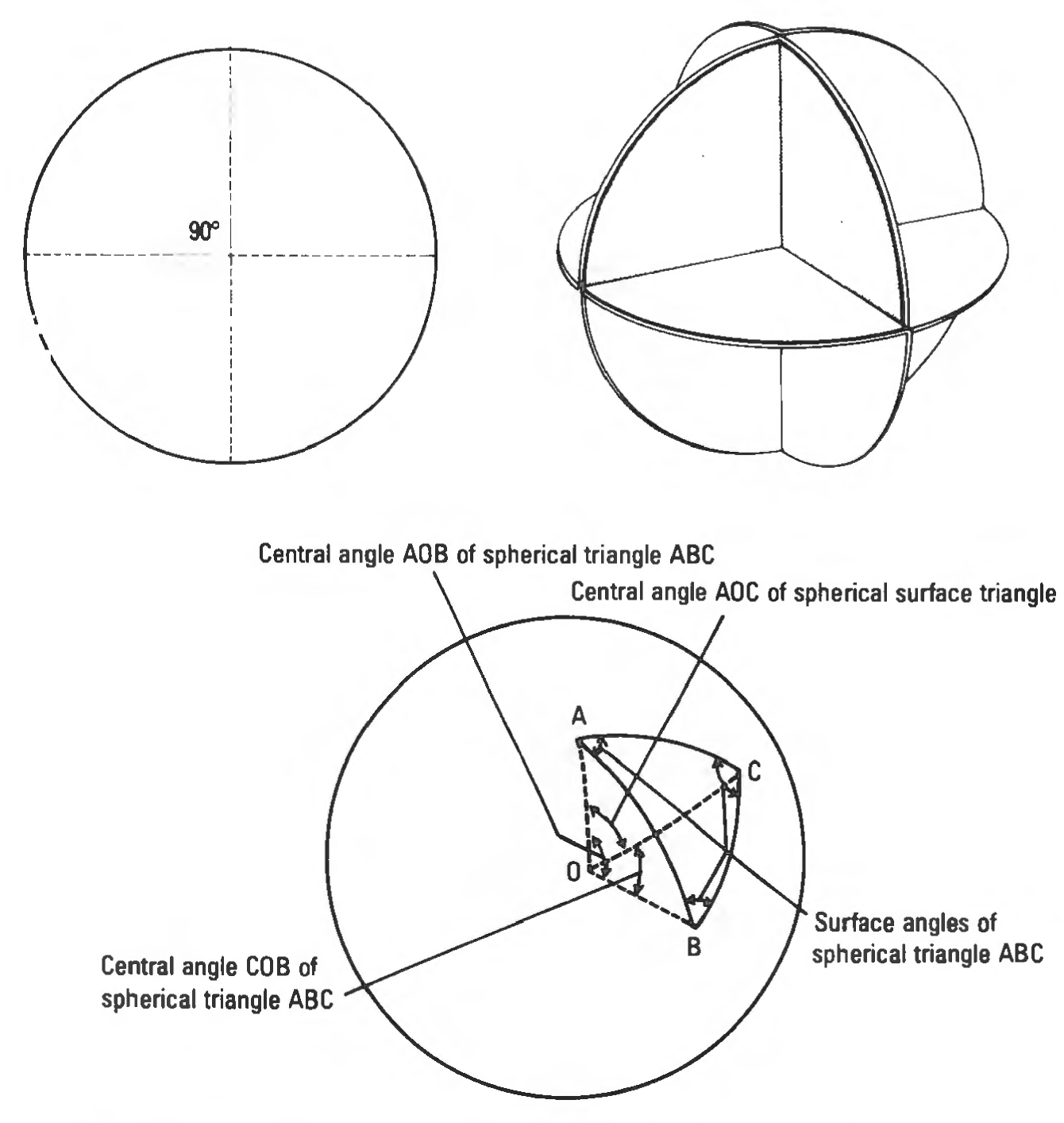
345 We next discover that the higher the frequency of spherical tensegrity structure, the shorter the islanded compressional chords, indicating that at very high frequency the chordal struts contract to become islanded spheres—spheres of compression. Any axis of a sphere is a neutral axis, and the high-frequency asymmetric polyhedra (the so-called spheres) contain the most volume with the least surface. The ‘‘sphere’’ is the unattainable limit condition of line contraction.
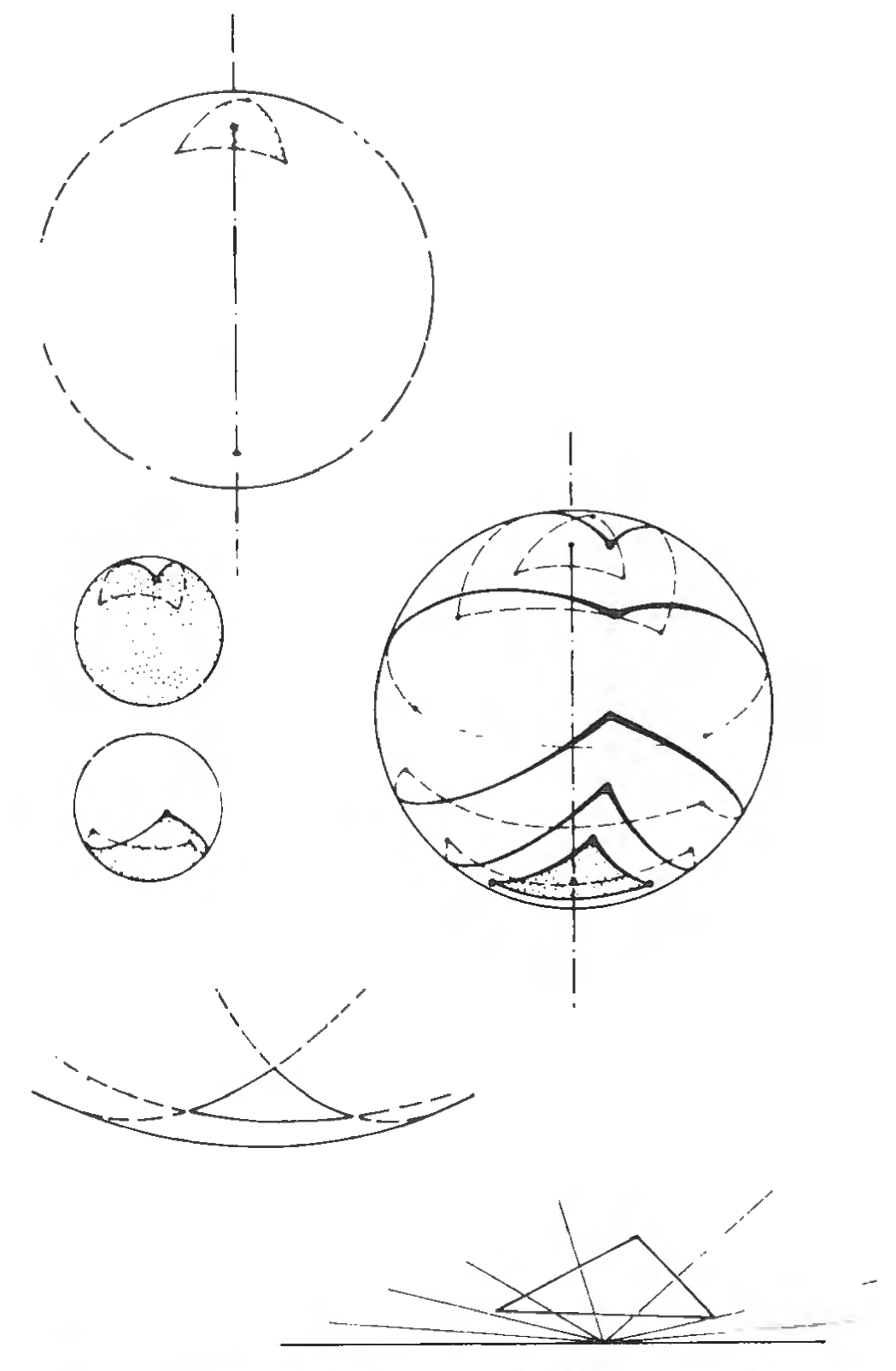
347 We then discover what has for ages disturbed physicists: the seemingly contradictory coexistence of particle discontinuity and wave continuity. Particle discontinuity is islanded compression of Universe, and wave continuity is tensional, gravitational integrity of Universe.
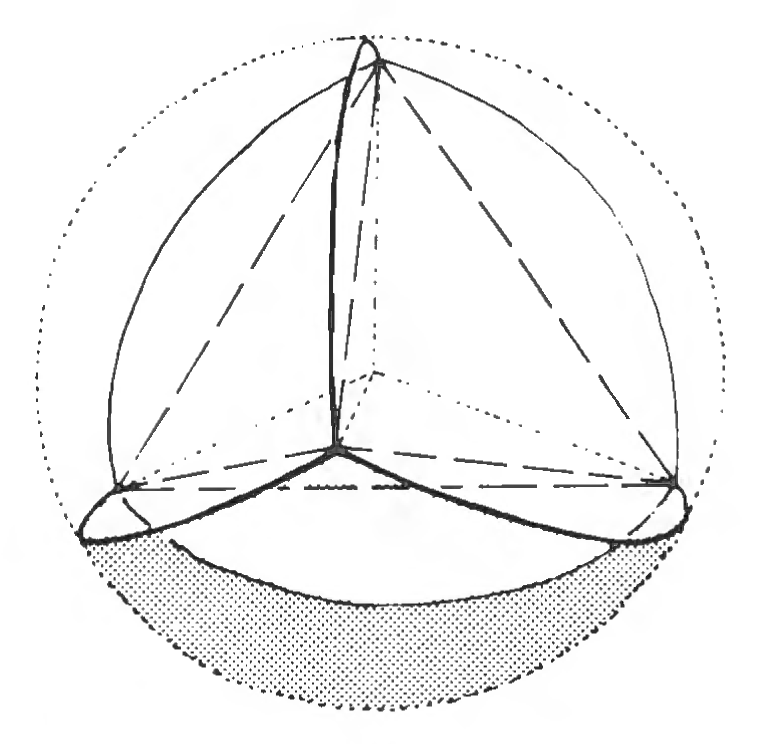
349 We have come to call this discontinuous compression with continuous tension tensegrity. As I described before, I coined the term to represent the universal phenomenon of tensional integrity. In tensegrity, all the system’s tension vectors are inherently wavilinear and vibratible, and they always distribute their closed-system, tension-imposed stressing absolutely evenly (as the pneumatic tires distribute their internal pressures evenly to all their tensionally enclosing, high-tension-resistant tire casings).
350 Each tensegrity system can be overall, evenly tunable, tightened or loosened by the microcosmic and macrocosmic forces internally and externally affecting the system by its cosmic environment neighboring system.
351 Closed-back-on-itself continuous tension is wave; spherical islands of compression are icosahedral aggregates of tetrahedral particles. Only in an ultra-high-frequency polyvertexial system (the quasisphere) is every axis a neutral axis. Spheres are the limit-reaction conformation of all omniinterrepulsive forces. Spheres may be implosive or explosive, energy importers or exporters, planets or stars, atomic nuclei or icosahedral aggregates of tetrahedral photons.
352 All structural systems can be demonstrated as tensegrity models. The relative lengths of either the interpulsing or interattracting vectorial components of any and all structural systems can be determined swiftly by spherical trigonometry and slowly by XY Z coordinate calculus. The tension and compression components are all chords of central angles of the convergent-divergent, spherical configurations of one or more of the seven sets of unique great-circle symmetries corresponding indirectly to all seven of the crystallographic symmetries. See synergetics [synergetics] for all such data.
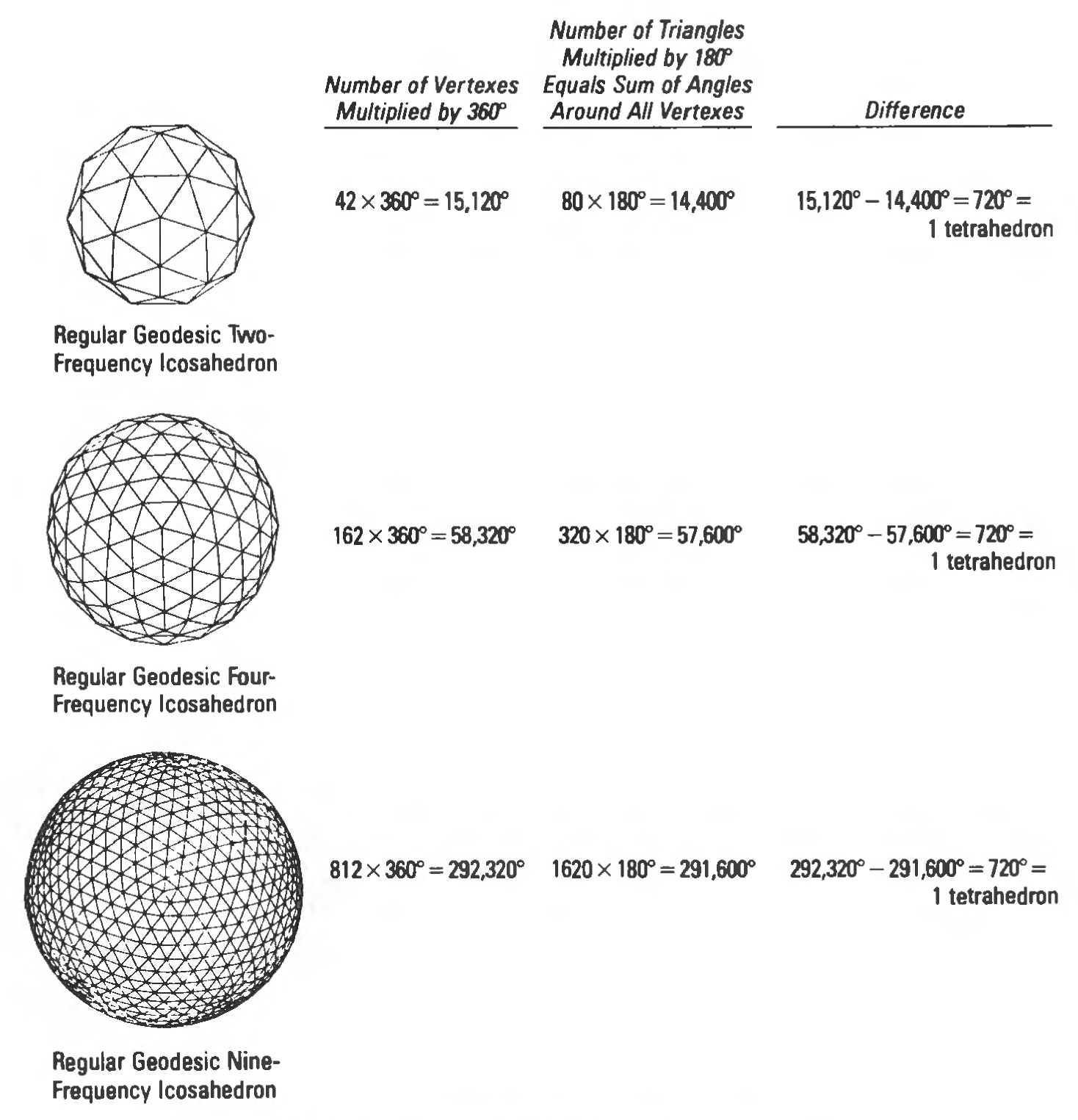
354 The spherical trigonometry is relatively simple, and the readily available trigonometric pocket computers make it possible to obtain in minutes the chord data for any structural system you choose. If you want to use the conventional XY Z coordinate system, you will have to use academic science’s calculus, which will take you much longer—years.
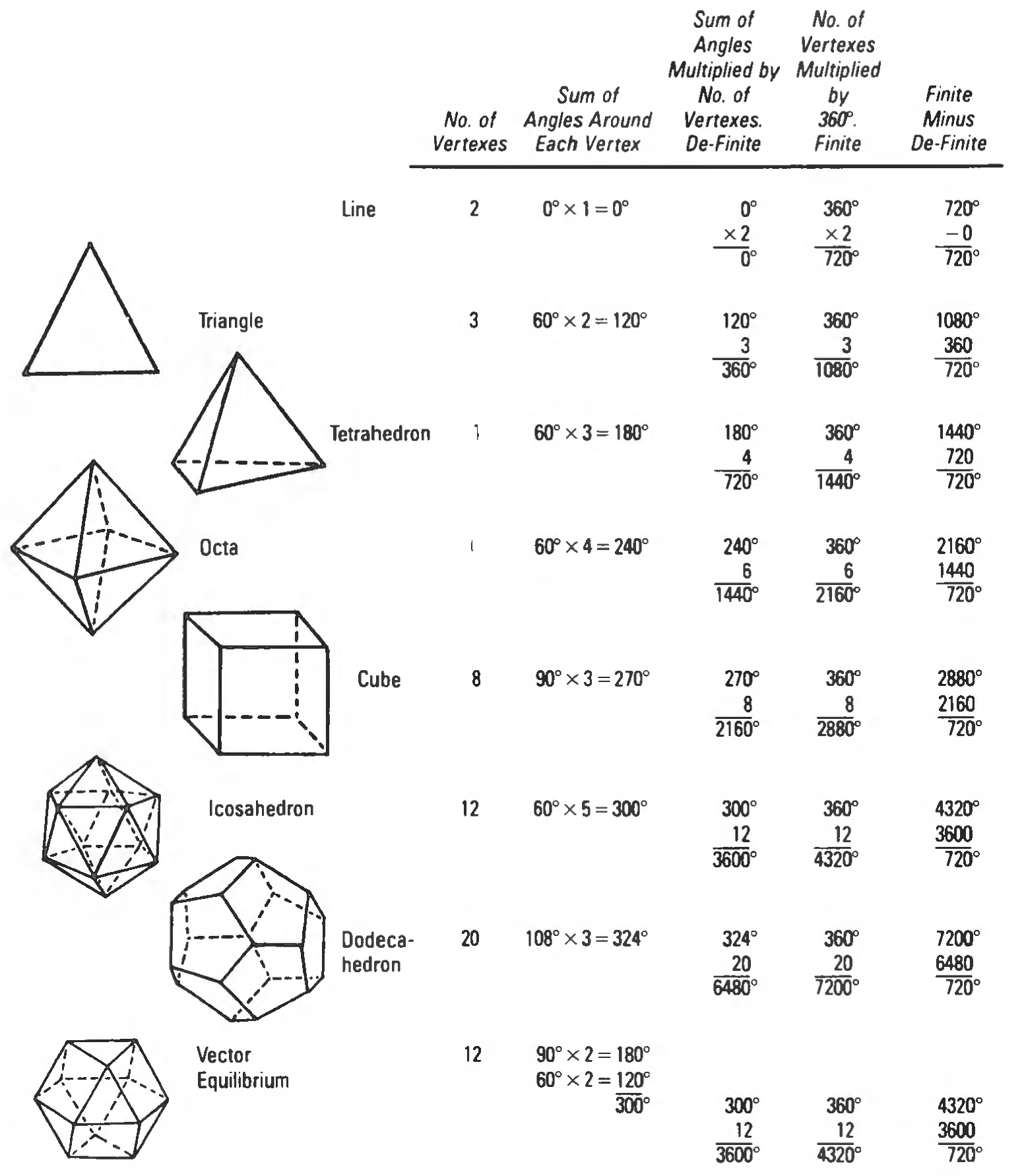
S + 720∘ = 360∘ Xn, where S = the sum of all the angles around all the vertexes (crossings) and Xn = the total number of vertexes (crossings).
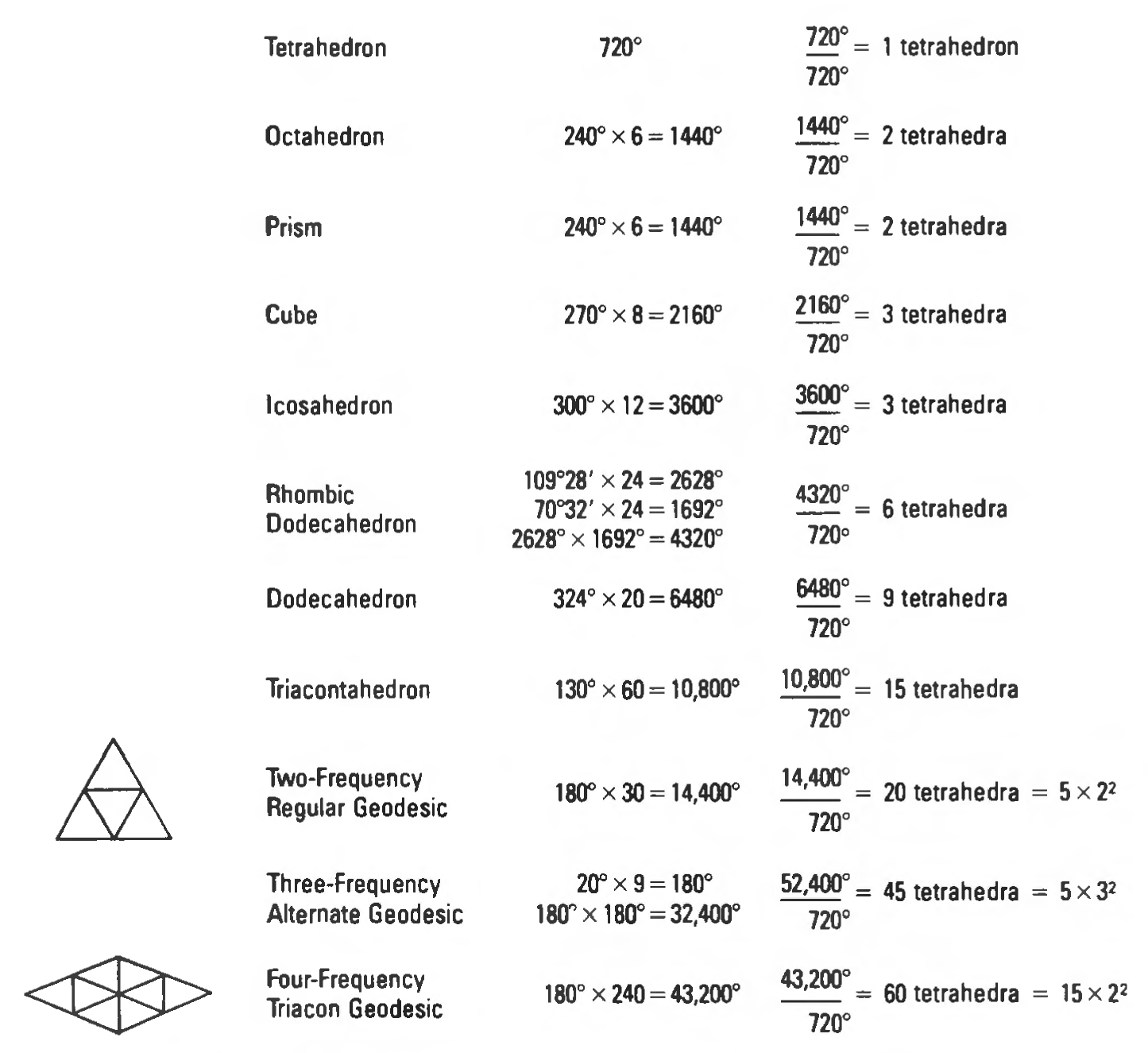
6.10 Six Fundamental Motions of Universe: Vectors and Degrees of Freedom
357There are always and everywhere insistently operative six positive and six negative degrees of freedom. All six of the degrees of freedom must be brought under local control to produce local Universe structure, which always also involves twelve comprehensively co-acting, reactive, inertial complementations, which govern all such structuring. The minimum of twelve wires that hold the hub of a wire-wheel stable in relation to its rim demonstrates this principle (see Fig. 6.60). Twenty-four positive Universe vectors and twenty-four inside-out Universe vectors are always involved.
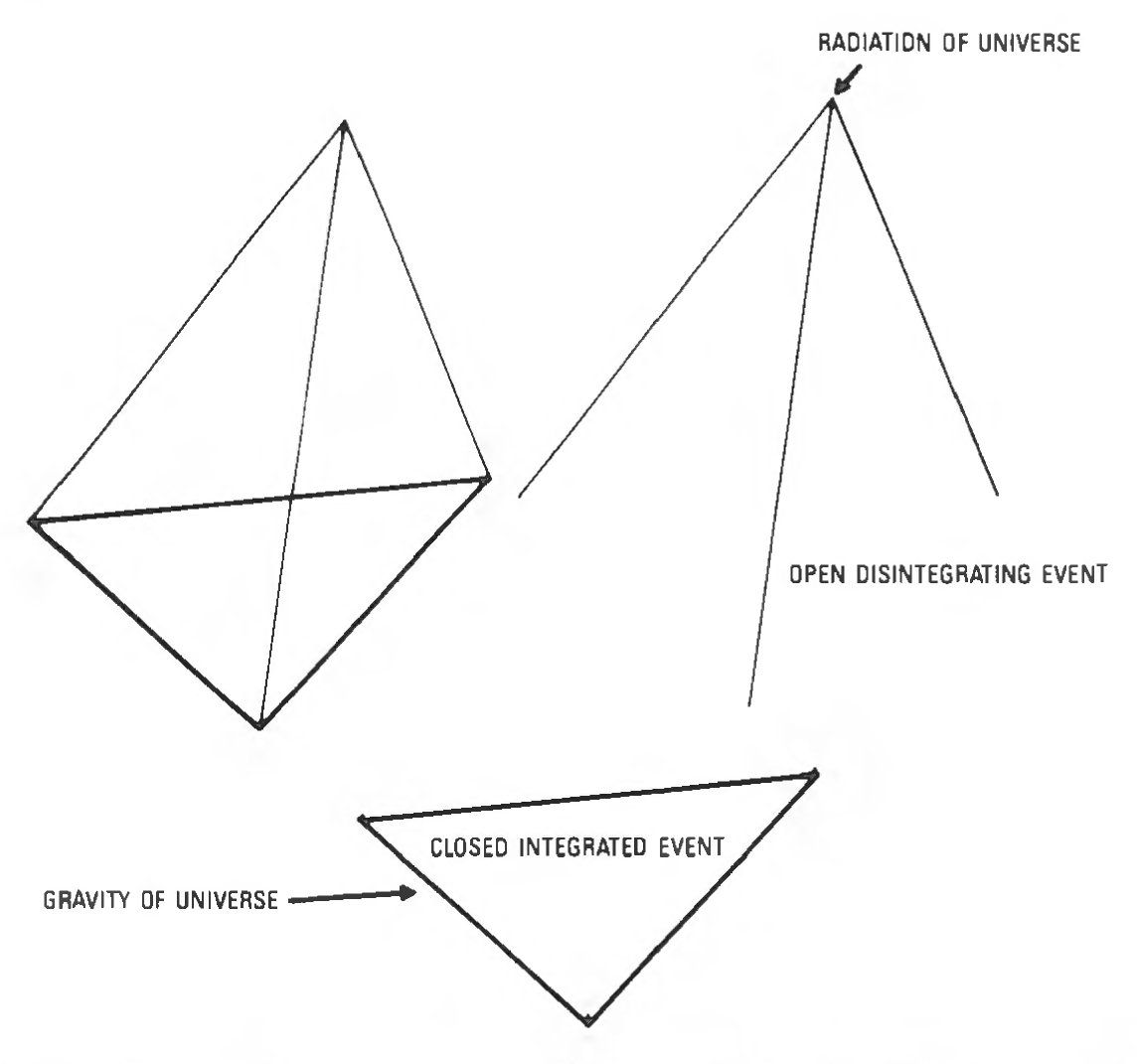
359 We will go on later to discover nonunitarily conceptual Universe and its conceptual systems subdivisions of Universe in further detail, but for the moment, note that the nonsimultaneous realistic conceptualizing of the macro-, mezzo-, and micro-tune-in-able, thinkaboutable systems are characterized by electromagnetic, gravitational convergences and divergences of the local system’s growths and decays, associatings and disassociatings, coexpandings and contractings. All this multiplexed convergence and divergence is inherently referenced to concentric wavesurface spheres of various radial wavelength magnitudes—all of which radii are always perpendicular to the wave-sphere surfaces and none of which radii are ever parallel to one another—and all the intercoordinating of the thinkaboutable and conceptualizable system may be realizably, definitively, and elegantly calculated in spherical trigonometry.
360 Spherical trigonometry’s whole-system, whole-circle 360∘ interrelationships are alone eternally, finitely intervarying complementations of one another and are always expressible as either central angles (previously misidentified as edges of surface angles) or as the surface-angle magnitudes themselves. To spherical trigonometry, synergetics and geodesics introduce the elegantly finite closed-system frequency of modular subdividing of its component parts as governed entirely by the trigonometric relationships within one of the spherical icosahedron’s 120 basic right triangles,5 as well as within only one of the octahedron’s eight basic triangles and within only 1 of the spherical tetrahedron’s 24 basic triangles.
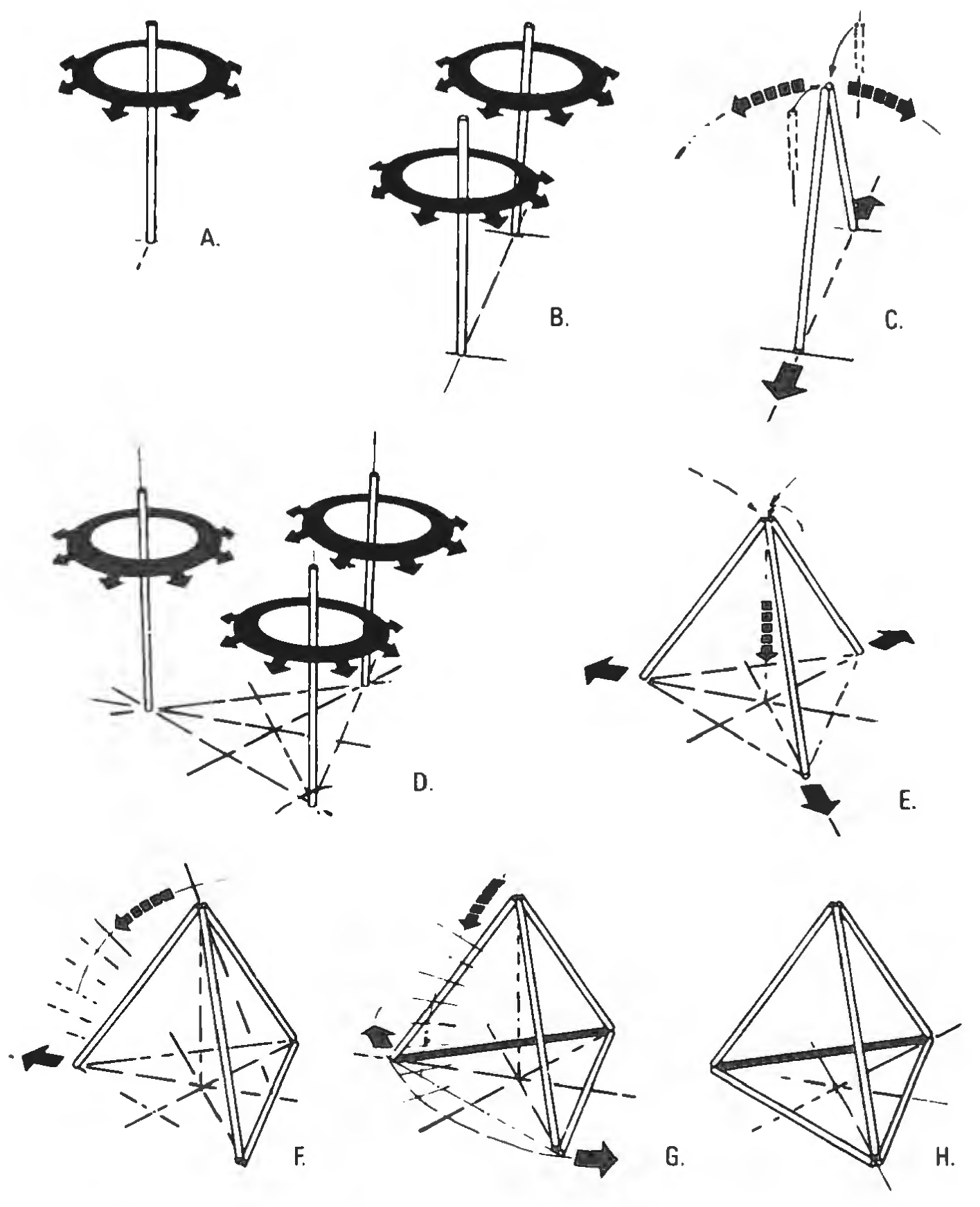
- A.
- Stick standing alone is free to fall in any direction.
- B.
- Two sticks: each is free to fall in any direction.
- C.
- Two sticks: top-joined by falling toward one another and now seen as a group; free to hinge-fall and to slide apart.
- D.
- Three sticks: free to fall in any direction.
- E.
- Three sticks top-pointed by falling toward one another; free to have its three feet slide apart at bases and its tip ends intertwist.
- F.
- Four sticks: a propped-up triangle, in which both the base of the triangle and the feet of the props are free to slide out.
- G.
- Five sticks (members): two triangles may hinge outwardly and collapse as their bases hinge-slide apart.
- H.
- Six sticks (members): complete multidimensional stability—the tetrahedron—the minimum structural system of Universe.
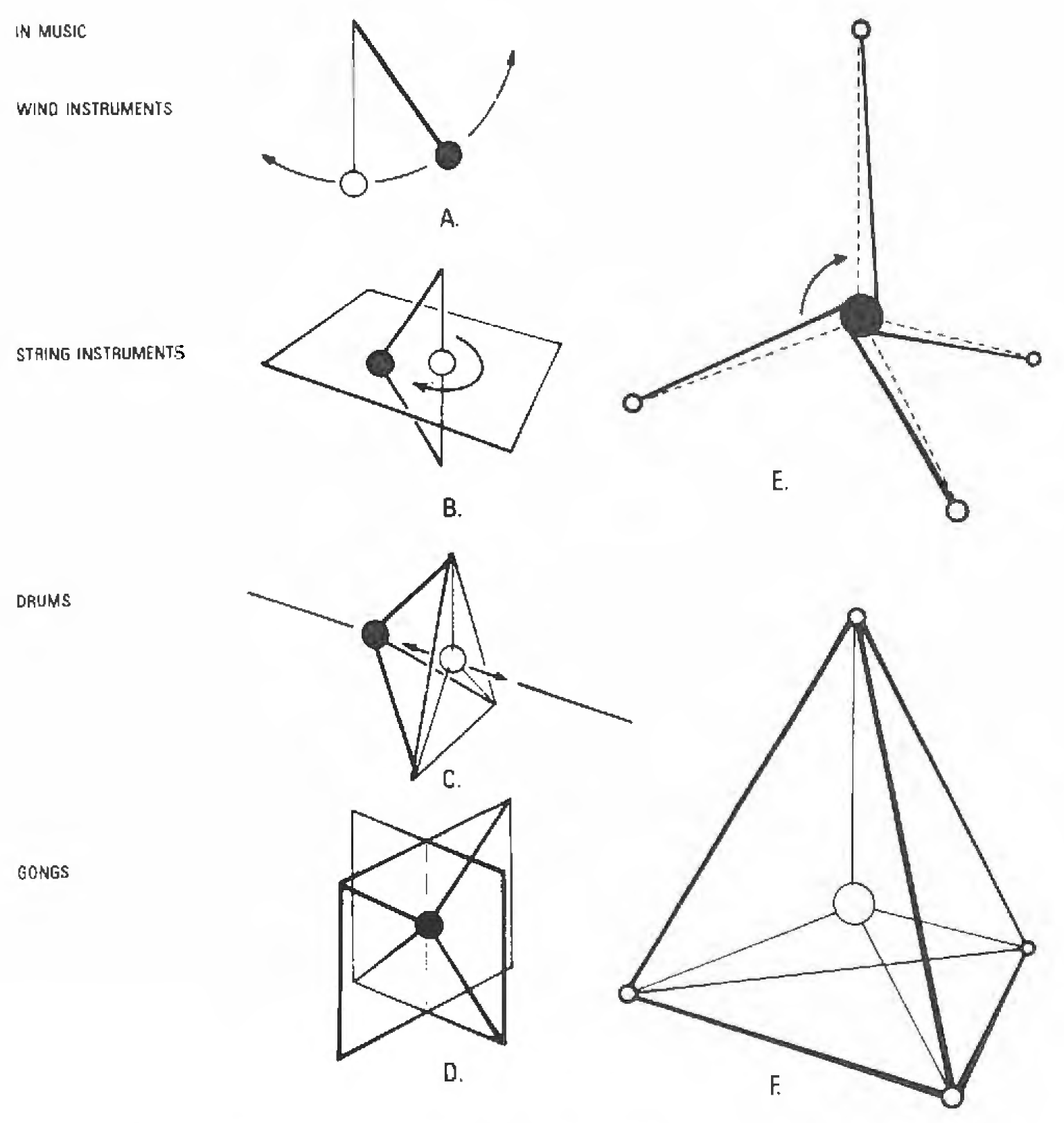
- A.
- A wavi-surfaced, varyingly radiused spheric system. Inherently the exclusively tensional restraint accommodates a constantly varying but greatest-limit radius sphere—a quasi-three-dimensional system.
- B.
- Two tension vectors inherently define only a plane—a quasi-two-dimensional system.
- C.
- Three tensional vectors inherently define only a line—a quasi-one-dimensional system.
- D.
- Four tensional vectors inherently define only a point with no spatial displacement—a quasi-subdimensional system.
- E.
- Note the possibility of in-place rotating with the position otherwise fixed by the four vectors of spatial displacement—a quasi-sub-subdimensional system.
- F.
- The four internal tensional vectors define a physically realized structural system.
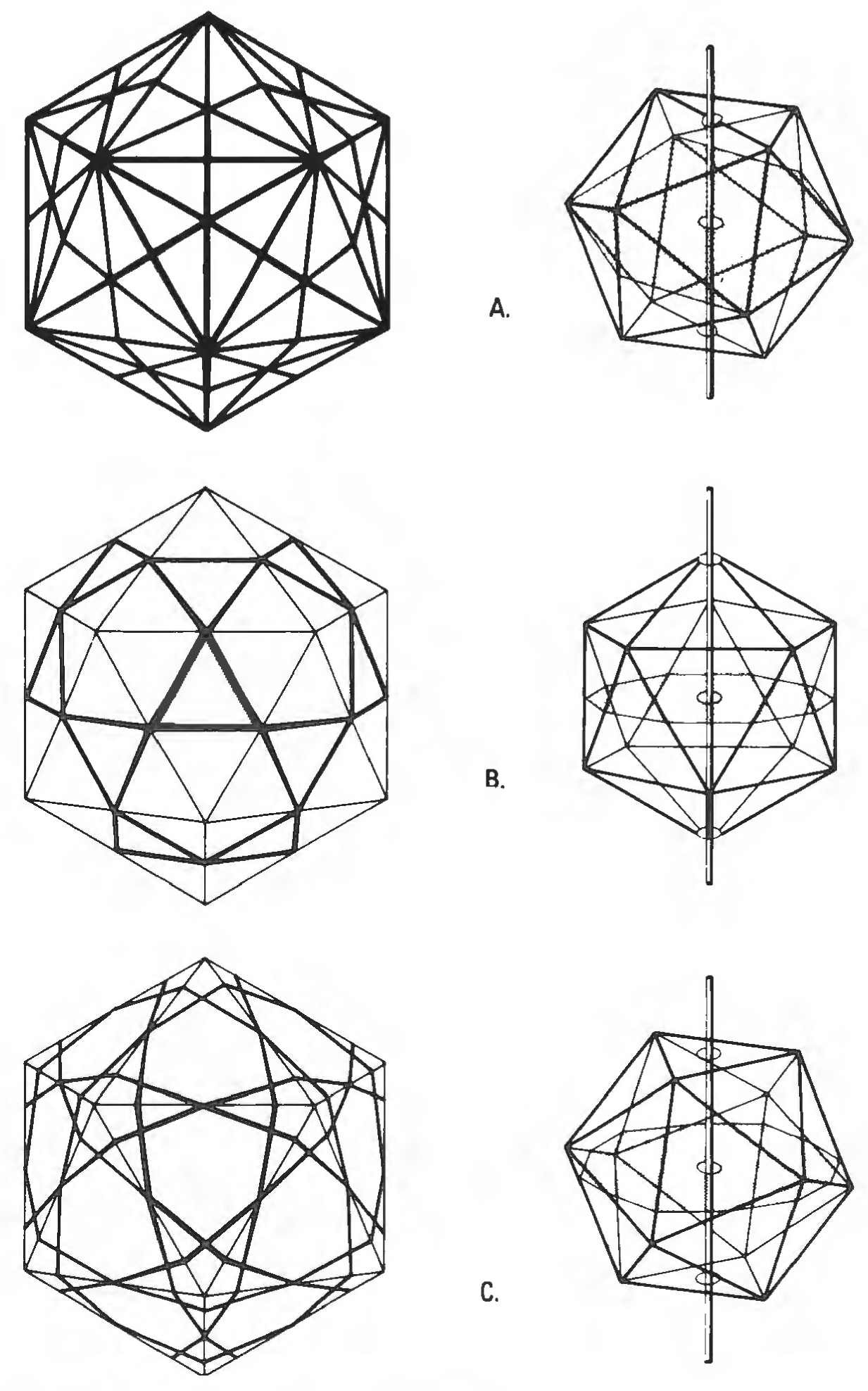
- A.
- The rotation of the icosahedron on axes through midpoints of opposite edges define fifteen great-circle planes.
- B.
- The rotation of the icosahedron on axes through opposite vertexes defines six equatorial great-circle planes, none of which pass through any vertexes.
- C.
- The rotation of the icosahedron on axes through the centers of opposite faces defines ten equatorial great-circle planes.
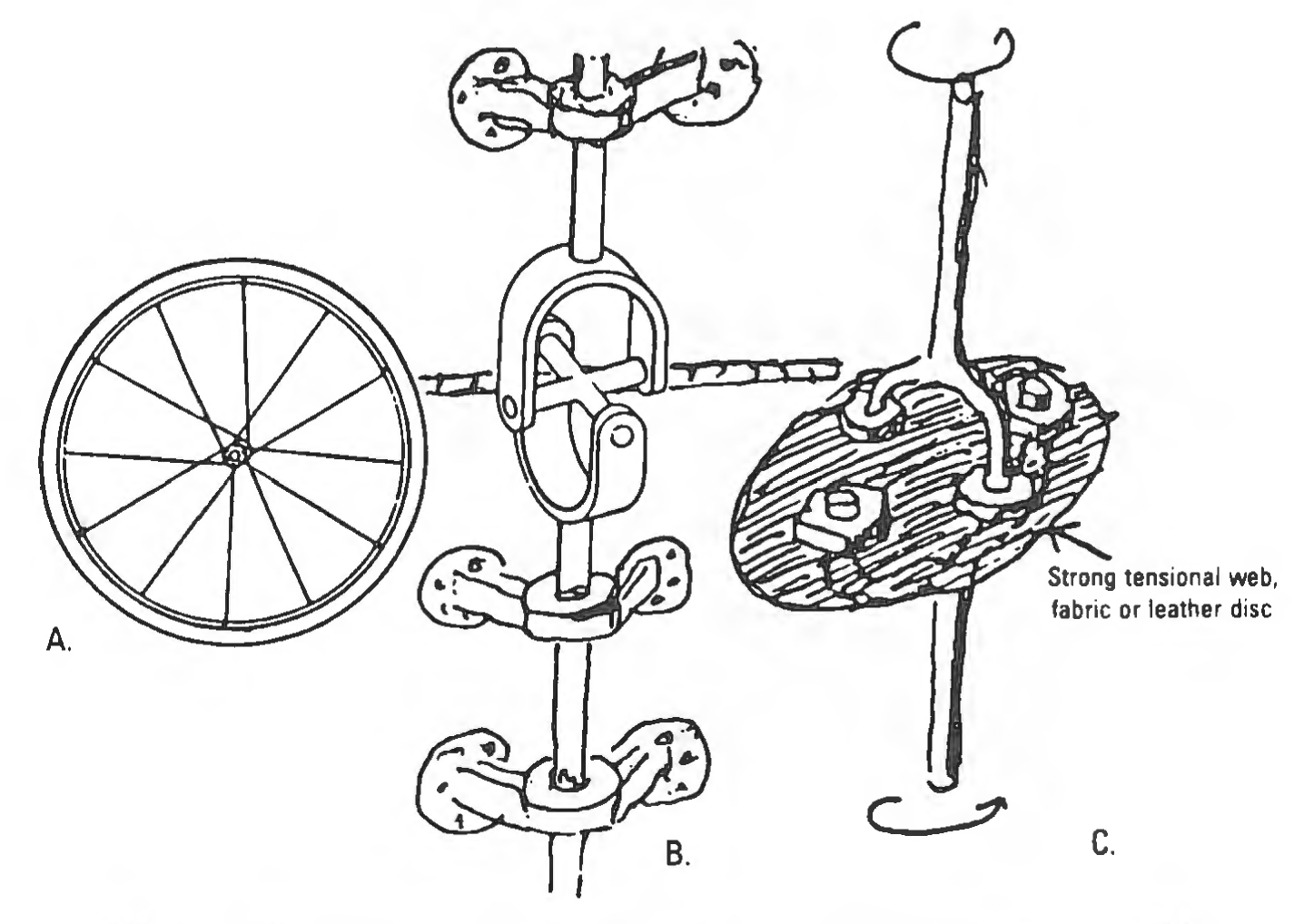
- A.
- It takes a minimum of twelve spokes to overcome the in-place rotatabilities, despite the minimum four vectors of within-system positional restraint. This is demonstrated by the twelve-spoke wire wheel with its six positive diaphragm actions and six negative diaphragm actions, of which, respectively, three positively and three negatively oppose turbining or torquing of members.
- B.
- Two-axis ‘‘universal joint,’’ analogous to the wire wheel, in basic principle relies on the independent differentiation of tension and compression for its effectiveness.
- C.
- A strong tensional web, fabric, rubber, or leather disk may serve as a continuous tensional sheet between the opposed turbining or torque members.
366 The modular frequency of the system’s radii can only be multiplied or additionally increased by progressive subdividing of the pre-time-size, cosmically primitive state of the omnisymmetrical primitive hierarchy of omnirational, intervolumed six-conceptual system subdivisions of the Universe: the four-vertexion, the six-vertexion, the eight-vertexion, the twelve-vertexion, the fourteen-vertexion, and the twenty-vertexion, now tuned-in for thinkable consideration as the family of eternally constant, closed, finite system subdivisions of sum-totally, nonunitarily conceptual though finite, mathematically omnirational, eternally regenerative, nonsimultaneously interepisoded scenario Universe.
367 All systems always and only have six positive and six negative primitive motion potentials—sometimes spoken of as degrees of freedom—of which the first four are integral to the system: (1) axial rotation, (2) torque, (3) expansion-contraction, (4) inside-outing (involuting-evoluting), (5) orbital travel, and (6) precession, which is the effect of systems in motion upon other systems in motion. All six of the above have their reverse behaviors.
6.11 Inside-Outing, Involuting-Evoluting
368The inside-outing transformation of a triangle is usually misidentified as ‘‘left versus right,’’ as ‘‘positive and negative,’’ or as ‘‘existence versus annihilation’’ in physics (Fig. 6.61).
369 Of all the Platonic polyhedra, only the tetrahedron can turn inside out. There are three ways it can do so: by single-, double-, and triple-bonded routes.
370 Inside-outing is four-dimensional and often complex. It functions as complex intro-extroverting.
371 A rubber glove, with its exterior colored red and its interior green, when stripped inside-out from off the left hand as red fits the right hand as green. First, the left hand was conceptual and the right hand was nonconceptual; then the process of stripping off inside-outingly created the right hand. And then vice versa as the next strip-off occurs. Strip it off the right hand and there it is left again. (See Fig. 6.62.)
372 That is the way our Universe is. There are the visibles and the invisibles of the inside-outing simultaneity. What we call thinkable is always outside out. What we call space is just exactly as real, but it is inside out. There is no such thing as right and left.
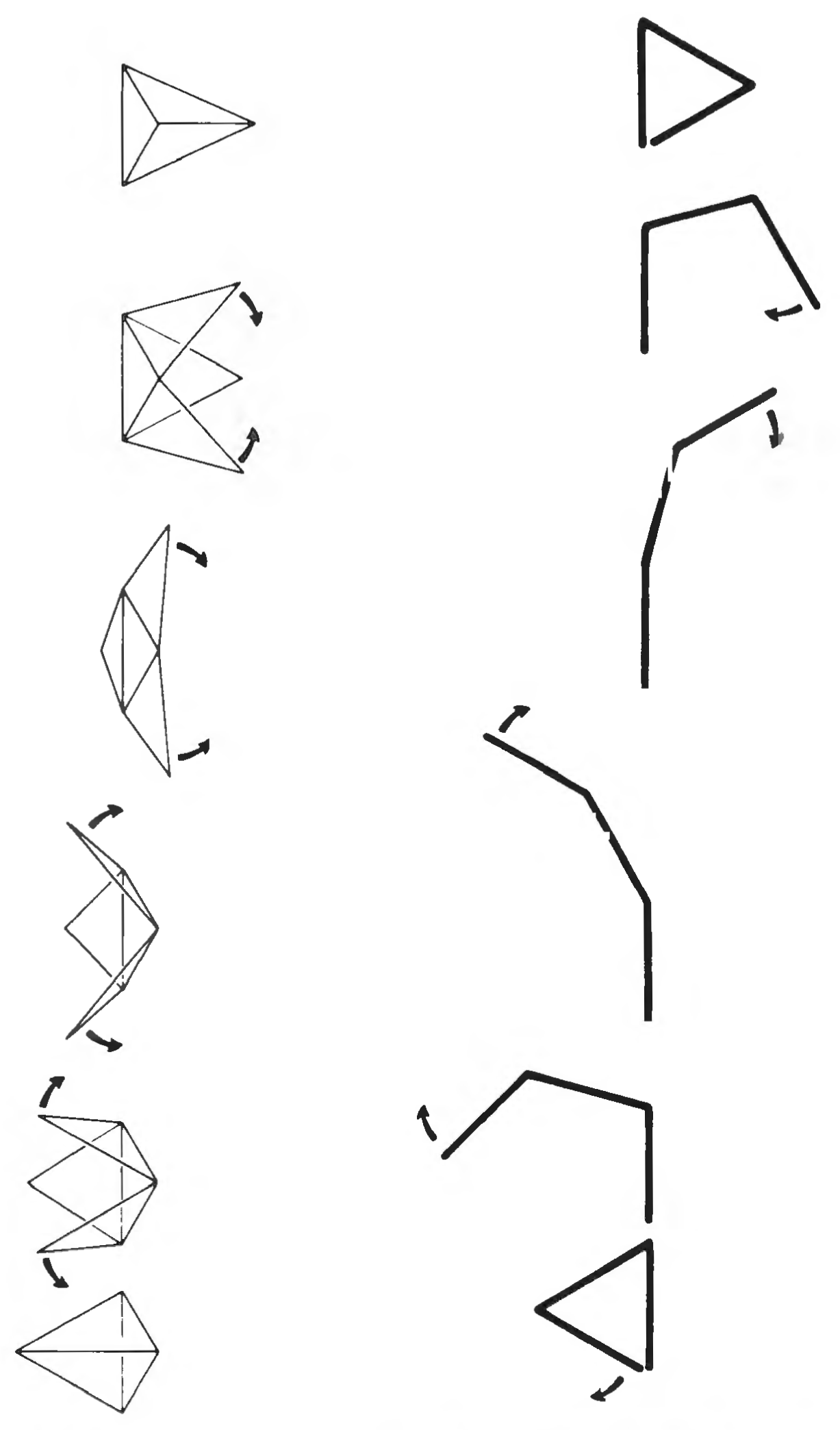
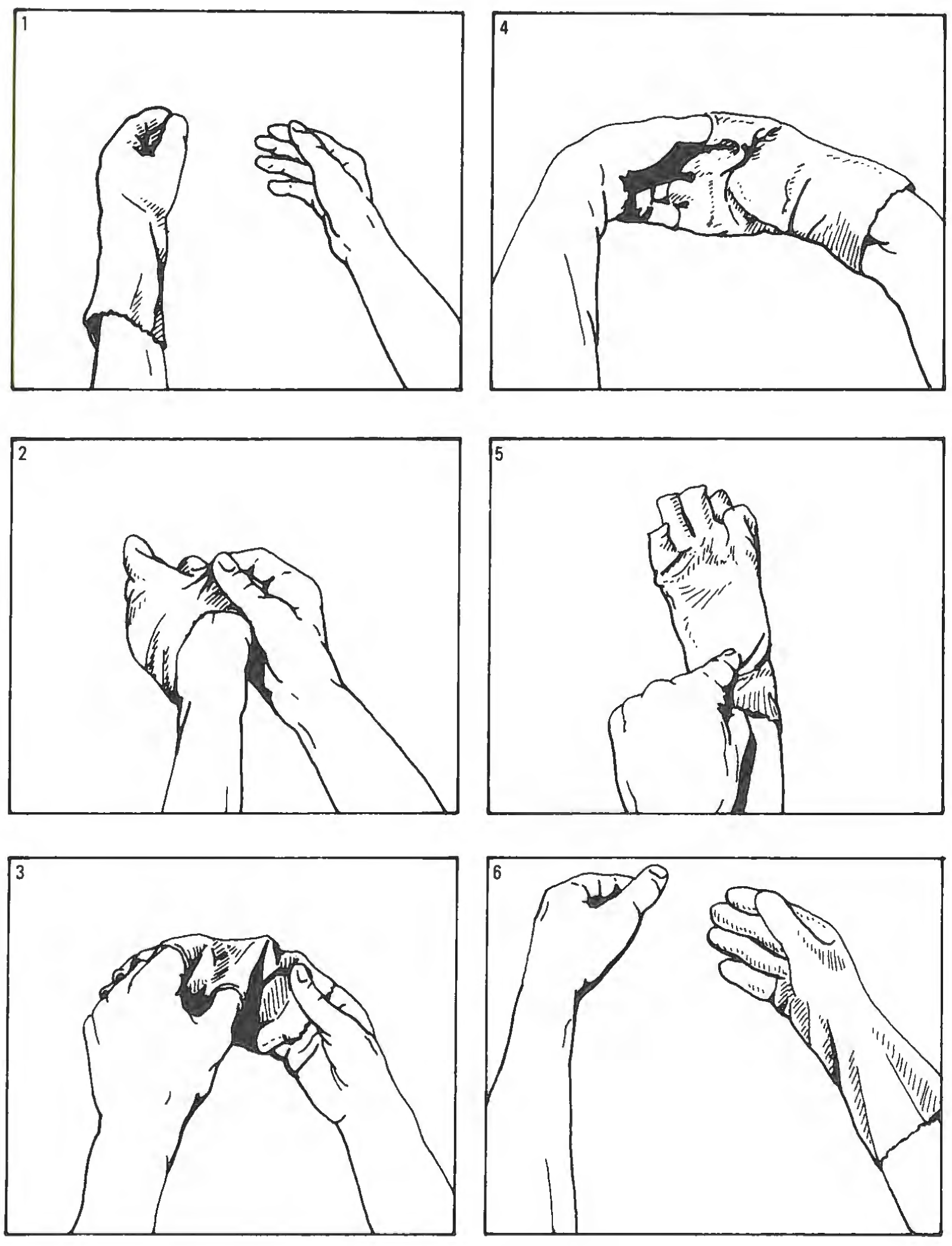
6.12 Orbital Travel
375Of the bodies in physical Universe 99.9 percent are operating orbitally—therefore normally. As the Sun’s pull on Earth produces orbiting, orbiting electrons produce directional field pulls.
376 The transition from being an entity to being a plurality of entities is precession, which is a peeling off into orbit rather than falling back into the original entity. Because unity is always plural and at minimum two, reality is always orbital. For the same reason, all orbits are elliptical rather than circular, having at least one additional critical proximity aberration to its very great circular orbit.
377 Orbit is equivalent to circuit. All terrestrial critical paths orbit the Sun. No path could possibly be linear. The Universe never reverts to the smaller, simpler circuits. (See Fig. 6.63.)
6.13 Involution and Evolution
378In four-dimensional conversion from convergence to divergence, and vice versa, the terminal condition reverses evolution into involution, and vice versa. Involution occurs at the system limits of expansive intertransformability. Evolution occurs at the convergent limits of system contraction.
379 If we mount rubber tires on the eight triangular faces of the vector equilibrium with each tire touching other tires at three points, as in Fig. 6.64, the whole assembly can operate like a rubber doughnut. It could be rotated inward like a torus, or it could be rotated outward like an atomic-bomb mushroom cloud, coming in at the bottom and opening outward and upward at the center. Seen in their sky-returning functioning as recirculators of water, trees have an ecological patterning that is very much like a slow-motion tornado: an evoluting-involuting pattern fountaining into the sky, while the roots reverse-fountain, reaching outward, downward, and inward into the Earth again once more to recirculate and once more again—like the pattern of an atomic-bomb’s cloud or electromagnetic lines of force. Fig. 6.65 shows examples of involution-evolution.

6.14 Precession
381The sixth motion is precession, which we covered in some detail in the early part of this book.
382 To reiterate briefly, physics has two kinds of acceleration: angular and linear. When you tie a weight on the end of a string and, holding it high, rotate it around above your head, the more muscle and speed you work into it, the farther it will travel when you let go of it. That is what physics calls angular acceleration . In angular acceleration you can accumulate the energy put into the acceleration. An Olympic hammer thrower accumulates his muscle-expended energy in the circular acceleration of the steel ball on the end of his steel rod. The amount of energy he has accumulated in the acceleration determines how far the hammer will travel when he lets go of it. The contest is to see who can accelerate the hammer so that it will fly the longest distance.
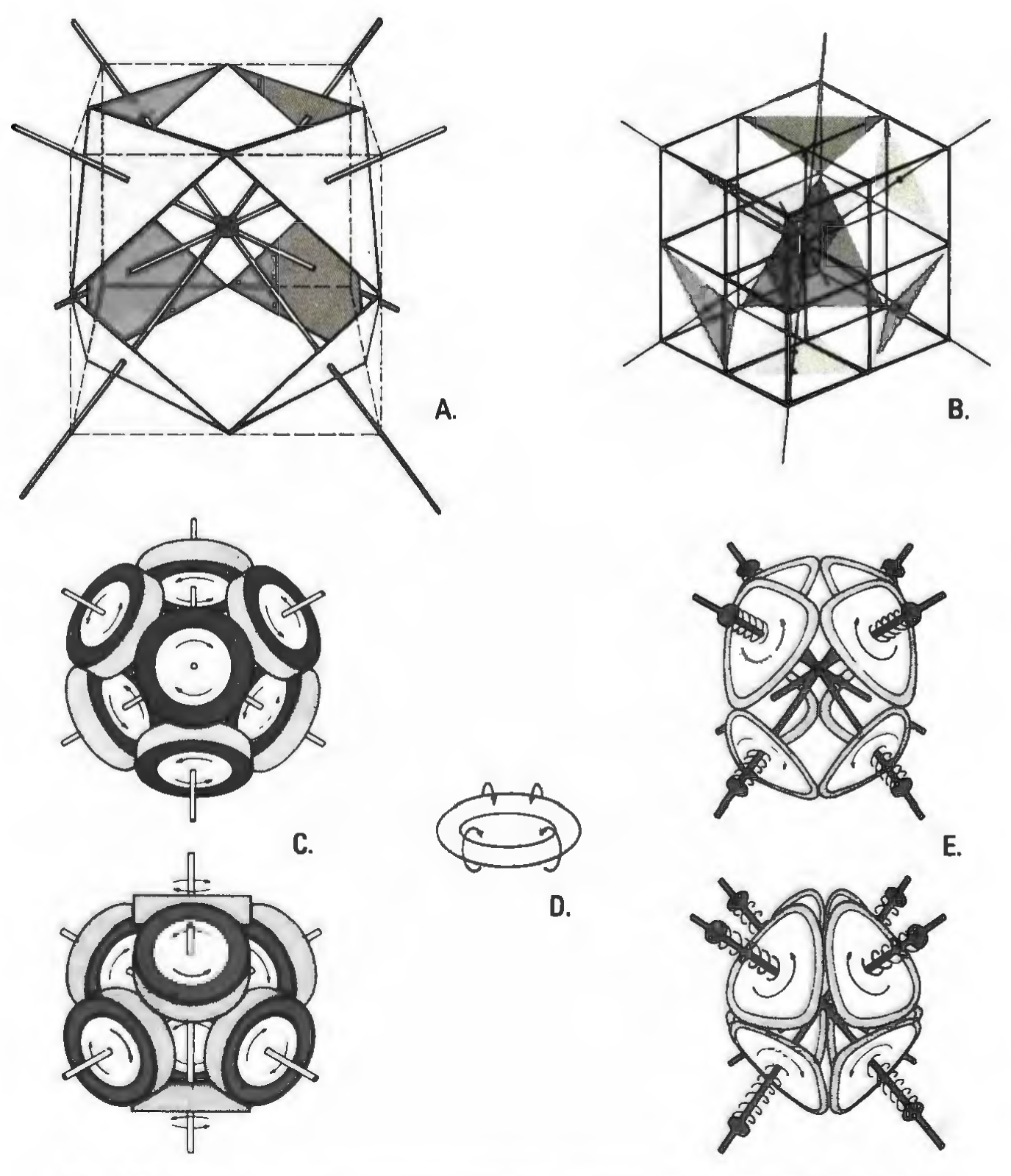
- A.
- The four axes of the vector equilibrium suggesting a four-dimensional system. In the contraction of the ‘‘jitterbug’’ from VE to octahedron, the triangles rotate about these axes.
- B.
- Each triangle rotates in its own cube.
- C.
- The four axes of the vector equilibrium shown with wheels replacing the triangular faces. When one wheel is turned, the others also rotate. If one wheel is immobilized and the system is rotated on the axes of this wheel, the opposite wheel remains stationary, demonstrating the system polarity.
- D.
- Each wheel can be visualized as rotating inwardly on itself, thereby causing all other wheels to rotate in a similar fashion. Or we can hold onto the bottom of one of the wheels and turn the rest of the system around it. If we do so, we find that the top wheel polarly opposite the one we are holding also remains motionless while all the other six rotate like an involuting torus.
- E.
- Each wheel is conceived as a cam shape. When they rotate a continuous ‘‘pumping’’ or reciprocating action is introduced.
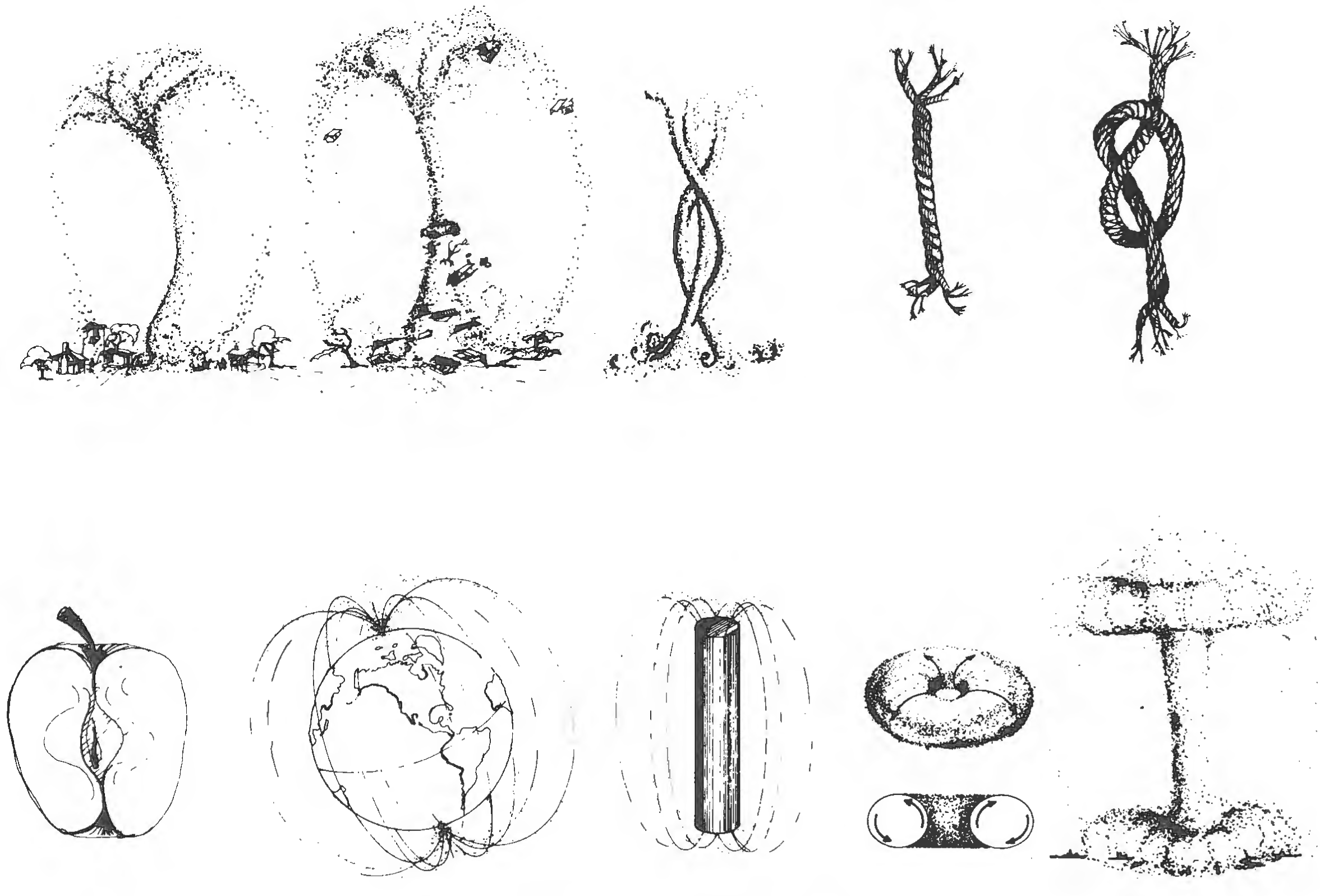
385 Linear acceleration is what gravity does to a body released far out from the Earth’s surface—a so-called falling body. By Galileo’s law, every time the Earth-approaching object halves the distance that it has yet to travel to reach the Earth’s surf ace, the pull of gravity increases fourfold and the object’s speed increases fourfold. We are now going to describe an experiment that involves angular acceleration.
386 In Fig. 6.66, we have prepared a circular floor.
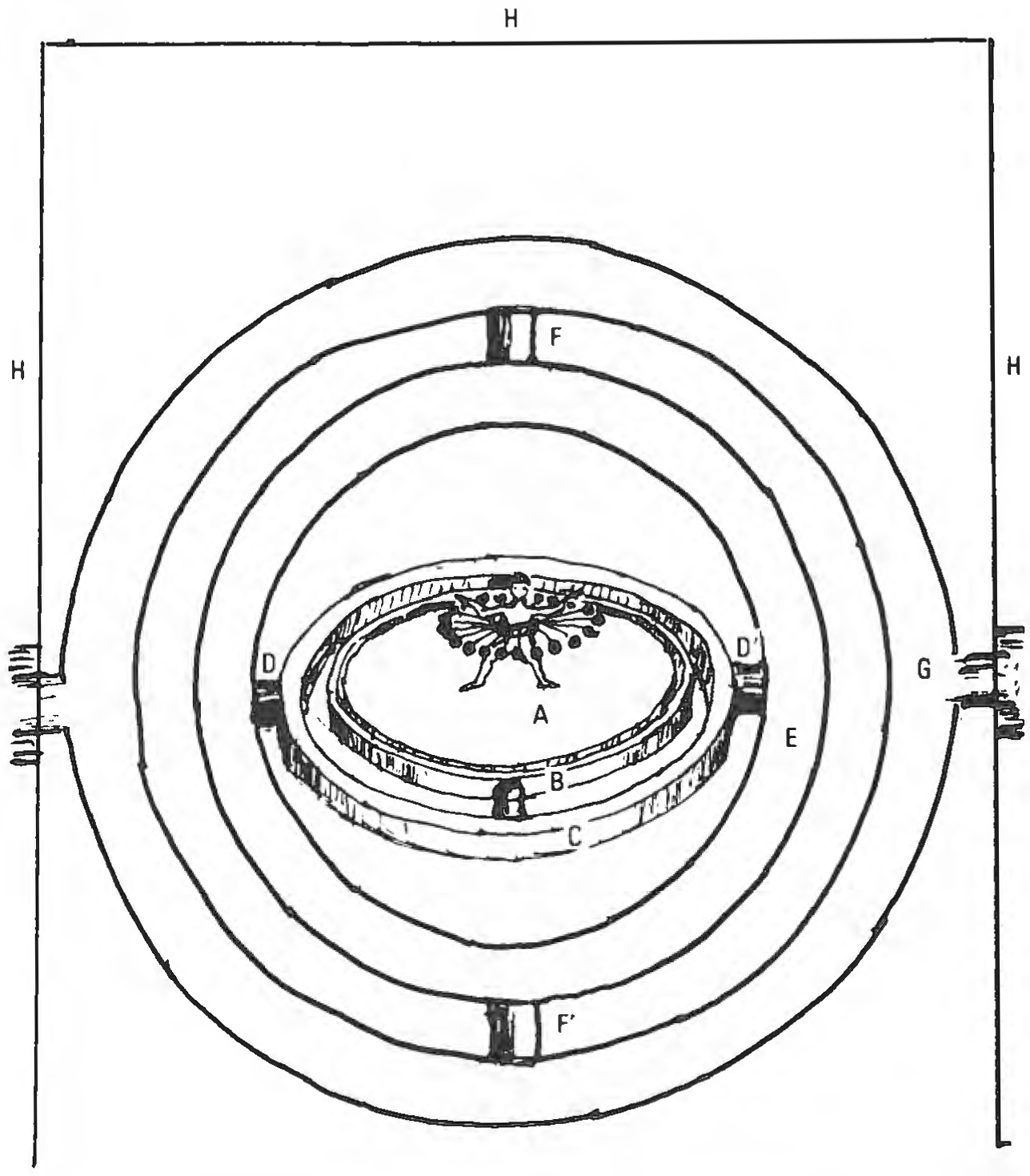
388 The floor is a thick disk floated almost frictionlessly on air bearings inside the ring B, which has two 180∘-apart axles turning in roller-thrust bearings mounted on the inside of ring C. Ring C itself has axles of rotation B − B′ at 90∘ to the inner ring B′s axes of rotation, which in turn is also mounted on tapered roller-thrust bearings D − D′ fastened at 90∘ from the C ring’s outer bearings on the inner side of a great aluminum annular ring E. This latter ring E is in turn roller-thrust-bearing-mounted at F − F′ at points 90∘ from the previous axis at D − D′, inside of an outermost fixed structure, ring G.
389 This mechanical complex of rings within rings mounted on the three 90∘-to-one-another X and X′, Y and Y ′, Z and Z′ axes is what is known as a gimbal. Gyroscopes and ships’ compasses are mounted in gimbals. Precession is the operative principle.
390 What we have described for our experiment is a giant gimbal system mounted either rotationally or fixedly inside a very large building H. We have electric switches connected to brakes on all the complex of bearings in the gimbal system. We now lock these brakes and leave that scene in building H.
6.15 Unity Is Plural and at Minimum Two
391In summary, we have discovered that all geometrical structural systems can be encompassingly realized only by isolated, islanded compression units of rational (whole number) volumes integrated by a continuous-tensional network (see Fig. 6.69). Whether simple or complex, structural systems in synergetics can only be realized as whole units.
392 From all the foregoing, we must conclude that there are no solids and, as defined, the Greek sphere could have no systemic substance or any of the topological characteristics of system. As defined by the Greeks, the sphere would have to be either an absolutely solid ball or a convex-concave shell, the inner surface of which would be of lesser radius than the outer surface.
393 Since you cannot demonstrate a surface of nothing, the Greek sphere could have no openings—no holes of any size. No energy could enter or exit. It would therefore defy the second law of thermodynamics, which states that all physical systems must in time lose energy. The Greek sphere would have to consist of an absolute, everywhere-undifferentiated, impenetrable, ergo inexperienceable, eternal continuum.
394 Since all experiences consist always and only of physically or metaphysically encountered systems and since Euler and synergetics make clear that all systems consist always of a minimum plurality of uniquely functioning and differentiable parts, topologically differentiable experience demonstrates that parts cannot exist separately from systems—i.e., by themselves.
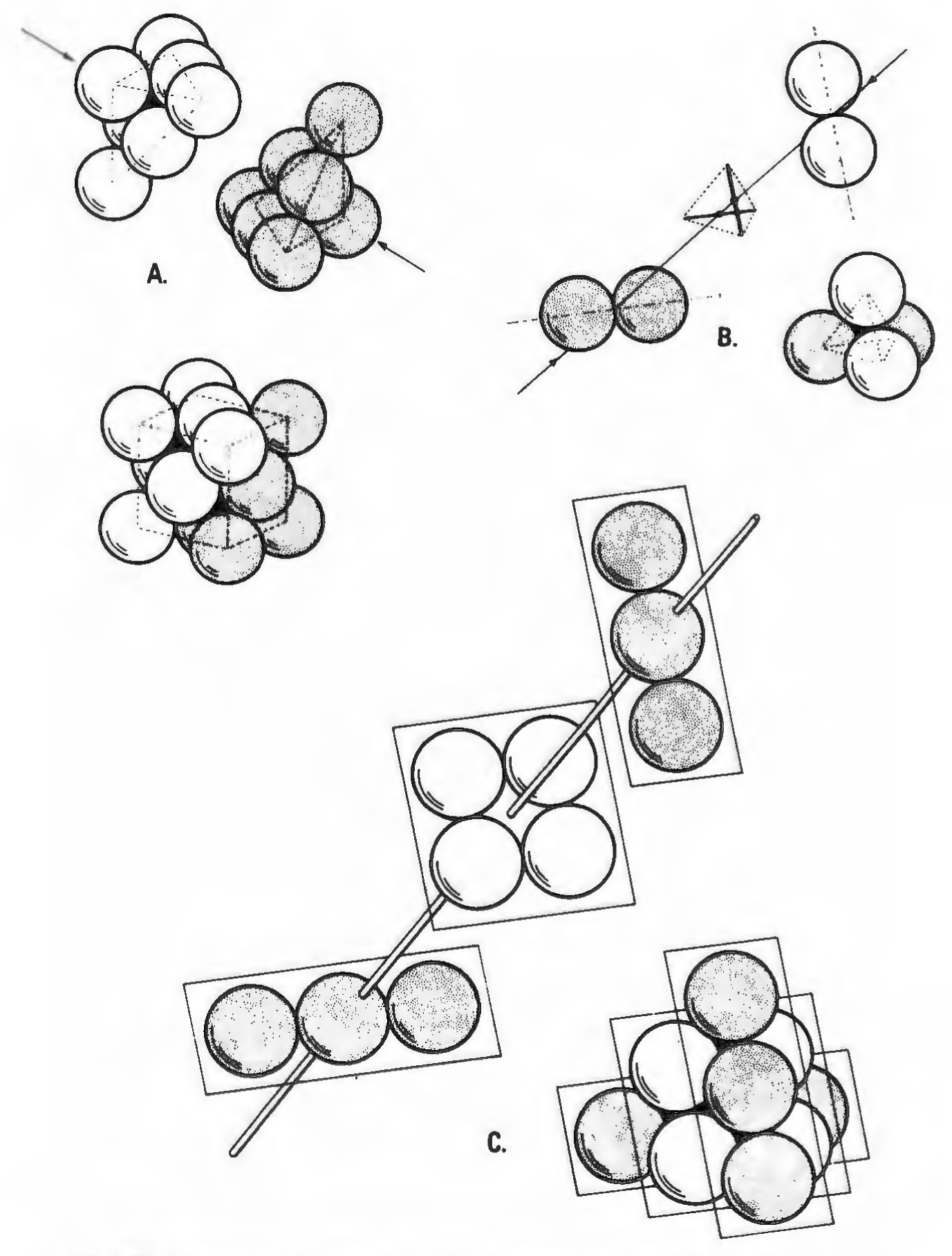
- A.
- Two pairs of seven-ball triangular sets of closest-packed spheres precess in 60∘ twist to associate as the cube. This fourteen-sphere cube is the minimum structural cube which may be produced by closest-packed spheres. Eight spheres will not close-pack as a cube and are utterly unstable.
- B.
- When two sets of two tangent balls are self-interprecessed into closest packing, a half-circle interrotation effect occurs. The resulting figure is the tetrahedron.
- C.
- The two-frequency (three-sphere-to-an-edge) square-centered tetrahedron may also be formed through one-quarter-circle precessional action.
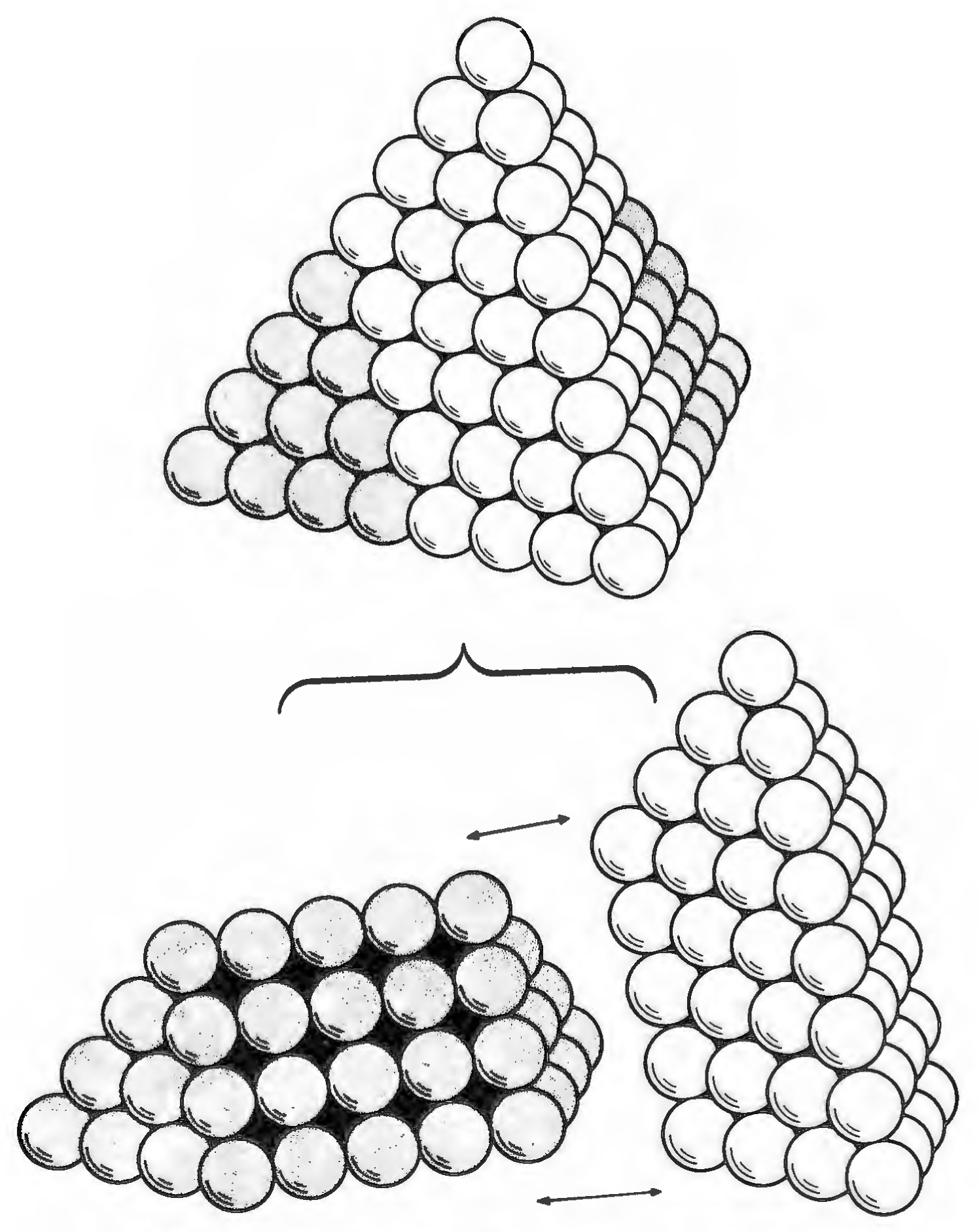
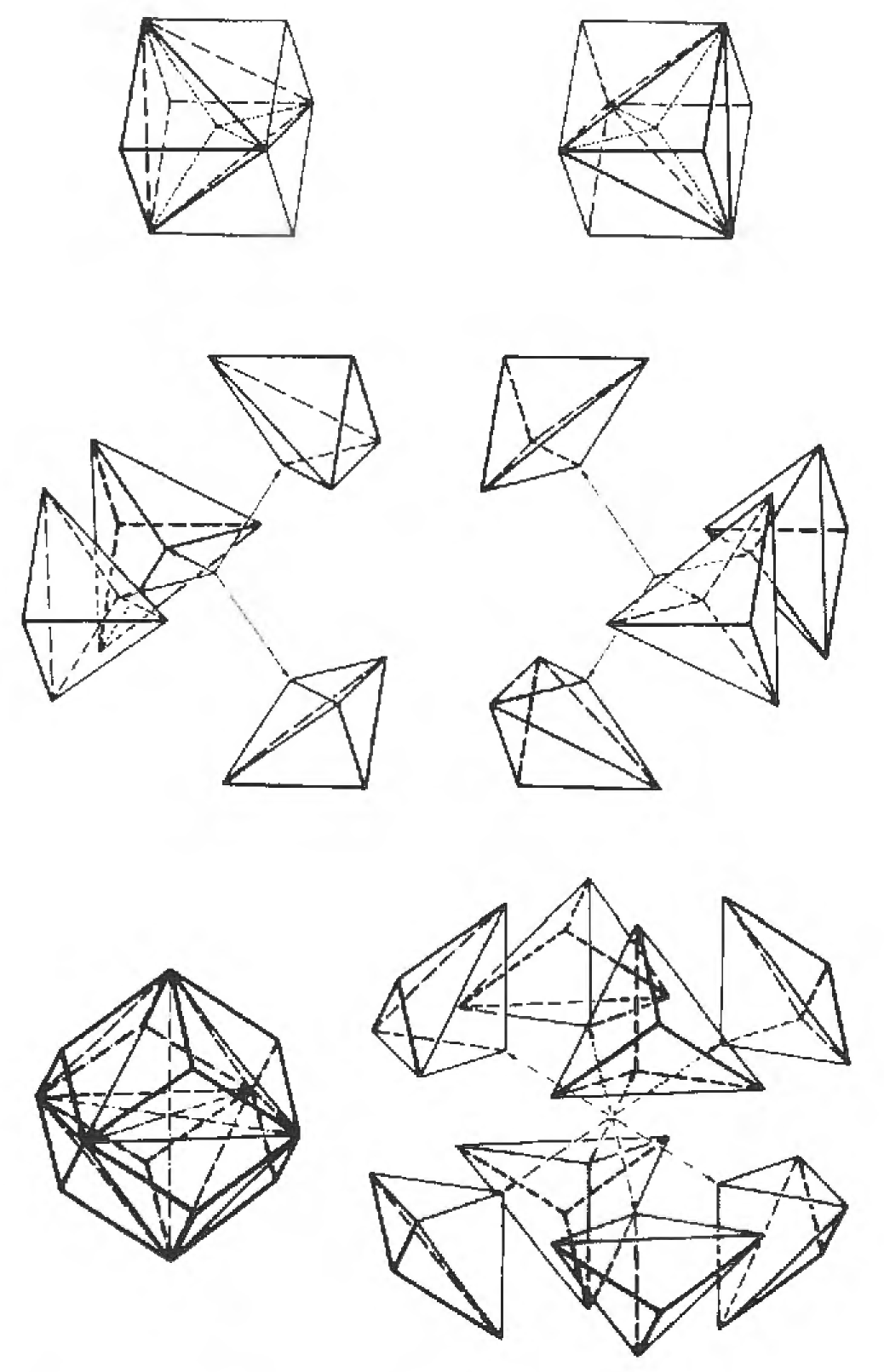
- A.
- The cube may be formed by placing four one-eighth-octahedra with their equilateral
faces on the faces of a tetrahedron. Since tetrahedron volume equals 1, and
one-eighth-octahedron equals 1 ⁄ 2, the volume of the cube will be 1 + 4(
 ) = 3.
- B.
- Because there are eight one-eighth-octahedrons, with each of them equaling a half-tetrahedron, four of them can be placed on the negative tetrahedron and four on the positive tetrahedron, making a total of 2 cubes = 6, four positive quarter-tetrahedra and four negative quarter-tetrahedra superimposed on one octahedron, giving the rhombic dodecahedron a volume of 6.
- C.
- The rhombic dodecahedron may be formed by placing eight quarter-tetrahedra
with their equilateral faces on the faces of an octahedron. Since the octahedron
volume equals 4, and a quarter-tetrahedron equals 1 ⁄ 4, the volume of the rhombic
dodecahedron will be 4 + 8∕(
 ) = 6.
398 There is no such phenomenon in Universe as ‘‘one,’’ the lone observer. There is necessarily something observed. Experienceable unity is necessarily plural and at minimum two. The system’s inherent insideness and outsideness, its inherent concavity of insideness aspect and inherent convexity of outsideness aspect, coexist in pure principle: one cannot exist without the other.
399 There is another way of demonstrating the at-minimum-twoness of the Universe (uni-verse means toward union, not toward isolatable oneness).
400 That which is concave concentrates impinging radiation, and that which is convex diffuses the same impinging radiation, so concave and convex are not the same function; ergo, the minimum otherness experience of life awareness is a system unto itself whose insideness and outsideness demonstrate that unity is always plural and at minimum two.
401 The other at-minimum-twoness of unity is the inside concavity and the outside convexity of the observer and the observed and their inter-kinetic life realization in pure principle.
402 Since no solids fulfill the Greek definition of a sphere as ‘‘the surface of a solid absolutely continuous in all directions from a point,’’ we must redefine the spheric experience to that of being a closed array of separate microevents (the locus of points) approximately equidistant in approximately all directions from one approximate event atom and its complex of electrons. All those microevents at approximately equal distances in all directions from the central event will have their nearest spheric-surface neighbors occurring at the most economical (shortest) interconnection distance between them, producing a network of great-circle chords between them. Altogether this spheric array produces a closed system pattern of triangular windows—which is to say, a geodesic sphere. Polished-marble, sphere-shaped stones are, on close examination, a net of omnitriangulated windows forming a system, and that is what all geodesic domes are.
403 Using nature’s most-economical design strategy, I first began making the tensegrity geodesic (most economically intertriangulated) domes. Keeping nature’s design strategies in mind, I realized that in order to think and communicate with fidelity I now had to reidentify the number of ‘‘corners’’ of Euler’s topology to read as the number of ‘‘somethings’’ and that I also had to reidentify Euler’s edge lines as the number of unique structural, push-pull, vector-tensor, line-of-force ‘‘interrelationships’’ existing among the system’s corner somethings, which interrelationships window-frame the number of different views of ‘‘nothingness’’ within the system.
404 Although some of what I came to observe, study, and explicate may seem difficult to understand, some of it is so obvious that readers may ask why it had not occurred to themselves at some time. It probably did. In childhood, spontaneous thought and unencumbered observation are quite common and simple, before the relentless disinformation process begins.
405 Principles are weightless. What we identify as weight is the principle of accumulative information as apprehended by the rate of our sensing data from kinetic events. The more nondirectly sensed information cognition there is, the heavier the phenomenon. In the same manner, the law of resistance of a penetrated medium by a penetrating body is that the resistance increases as N2—i.e., as the second power of the linear speed of the penetrating body in respect to its initial resistance and as predicated upon its shape, its surface condition, and the initial viscosity of the penetrated medium. Initial resistance to a penetrating body and the seemingly inert weight of a seemingly motionless body are the same, since all is in motion and the kinetics are omni and always in operation in pure principle; ergo, frequency and speed relationships are operative only in pure principle, and principles are weightless and their local weighabilities are realizable in the pure principle of interrelativity itself.
406 In long-distance electric power transmission, as the voltage increases, the resistance decreases as of the third (or volumetric dimensional) power N3, and the overall efficiency of the conducting system delivery increases as N4. And now that we comprehend the exclusively frequency-dependent experiencing of solids, we can begin to see that weight and substance (as with so-called solids) are the consequences of (1) the magnitudes of the interrelativity timewise of linear, planar, and volume measures, and (2) the frequency in respect to abstract, weightless topology, and geometry of thinkability and its image conceptioning.
407 In my recently published writings, I have summarized my discovery of the option of humanity to become omnieconomically and sustainably successful on our planet while phasing out forever all use of fossil fuels and atomic energy generation other than the Sun. I have presented my plan for using our increasing technical ability to construct high-voltage, superconductive transmission lines and implement an around-the-world electrical energy grid integrating the daytime and nighttime hemispheres, thus swiftly increasing the operating capacity of the world’s electrical energy system and, concomitantly, living standard in an unprecedented feat of international cooperation.
408 If, to the best of your knowledge and judgment, you are convinced of the technical validity of the information I submit to you, as well as of the comprehensive integrity of my commitment, I am hoping that you will study even further in my books criticalpath [criticalpath] and synergetics [synergetics], and will commit your own genius to helping humanity understand and implement its option to use human mind for information gathering and problem solving and to apply its technological legacy to bring about peace, harmony, and an undreamed-of higher standard of living to everyone on the planet.
409 We are so accustomed to our school-trained linear-pattern writing, reading, and communication of information that we have failed to think spontaneously in the omniconvergent-divergent, systemic, kinetic geometry patterning of all our breathing, heart-beating, expanding-contracting, hearable-sound-and-unhearable-electromagnetic, omni-directional-wave-propagating, physical experiencing.
410 All living organisms grow or think ‘‘in the round,’’ which means systemically. We expand and contract radially.
411 We do not live in a rectilinear, perpendicular, and parallel interpatterning of no-dimensional points, one-dimensional lines, two-dimensional planes, and three-dimensional cubes, as is still taught in all the world’s schools.
412 Because our reflexes are academically conditioned to predominantly linear apprehending, we have failed to realize that our thoughts are inherently radially expansive and contractive, topological systems that are mathematically describable only as four- and six-dimensional systems.
413 General System Theory, of recent academic vintage, consists of linear lists of linearly written words on two-dimensional paper trying to describe all the linearly remembered relevant factors and parameters characterizing a given linearly experienced problem. Even ‘‘expert’’ parameter cerebrating at its best is mere ‘‘groping in the dark.’’
414 Laughter and loving are omniradiant, ornniembracing, topologically coordinate phenomena. Love synergetically integrates metaphysical radiation and metaphysical gravity, whose interpulsative, intercomplementary oppositeness regenerates life.
415 The mathematical and geometrical concepts I am disclosing to you clearly comprise the rational and numerically elegant mathematical coordinate system of nature.
416 The history of science is replete with stories of individuals breaking free from the constraints of the conventional science of their times and initiating scientific revolutions or making great discoveries. At the root of much of this trailblazing activity is discarding in its entirety the conventional wisdom and getting to the basics—universal principles, structure, the essentials. Einstein was such an individual. His thought has changed our world view. My experience has shown me that the discovery and practice of synergetics is an operational method and tool that is without equal for today’s scientific explorers. As a case in point, I shall describe some of the outstanding events in the history of organic chemistry.
417 In 1852 Sir Edward Frankland discovered that organic chemistry continually manifests the numbers one, two, three, and four. At about the same time, a Russian chemist named Alexander Butlerev identified the oneness as the univalent (single) bonding of atoms into molecules, the twoness as bivalent (double) bonding, the threeness as trivalent (triple) bonding, and the fourness as quadrivalent (fourfold) bonding.
418 Thirty-five years later, J. H. van’t Hoff asserted that the oneness, twoness, threeness, and fourness manifest by the quantitative results of the invisible behaviors of organic chemistry related to the tetrahedron. Van’t Hoff was called a faker, an impostor of science, which at that time had concluded that nature used only equations and never geometrical models in her fundamental formulations.
419 Fortunately for van’t Hoff, he lived to produce optical proof of the tetrahedral configuration of carbon. As a happy consequence, van’t Hoff received the first Nobel Prize in chemistry.
420 This all occurred a century ago, yet neither elementary school nor university mathematics and physics departments seem to have heard the van’t Hoff news. The tetrahedron is not included in any of their curricula. In its history of philosophy, the academy briefly mentions the tetrahedron as one of Plato’s ‘‘solids.’’
421 Despite its universality and elegant economy, the tetrahedron has been all but ignored on planet Earth. Academic science references all its physical mensuration to the XY Z-three-dimensional coordinate system and all of its energetic phenomena to the c-g-s system, which represents the amount of energy required to lift 1 cubic centimeter of water of a given temperature 1 centimeter in 1 second of time. The cube is the chosen geometrical unit of volume measure, and the square is the geometrical unit of areal measure in all of today’s world-around, state-of-the-art scientific activity, not to mention everyday use.
422 If you visit the General Electric Laboratories in Schenectady, New York, and witness their manufacturing of diamonds (atomically real but called artificial), you will see synthetic diamonds produced by compressing carbon to adequate degree in a powerful convergent press. The product is a complex of octahedral and tetrahedral gems of varying sizes, all in a state of intercomplementary, allspace-filling compaction.
423 Science opens its treatises on quantum geometry with a nonstructurally demonstrable (i.e., nonstably patterned) cube and its successive, crudely asymmetric, untriangulated fractionations. These procedures are structurally unsound, as can be demonstrated.
424 Take twelve rigid push-pull struts—for instance, 12-foot-long, 1 ⁄ 2-inch-diameter wooden dowels. Drill small holes through them 1 ⁄ 4-inch from each of their ends. Take a fine Dacron fishing line and tie their ends together in groups of three. If you elevate the top two members of this assembly and hold them parallel to one another, the assembly will hang from your hands in a pseudoform, a wriggly cube. It is not triangulated and is therefore nonstructural.
425 If you let go of the assembly, it will immediately plop to the table or floor and collapse in a noncubical heap (see Fig. 6.70).
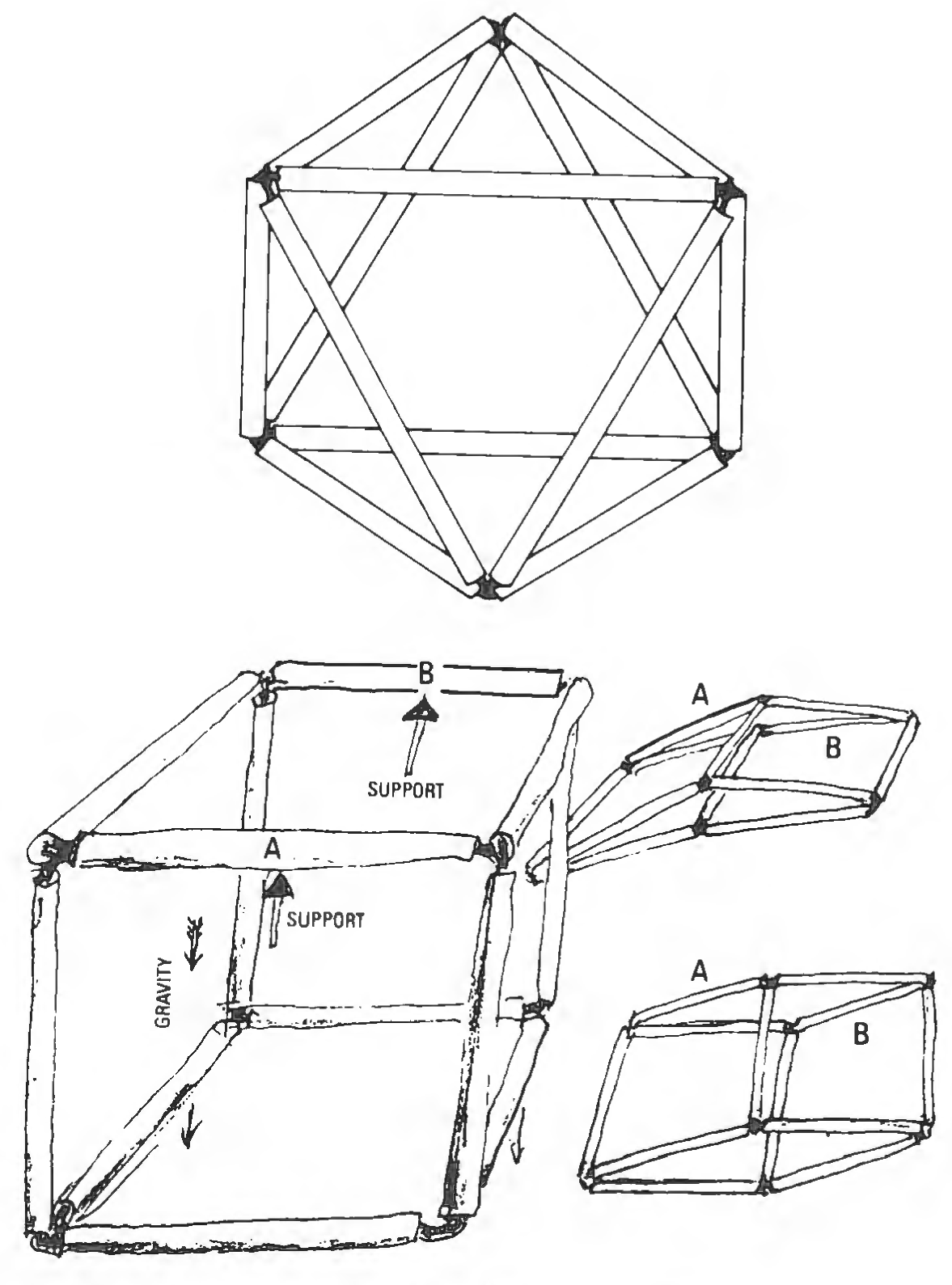
427 If you now take the same twelve struts and tie their ends together in groups of four, the whole assembly will spontaneously take its own geometrical shape, that of the octahedron (see Fig. 6.71), which will not collapse unless you apply a force greater than the tensile strength of the fishing line or greater than the compressive, buckle-resisting strength of the wooden struts. The octahedral shape persists eternally in pure principle as an omnitriangulated structure. The octahedron is eternally, inherently noncollapsible.
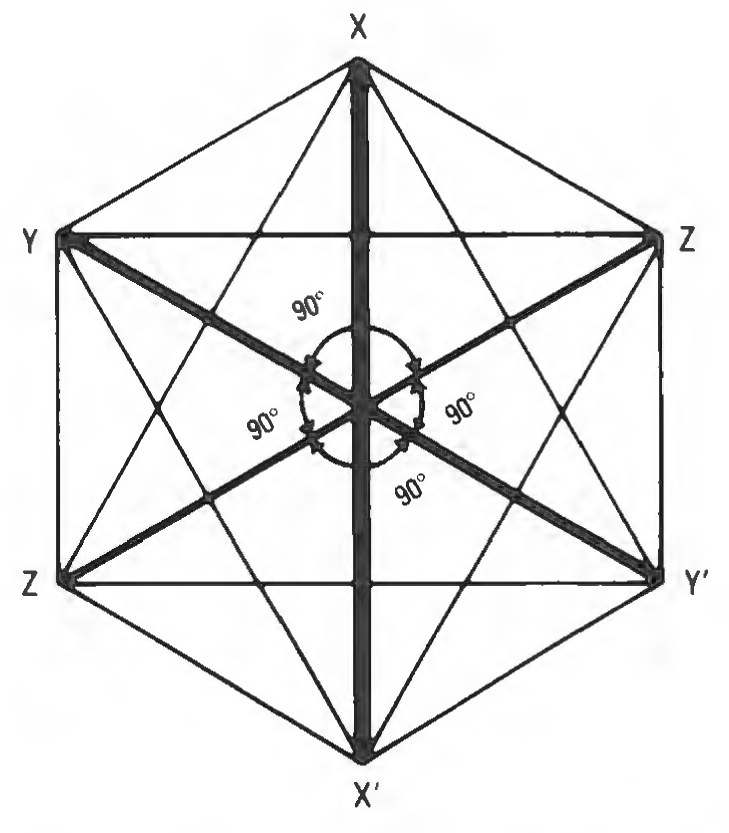
429 We use the word primitive to identify brain-imaginable systems whose principal structural constituents (components) are conceptual independent of size.
430 A tetrahedron and the four corner convergences of its six structural lines outlining four triangles is a conceptual system independent of size. Size always takes time to measure. The tetrahedron and the octahedron are primitive, pretime and presize conceptualities.
431 There is no such thing as a primitive cube, because it is impossible to find any position in which the three edges convergent at each of eight corners will interstabilize themselves at an omni-90∘ position. The way in which human society became academically hooked on the cube was by carving out rectilinearly dimensioned wall building blocks of marble while misassuming an inherent solidness to be demonstrated by the marble. We know today that there are no solids. Democritus’ atoms disintegrated Plato’s ‘‘solids,’’ but proof of that waited upon Fermi’s nuclear pile.
432 If you take six wooden struts 16.97 inches long and tie their ends into the three-together opposite corners of each of the six four-sided openings of a quasi-cubic model composed of 12-inch edges with three long struts at each corner (see Fig. 6.72). This structure is designed in such a way as to produce six struts coming together at every other corner of your eight-corner assembly. You will then have a spontaneously rigid, omnitriangulated, geometrical form that is an overall tetrahedron, which is the minimum inherently self-stabilizing system of Universe.
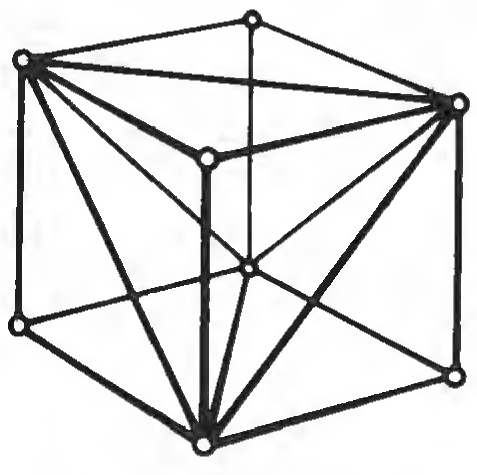
434 In the conventional geometry mensuration taught in schools, which is based on the edge of the square and the square and the cube as the conventional modules of unity of length, area, and volume, we have, as stated in the 1982 edition of Marks:wj[Marks:wj], the following basic data:
| With A | = area of surface of polyhedra of equal edge length | ||
| V | = volume of polyhedra of equal edge length | ||
| a | = common edge length |
| A∕a2 | V∕a3 | ||
| Tetrahedron | 4 triangles | 1.7421 | 0.1179 |
| Cube | 6 squares | 6.0000 | 1.0000 |
| Octahedron | 8 triangles | 3.4641 | .4714 |
| Dodecahedron | 12 pentagons | 20.6457 | 7.6631 |
| Icosahedron | 20 triangles | 8.6603 | 2.1813 |
437 The volume of the conventional cube is to the volume of the synergetics vector diagonal cube 1 : 0.9428.
438 Therefore, when the square and the cube are employed as unity, only the square and the cube have whole rational number areas and volumes. When the edge of the regular tetrahedron is employed as unity, the regular primitive structural systems have whole number areas and volumes.
439 For conversion of conventional to synergetic, omnirational-valued tetrahedral math, here are the linear, areal, and volumetric conversion factors:
441Dymaxion Constants
| Linear conversion factor | 1.0198255 |
| Areal conversion factor | 1.0400440504 |
| Volumetric conversion factor | 1.0606605 |
| Area | Volume | Edge | |
| Tetrahedron | 4 | 1 | 1 |
| Octahedron | 8 | 4 | 1 |
| Cube | 1.01387 | 3 | 1.414214 |
| Rhombic Dodecahedron | 6 | ||
| Vector Equilibrium | 21 ⁄ 2 or 20 | 1 |
442 A plane can be defined only as a triangle. A square is always and only two equisized 90∘ isosceles triangles hinged together along their congruent, unit-length hypotenuses and hinged open with the two triangular planes arrayed at 180∘ to one another. Squarings are always 2N2.
443 As Fig. 6.73 shows, the second-powering of any number (i.e., N2) can be experimentally demonstrated to be the number of uniformly dimensioned triangles equally subdividing the enclosed area of any triangle of the same or different-length edges, each edge being uniformly subdivided into N lengths.
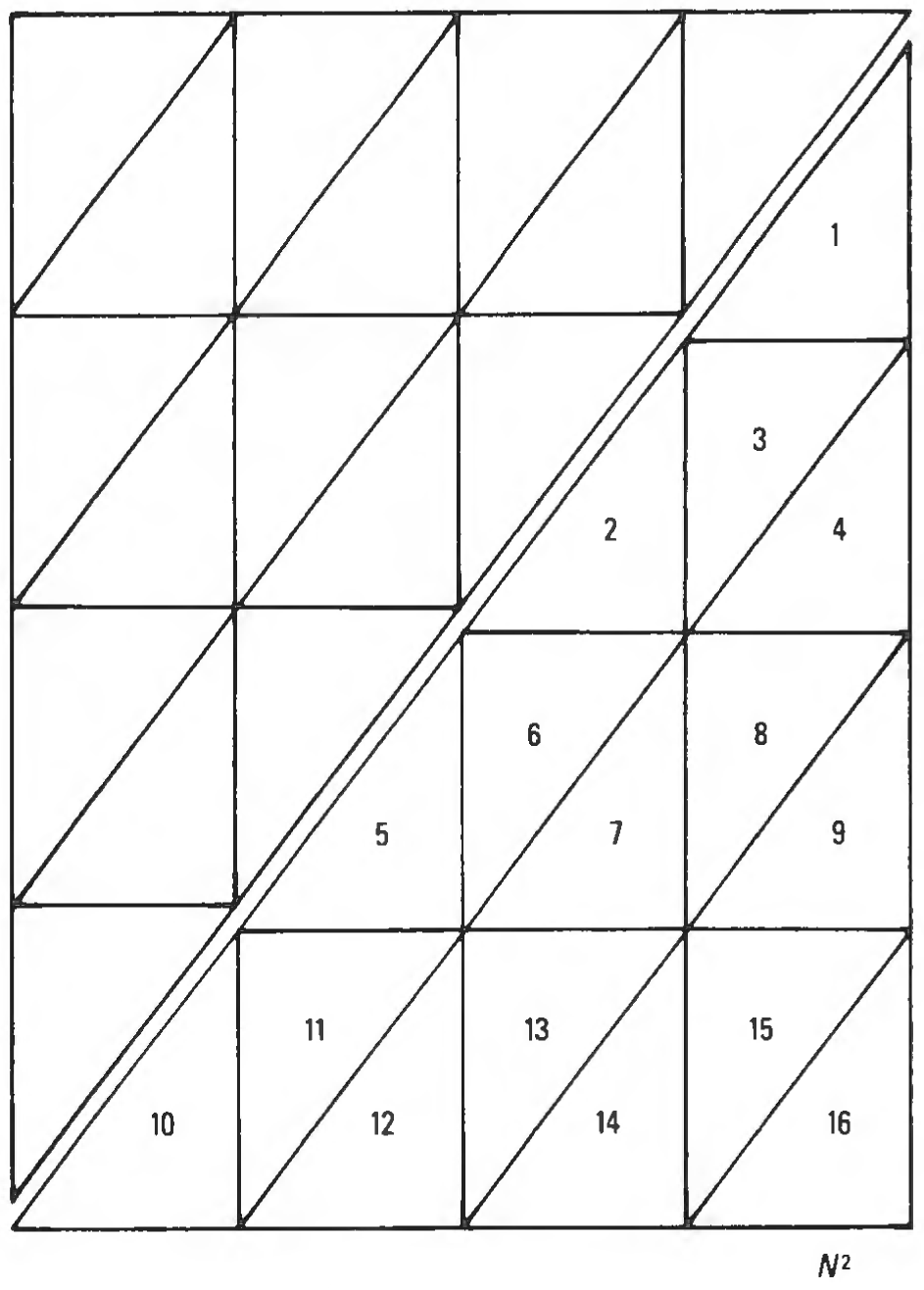
445 All academic mathematics and all the sciences now identify N2 as ‘‘squaring.’’ Squares or four-flex-cornered polygons will not hold their shapes (i.e., are nonstructural), and the only structurally demonstrable ‘‘square’’ is produced by two hinged-together-at-180∘ triangles.
446 Always operating most economically, nature second-powers the frequency of uniform subdivisions of the edges of its polygonal systems to arrive at the number of uniform subdivisions of each of the facets of any polyhedral system. If a polyhedral system has facets other than triangular, nature subdivides them into triangles to arrive at their structural stability. If you want to do your own topological accounting, you too will have to omnitriangulate, and ergo structurally stabilize, your earnestly considered polygon.
447 It is scientifically demonstrable that nature must always be triangling and not squaring.
448 Bisecting the edges of any planar figure with four different-lengthed edges (as in quadrangular accounting in Fig. 6.74) and interconnecting the bisecting points does not produce modularly dimensioned, similar four-edged figures. Bisecting the edges of any triangle, whether regular, isosceles, or scalene, always subdivides the big triangle into four always modularly dimensioned, similar triangles.
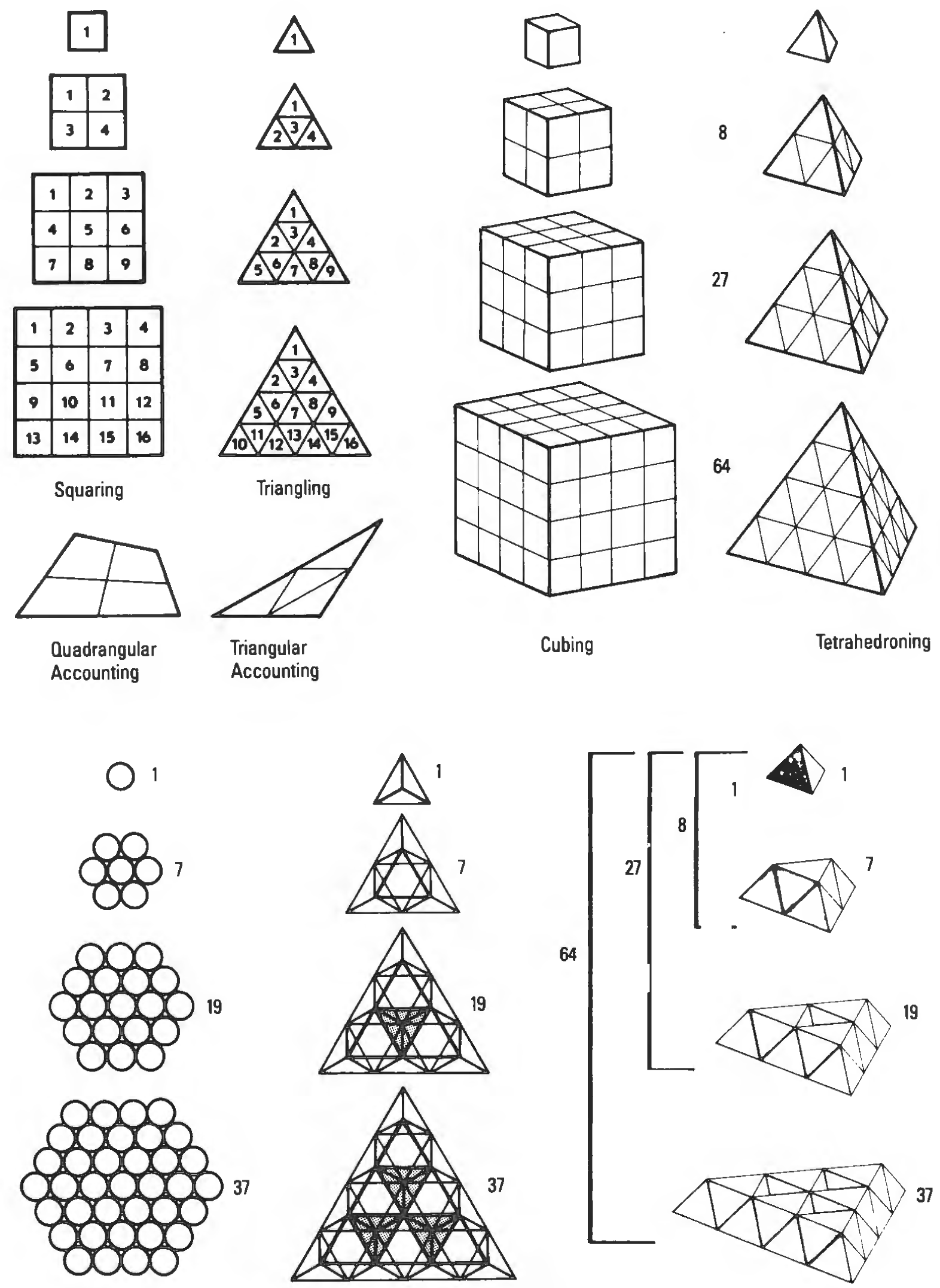
450 Any nonequiedged cube or hexahedron ABCDEFGH whose twelve edges are each divided into uniform fractional lengths, with each edge halved to start with, and that has those modular interval points interconnected with straight lines, will not be volumetrically subdivided into eight equivolumed and identical hexahedra.
451 Whereas any nonequiedged tetrahedron with its nonequiedges subdivided respectively into equilength linear increments, halves to start with, will always be volumetrically divided into identically volumed tetrahedra and octahedra whose octahedral volumes always exactly equal four times the volume of the tetrahedral components of the overall large tetrahedron. Nor can any asymmetric polyhedron other than the tetrahedron be uniformly subdivided into identical volumetric and linear module increments.
452 The tetrahedron uses only one-third the volumetric space of the cube and is therefore nature’s most economic and universally employable volumetric unity and energy quantum unit.
453 Thus, the minimum structural system in Universe, the tetrahedron, with its six push-pull interstructuring relationships and its four corner somethings and their four opposite nothingnesses (windows), becomes the logically most structural-system-meaningful conceptuality. It has already been demonstrated that the tetrahedron has comprehensive cohering integrity. The energy involved in its comprehensive coherence is the energy of its total surface growth rate. This leads us to Einstein’s energy equation E = mc2, where m is the relative mass of the increment of energy considered as matter and c equals the linear speed of energy unfettered in a vacuum and c2 equals the rate of growth in the system’s energy radiantly expanding surface.
454 We find that we can say—indeed, must say—‘‘triangling’’ instead of ‘‘squaring’’ when nature multiplies her linear dimensional units by themselves to arrive at a system’s surface areas (N2).
455 We find that we can say ‘‘tetrahedroning’’ instead of ‘‘cubing’’ when nature multiplies her system linear measurement to the third power (N3) to obtain system volume.
456 Since squares, as shown by our necklace experiment, have no structural integrity, and since nature is always operating in the most economically effective way, and since every square is always two triangles hinged together supposedly at 180∘, and since any triangle-regular, isosceles, or asymmetrical—will do to demonstrate N2 triangling, it is clear that nature’s second-powering always and only refers to triangling.
457 Since necklace cubes will not hold their shape, and since the volume of two tetrahedra joined together symmetrically produces the eight vertexes of the cube whose volume is exactly three times that of the tetrahedron, and since the regular, equiedged tetrahedron is the minimum structural system of Universe and is never made asymmetrical by local asymmetrical fractionating (as shown in the cheese Platonic description below), it is obvious that nature, being most economical, must employ the tetrahedron as volumetric unity in all of her primitive systemic formulating as well as in all of her size-time interactions and intertransformings. Since the use of the cube as unity employs three times as much volume as exists in Universe, physics has to employ imaginary complex number calculations and must employ Planck’s Constant of 6.625 to unburden itself of the two-thirds superfluous volume inherent in the XY Z, c-g-s calculations.
458 If we take a symmetrical polyhedron, such as a cube made of cheese, and slice parallel to one of its faces, what is left over is no longer symmetrical; it is no longer a cube. Slice one face of a cheese octahedron, and what is left over is no longer symmetrical; it is no longer an octahedron. If you try slicing parallel to one of the faces of any symmetrical geometric solid (i.e., the Platonic and Archimedean solids), what is left after the parallel slice is removed is no longer the same symmetrical polyhedron—with but one exception, the tetrahedron (see Fig. 6.75).
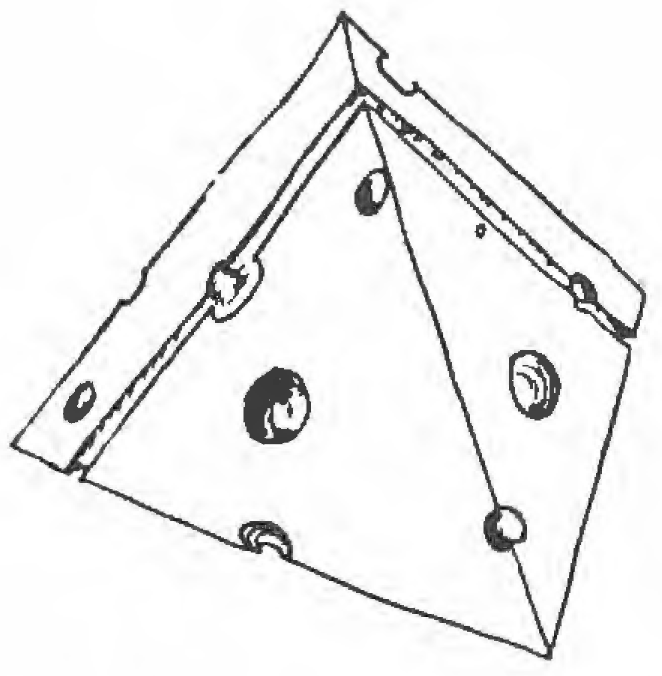
460 The tetrahedron has the extraordinary capability of remaining symmetrically coordinate and entertaining fifteen pairs of completely disparate rates of change of three different classes of energy behaviors in respect to the rest of Universe without changing its size. As such, it becomes a universal joint to couple disparate actions in Universe. For this reason, we should not be surprised at all to find nature employing such a facility for moving around Universe to accommodate all kinds of local transactions, such as coordination in organic chemistry or in the metals.
461 The tetrahedron’s symmetry, its fifteenness, its sixness, its fourness, and its threeness are all constants. Its induced motion or position displacement to accommodate alterations in the center of gravity may explain all apparent motion of Universe. The fifteenness is unique to the icosahedron and probably valves the fifteen great circles of the icosahedron.
462 A tetrahedron is unique in its strange property of coordinate symmetry, which permits local alteration without affecting the symmetrical coordination of the whole. This means that the tetrahedron can receive changes in respect to its relation to one direction of Universe and not in respect to the other directions while at the same time maintaining its symmetry as a whole. In contradistinction to any other Platonic or Archimedean symmetrical solid, only the tetrahedron can accommodate local asymmetrical addition or subtraction without losing its cosmic symmetry. Thus, the tetrahedron becomes the only exchange agent of Universe that is not itself altered by the exchange accommodation.
463 There is an absolute constancy of areal, volumetric, topological, and symmetry characteristics that is exclusively unique to triangles and tetrahedra. This constancy is maintained despite any and all asymmetrical aberrations of those triangles and tetrahedra, as caused by (1) perspective distortion; (2) interproportional variations of relative lengths and angles as manifest in isosceles, scalene, acute, or obtuse system aspects; (3) truncatings parallel to triangle edges or parallel to tetrahedron faces; or (4) frequency modulations.
464 In contradistinction, all polygons other than the triangle and all polyhedra other than the tetrahedron exhibit a complete loss of symmetry and topological constancy as caused by any special-case, time-size alterations or changes of the perspective point from which the observations of those systems are taken.
465 All attempts at modeling four-dimensional cubes, the ancient Greek tetrakytis or the hypercube of the early twentieth century, for example, have resulted in gross distortions of size, shape, perspective, and perception. The tetrahedron (simple, quadrivalent, or unfolded as the vector equilibrium), being inherently four-dimensional, with four intercoordinate planes of mutual symmetry, undergoes no such distortion. The significance of such modeling capability becomes fully apparent in observations of four-dimensional intercoordinate rotations, such as are for the first time possible without distortion in the ‘‘jitterbug’’ model (see Fig. 6.76).
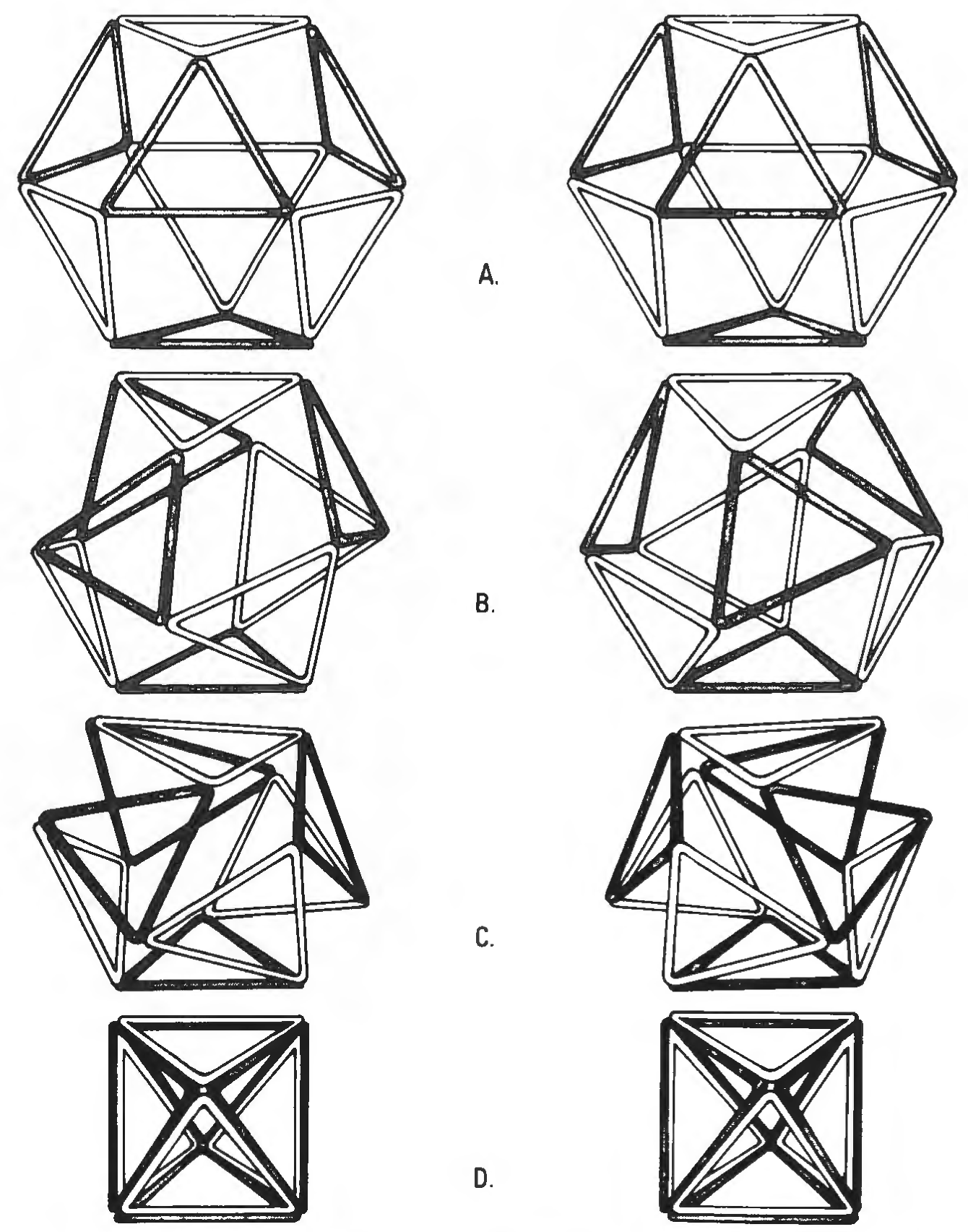
- A.
- Vector equilibrium phase: the beginning of the transformation.
- B.
- Icosahedron phase: when the short-diagonal dimension of the quadrilateral face is equal to the vector-equilibrium edge length, twenty equilateral triangular faces are formed.
- C.
- Octahedron phase: note the doubling of the edges.
467 The fact that academic science is using the cube for unity means that physics is involving threefold the volume available in always-most-economical Universe. That is why physics must always commence analysis of the energy behavior significance of its experimentally harvested data by multiplying it by Planck’s Constant, 6.625, which automatically removes the excess two-thirds volumetric value imposed by use of the c-g-s system.
468 The cube is structurally nonexistent in nature (except as a tertiary, nonstructural pattern aspect of the complex of vectors in an isotropic vector matrix).
469 Had I not started with the tetrahedron as the minimal structural system of Universe, I would not have come upon the integrity and energetic significance of the six-equivolumed A, B, S, T, and E modules.
470 Academia’s failure to understand, acknowledge, and adopt these facts that are elementary to synergetics indicates that academia has failed altogether to understand that the omnitetrahedrally conformed A and B, S, T, and E modules would not have been discovered if I had not altogether cast out the cube from its role in present-day physics.
471 IN RECOGNITION OF THERE BEING NO true spheres and only high-frequency polyvertexia, when we speak and think of unit-radius spheres close packed together around the one sphere and of them being further packed together around the nuclear sphere in the always eight-triangle and six-square pattern, the sphere centers of which aggregates produce what we have shown and described elsewhere as the isotropic vector matrix, it becomes appropriate to consider what the orientation to one another of the unit-radius polyvertexia may be, since they could be symmetrically interrelated in three ways: univalent, bivalent, trivalent. They may connect one vertex to one vertex, two vertexes to two vertexes (edge to edge), and three vertexes to three vertexes (window to window, face to face). The first way (one vertex to one vertex) produces gases; the second way (two vertexes to two vertexes) produces liquids; and the third way produces crystals (i.e., superficial ‘‘solids’’). The first way (as gases) uses the greatest diameter; the second way, a lesser diameter; and the third way, the least diameter.
472 The least diameter produces what used to be called spheres, which, we now learn, do not touch one another when closest packed.
473 The isotropic vector matrix is the condition of which Avogadro speaks in which all the conditions of heat and pressure (expansion and contraction) are identical—the positive and negative vector.
474 What can touch one another are only gases. This gives importance to Avogadro’s law that under identical conditions of pressure and heat, all gases disclose the same number of molecules per given volume. This is what we have as the interpatterning of the isotropic vector matrix, all of which proves that ‘‘solidly’’ speaking or crystallinely speaking, nothing in Universe touches anything else in Universe, and all is cohered only remotely by tensegrity (tensional integrity).
475 Since mites (quarks) are the minimum allspace fillers and since they can fill it vertex to vertex (quadrivalently), they can fill with any proportionality of positive and negative mites. That they can do so—the vacancy option—explains why ice can, and does, float on water.
476 Since more than one event cannot occupy the same point at the same time and since more than one event cannot passage any one point in Universe at the same time, two great circles cannot cross one another at the same radius from the system center, wherefore all of the seven foldable-into-bow-tie patterns that may be associated to seemingly reestablish their circulating of the seven systems of symmetry are demonstrating only approaches to the point of relayable continuance of their most economic travel. Their approach to points of relay can readily induce a transmitted momentum (as do hung rows of metal spheres), wherefore we may now understand that electromagnetic waves are not continuous, except in their continuum of local Lissajous figures, and that wavelike particles are finite packages.
477 The fact that all the seven great circles inherently fold into simple and complex bow ties, all of which are reintegratable to produce spheres, seemed at first ‘‘interesting’’ to me. Then it became evident that the individual 360∘ basic wave cycle that each manifests provides a means of holding information in a local self-regenerative shunting pattern, with releasability into cosmic travel through the tangency points inherent in closest-packed-together unit-radius spheres.
478 A surprising manifest of this model was that the great-circle tracking was interconnectable at the twelve tangent points only as a gap-jumping.
479 Such arcing may in the future explain radiant energy as a demonstration of discontinuous photon trains.
480 AS WE HAVE DETERMINED, LINES MAY BE more accurately described as trajectories of events.
481 Since two lines and their respective events cannot go through the same point at the same time, we have interferences, reflections, refractions, and smashups. This is what is discovered in the atom smashers and their peripheral cloud chambers.
482 A great circle is said to be a line formed on the surface of a sphere by a plane going through the center of that sphere. Great circles are said to be the shortest distance between points on a spherical surface. In spherical trigonometry, two great circles must always cross each other twice.
483 We are now forced to say that since lines cannot go through the same point at the same time, great circles cannot go through the same point at the same time. Great circles’ tracks are not the shortest distance between two points on a sphere; the chords between those points are the shortest distances. In a polyvertexion of very high frequency, the continuum of chords may seem to go through the same point at the same time, but that cannot be. What we must conclude is that in view of the fact that two lines cannot go through the same point at the same time, all of the ‘‘foldable great circles’’ (which can be vertex-fastened together to seemingly reconstitute the great circles) represent the actual and only possible pathways of energy.
484 Lissajous figures (Bowditch curves) were discovered as useful tools for science during the early days of World War II. These figure-eight patterns were found to be the patterns that energy was producing in the microworld. I found that the seven unique cases of the foldable great circles which can be interassembled vertex to vertex seemingly reconstitute the three, four, six, and twelve great circles of the vector equilibrium and the ten, fifteen, and six great circles of the icosahedron. These represent the fundamental self-interference patterns of nature trying to achieve most economic travel routes—that is, the shortest distances between points. Energy continually recompletes these cycles. In this way, nature can have local holding patterns of energy, which can, however, be gap-jumped into wave continuums.
485 Synergetics, through modeling, provides this demonstration of how continuous waves and packeted quanta can be reconciled, which I shall further describe now.
486 All but the six great circles on the icosahedron go through the twelve main vertexes of the system. In the case of the vector equilibrium, the twelve vertexes are in even-numbered rotational symmetry, whereas the twelve vertexes of the icosahedron are in odd-numbered rotational lock. By removing the nuclear sphere of the vector equilibrium, the twelve spheres of the icosahedron collapse into the nonsymmetrical position. This could be a way of shutting off a circuit: circuits that are open on the same twelve vertexes as are open on the vector equilibrium can be cut off by collapsing the central sphere of the vector equilibrium. (See Fig. 6.77).
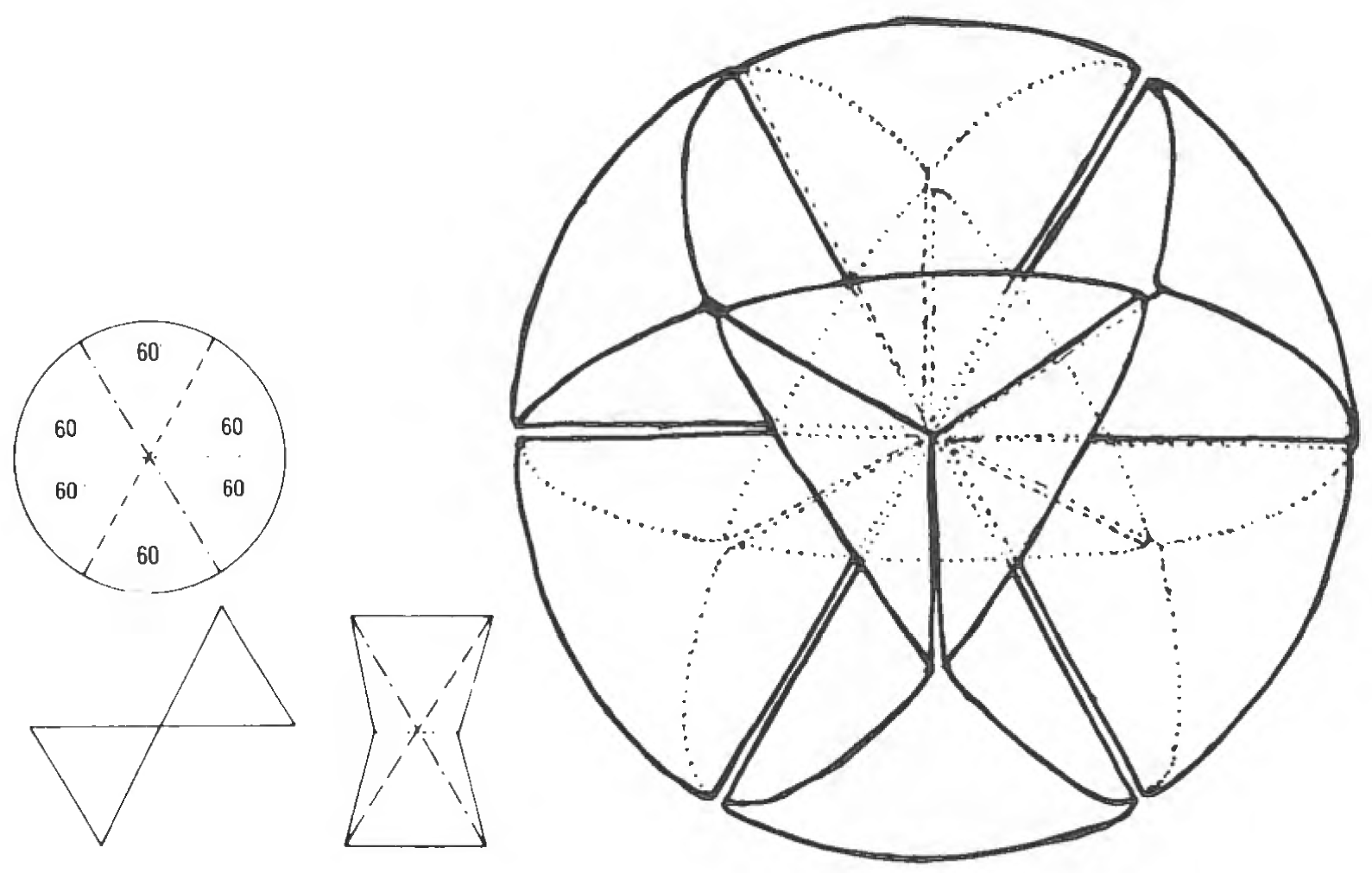
488 The twenty-five great circles on the vector equilibrium all pass through the twelve points of tangency of the spheric system with other spheric systems in closest packing. In fact, energy always follows the convex surface, which is always the most highly tensioned surface. If you bend a piece of flexible steel, the outside surface goes into higher tension, and the inside, into compression. Electrical energy always follows the highest tension. You can safely walk around inside a 20-foot copper sphere that has 2 million volts statically introduced at the surface.
489 The shortest routes through Universe would be from sphere to sphere, following those great circles that alone go through the twelve points of tangency of the spheric systems.
490 The foldable set of twenty-five great circles of the vector equilibrium are the only great circles that can be so folded. There are no other known cases of foldable great circles. We have only one case of nonpassage through the twelve points of tangency of the vector equilibrium and twelve points of shunted energy of the icosahedron—those being the six great circles of the icosahedron, which constitute the six equators of the icosahedron.
491 It is perfectly clear that at the point of contact of the folded great circle with its counterpart of the great circles, there is a true gap, which explains the phenomena—not explained by physicists—of what seem to be particles and waves. Waves seem to be continuous, and particles seem to be discontinuous. Now we can see that the wave is also the particle: it is the Lissajous figure, which with the right gap closing would constitute a circuit. Tuning, I am sure, is exactly this closing of a gap. A solenoid, for example, is used to tune to the right number of coils to allow a gap to be closed.
492 There is, as we have shown, no absolute continuum of anything. Higher and higher tensions are built up until one is able to ‘‘arc the gap’’—to cross the gap of the (appropriately named) arc altitude between two apparently touching noncontinuous spheric systems.
493 From here we look at Ohm’s law, which states that the amount of current equals the resistance divided by the voltage. The resistance builds up, and suddenly the charge jumps across.
494 WHEN I DEVELOPED MY DYMAXION MAP, Life magazine brought in five experts: Dr. Boggs, the chief geographer and cartographer for the U.S. State Department; the president of the American Geographical Society ; and three mathematicians recommended by New York University, all of whom said that the cartographic projection I had developed was pure invention and did not conform to any known mathematics. It was easy for my patent attorney, using this information, to get the projection system granted a patent.
495 I told these experts that I had a three-way grid of great circles. They said that there was no such thing as a three-way grid of great circles. They overlooked the spherical octahedron, which we learn can only be done with six great circles.
496 My friend Mr. Norquist, who was president of Butler, the grain bin company in Kansas City, told me he could spin very accurate hemispheres. We ordered two hemispheres spun in copper 1 ⁄ 16-inch thick, one sliding spherically around inside the other. They were precisely machined hemispheres. Their edges were great circles. They became great-circle rulers. I put half of the spherical vector equilibrium on one of them. There were four of the eight triangles, to the edges of which I inscribed perpendiculars. I started at the poles and went from pole to pole, from triangles into the squares. I got down to 60∘ (exactly one edge of the vector equilibrium). I marked 1∘ positions, and I scribed great circles from pole to pole. There was a square grid in the six spherical squares and a triangular grid in the eight triangles; this formed a three-way grid inside the triangle and a two-way grid inside the square. The 1∘ grid was very carefully scribed. When I began experimenting with spherical trigonometry and geodesic domes, I was convinced that there was a three-way grid of great circles within a triangle. When I began doing my spherical trig for the geodesic dome, I found that the lines of the grid did not cross exactly, they made little triangles with approximately 15 minutes of arc to the edge. It seems that what nature is doing is weaving in and out with the three-way grid.
497 Since you cannot go through the same point at the same time, nothing could be more wonderful or natural than these little triangles that at first annoyed me when I saw them as a discrepancy. I proved that there really could be a three-way grid, but it had to be a woven three-way grid. The weave would have to be close to the thickness of the material you were weaving.
6.16 Brain, Mind, and Universe
498Elaborating on my earlier definition of Universe as ‘‘the aggregate of all humanity’s consciously apprehended and communicated-to-self-or-others experiences,’’ I note that to each individual human, Universe is the ever-multiplying totality of a uniquely evolving, special-case history of omnidimensional, omnidirectional, omnimagnitude, omnifrequency, self-and-all-others lived-in scenario.
499 Scenario Universe is a plurality of individual, nonsimultaneously occurring overlappings and interweavings of both unique and similar episodic characters, things, scenes, and themes.
500 The complex overlappings and interweavings are omnisensed, imagined, compared, and remembered only and entirely within the individual human’s brain as an ever-local, time-space-conceived, evolving summary-complex of sought-for and progressively assumed-to-be personally discovered concepts of specific phenomena interrelationships holding various relative magnitudes of significance.
501 The relative-significance judgments by the human individual are continually translated and fed back into anticipatory reorganization of the individual’s initiatives, criteria of judgments, and attitudes.
502 All of the foregoing subjective and objective individual prospecting and formulating always and only constitute special-case realizations of the eternally regenerative total complex of the ever nonsimultaneously integrating, intertransforming, growthfully converging and dissipatingly diverging importing-here, exporting-there sortings, selectings, combinings, implementations, and realizations of the potentials of the omniinteraccommodative cosmic totality—the family of thus-far-discovered, generalized metaphysical principles governing all the only special-case, physical realizations of Universe.
503 The unity of Universe is an inherently plural, complex unison. It is a uniting of all known human experience of all the special-case realizations of the eternal plurality of individually unique generalized principles.
504 All of the thus-far-discovered and only mathematically definable generalized principles have been discovered solely by human minds. Human minds alone are always concerned with the discovery of the inherently nonsensorial, non-brain-apprehensible interrelationships of Universe. Brains deal only in the special-case experience with temporal beginnings and endings. Minds of humans reconsidering the special-case experiencings recalled from the brain’s memory banks alone are admitted to discovering and objectively employing the eternal principles of Universe.
505 As a consequence of the unique functioning in Universe of human mind and its discovery and objective use of the omniinteraccommodative generalized principles, as set forth in the foregoing complex statements, there has been an extraordinary harvest of significant knowledge and human capability advantaging, enumerated below.
- 1.
- The energy of the nonsimultaneously overlapping episodes of eternally regenerative Universe is only sum-totally but never omnisimultaneously constant. All energy-event multiplication in Universe is accomplished only by dividing the never-at-any-one-instant sum-totally available energy into progressively greater numbers of progressively more-frequent and smaller-magnitude events. Multiplication only by division ranges all the way from eternally tranquil novent,6 through a few infrequent macrocataclysmic events (e.g., novae), to many frequent microminitude events (e.g., microbes). This multiplication only by division of the total energy of Universe is uniquely identified with quantum mechanics.
- 2.
- Galileo’s law of similitude is manifest in the succession of relative magnitudes of
energies involved in iceberg melting, during which process there is an initial slowness
of melting, because an iceberg melts only as it takes in energy as heat from outside
through its relatively small surface area—as it is proportioned numerically to its
volumetric mass. However, its volume becomes progressively smaller at a velocity of
N3, while its surface gets smaller only at a rate of N2, wherefore as the iceberg melts
it admits heat ever faster to melt its interior mass. We can see how its volume is
decreasing at a far faster rate than the accelerating rate of admittance of outside
heat which accomplishes the melting. We witness the iceberg’s last frozen remainder
vanish ever more rapidly.
506Let us think next about Galileo’s similitude law in respect to this melting and as also manifest in the case of the 18 : 1 slenderness-ratioed, cigar-shaped piece of steel 6 feet long that swiftly sinks into water while its 11 ⁄ 2-inch-long steel needle counterpart floats on the same deep, still-surfaced water, wherewith we realize that both the iceberg and the steel cigar and needles manifestly demonstrate that going from the macrocosmic to the microcosmic, the volume-mass-weight relationship becomes progressively less energetically significant in respect to the now energetically great significance of the surfaces, and that surfaces in turn become progressively less significant in respect to exclusively linear interrelationships, such as those of gravity or electromagnetic proximities.
508It is thus that we note the increasing interattractiveness of bodies with the diminution of the size of the bodies and their linear interdistancing. The astonishing coherence of the atomic nucleus is thus explainable, as is, to an only somewhat less dramatic degree, the ever-more-with-less tensile strength of coherence augmentations of metallic alloys.
509Let us also think about the way in which this Galileo principle governs nature’s own designing of all zoological creatures and botanical species—for instance, in his book sevenmysteries [sevenmysteries], Guy Murchie gives the example of a mouse jumping out of an airplane and landing safely because its skin acts successfully as a parachute in arresting the mouse’s rate of descent. This would not be the case with a human being, because of his greater weight per unit of skin area, or with an elephant, with its even greater weight-to-skin-area environment-imposed limitations of behavior. A human can high-jump about a foot and a half more than the human height and pole-vault about three times that height, but the fall from the latter height has to be carefully cushioned if the human legs are not to be broken. A grasshopper, on the other hand, can jump fifty times its height and land without harming itself because of its great body-surface-to-weight ratio, its jumping strength being vested in surface-tension mechanisms. Murchie cites many of these relative-size controls of the life-styles of biological life in relation to environment. His figures on hummingbird energy requirements and their rate of refueling are all part of the same mathematically statable topological, geometrical, energy-vector-quanta, chemical-bonding, electromagnetic, and gravitational relative-magnitude laws. Shipbuilders long ago learned that doubling the length of a ship increases its payload capacity eightfold but increases its hull area only fourfold—thus saving on construction cost and friction with the sea—and doubles the earning potential.
510For my own part, I learned long ago that not only do spherical structures contain the most volume with the least surface but also that the curved (inherently triangulated) structure of spheres gives the greatest strength per pound of materials employed. Every time I doubled the diameter of my spheric-domical structures, I increased the contained volume of atmosphere eightfold while only fourfolding the amount of structural shell per each enclosed molecule of atmosphere, through which enclosing skin the contained molecules of atmosphere could gain or lose heat.
511I have also found this same energetic-effectiveness increase as relative size is diminished to be mathematically and incisively demonstrable in going from the triple-bonded crystal’s rigid structuring to the flexible viscosity of the double-bonded liquids, whose surface tension embracingly coheres a droplet of liquid or spherically embraces a bubble—whereas the only singly interbonded gas, with its atom-structured molecules, cannot maintain a system integrity very easily and to be locally retained must be enclosed within sealed containers.
512In summarizing the concepts of volume, surface, and line, and quartemary, tertiary, dual, and angle bonding, the material covered earlier in this volume shows that the minimum demonstrable-reality ‘‘something’’ is a system having insideness and outsideness, and ergo the tetrahedron is the minimum considerable system; that a seemingly surface-only phenomenon is a tetrahedron of almost zero altitude; that a line is realistically a tetrahedron of great altitude and almost zero base whose altitude could be extended as long as there is time; and that its frequency within Universe is also shown by synergetics in the terms of the A Quanta Module, whose linear energetic content is constant, its wavelength always being measured from base to pinnacle.
- 3.
- First, combining (a) all the foregoing
design-science considerations of the relative-magnitude and quantum-mechanics
conceptioning with (b) Newton’s relative-mass laws and his second-power-varying,
remote-from-one-another body-interattractiveness laws and with (c) my own vector
equilibrium’s experimental redemonstrability of the four-dimensional jitterbug’s
twenty volumes omnisymmetrically and omniconcentrically contracting to one volume
while intertransforming from VE to icosahedron to octahedron to tetrahedron and
from single interbonding to double to triple to quadruple interbonding—i.e., to fourfold
tetravertexion vectorial congruence. All of which follows a complex of elegantly
statable, omnirational, mathematical-transformation laws.
513We have altogether the Galilean similitude progression of volume decreasing at a third power N3 rate while the surface of the same symmetrically shrinking geometrical form decreases at a rate of only N2 and the linear dimensions of the symmetrically shrinking geometrical object decrease at only a first-power rate N, an arithmetical rate. This similitude progression saw the steel needle 4 inches in diameter and 72 inches long with a ‘‘slenderness’’ (diameter-to-length ratio of 1--181 ⁄ 2, similar to that of Greek columns). We saw such a steel cigar sink swiftly in deep water, whereas the same steel cigar reduced to a length of 2 inches becomes a delicate steel sewing needle that floats on the same deep water, weight having become negligible and only the surface tension of the water and the surface-maintained structural integrity of the steel cigar having environmental behavior significance. We are now going to marry this Galilean similitude progression with my synergetics geometrical hierarchy’s progression of volume-to-surface interrelationship changing with symmetrical intertransforming as the mass (volume/weight) changes as well as the vector structuring transforms from single to double, to triple, to fourfold, doubling up all vector lines, which alters the system’s internal coherence at first-, second-, third-, and fourth-power rates as their shrinking interproximities are governed by the Newtonian mass-interattractiveness law.
514In this altogether considered marriage of the similitude progression of an object system’s progressively changing behavioral relationship to a given environment (e.g., the spider falling off a cliff versus the elephant falling off the same cliff), to the synergetics principles of symmetrical shape and mass transformation, we then extend these progressions to the surface by examining synergetics asymmetrical transformation in an only-altitude-decreasing transformation of a tetrahedron that approaches an almost but never entirely flat and volumeless triangular base plane. After this, we have the progression of surface contraction at a second-power rate N2 becoming insignificant in respect to the only-arithmetical rate of shrinking the system’s linear dimension as we get ever smaller. We learn in synergetics that what seems to be a line is in effect a tetrahedron whose base dimension is shrinking faster than its altitude is (see Fig. 6.78).
515Then we come to synergetics’ fractionation of all its hierarchy into the univolumed A, B, T, and other 1 ⁄ 24 regular tetrahedral volume units, and to these A and B phases as constituting nature’s minimal all space filler of Universe, and to the successive quartering into ever ‘‘flatter’’ tetrahedra of the particles themselves. And then we come to the C, D, E, F modules to any linear extension to interreach any bodies in Uni.verse, with all the intercohering strength of all Universe progressively concentrated to provide the intercosmic tensional capabilities discovered by Kepler to be comprehensively manifest. We also discover that at the Einstein module level, all the energies become transformed into radiation, only to have the pushed radiation bending back on itself to become eventually inward-bound as by photosynthesis it is converted into biomatter, as Murchie so magnificently discloses in sevenmysteries [sevenmysteries].
516Unlike other polyhedra, the tetrahedron exhibits constant properties with respect to altitude, volume, and cross-section (see Fig. 6.79).
517We find as we look ever microward that bio-‘‘life’’ progressively miniaturizes its componentation until it crosses the threshold between bio and crystal, after which the progression of similitude and synergetics takes over, again giving us a magnificent overview of eternally regenerative Universe.
- 4.
- Because of my physical-model-proven knowledge of the Einstein model’s
transdeformation in a light photon as mc2 = mass times the speed of the spherical
surface growth rate of radiation expansion converted into a single tensor.
518Modeling transformation and its altering noncontact, intercoherence augmentations in the following exposition of metallic alloying interaugmentation which require meshing of event patternings.
519And finally with my physically proven discovery that a triangle is the only polygon that holds its shape.
- 5.
- With my discovery that there are only three primitive structural systems in Universe:
the six-vertexion, the four-vertexion, and the twelve-vertexion.
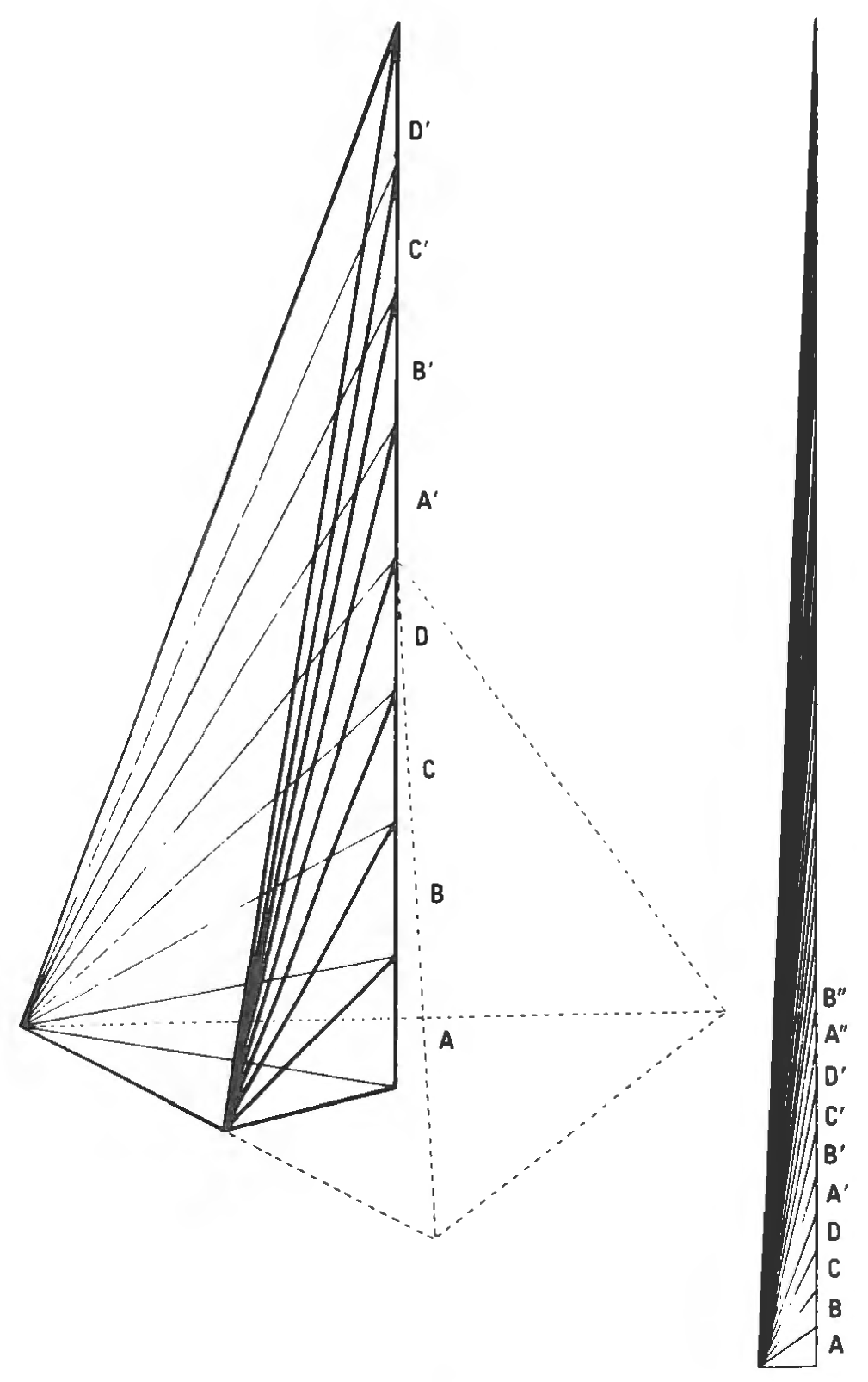
Figure 6.78: Constant-unit-volume progressions of asymmetric tetrahedra. In this progression of ever-more-asymmetric tetrahedra, only the sixth edge remains constant. Tetrahedral wavelength and tuning permit any two points in Universe to connect with any other two points in Universe. - 6.
- With our proven knowledge that there always and only are twelve degrees of freedom in Universe, six positive and six negative.
- 7.
- With my own proven knowledge of tensegrity, in which no compressional component of a
structural system ever touches another.
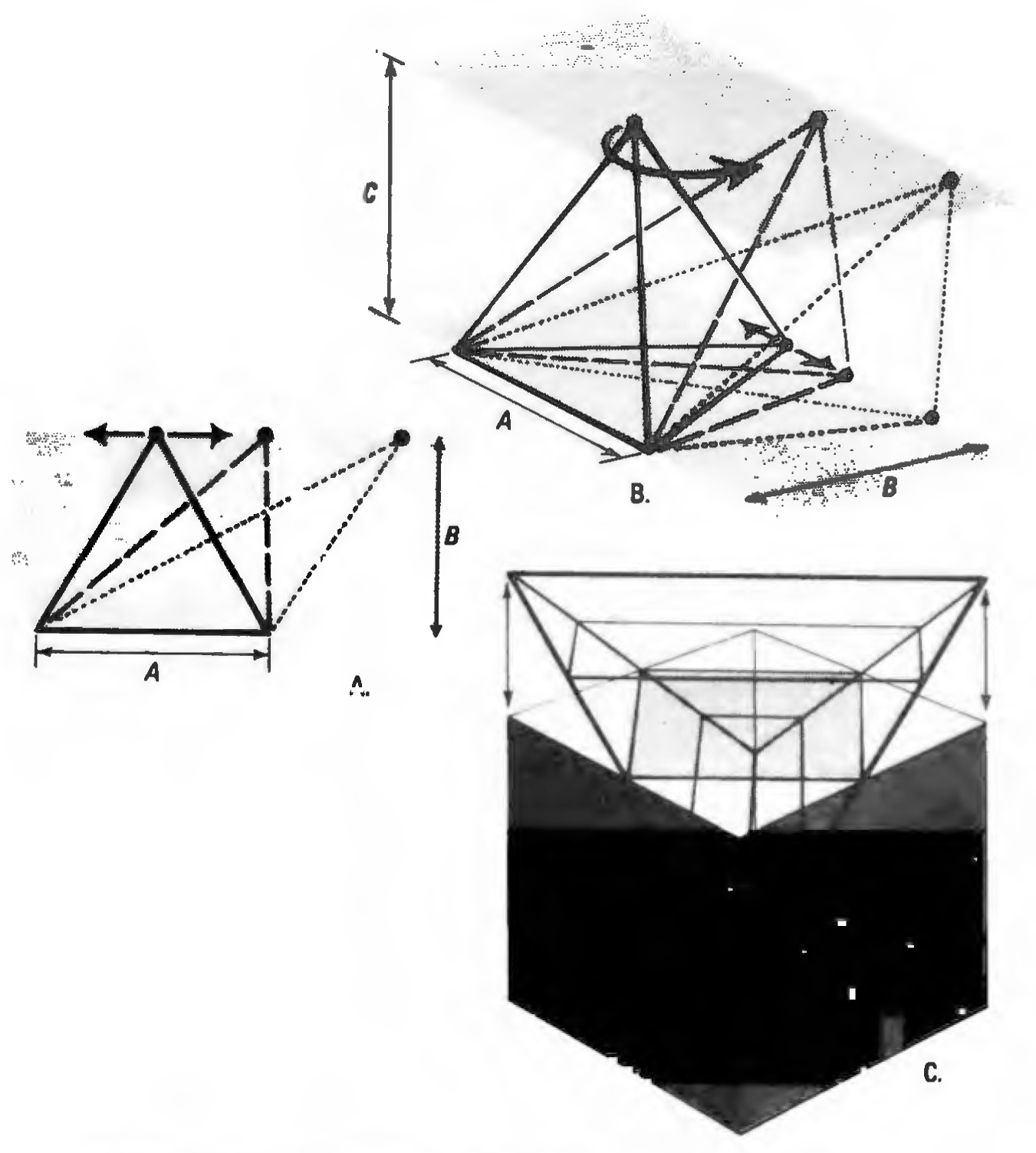
Figure 6.79: Constant properties of the tetrahedron. - A.
- The area of a triangle is one-half the base times the altitude. Any arbitrary triangle will have the same area as any other triangle so long as they have a common base and altitude. Here is shown a system with two constants, A and B, and two variables—the edges of the triangle excepting A.
- B.
- The volume of a tetrahedron is one-third the base area times the altitude. Any arbitrary tetrahedron will have a volume equal to any other tetrahedron so long as they have common base areas and common altitudes. Here is shown a system in which there are three constants, A, B, C, and five variables—all the tetrahedron edges excluding A.
- C.
- As the tetrahedron is pulled out from the cube, the circumference around the tetrahedron remains equal when taken at the points where cube and tetrahedron edges cross; i.e., any rectangular plane taken through the regular tetrahedron will have a circumference equal to any other rectangular plane taken through the same tetrahedron, and this circumference will be twice the length of the tetrahedron edge.
- 8.
- With my knowledge that every seemingly solid compressional strut of a tensegrity structural system can be replaced by a tensegrity mast.
- 9.
- Because of my knowledge that a nucleated tensegrity four-vertexion requires eighteen tensional restraints externally and twelve internally.
- 10.
- Because of my knowledge of the octahedron as conservation and annihilation model, in which one unit of volume can be lost and regained within the same energy restraints (see synergetics [synergetics], 985.08; 935.38; Fig. 936.12 and Color Plate 6).
520 All the foregoing seems possibly to explain why physicists have been confounded by the fact that the magnitude of atomic-nucleus integrity of self-coherence greatly exceeded explainability by Newton’s second-power law.
521 By way of example, I can explain the reason why the atomic nucleus is so dense. It is the limit condition. It is structurally quadrivalent (to the fourth power, so to speak, i.e., N8 ), which can be demonstrated by the jitterbug model. Its quadrivalence is complemented by a quadrivalence of negative Universe (see Fig. 6.80).
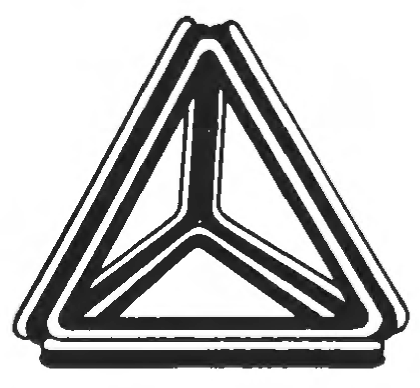
523 In synergetics [synergetics] I published the clear identity of nature’s minimum allspace-filling tetravertexion, consisting of two back-to-back A modules and one B module whose respective internal reflectivities’ energy-releasing behaviors exactly correspond with the quarks, and went on to show that the A′s and B′s could be exactly quartered around their volume centers—whereby their quartering always produced tetravertexia, and such successive quartering produced tetravertexia, ad infinitum. All of which corresponds with the experimental results of ever more powerful ultra-ultra-high-power atom smashing.
524 I must conclude that the present preoccupation of the world’s physicists is to use billions of dollars’ worth of atom smashers to discover something about the nucleus of the atom, which is akin to smashing a Boeing 747 in order to discover how its 500,000 component parts fit together in one functional design.
525 All that physicists need to do is study synergetics to learn how nature designed atoms and combinations of them—in pure principle.
526 ALL THE CELESTIALLY EVERYWHERE AND everywhen, ever more disorderly, multitudinous, radiational broadcastings of all nonsimultaneously disintegrating star and galaxy systems of eternally regenerative Universe remotely and nonsimultaneously intermingle their differently accelerated and differently aimed cosmic offcastings to produce nonsimultaneous entropic maelstroms variously distanced from one another: cosmic clouds.
527 In passing one another at a wide range of high velocities, these separate novae-refuse entities intermingle in a wide variety of densities. As they do so, their patterns interweave, accidentally thickening because their relative interattractivenesses vary inversely, according to Newton’s interattractiveness law. Their interattractivenesses are countered by their respective velocity momentums, resulting in progressive veerings of the celestial courses of the individual items of cosmic refuse.
528 The interattractions produce progressively higher orders of gain and ever-decreasing radii of individual orbiting.
529 Gradually entropy gives way here and there to syntropy, as the individual components from a myriad of different stars gravitationally integrate here and there as new individual cosmic clouds. Within these clouds the process of orbital course veering into ever-lesser radii continues, and the cloud thickenings continue to seemingly endless progression.
530 In the same integrated interattracting and momentum veering of their orbital courses, all the separate, individually thickening clouds progressively converge here and there as larger and more complex clouds. These individual larger clouds progressively thicken together. This process leads eventually in sufficient condensations here and there in Universe to produce asteroids and planets.
531 Now repeating, now amplifying, it follows that the omniconserved, complexedly and nonsimultaneously intertransforming energies of eternally regenerative Universe consist most simply of two prime patterns: one of energy convergently associative as a complex mix of disorderly, cosmically broadcast, individually and multiplicatively disintegrating, asymmetric components in the course of the systematically organized and symmetrically converged, nonintertouching interarrays transformed into a radiantly entropic star whose randomly broadcast entities progressively intermingle in an even more disorderly manner with entropically (disorderly) broadcast energetic entities of a myriad of other as yet entropically broadcasting stars as well as with the still entropically traveling broadcastings of now energy-spent, only ‘‘has-been’’ stars. The superdisorderly cosmic intermingling of the energetic rubbish of vast numbers of stars sometimes interapproach one another to such a degree of proximity that Newton’s celestial-bodies interattraction law progressively decreases the distances between them and thereby increases their interattraction at a second-power rate of the arithmetical distances intervening; thus, they palpitatingly interpulse now this way, now that way, finally collecting dominantly in zillions of initial trendings toward symmetries and responses in antientropic (i.e., syntropic) forces of orderly convergence. Gravitationally embraced, they begin interapproaching one another to become progressively electromagnetically and gravitationally self-sorting in terms of size and angularity and, in relative proximity, attaining here and there closest proximities of symmetric interpositionings which, when numerically and geometrically and vector-balanced in sufficient degree, finally attain the state of matter designed thereby to agglomerate with other newly formed matter until a critical mass of matter is convened, at which moment that matter suddenly starts to transform again, becoming a radiant star.
532 What is important to understand and to concern ourselves with anew is the phase when only as maximum disorderliness occurs and only as myriads of disorderly, interdisposed groups of mistily lesser or foggily greater densities of disorderliness in many locations of Universe, tentative precloud pulsations occur on the myriads of nonsimultaneous critical thresholds of the moments-of-imminence of cosmically localizing, thereafter to become progressively denser, yet only locally within their interclearing and convergence, owing to varying dominances of radiational and gravitational forces, and, at first and for long, progressively disorderly for aeons vast quantities of energetic Universe are at all times preoccupied in this still disorderly limbo and thus still unconceptualizable vacillating condition, and ergo large quantities of cosmic energy are undifferentiated and not yet accountably associable as a certifiable entity.
533 After aeons of subcomponents interacting in the void of darkness, gradually, on the face of the deep, gravitationally collecting clouds once again began to appear and their relentless trending eventually in new creation would render once more cosmos out of chaos.
534 Synergetics reveals much more about the way energy quanta become temporarily vectorially lost to cosmic account, yet are realistically recoverable by Universe through the octahedron as conservation and annihilation model.
535 This pre-Magellanic-cloud, prestardust, preanything, for-the-time-being-inevident, nonconceptual, unimaginable, only-potentially-unlost, and only-in-pure-principle-recoverable phenomenon physically demonstrates my transformation model and shows the octahedron in its annihilation and conservation modes.
536 The vastness of overlapping unaccountability is difficult for those unschooled in synergetics to comprehend—resorting to explanations involving inverted energies, black holes, and latent phases—within an ever vastly regenerative Universe, with its multinonsimultaneity and, only in overall eternity, regenerativity.