1 The Dawn of Einstein’s Universe
2THE DARK AGES STILL REIGN over all humanity, and the depth and persistence of this domination are only now becoming clear.
3 This Dark Ages prison has no steel bars, chains, or locks. Instead, it is locked by mis-orientation and built of misinformation. Caught up in a plethora of conditioned reflexes and driven by the human ego, both warden and prisoner attempt meagerly to compete with God. All are intractably skeptical of what they do not understand. We are powerfully imprisoned in these Dark Ages simply by the terms in which we have been conditioned to think.
4 Some concepts have been long imagined by humans to be real: up and down, straight lines that extend to infinity, measurement based on squares and cubes. For ages, humans have mistakenly thought that solids were truly solid and that several lines could conceivably pass through the same point at the same time. Humans have deceived themselves that the existence of one, two, and three dimensions is independently demonstrable and that there is factual evidence proving the existence of more than one race of human beings. And further, humans attest to belief in God, although only paying ‘‘him’’ once-a-week lip service in an otherwise human, male-dominated Universe.
5 Formal religions have been organized to attend to the otherwise inconvenient, constant recognition of God, while humanity gives six-sevenths of its time to rendering service to the exclusively selfish dictates of human power structures.
6 Mis-orientation, wrong beliefs, and conditioned fixations are escapable only when that which is physically and metaphysically true becomes experimentally provable and comprehensible. The untrue is rendered spontaneously obsolete only by the demonstration of that which is true. It is here I am compelled to begin.
7 The only important fact about me, as I write this book, is that I am an average, healthy human being. There is nothing that I have done that could not have been done equally well or better by any other healthy human being, given the unique working circumstances under which I have operated for the last fifty-five years.
8 This book presents my individual efforts to escape from the clutches of the Dark Ages, but in a larger sense it shows the beginnings of our species’ epochal rebirth, what I call the dawn of Einstein’s Universe. As an average, healthy human being, I have learned how little we know about ourselves. For an instance: Why are we humans included in the design of Universe? How is the designing of eternally regenerative Universe both anticipatorally and progressively conceived and realized,together with the part already played and as yet to be played by humans?
9 I am sure that the only reason that I am widely known is because in 1927, when I was thirty-two, I decided to make an experiment of myself. The experiment sought to discover and realize what would happen if a healthy, moneyless, unknown individual with dependent wife and newborn child altogether discarded the assumption that an honorable human must earn the right of family and self to live (‘‘earn a living’’) and do so to the satisfaction of the socioeconomic power structure governing the political system in which he lived and, breaking away from all socially accepted concepts of the significance of human presence on planet Earth, undertook to discover what—if anything—a mature individual might be able to do effectively on behalf of all humanity that would be inherently impossible of accomplishment by any political system, nation, or private-enterprise corporation no matter how powerful or well-endowed.
10 Because (a) I had no competitors in such an initiative and (b) the experiment has been so richly productive, I have come to be widely known. If there had been any competitors, you would probably never have heard of me. If there had been competitors, I would long ago have dropped out, leaving the task to the competence of my competitors. I initiated that which I did only because I was convinced it needed to be done and to the best of my knowledge no one else was attempting to do it.
11 I was thirty-two years old. In the year I was born, the life insurance companies’ actuarial tables showed that life expectancy was forty-two years for white males born in New England. Being thirty-two, it was my feeling that I had only ten years left within which to carry out my experiment. I realized even then that I would get nowhere by asking the three billion humans then on planet Earth to listen to me--let alone support me. As a rule, I found that people listen only when they ask you to speak to them.
12 It seemed clear to me that the only possible way I could become effective would be by doing what I did on a scale all out of proportion to what one would imagine possible for a mere individual. First, it would have to be done on behalf of all humanity, and second, it would have to take advantage of the human mind’s capability to discover the generalized principles. These generalized principles govern the operation of our physical Universe. I set out to discover the entire inventory of generalized, only-mathematically-expressible scientific principles that had thus far in history been discovered by humans. Third, I surmised that I must employ those principles to develop artifacts that would render the living environment more favorable for all humans and their supportive ecology.
13 The role of human mind, invention, and tools in the relentless course of human cosmic evolution became quite clear to me.
14 My hope was that the development of this more favorable physical environment would bring about such a reduction of physical disadvantage to humanity that individuals with vastly greater knowledge of their technological options would become principally concerned with unselfish goals: the realization of potential advantages for all humanity to be attained only by an artifact revolution. Such developments would encourage worldwide understanding and social accords sufficient to entirely eliminate the local condition of degeneration or prolonged economic want and anguish. Ultimately, I hoped that competition for limited resources would be ended and thus the root cause for war.
15 Perhaps on some level, expressed or unexpressed, similar motivation drives all those who set out to discover and invent.
16 OVER A HALF CENTURY AGO, when I embarked on my ‘‘experiment in individual initiative,’’ I set before myself (as I have repeatedly ever since then) one very large question: What is our human function here in Universe?
17 My first answer to that question came from three closely related observations:
- 1.
- That all the known living organisms other than humans have some integral bodily equipment that gives them special operating capability in special environments.
- 2.
- That many creatures, including humans, have brains and that brains are always and
only sorting the information reported by the senses and integrating this information
into system images and therewith coordinating nervous control responses or forming
improved new system imaginings.
18Brains are therefore always dealing with special-case experience--for example, ‘‘This one smells a little sweeter than that one.’’ Brains must sleep periodically. Brains deal in beginnings and endings of special-case considerations. Brains are physical, temporal, and frequently terminaled.
- 3.
- Humans also have a faculty unidentified with any other creatures the faculty of mind. Minds are always and only concerned with the discovery of eternal, constant interrelationships manifest in a myriad of special-case experiences of the brain, which interrelationships are not to be found in any one of the special-case system components considered separately.
19 One of the most important events of classical science involving the interrelationship findings by the human mind is demonstrated by the mathematician-astronomer Johannes Kepler, whose story I shall recount here.
20 Based on his accurate observations and measurements, Kepler found that all the planets of which he was aware (a) were of different sizes, (b) operated at different distances from the Sun, (c) orbited the Sun at different rates, and (d) traveled their respective orbits at different rates. Kepler said that the planets, though apparently on the same team, seemed to be utterly disordered. He then said they did share one thing: the fact of all going around the same Sun. As a mathematician, he knew he could assign these planets something else in common. He also knew that given two known constants, one may discover other interrelationships within the team. Kepler then assigned a common constant to each and all the known planets—exactly the same increment of calendar time.
21 Starting at the same moment of calendar time and finishing at the same moment of calendar time, Kepler observed and recorded the planets’ concurrent orbital travel over a twenty-one-day period. This gave him the data for graphing the slices-of-pie-shaped, triangular patterns formed by the starting and finishing radii of measured distance from the Sun to each planet at the start and finish of the twenty-one-day event. The arc of travel distance between the start and finish closed the radii ends to form triangular shapes. Kepler intuitively decided to calculate the area of each of them. Doing so, he found that they were not only similar areas but were elegantly, exactly the same size.
22 He surmised that the planets could not sweep out exactly the same cosmic areas unless they were coordinating in some exact manner. Since the planets were not touching one another, they could not be coordinating like toothed gears. Far from touching, these massive bodies were rotating and orbiting millions of miles distant from one another. Kepler was forced to conclude that there was an invisible, unsmellable, soundless, untouchable, inter-tensionally restraining force governing the planets’ orbital motions.
23 The work and findings of Kepler’s contemporary Galileo regarding the exact mathematical rate of acceleration of ‘‘falling bodies’’ led to Isaac Newton’s discovering the mathematical expression of the gravitation laws of Universe. Newton found that the interattraction of any two celestial bodies always varies inversely with the second power of the arithmetical distances intervening. Thus, halve the distance, and increase the interattractiveness fourfold.
24 Here again we have the human mind discovering what the brain’s sensing is utterly incapable of apprehending. The mind can, and does, from time to time discover the only mathematically expressible laws governing these nonsensorially discoverable macro-microcosmic interrelationships which always hold true in all special-case instances. When such initial discoveries are found to be exceptionless, they become known as ‘‘laws’’—hence, the generalized laws of science.
25 Exceptionlessness can be termed eternal. Human mind has discovered a meager inventory of these only mathematically statable, eternal laws governing the physical design and operation of Universe. These laws have never been found to contradict one another. All have been found to be interaccommodative. All of them may be objectively employed in special-case technology.
26 Humans possessed of the family of generalized mathematical laws governing all the relevant, variable factors in aerodynamics are able to build a flying machine by which they can outfly birds in speed and altitude. Humans can lend one another their ‘‘wings.’’
27 That humans alone of all known phenomena have access to the great design laws of Universe immediately implies that we must have been introduced into Universe for some very significant ultimate functioning.
28 I realized that humans must have been given their extraordinary minds in order to discover principles, the conceptual comprehension of which permits invention and development of instruments and tools. With these instruments and tools we can explore our immediate senses-apprehended environment as well as our vast outward macrocosmic instrument reachings and exquisite inward microcosmic penetratings of our locally experienced scenario Universe.
29 In 1923, E. P. Hubble discovered another galaxy. Between that event and November 1982, astronomers using the new radio telescopes were able to ‘‘see’’ through the great dust clouds of our Milky Way and discover a hundred billion additional galaxies. The accelerating rate in the increase of acquisition of ever more exact macro- and micro-information seems beyond comprehension. Only by such nonsensorially apprehended, macro-micro, experience-obtained information do we discover ever new challenges to our unique problem-solving capability as provided for by our eternal principles-discovering and -comprehending minds. Another of the concepts leading to my discovery of a logical answer to why humans are included in the design of Universe is illustrated by the following example.
30 In the forward cockpit of the Boeing 747 and all other air transports there are an enormous number of computer-activated instruments. In flight, those instruments are constantly and exactly reporting all the thus-far-known-to-exist and knowable critical conditions operating throughout the airplane’s power plant, airframe, landing gear, etc.
31 This suggested to me the following: that through all those instruments his cockpit team is monitoring, the captain of the Boeing 747 is apprehending in flight all of the airplane’s locally critical (relevant) information, and through all the captain’s total experience and his information-integrating brain and his physical-principle-comprehending mind, he is serving not only as the ship’s comprehensive information harvester and integrator (teleologist) but also as the ship’s constant comprehensive local problem-solver in maintenance of the integrity not only of the airplane and its passengers but also of local Universe and thereby of eternally regenerative Universe.
32 From this model, I made the following working assumption: Since it is only through our ability to use mind-discovered cosmic principles and the therefrom-developed instruments that we gain information, no matter how many more human-mind-performable cosmic-scale functions we may in time discover ourselves capable of coping with, it seems to be confirmed that the cosmic function of humans is indeed analogous to that of the captain of the Boeing 747, together with his pilots, engineers, and their galaxy of instruments; they, as we humans, are here for local Universe information gathering and local-Universe problem solving in support of the integrity of eternally regenerative Universe.
33 What is common to all humans in all history is problems, problems, and more problems. If you are good at problem solving, you do not eventually arrive at Utopia: you get ever more difficult, more comprehensive, more incisively stated problems to solve. By great good fortune,we have progressively greater access to the comprehensive design principles of the Universe with which to solve these problems. It is undeniable that we humans have this local-Universe function. It is reasonable to assume that is why we are here. It seemed to be a very good working assumption. It has served me well for the last half century.
34 In order to avoid rousing the fears and consequent active opposition of the powerful financial, religious, and political interests who might foresee in my artifacts revolution the obsolescence of their own profitable products or services, I deliberately designed far into the future. I confined my complex of omniintercomplementary artifact-designing to function only within a socioeconomic era so many technological evolutional stages further ahead in the future as to render the only-synergetically-effective interfunctioning of the many seemingly uninterrelated artifacts entirely unanticipatable by the overspecialized viewpoints of the pre-1929 economic world’s most astute masters or of their most farsighted advisers. For instance, who in 1927 could foresee the intercomplementation of my various inventions: the cartographic projection of the world; my one-piece stampable bathrooms; my synergetic geometry; or my air-deliverable, mast-suspended dwelling machines?
35 Careful study of my anticipatory strategy for avoiding the incumbent world power structure’s opposition to my only-in-distant-time-integratable artifact revolution placed the era for such safely immunized practical realization of a sustainable high standard of living for all Earthian humans as beginning sometime between 1980 and 1990. The latter was the date by which my design science’s comprehensive inventory of artifact specifying and schematic inventing could be completed as initiated, organized, and maintained only by the single individual, demonstrating what happens when one invents always and only with total humanity in mind, along with total physical resources of planet Earth and the total cumulative technoscientific know-how, know-what, and know-when of all human history.
36 In production management there is a fundamental order of ‘‘lags’’ i.e., invention-to-use gestation periods-which relates directly to velocities operative in the respective phenomena considered: the slower the action, the longer the lag. In electromagnetics, where the velocity is 700 million miles per hour, there is a lag of only a few months between invention and industrial use. In the astro-aeronautical arts, where the velocities range from a few hundred to a few thousand miles per hour, there is an average five-year lag between invention and practical industrial production use. In the automobile arts, where the average velocity is only 60 miles an hour, there is a ten-year lag between invention and industrial use. In the skyscraper-building arts, where the highest velocity of motion is that of the completed structure’s rate of heat- and cold-caused expansion and contraction and yieldings to hurricanes, which is measured in mere inches and fractions of an inch, the invention-to- industrial-production lag is one quarter of a century. In the production and operation technology of single-family dwellings, which are relatively immobile, there is a fifty-year lag between invention and use.
37 This anticipated fifty-year lag in the gestation of single-family livingry1 technology happened to coincide neatly with the fifty-year minimum immunization period I adopted in 1927 to avoid the incumbent power structure’s anticipatory opposition to an artifact revolution. (See the charts in my first book, published in 1938, ninechains [ninechains].) When I say artifact, I mean any participation using the principles of nature to re-associate these principles for a specific purpose. Nature, for example, does this: she takes her own rocks apart. Nature is ceaselessly transforming.
39 The methodology of my artifact revolution is quite simple. Taking nature’s cue, I determined that I must commit myself to solving problems by artifacts: what I call reforming the environment rather than trying to reform human behaviors. The function of what I call design science is to solve problems by introducing into the environment new artifacts, the availability of which will induce their spontaneous employment by humans and thus, coincidentally, cause humans to abandon their previous problem-producing behaviors and devices. For example, when humans have a vital need to cross the roaring rapids of a river, as a design scientist I would design them a bridge, causing them, I am sure, to abandon spontaneously and forever the risking of their lives by trying to swim to the other shore.
40 Having committed myself to developing physical artifacts which would reform physical circumstances instead of trying to reform human customs and the socioeconomic-political system, I faced another problem: it was obvious that to be realized, these physical artifacts were going to require costly materials, skilled craftsmanship, energy, and all kinds of tools and workshops. Since I was penniless, the number-one question was ‘‘How can I undertake such a fifty-year, world-embracing commitment with little or no money?’’ The logical answer to that question evolved in the following manner.
41 First, I was deeply impressed with what my scientific training had taught me regarding ecology and the fact that a great deal of energy is required to produce and sustain biological life on our planet.
42 Second, it was apparent to me that human beings must have some very important function to perform on planet Earth and in Universe-as I have already described.
43 That function and the human organisms which perform it require much energy. The Sun is planet Earth’s greatest source of energy. However, human beings, being mammals, cannot acquire this life-sustaining energy through sunbathing. Solar energy must be gotten indirectly.
44 The planet Earth’s botanicals convert their random, disorderly, entropic radiation-receipts from the stars—primarily the Sun—and then angularly rearrange the divergent radiation into convergent pattern integrities with beautifully ordered, syntropic2 atomic and molecular structures—i.e., the hydrocarbon molecules used by all the discrete botanical species respectively in their unique, evolutionarily ordered growths. These botanically harvested, evolutionary-structuring hydrocarbons and their constituent atoms—together with all those atoms’ unique behavioral characteristics—are then superficially consumed and multiplied by the vast variety of hydrocarbon-hungry, mobile zoologicals. Sum-totally, the intershuttling of the mobile zoologicals—busy as bees in their travels—inadvertently but effectively cross-fertilizes the remote-from-one-another, rooted botanicals.
46 The complex, comprehensive, inter-regenerative system thus produced we speak of as ecology.
1.1 Generalized, Scientifically Verifiable Principles
47The Earth’s ecology is in such exquisite balance—with all its elements so interconnected and interdependent—that it appears seamless.
48 Observing this careful balance, the human mind gathers experiential evidence to intuitively project the same orderliness and connectedness onto Universe, surmising that the terrestrial order comprises a subset of a Universe that operates on pure principle.
49 This Universe of pure principle is so exquisite and absolute as to be perceived by the brain-coordinated human senses as constituted of altogether solid objects and organisms, even though no event or system touches any other event or system, with the atomic nucleus as proportionally remote from its electrons as the Earth is from the Sun.
50 One such pristinely generalized principle is that of interference. Conventional academic (Euclidean and post-Euclidean) geometry mis-assumes that a plurality of lines—more than one—may pass through the same point at the same time.
51 But a line is a trajectory of an energy event. If two events converge in the same location at the same time, an interference occurs, resulting in either a reflection, a refraction, a smashup, or a conjoined line of travel.
52 Experiments employing billion-dollar atom-smashers have demonstrated this fact. If lines could transit the same point at the same time, light rays would pass through objects and would not reflect back from an object to enter our eyes, and there would be no vision. Our vision requires interference between light and the surfaces of objects—more properly described as event complexes, since surfaces are always high-frequency event fields or grids. Because of this unfailing interference between lines of light and surface lines, the light rays bounce back to enter our optical system; that information is then quickly transmitted to the brain.
53 Another manifest of the same principle is the kinetic barrier produced by the invisible high-frequency motion of an airplane’s revolving propeller blades. Even so, a machine gun can be coordinatedly timed to shoot so that its high-speed bullets pass through this kinetic barrier. On the other hand, the relatively slow speed of human arm motion makes it impossible to insert a hand between the revolving propeller blades and then withdraw it in time to avoid injury. A human can throw a baseball at a revolving airplane propeller and it will inevitably bounce back. It may be possible to throw a baseball fast enough to have it pass through an airplane’s revolving propeller blades but probably not quite fast enough to avoid having one of the blades hit the baseball a glancing (refracting) blow, thus angularly diverting its path—a foul ball, in other words.
54 Instead of a machine gun whose firing is synchronized to shoot through the openings between the successive cycles of an airplane propeller, we can use a baseball-pitching machine and a propeller to illustrate the principle of relative frequency. Baseball-pitching machines are used in batting practice by baseball teams. Pitched-ball speeds can be accurately controlled with such a device.
55 As we stand and face a revolving airplane propeller, we recognize that the top ends of the blades move rightward and the bottom ends leftward. The farther out from the propeller’s hub we look, the more space intervenes between the blades and the faster is its rightward or leftward motion—with the center of the hub turning ever more slowly rightward or leftward and with a theoretical absolute center hub point that is moving neither right nor left. Such a motionless axis can be optically and physically proven to exist only four-dimensionally by the dynamic vector equilibrium model—the ‘‘jitterbug’’ (my geometrical model, not the dance). With the jitterbug humans can for the first time demonstrate omnidirectional wave pulsation, as we will see later in this book.
56 Further, we can recognize that the extremities of the propeller blades are first sucking and then thrusting a volume of air through the blades and that the farther outward from the hub, the more powerful and high-speed the motion of the sucked and thrust-through air column.
57 If we aim our propeller-synchronized baseball-pitching machine’s high-frequency-operating trajectory successively outward from the hub of the propeller, the pitched balls will encounter successively greater air-column suction and blowing forces. If we move the baseball-pitching machine somewhat to the side and aim it to pitch the baseball slantwise through the propellers’ suck-thrust air column, the baseball’s line of trajectory will be progressively deflected as it passes otherwise untouched through the revolving propeller. The more slantwise we shoot the baseball through the propeller, the lower the frequency of impacting and the greater the angle of deflection.
58 If we now take a sheet of parallel-ruled paper and draw a line with a straightedge laid perpendicular to the uniformly spaced parallel lines, we will have a diagram of the baseballs being pitched perpendicularly through the propeller. If we slant our straightedge and draw successively more slantwise lines, we find the distances between the parallel lines crossing those slantwise lines, to be ever greater.
59 Scientists make X-ray diffraction gratings consisting of tiny parallel grooves scored into the surface of a sheet of glass. The sides of the grooves are tilted at various angles not only to discover the interference variations resulting from such angle-produced, progressive widenings of the intervals but also to find the exact wavelengths and frequencies of the radiation examined.
60 Each groove in a diffraction grating is like a prism. The cross section of a prism of glass is a triangle. The sets of lines evenly parallel to the baseline of the triangle become progressively shorter as they occur ever nearer to the triangle’s apex opposite the base. When a column of light passes through a prism of glass, the rays nearest to the bottom of the triangle pass through a greater number of atomic ‘‘electron-around-nucleus’’ propeller-like systems. The wider the glass, the greater the angular deflection of the radiation.
61 The many local propeller-like atomic-energy events of the glass prism structure operate like the parallel-arranged sets of pins in a pinball machine. This analogy holds true for annular distance variations of paper and straightedge intervals and for the X-ray diffraction grating interference with variations in ‘‘propeller blade’’ frequency. We can then comprehend how it happens that the trajectories of photons of light passing through the thickest part of the triangular glass prism get bent toward wider angles than those passing through thinner parts; and so we see why when the wavelength is most retarded it appears red and then, as the angles become narrower and the wavelength less retarded, orange, yellow, green, blue, and violet.
62 We can now understand, for the first time, why the Sun’s rays passing at a low angle through the most atmosphere at dawn or twilight are reddish, while those passing more perpendicularly through the least atmosphere are bluish. And understanding this principle, we see the differentiating process of the colors of the rainbow.
63 The principle of relative frequency of interference and angularly diverted courses of travel is operative when light transits the myriad of regularly interspersed, locally repetitive, atomic-energy events that comprise our seemingly solid eyeglasses, which act like the alleyways between local pins in a cosmic pinball machine. Light moving at 186,000 miles per second can penetrate bumpingly from side to side through the ‘‘pin alleyways’’ in eyeglasses with only small angular and frequency changes of course, which by optical design can be refractively reangled to produce corrected eyesight. It is thus in pure principle that we can see through seemingly solid objects.
64 We must dispel our notion of solidity. Scientific experiment has demonstrated irrefutably that what continue to appear as solid objects to us are composed of atoms which are as relatively distant from each other as are planets in our solar system. Interferences and diverted courses of travel give a clearer picture of what happens when solid objects encounter each other. To reiterate, lines cannot pass through the same point at the same time.
65 Relative frequency is another way of viewing relative size. Take, for example, a cigar-shaped steel object 6 feet long and 4 inches in diameter; the object thus has a length-to-thickness (slenderness) ratio of 18:1 and weighs proportionally so much that it sinks swiftly in water. If we reduce this object to a length of 1 inch but maintain the 18:1 slenderness ratio, we will have a steel needle with a shaft diameter of 1 ⁄ 18 inch, an object that floats on the water. The surface-to-weight ratio has changed dramatically.
66 Mathematically, this situation is expressed by the fundamental consideration that doubling the linear measurement of a symmetrical polyhedron is an increase at an arithmetical rate-i.e., at the first-power rate (n)—while the surface area increases at a second-power rate (n2) and the volume increases at a third-power rate (n3). In other words, as an object measured linearly increases in size at a ratio of 1 to 2, its surface area increases at a ratio of 1 to 4 and its volume increases at a ratio of 1 to 8. Thus, when an object’s length is doubled, its surface area is quadrupled and its volume is octupled.
67 Physical behaviors of Universe vary greatly as size and frequency vary, though the principles are constant and eternal. Guy Murchie, in his 1981 book sevenmysteries [sevenmysteries], points out that a mouse can fall unharmed from an airplane at great height, its skin-surface-to-weight ratio being that of a man with an opened parachute. Because of the same principle, an elephant falling from an airplane at great height would splatter on landing like a june bug on a speeding automobile windshield. This principle of greatly varying life behavior dependent on relative size was discovered by Galileo and named by him ‘‘similitude.’’
68 Long ago, clipper ship owners discovered that doubling the length of a ship increased its payload eightfold but the amount of ship surface to be constructed and driven through the sea only fourfold, thus halving the amount of energy (and expense) per pound of payload necessary to drive the ship through the sea.
69 This principle of similitude persuaded these capitalists to venture their wealth in building ever-longer, ergo ever-larger, ships of the sea, which in turn ultimately led to their controlling and monopolizing the planet’s lines of supply.
70 The method for producing ever-larger ships was first to build the keel, ribs, and skin of the hull in dry dock and then, after launch, move the hull from one outfitting dock to another. Local acquisition of vital parts for the sailing ships was followed by an around-the-world series of acquisitions: stronger masts when docked in a country with superior knot-free wood, rope when docked in locales known for the strongest hemp, and so on. This moving production line became the prototype for all present-day mass production—that is, moving assembly lines.
71 The principle of similitude (or relative size advantage) also motivated bankers to amass capital by employing the funds banked with them by unwitting depositors to achieve the vast magnitude of resources required to take advantage of similitude-doubling the length of their ships, thereby four-folding their profit. The person who invented and produced a keel-and-rib rowing boat, though possessed of the knowledge of the principles involved, never had sufficient capital to build the big ships. Then as now, profits derived from the ingenuity of inventors are usually realized only by the owners of mass capital.
1.2 Artifacts: Application of Pure Principle
73This principle of relative size advantage is not popularly understood. Indeed, despite the economic importance of the principle of similitude, it has yet to be incorporated into university engineering curricula.
74 In 1954 I patented the geodesic dome, a new structural system that solved centuries-old architectural problems of enclosing space and spanning distance. The ‘‘omnitriangulated’’ structural principle of the geodesic dome was described by the American Institute of Architects, in their Gold Medal citation, as ‘‘the strongest, lightest, and most efficient means of enclosing space yet devised by man.’’3 It is the only structure we know of that gets stronger as it gets larger and has no limit to its span. When we double the diameter of a geodesic dome, we increase the volume by a factor of 8 and the surface by a factor of 4. This means we enclose eight times as many molecules of atmosphere with only a fourfold increase in the enclosing skin through which that atmosphere can gain or lose heat. Doubling dome size doubles the thermal efficiency of domes while halving the amount of enclosure that needs to be built.
76 The economic importance of these mathematically derived principles remains unknown and undiscussed in the academic world. I felt that many of the world’s most serious problems were rooted in the ignorance of how to apply these principles to solving problems in the real world.
77 With this working assumption regarding the eternal reliability and absolute reality of pure principle, I intuited in 1927 that it might be possible for me to commit my energies to the realization of artifacts of a physical environment whose performance per unit of invested resources would be so comprehensively improved that it would free humans from the competitive struggle to exist and thus encourage humanity’s spontaneous cooperation to achieve and sustain mutual physical success for all—that is, an unprecedentedly high standard of living for everyone on the planet.
78 My intuition seemed to describe an evolution that is intent upon developing humans to the point where they can achieve total physical success. At that point, humans could become preponderantly preoccupied with-or, more correctly, could act upon-the exclusively mind-solvable problems attendant upon supporting the integrity of eternally regenerative Universe.
79 In view of all the foregoing considerations of principles and …of cosmic purposes, I recognized that it might well be that as a mere individual, I would need no planetary socioeconomic authority’s approval for my undertaking and that if I conducted it effectively, my work would be economically sustained in entirely unexpected, unsought-after ways.
80 I observed that in nature’s own economics, that of ecology, the grass was not obliged to pay the clouds for rain. Regeneration, being comprehensive and interdependent, neither gained nor lost energy and could only grow sum-totally in the realized wealth of ever-greater know-how and wisdom.
81 This observation answered my number-one question. It seemed to me that I was clearly informed on how to proceed. If and when I was doing first what first needed to be done, working out the most effective strategies in pure principle, I would be able to carry on successfully. If I was not doing things in proper order or doing irrelevant things, I would be unable to carry on. If I was not getting along, I would change course and look for a way to return to smooth sailing.
82 With the backing of ‘‘great intellectual integrity,’’ I would require no other support. My support would be in exercising the operation of the comprehensive set of all omniinteraccommodative generalized principles of eternally regenerative Universe. My support might show up as money or materials or tools or workshops or whatever else might be needed.
83 Only time and sustained commitment would tell me whether my principal working assumptions were correct. I posited, for example, that humanity was entering an unprecedented state of comprehension of principles and mental competence adequate to the epochal inception of conscious, spontaneous, voluntary realization of magnificently essential, new-to-Earthian-humans, functioning in Universe. This new stage of human evolution was no longer automatic, but a matter of conscious will.
84 Looking for confirmation of my many working assumptions, I returned to terrestrial ecology. I noted that vegetation had to be rooted in order to (1) expose enormous amounts of foliage and not be knocked down by the great winds and (2) draw water from the ground through roots with which to structure itself as well as to return waters to the sky regeneratively to structure and energize all terrestrial life.
85 Because vegetation is rooted, it is prevented from reaching other vegetation for purposes of procreation. For this cross-fertilizing purpose, nature designed the mobile zoological hosts of subsurface-boring, surface-crawling and -walking, and air-flying creatures to traffic back and forth among the rooted botanicals. Nature chromosomically programmed the zoologicals to go after honey or other metabolic rewards and only incidentally to cross-pollinate the botanicals. Nature did not say to the honeybee, ‘‘I want you to go out and cross-pollinate.’’ Nature, through DNA-RNA coding and chromosome-level programming, said to the honeybee, ‘‘Go after honey,’’ knowing that the honeybee must inadvertently cross-pollinate with its bumbling tail, inherently facilitated by the purposefully designed proximities of the flowers’ vital organ arrangements.
86 Human beings have been designed to be born naked and helpless. They are given comprehensive regenerative equipment but, having no experience, are absolutely ignorant. They become hungry, thirsty, and curious, and in usual course have a procreative urge, all of which ‘‘drives’’ or forces cause them to take initiative and thus learn. This learning takes place gradually, often at great expense and exasperation, and only by trial and error. Eventually humans learned how to domesticate animals and vegetation.
87 Let us consider the case of a human being who is a milk cow breeder and herder. He has ten children, all of whom need milk. He has cows enough to take care of not only all his children but also those of a hundred other families. However, his ten children also all need shoes. There exists a man in the same tribe who has developed the ability to make shoes from cowhide. The shoemaker can make many more shoes than he and his family of ten milk-thirsty children can wear. The shoemaker wants milk for his children. The cowherd comes to the shoemaker. They realize that they cannot cut up the cow and still milk it.
88 They talk over their needs as well as their experience in producing their respective products. They agree that the cowhides for the shoemaking become available from cattle that are not being used for milking and therefore do not enter into their particular trading problem. They agree that it takes very much longer to produce a milk cow than it does to make a pair of shoes.
89 To accommodate such exchanges of disparate goods, humans invented money. Money consisted of tokens made of substances of no intrinsic value-such as white pebbles or beads-which all of the tribe recognized and accepted as representing easily counted tokens for purchasing capability and as calculating devices representing the holders’ input into the community wealth. This wealth was realistically accounted as being the capability to support, protect, and accommodate forward days of various numbers of human lives.
90 Money ‘‘beads’’ realistically represented the accountable hours and days of human production or work invested in the respective exchange items and services. The tokens could be set aside until needed.
91 In ascertaining nature’s economic principles, I next recognized that the principle of laying the credit tokens to one side demonstrated how nature often operates at 90∘ (that is, sidewise). In railroad operations this is called shunting. It allows society to sort out its resources and to selectively time their interaction. The shunting can be accomplished by veering off into a sidetrack, or it can be accomplished by deliberate right-angle setting aside into a local holding pattern.
92 The honeybee inadvertently bumbles off its cross-pollinating perpendicularly to its chromosomically programmed line of action. Ecology is comprehensively interregenerative at 90∘ to the ‘‘in-front-of-your-nose’’ line of attraction. For instance, the honeybee aims at the nectar-sack and inadvertently knocks off the pollen sideways—at 90∘ to the direct line of honey approach.
93 Humanity likewise can be seen to be chromosomically programmed to act like honey-money bees—continually buzzing in and out of attractive situations in search of honey-money with which to support self and family. Humanity then, inadvertently, through fear-supported government war budgets, produces the high-efficiency technological production facilities that are reserved for weaponry and government-sanctioned murder but, fortunately, in due course, are used for the right life-supporting reasons. For example, electric refrigeration, first used on battleships, is adopted a generation later for use in the domestic environment on dry land. Here again is the principle of similitude at work—adequate capital made available only for life-or-death defense armaments. Human beings, while apparently working at cross-purposes, do the right things for the wrong reasons—inadvertently—in a precessed (sideways) manner. Of course, acting with conscious direction is the next stage of human evolution. I call this discipline anticipatory design science.
94 The Bible speaks of the postwar conversion of swords into plowshares. If the metallic plowshares had been produced in the first place, sufficient food production for everybody would have been possible. Lack of food and other life support brought about the fighting to begin with. Those suggesting production of metal plowshares before the war were always given the brush-off by tribal or state leaders and told, ‘‘Metal plowshares are far too expensive. We shall make do with wooden ones.’’ The peacetime economy was differentiated from the state ‘‘on a wartime footing.’’ In the long view, however, heroic expenditures for basic life-support needs make good economic sense.
95 It became apparent to me that in its primitive stages nature attained its energetic regeneration only inadvertently—by its 90 ‘‘side effects.’’ Nature employs the 90∘ effects comprehensively in its magnificent regenerative design manifest—the right-angle principle of which is called precession.
96 What appears on first viewing to be linear motion is seen in the greater view as the cyclical motion of regeneration.
97 The precessional effect of the Sun’s motion on its gravitationally retained planet Earth makes the Earth orbit the Sun in a path of 90∘ to the line of gravitational interattraction; so, too, does the electron orbit around the atomic nucleus, a manifest of pure principle.
98 As we will detail later, there are six positive and six negative degrees of freedom in Universe in respect to which all structural systems in Universe must abide. Every healthy and active child quickly discovers five of them, as more fully described in synergetics (1975) [synergetics]: (1) axial rotation, (2) orbital rotation, (3) expansion-contraction, (4) torque (twist), and (5) ‘‘inside-outing.’’ The sixth, precession, is also experienced by the child, most clearly in the realm of toys: the child’s top, during its fast axial spinning, also leans away from its axis, revolving in this half-fallen attitude, without any witnessable tendency to fall further. This precessional behavior is also manifest by a toy gyroscope, which can spin on the end of a pencil while leaning precariously. Not only do children find nothing in their other experiences to explain these ‘‘peculiar’’ and ‘‘exceptional’’ behaviors, but neither do all the professors of science. Because scientists have had physical experiences that defied their capability to explain in strictly sensorial terms but could be reconciled through the use of mathematical formulae employing quantum mechanics, science in general determined that only mathematical formulae should be used by pure scientists and that models were dangerously illusory.
99 I have always found models quite useful in illustrating apparently complex phenomena in nature. For instance, I have found the models of synergetics, my system of geometry, quite capable of illustrating such basic principles as quantum mechanics, fourth-dimensional forms, and complex motions and phase transformations.
100 From 1938 to 1940 I was on Fortune’s staff as the science and engineering consultant. In late 1939 I prepared an article on the Sperry Gyroscope Company which appeared in May 1940. Mr. Bassett, vice president of Sperry’s engineering department, pointed out that the American naval and air forces used many gyroscopes for both directional compasses and directional control mechanisms. Although told by the president of Sperry that precession, the heart of the story, could be explained only in terms of the mathematics of quantum mechanics, I presented a two-page explanation of precession in terms of human senses rather than mathematically abstruse formulae, as I have done from the lecture podium many times since.
101 The fact that precession occasioned science to adopt only mathematical formulations for all its pronouncements makes clear that precession’s sensorial explicability should also occasion science’s return to sensorial procedures. In synergetics [synergetics] I set about to do just that. Science has not yet yielded to models, but it will, returning mathematics to a more comfortable relationship with the everyday world.
102 The only explanation of precession thus far written in realistic—that is, sensorial—terms is the article on Sperry that I wrote for Fortune. Here follows an even more concise sensorial and modelable explanation of precession.
103 There are two kinds of physical acceleration, linear and angular. The field athlete known as a hammer thrower uses angular acceleration to accumulate the energy he exerts to build momentum in his steel sphere ‘‘hammer.’’ Hammer throwers use their muscles to accelerate the hammer. They use the muscles of their arms and their hands to tightly grip the triangular handles attached to the end of the steel rod that is connected at its other end to the heavy steel ball called the hammer.
104 Olympic hammer throwers must stay within a circle that is clearly marked on the ground and is just large enough to allow them to use their leg and back muscles to rotate their bodies while tightly gripping the handles of the hammer. Hammer throwers thus angularly accelerate the ball as they rotate their bodies. After the permitted amount of rotation, during which the hammer and its control rod are angled at 90∘ to the line of desired travel, the thrower releases the hammer.
105 The hammer thrower’s rotating motion elevates the hammer from the ground, swinging it around at an ever-greater elevation and at an ever-increasing circumferential speed until the hammer is finally rotating at the athlete’s shoulder height. The more muscle energy the athlete invests in the acceleration, the farther will the released steel hammer travel before landing. When the hammer thrower lets go, the hammer travels away tangentially at 90∘ to the circle of its acceleration. Thereafter, until landing, the hammer is operating in linear momentum.
106 A tennis player angularly accelerating his tennis racket around his own center of gravity hits the tennis ball, which is then linearly accelerated toward the net. The bullet in a gun is linearly accelerated. The molecules of water in a garden hose are linearly accelerated.
107 Linear acceleration does not accumulate momentum and is progressively expended. A spaceship rocket is linearly accelerated, as successive multistage explosive linear accelerations enable it to attain exit velocity and escape from the density and friction of the Earth’s atmosphere. Once the rocket is in orbit, the gravitational pull of the Earth and other celestial bodies is only radial or angular and, like the arms and steel rod of the hammer thrower, has no axially fricative, acceleration-retarding, or energy-expending effects on the initially linearly accelerated body.
108 Celestial bodies always travel orbits in a direction at 90∘ to gravity’s tensional pull on the orbit. The orbited-around body is the gravitational master body.
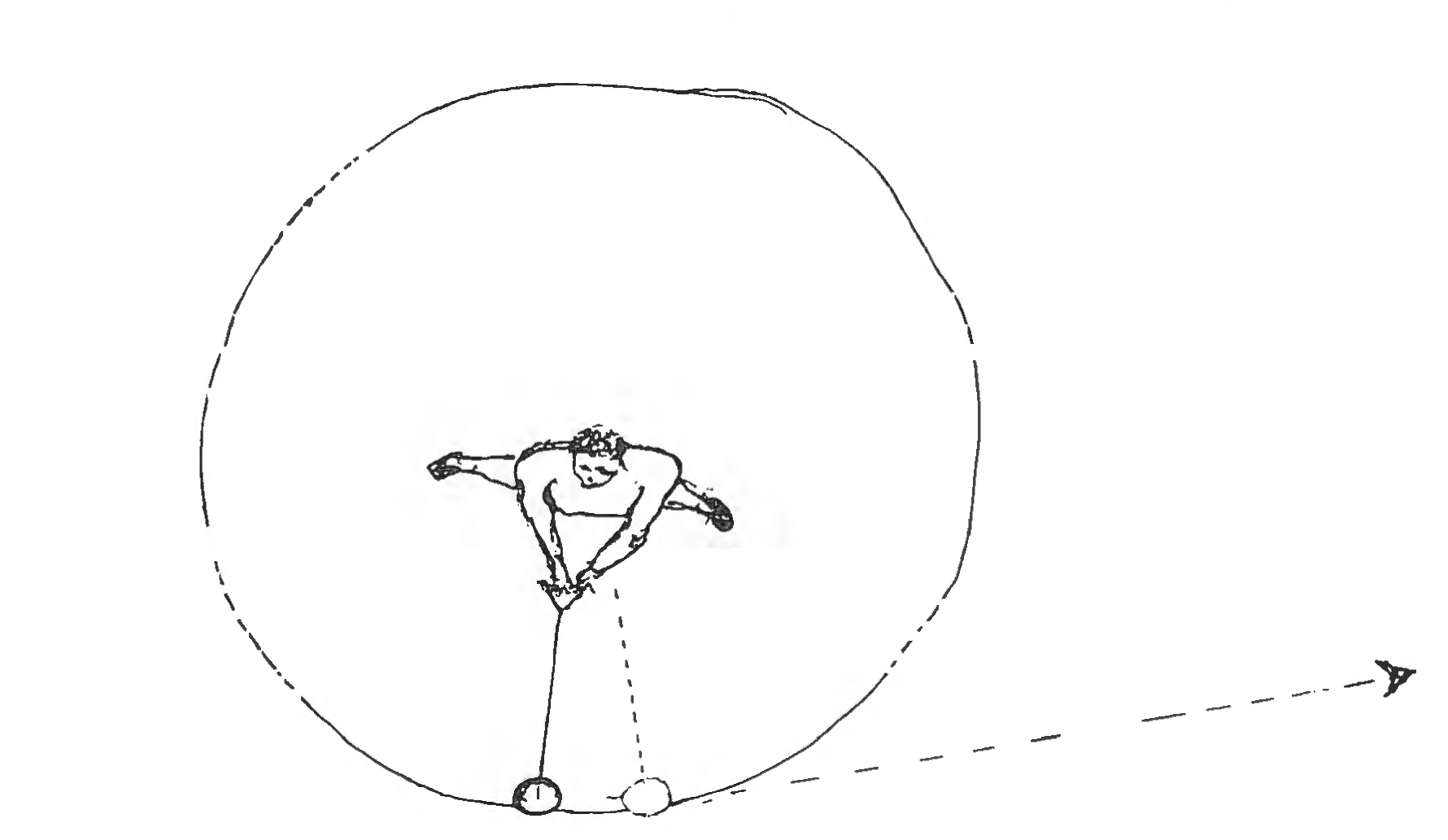
109 Going back to our first example, we recognize that what the hammer throwers muscularly contend with are (1) gravity’s constant downward pull both during the acceleration and after release of the hammer and (2) air resistance to the hammer athlete’s angular accelerating as well as to the hammer’s released-in-flight, linear, through-the-air travel. As a consequence, the pattern of overall travel of the released hammer on a windless day is that of a quarter ellipse in a vertical plane, with the hammer constantly slowing in its horizontal travel and finally decelerating into exactly vertical travel toward Earth.
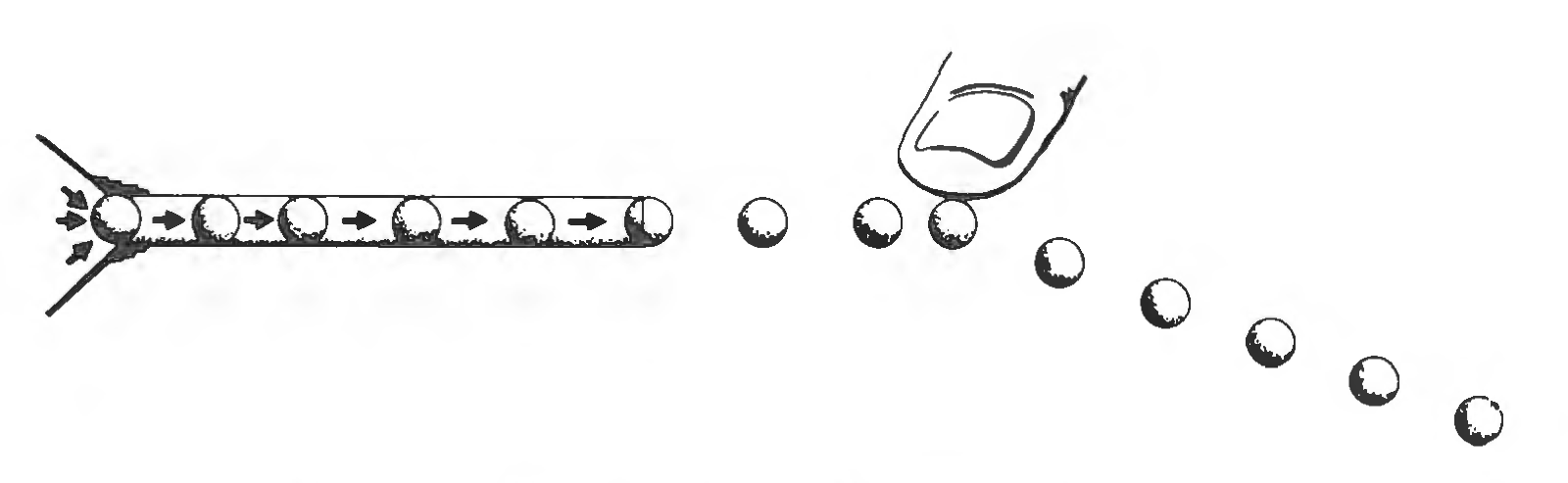
110 Abruptly leaving the hammer thrower, we will now consider a pea-shooting device driven by compressed air. This device causes the linear acceleration of unit-radius plastic ‘‘peas’’ blown out through a tube whose diameter is just an invisible increment greater than that of the plastic peas passing through it. Again assuming a windless or draft-free environment, we witness the pea-shooting machine aimed due north and parallel to the ground. Gravity gradually pulls the shot-forth peas’ trajectory Earthward all along its northward route of forward travel. Each blown pea travels along a path describing a quarter ellipse in a vertical plane and ending in a vertical descent to Earth. If we stand close to the plastic peashooter’s nozzle and insert our finger into one side of the pea trajectory near the mouth of the shooting tube, we find that we can deflect the exiting peas’ trajectories in various ways.
111 Putting one’s finger exactly in front of the tube opening will completely arrest the peas’ linear acceleration; now accelerated only by gravity, the peas will plummet perpendicularly to the ground. We can also move our finger in from one side of the trajectory and very gently touch the bottom of a train of accelerated peas, causing them to rise very slightly. Now, resting our hands on a slidable side table, we extend our index finger beyond the table’s edge in a fixed position touching the right side of the trajectory of exiting peas. Thus, the peas’ horizontal trajectory is deflected leftward, to the north-northwest while also, as always, being pulled ground-ward by gravity. So long as our finger remains in this fixed position, it will continue deflecting the horizontal path of the linearly accelerated peas, each of which will keep on describing the same one-quarter ellipse in a vertical plane aimed north-northwest.
112 In Figure 1.1 we see the train of uniform-diameter plastic peas being blown out of the peashooter. We see the human finger intervening delicately into the train and deflecting the train. We note that no pea has a memory that directs it to resume its earlier direction of travel.
113 What we learn from the foregoing is that after being deflected, a pea (or any other body in acceleration) does not resume its earlier course. It has no memory of its earlier travel pattern. It continues to be affected only by (1) the initial acceleration, (2) the friction and density of resistance of the medium penetrated (in this instance, the air), and (3) the last angular redirection of its trajectory, such as a cross wind’s gust or a deflecting contact with a finger.
115 If, instead of deflecting northwestward the initially northward accelerated peas, I were to bring my finger down exactly vertically 1 ⁄ 32 of an inch on top of the peas’ northward path and keep my finger exactly in this position, I would deflect the trajectory mildly downward.
116 Now we return to observing the hammer-throwing athletes. In Fig. 1.2 we look at the hammer thrower at peak angular acceleration of the hammer. We note—and this is very important—that he releases the hammer when it is tangent to the circle of his gyration, so that it travels in the direction he wants it to travel when he releases his grip. Unlike the javelin thrower and the shot-putter, he does not release his thrown device at 180∘ (in the direction in front of him). The hammer thrower (like the discus thrower, tennis player, and baseball batter) ends his angular acceleration at 90∘ to the desired line of travel of his hammer that is, when it is 90∘ short of the direction of realized acceleration. Linear acceleration terminates at a point that is in a direction exactly 180∘ away from the accelerator.
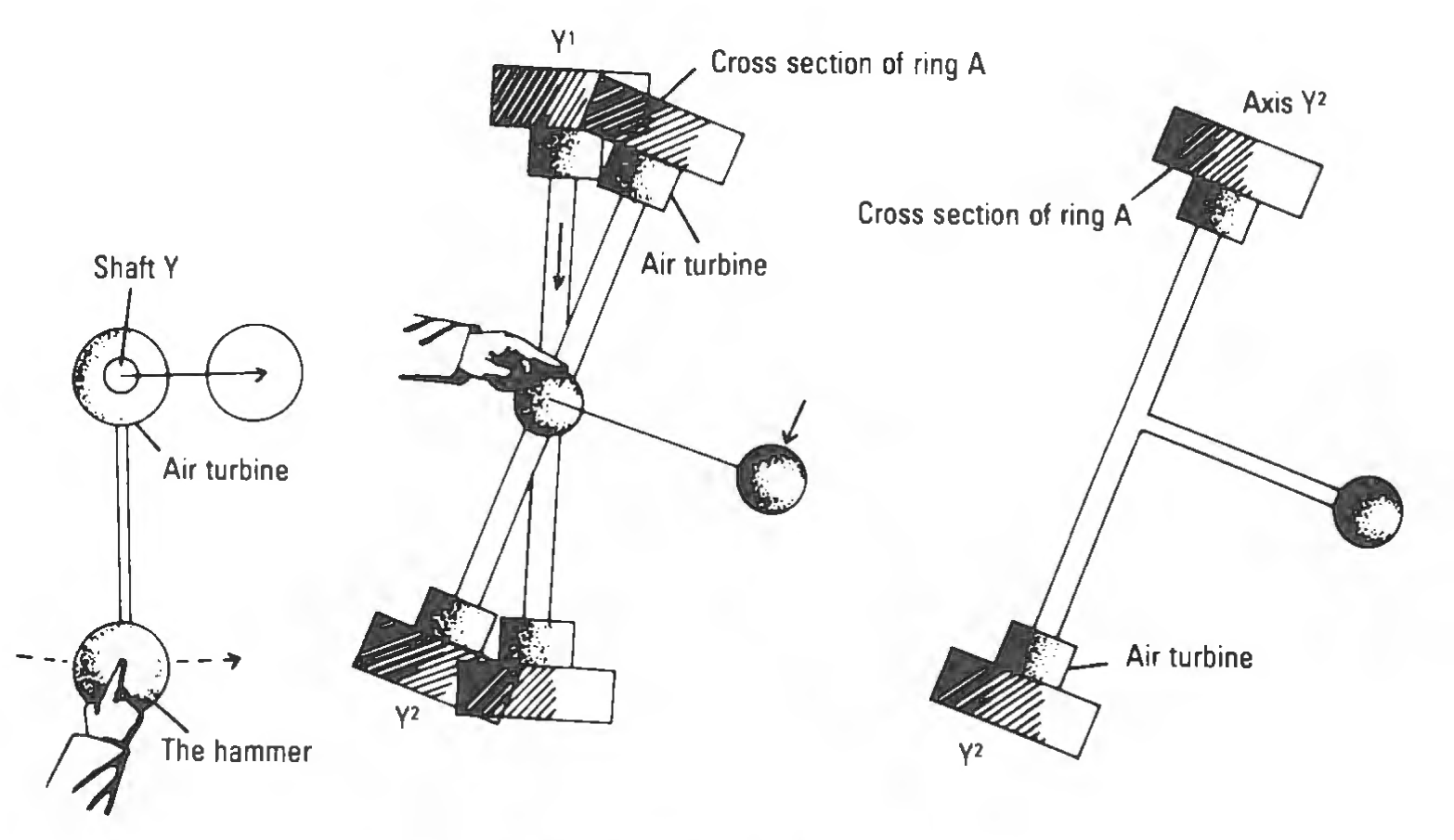
117 Let us assume that the formal Olympic Games—determined direction in which the hammer is to be let go is true north. Thus, as angular-accelerators, the athletes are going to let go of the hammer when they are facing true east. We will make a simple mechanical model of this event. The model of the hammer thrower will be a vertical 1 ⁄ 2 inch round steel shaft 6 inches high; the hammer will be represented by a steel ball 1 ⁄ 2 inch in diameter; the thrower’s arms and hands and the steel rod leading out to the hammer will be represented by a round steel shaft 1 ⁄ 8 inch in diameter.
119 We will now take a 1 ⁄ 2-inch-thick circular steel ring 8 inches in inside diameter and 9 inches in outside diameter.
120 This ring has two short cylindrical housings mounted on the inner surface at both the top and bottom. These housings contain compressed-air turbines and tapered roller bearings to drive and align the ‘‘thrower.’’ The tapered roller bearings in these housings now receive the top and bottom, respectively, of the 1 ⁄ 8-inch diameter, 6-inch-high vertical steel shaft representing the hammer thrower.
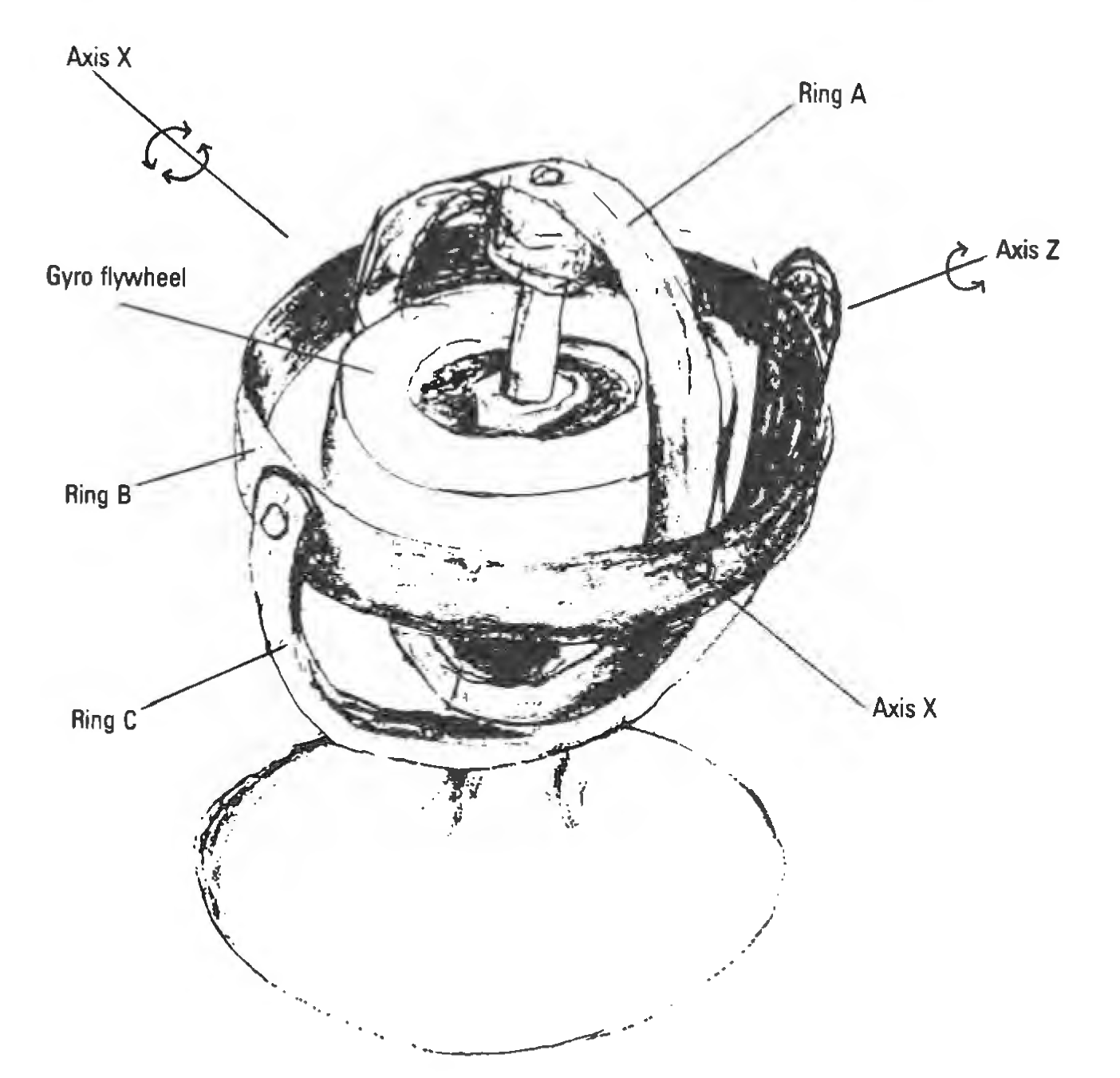
121 The thrower’s body, represented by the vertical shaft, constitutes the axis Y and the 1 ⁄ 2 -inch-diameter steel rod representing the thrower’s arms and hands grasping the triangulated handles attached to the steel ball hammer constitutes the X axis in Figs. 1.3--1.7. The air turbines are driven by compressed air supplied through ducts in the hollow steel A ring (labeled A in Figs. 1.5--1.7). The compressed air is continuously ducted through hollow tubular shaft bearings at axes X and Z and through the hollow B ring, the hollow half-round C ring, and the base of the whole three-axes-of-circular-freedoms apparatus shown in Fig. 1.7.
122 In Fig. 1.3, A is a bird’s-eye view of B, which is axis Y , the model of our hammer thrower with the air turbine in operation and the hammer whirring around axis X. We have a 1 ⁄ 10,000 -second view of our hammer thrower at a moment when his hammer, H, is extended toward you and me, the viewers.
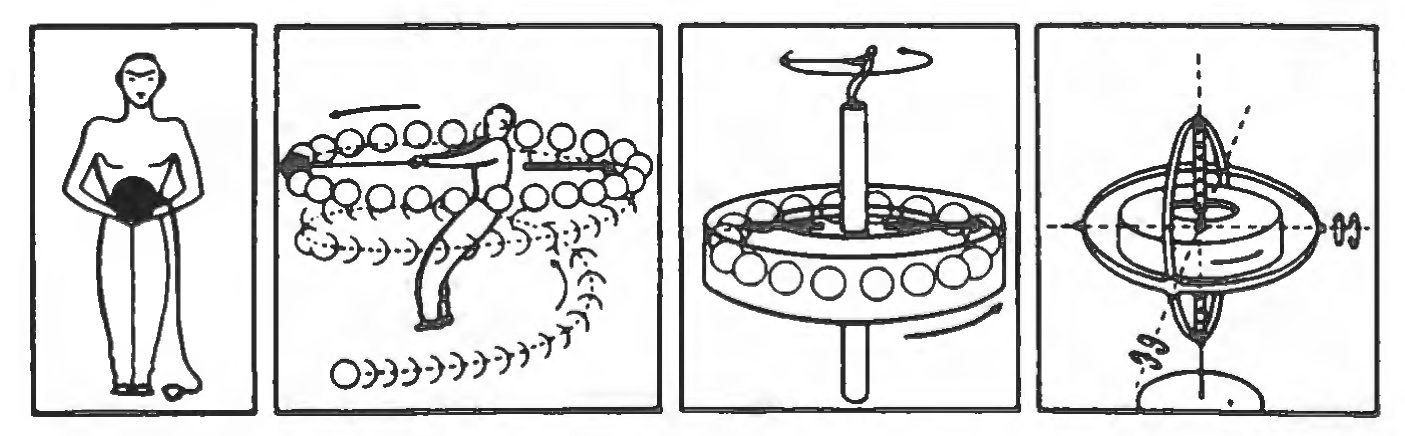
123 In Figs. 1.4--1.6, we have the same 1 ⁄ 10,000-second flash glimpse of axis Y , with our hammer thrower revolving at so high a speed that his ball becomes in effect a flywheel, as seen in Fig. 1.7.
124 Our human finger now touches the top of revolving hammer H as it passes in front of us. This top touch deflects the hammer’s line of travel downward and to the right. This deflection forces the thrower’s head and his Y axis top to also rotate downward and to the right, while his feet and legs rotate up and left; this rotation is accommodated by the rotatability of axis X (see Fig. 1.7).
125 Using a complete wheel to reduce directional stresses in the apparatus, we learn that if we touch the top of the spinning flywheel at point T in Fig. 1.7, it will cause the wheel and the top of its axis Y to rotate around axis Z. If, instead, we try to pull the top of axis Y left toward the left-hand edge of axis Z, we will witness the top of axis Y rotating right more or less around axis Z, toward us. It is this natural yielding in a direction at 90∘ instead of the expected 180∘ to the direction of force that has made the gyroscope so perversely incomprehensible to our senses-coordinating brains.
127 This yielding-at-90∘ phenomenon is known as precession. Its inherent incomprehensibility persuaded physicists to assume that it could, in the end, only be explained and manipulatingly coped with through the mathematical formulae of calculus and quantum mechanics. Because there existed an area of physical experience that seemingly could not be explained in sensorial terms, academic science concluded that the physical world’s behavior could be comprehensively coped with only (without exception) through equations and calculus.
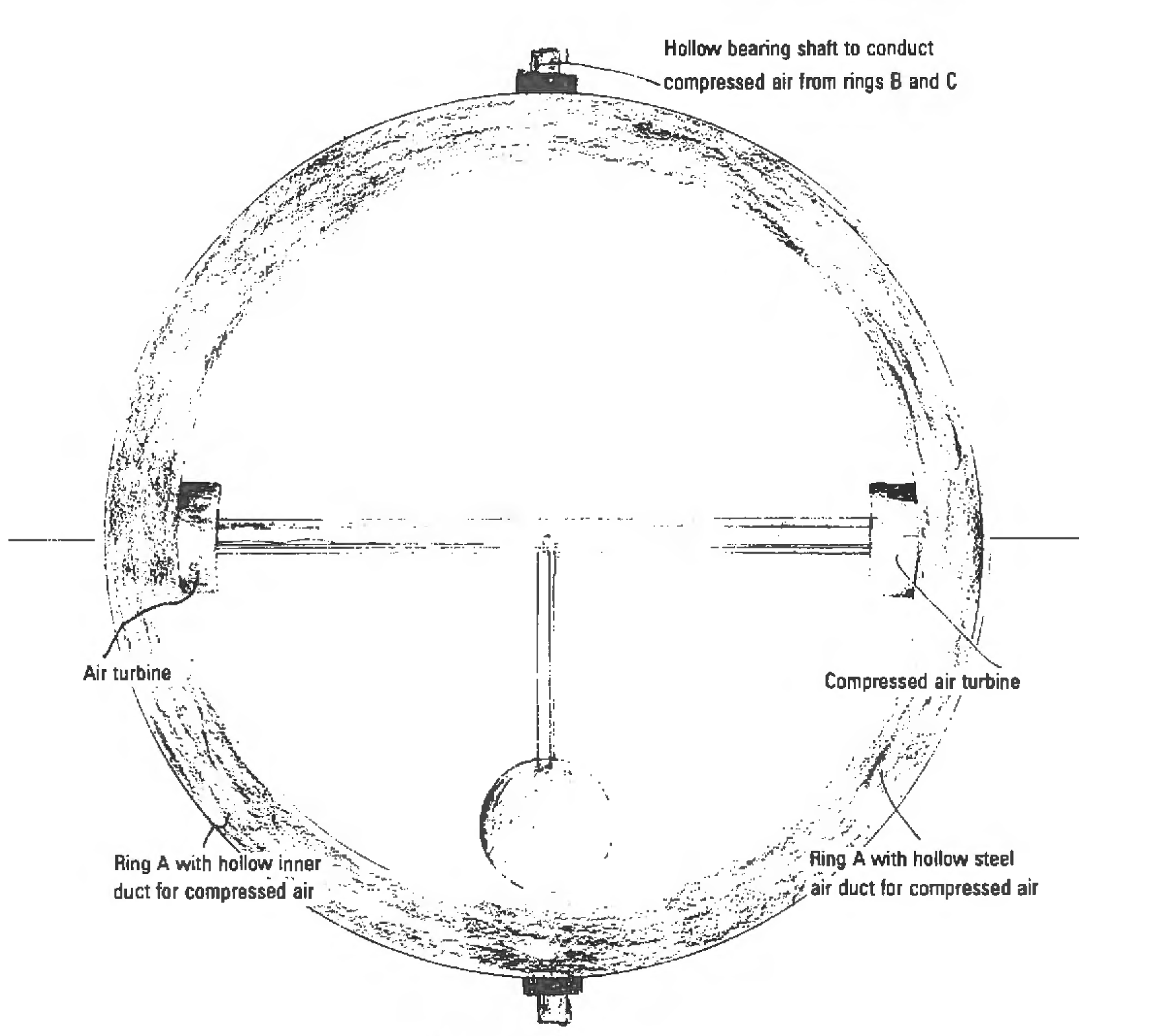
- a.
- Hollow bearing shaft to conduct compression air from rings A, B, and C
- b.
- Compression air turbine
- c.
- Hollow steel air duct
- d.
- Ring A with hollow inner duct for compression air
- e.
- Air turbine
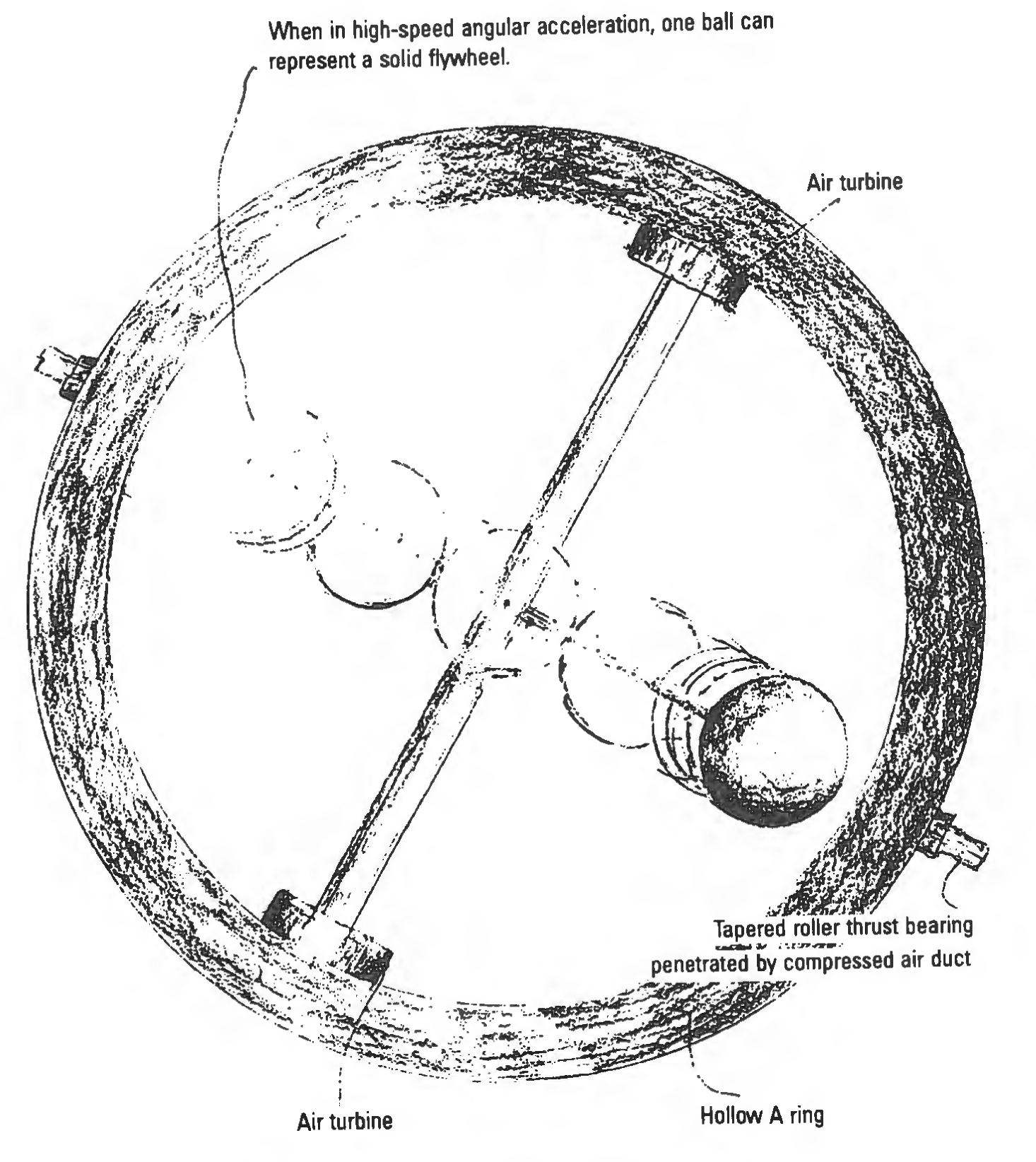
- a.
- When in high-speed angular acceleration, one ball can represent a solid flywheel.
- b.
- Air turbine.
- c.
- Tapered roller thrust bearing, penetrated by compressed air duct
- d.
- Hollow A ring
- e.
- Air turbine
132 Sensorially comprehendible precession makes lucid much of wave theory and electromagnetics (see my 1982 book, tetrascroll [tetrascroll]).
133 In the social sphere, precession accounts for humans not yielding at 180∘ but yielding at 90∘, and thus the orbiting of the less-powerful around the more-powerful in the various classes considered.
134 Doing the right things for the wrong reasons is typical of humanity. Precession—not conscious planning—provides a productive outcome for misguided political and military campaigns. Nature’s long-term design intervenes to circumvent the shortsightedness of human individuals, corporations, and nations competing for a share of the economic pie.
135 Fundamentally, political economists mis-assume an inadequacy of life support to exist on our planet. Humanity therefore competes militarily to see which political system—socialism or capitalism (less exactly known as free enterprise)—is fittest to survive. In slavish observance of this misassumption, humans devote their most costly efforts and resources to ‘‘killingry’’—a vast arsenal of weapons skillfully designed to kill ever more people at ever-greater distances in ever-shorter periods of time while employing ever-fewer pounds of material, ergs of energy, and seconds of time per killing.
136 Initially unforeseen, the mass-production technology acquired supposedly only for weapons making has been converted after each war to powerful and practical use. Cosmic evolution has put humans to work developing, unconsciously, the technology to produce ever more effective results in ever-quicker ways at ever-greater ranges of effectiveness with ever-fewer pounds of material, ergs of energy, and seconds of time per accomplished function, thus inadvertently acquiring the technological capability to do what politics could never do—that is, to produce so much high-standard life support with so little material and energy investment as now, for the first time in history, to be able to sustain all humanity at ever-higher standards of living than any have ever before experienced or dreamed of.
137 Because, as with all children, I had been born a deliberate comprehensivist and because I had not had that innate interest stifled and had grown to be a deliberately self-cultivated comprehender of invisible as well as visible reality in an age of specialization, I clearly saw, and broadly announced, that all the foregoing was true and feasible.
138 I also realized that our newly achieved evolutionary stage of technical ability to sustainingly support all humanity at an unprecedentedly higher standard of living was, or is, to be accomplished only by objectively and synergetically integrating the vast ranges of invisible reality’s electrochemical and electromagnetic spectra. The realization demonstrated to me the exclusively mind-over-technology functioning of humans in Universe.
139 It became clear that only by good fortune did I happen to first stumble upon this emerging potential when I did. In 1927, I was a complete failure by society’s standards of economic success. I was about to commit suicide on the shore of Lake Michigan when it dawned on me that potential success, not just for the individual but for all humanity, was implied in doing-more-with-less, invisible-reality technology.
140 I was convinced that humanity was graduating into a new era of consciously direct—rather than inadvertent—evolution marked by the realization of its cosmic, intellect-conceived, design-science functioning advantage in Universe. Henceforth, and swiftly, we must progress to the stage of doing all the right things for all the right reasons instead of doing all the right things for all the wrong reasons, a by-product of precessional phenomena.
141 Einstein proclaimed that there are only two prime motivations for all human initiatives: fear and longing. Acquiring the costly technology for producing national-defense armaments alone is the politically assumed number-one mandate, a mandate based on national fear. Such a survivalist mentality inadvertently also produces life-supporting technology, but it takes a quarter of a century longer than it would if humanity first recognized the public longing to attain sustainable peace for all humanity and directly used that same high-technology production for livingry rather than for armaments.
142 I am convinced that nature uses different gestation rates for both biological and technological phenomena. I am also convinced of the infallibility of nature’s revolutionary inter-timing design of these different gestation rates.
143 In my personal strategy, I eschew all promotion for this reason. I have no desire to develop the ‘‘premature babies’’ of industrial technology. As a consequence, I have no literary agents, no lecture bureaus, no advertising or public relations people, no sales agents of any kind. Neither myself nor anyone on my staff is allowed to solicit supporting grants. I have no sales people who go out to sell me in order to fund an operating budget. I ask no one to listen to me or to look at what I have produced. I speak to people only when they ask me to do so. When, however, people ask me what it is they see that I have produced, I give them my very best explanations. These personal operating principles are based on a kind of self-sufficient mechanism that I have always appreciated in nature’s designs—and some supply-side economists have admired in human institutions. These rules of thumb have carried me through many crises during the past fifty-five years.
144 My economic survival pattern was based on my fortunate assumption that nature would support me and my work but only if I eschewed all politics and worked entirely in artifact invention and development and only on behalf of all humanity.
145 In view of all the foregoing, I saw the work of Albert Einstein as that of an individual who seemed to have been uniquely inspired by a clear vision of nature’s generalized principles. I found myself to be inspired by an awareness of the evolutionary significance of the human mind’s winnowing out of those generalized principles and the synergetic consequence of the objective reintegration of the Universe of principles into a myriad of local in-Universe special-case-evolution-through-problem-solving technology.
146 The era of human exploration and operation in the 99.99 percent of reality non-directly contactable by the human senses is coincident with Einstein’s realization that evolutionary change is normal and that the normal speed of all electromagnetic radiation is 186,000 miles per second.
147 This view completely altered for humanity the concept, established by Isaac Newton, that the physical norm is the state of rest. In this view, the physical norm is changeless, and thus, change is to be avoided.
148 When Einstein’s concepts were first introduced, Professor Percy Williams Bridgman of Harvard, the pioneer in cryogenics, sought to understand why Einstein had caught the whole world of science so far off physically comprehensible balance. Bridgman concluded that the difference between the viewpoints of conventional science and Einstein (and their consequently employed methodologies) was that in contrast to science’s attempt to isolate experiments within ‘‘controlled conditions,’’ Einstein was always comprehensively considerate of all the environmental conditions and events attendant upon the experiment.
149 Bridgman called Einstein’s methodological concern with both comprehensive and incisively focused-upon information ‘‘operational procedures.’’
150 I was excited to learn from Dr. Bridgman in 1947 of Einstein’s operational procedures, for without knowledge of Einstein’s having done so, I had come to share similar concerns and had in 1927 spontaneously adopted similar comprehensive concerns in my own work.
151 Operational procedures eliminate all recourse to axioms—the ‘‘it-has-always-been’’ or ‘‘it-is-assumed-to-be’’ truisms commonly employed by much of our educational system, particularly in those areas of education that most people think of as having long ago been infallibly explained by mathematics, physics, engineering, semantics, geography, meteorology, and cosmology.
152 I am convinced that academic science’s comprehensive, three-dimensional, perpendicular-parallel, non-intertransformative, coordinate mathematics of ‘‘framed’’ referencing of all physical experiences is so awkwardly alien to nature’s four-dimensional, convergent-divergent discretely tunable, coordinately constant system as to render present-day academic science’s mathematics unnecessarily complex and understandably incomprehensible to the majority of clear-thinking youth. As such, present-day science’s inscrutability prevents us, who are laboring under the political-religious axiom that a fundamental inadequacy of life support exists on planet Earth, from spontaneously apprehending what has transpired in the invisible reality and thereby comprehending why and how it is now technically feasible to take care of all humanity at a sustainable higher living standard than any humans have heretofore experienced.
153 On the other hand, I am confident that I have discovered nature’s own coordinate system. This most economical and popularly comprehensible, mathematical, intercoordinate, formative, energy-matter intertransformative, and deformative system is definitively presented in the approximately thirteen hundred pages of synergetics [synergetics] and synergetics2 [synergetics2]. These volumes enable an individual to comprehend design science effectively and adequately.