2 Discoveries of the Human Mind
2I WROTE SYNERGETICS BECAUSE I was overwhelmed by the experimentally provable evidence of what we have come to call synergy—i.e., the behavior of whole systems unpredicted by the behavior of any parts of the system when considered only separately. Synergy is antithetical to our society’s preoccupation with specialization. I felt there was no concept more prominently conducive to effective thinking about the lesson-learning significance of the history of all humans’ experience than is-and-always-has-been-and-will-be synergy.
3 To elucidate for you, I shall describe how I differentiate the function of brain and mind, as I first did publicly as the Harvey Cushing Orator of the American Association of General Surgeons at their annual congress in Chicago in 1968. This differentiation developed as one of the consequences of my lifelong quest to discover and identify the function of humans in Universe. In comparing humans with all other living organisms, it became clear that all living organisms other than humans have some built-in, integral, organic equipment that gives them an advantage in some special physical environment—for instance, the little vine that grows only along the banks of the upper waters of the Amazon or the dog with very short legs and nose close to the ground, allowing it to follow a scent trail, and with sharp claws to open the holes to the hiding places of its quarry. Birds fly in the sky with their beautiful wings, but when they are not flying, these wings greatly impede the birds’ walking, because they cannot be discarded when not in use.
4 It was clear to me that if nature had intended to have humans function as innate specialists, she would have provided them with, for instance, organically integral telescopic or microscopic eyes.
5 Also clear was the fact that humans are not unique in having brains. Many creatures have brains. Brains are always and only coordinating the information of the senses—sight, hearing, smell, taste, and touch. Our brains provide the only means by which we are aware of ‘‘otherness’’ and ergo aware of being alive in Universe. Brains are always coordinating the sensed information regarding each special-case experience: this smells this way, that sounds that way. Brains always and only deal with special-case data, packaging them systemically and storing them for later recall.
6 Despite claims to the contrary, no one has ever seen outside self. We see only in our brain’s ‘‘control room’’, with its omnidirectional television system. What we see there has proven to be so reliable regarding our surroundings that we now misassume that we are looking outside, seeing it ‘‘over there.’’
7 In contradistinction to brain, human mind manifests from time to time the extraordinary capability of discovering relationships between special cases of the sort not evident from examining any of the special cases alone. Mind discovers interrelationships.
8 While there is an impressive list of the human mind’s invisible interrelationship-discovering capabilities, there are twelve cases that stand out.
9 The first was demonstrated in a complex of historical scientific discoveries and measurements that began with Copernicus, Kepler, and Galileo and culminated in Isaac Newton’s mathematical formulations of the laws governing the covarying, invisible interattractiveness of any two celestial bodies . This invisible interattractive force varies inversely as the second power of the arithmetically expressed distance intervening between the two bodies considered, while the relative interattractiveness of any two celestial bodies in respect to that existing between another pair of celestial bodies is always proportional to the multiplicative products of the respective pairs’ respective masses.
10 The second of these twelve historically most extraordinary manifests of human mind’s invisible interrelationship-discovering capability occurred when a human mind discovered the desirability and complex calculating capability inherent in the mathematical symbol for nothing—the cipher. That unknown something, the x of algebra , is a conceivable ‘‘something,’’ but an unknown, unitarily specific ‘‘nothing’’ is quite inconceivably different from all the other unknown nothingnesses of Universe. You cannot eat ‘‘no sheep.’’ You cannot think of, or feel hungry for, a specific ‘‘nothing.’’
11 Only the Polynesian navigators’ offshore orientation needs necessitated the invention of trigonometry for locating terrestrial sea position by observed and calculated intertriangulation between the boat’s position and any two other remote fixed objects, such as any two stars in the sky.
12 From time to time, being subject to being washed overboard by gale-driven seas, these naked Polynesian navigators found it necessary to keep track of the cumulative scores of their fingers-and-toes ten- and twenty-increment counting. They did this by fastening sets of rings round their wrists, ankles, and neck. Each ring represented already counted bundles of ten fingers, ten toes, or both. This inventive use of sliding rings to represent cumulative decimal increments I am sure led to the invention of the abacus—a formalized and more-convenient-to-use device in the form of a framed, bamboo-rod-mounted, ring-bead calculator. In the Polynesians’ ingenious precursor to the abacus the counters are the anklets, bracelets, and necklaces which would not be lost in ocean storms.
13 Only the foregoing could account for the operational-method-enforced leftward positioning to symbolize a leftwardly moved bead or modular increment of ten. From such a model, it is reasonable to assume, arose the mind-invented set of Arabic numerals.
14 To represent an empty column necessitated the invention of the cipher. It symbolized a uniquely unified, precisely interpositioned, immensely useful nothing.
15 In the mists of antiquity, human mind conceived the need for, and the operating mechanics of, the digital calculator, but surely not all of its future possibilities.
16 The third most-extraordinary manifest of the human mind’s discovery and mathematical formulation of invisible interrelationships occurred when, prior to the French political revolutionaries cutting off his head, Antoine-Laurent Lavoisier intuitively reasoned that the invisible nothingness known only as the mystical element air was ignited within the bell jar of Joseph Priestley’s experimental isolation of phlogiston (‘‘fire’’). The experiment-produced substances weighed more than the substances originally placed under the bell jar prior to ignition. This experiment caused Lavoisier to assert that the air under the bell jar consisted of a plurality of entities each so fundamental as to be identified as chemical elements. This was an extraordinary conception: the differentiation of the undifferentiated nothingness into identifiable gases—each so unique as to rate as a chemical element. Lavoisier did his thinking in an era when all the thus-far-discovered elements were metals—tangible and substantive. Lavoisier named one of the gaseous elements oxygen, which he said had separated out from the other invisible gaseous elements and had combined with the weighed-in substances, wherefore he proclaimed combustion to be ‘‘oxidation.’’ He went on to substantiate his argument by demonstrating that rust is oxygen combined with iron and that separating oxygen from mercuric oxide produces the liquid metal mercury.
17 The fourth most-extraordinary manifest of human mind’s ability to discover invisible interrelationships of Universe occurred when Democritus conceived of atoms.
18 The fifth most-extraordinary manifest of human mind’s ability to discover invisible interrelationships occurred when Hertz discovered electromagnetic waves.
19 The sixth most-important manifest of human mind’s discovery of invisible cosmic interrelatedness occurred when the mathematical working of gyroscopic precession was discovered by Elmer Sperry.
20 Human beings, for at least three and a half million years on board our planet, have observed the seemingly fixed constellar patterns of the starry skies. In stark contrast to the fixed stars viewed from Earth as members of stable constellation groupings, humans also sometimes observed one, two, perhaps three or more starlike objects, often a little brighter than the other stars and with a little more vivid coloration.
21 Appearing first in one fixed-star constellation on one night and then reappearing in another constellation the next night, these bright, wandering objects were obviously like the Moon, traveling in respect to the thought-to-be fixed stars. These were the planets, and humans gave them the names of gods and began superstitiously identifying the significance of the planetary appearances with various experiences of their Earthbound lives.
22 In the fifteenth century the South German and North Italian scientists acquired calculating capabilities made possible by the cipher and consequent positioning of numbers.
23 In Poland, Copernicus discovered mathematically that the Sun was not encircling the Earth but just the reverse. The Earth was in fact one of the planets orbiting the Sun.
24 Then, Kepler made very accurate observations of all planetary behavior and characteristics. The planets appeared to constitute a very disorderly team. Kepler plotted the position of each planet at the beginning and end of a twenty-one-day period, and the calculated areas swept out by each of the pie-shaped triangles proved to be exactly the same.
25 Kepler reasoned that there are invisible, interattractive tensional forces—i.e., zero-diameter ‘‘cables’’—at work. He took a giant step toward describing the gravity existing between celestial bodies. Kepler’s mind had discovered the nonsensorial and thus invisible relationships existing between celestial bodies, even though these interrelationships are not made evident by the behavior of any one of the bodies or parts of the system when considered only separately.
26 Brains can only discover via the senses. The interrestraint of those planets and the Sun could not be seen, smelt, felt, tasted, or heard. No one could see these zero-diameter tethers that exist between each of the planets and between each of those planets and the Sun. Mind alone, in contradistinction to the sensorially apprehending brain, had discovered invisible interrelations through the irrefutable data of scientifically observed and measured natural behaviors.
27 Kepler pondered, ‘‘If the diameter of the fibrous ropes or strings with which I accelerate the weights I swing around my head is progressively reduced by using ever thinner and fewer-fibered cords, eventually the cords will break.’’ To think of a string of no thickness at all holding together bodies the size and weight of the Sun and the planets, and doing so across many millions and even billions of miles of space, is to consider physical interrelationships existing in Universe heretofore unapprehended by the senses, unanticipated by the senses and ergo imponderable by human brains.
28 Kepler had to think also about forces operating between and among groups of all the other planets and each planet, as well as between and among various groups of planets and the Sun. Because the planets orbit at different rates, from time to time they bunch together and at other times move far away from each other. When bunched, their combined local group mass produces greater pull on each of the individual planets than does their separated-from-one-another interpair pulls. Kepler realized that this causes the planets to move in elliptical orbits: ellipses being determined by a pair of restraining forces. Kepler had to think about, comprehend, and explain to the satisfaction of his own mind’s functional integrity exactly how and why the solar system’s intercoordinating tensions govern all these ever-changing planetary interrelationships.
29 Next, using the new cipher-implemented calculating possibilities, Galileo computed the rate of acceleration for free-falling bodies. He found them accelerating at a second-power rate of velocity in respect to the arithmetical distance traveled.
30 Isaac Newton soon became intensely and passionately driven to understand the invisible tension forces that Kepler had found operating across millions of miles of open interplanetary and intersteller space. Newton was very much advantaged by the experiences of others. He recognized, for instance, as must anybody living by the sea, that the full Moon brings with it much higher tides.
31 Newton sensed a vast body of water being pulled. A full Moon occurs only when the Moon, Earth, and Sun are in 180∘ alignment, with the Earth positioned in the middle. Newton saw how the combined 180∘ pull of the full Moon and Sun is very much greater than when the Sun and Moon are interangled at 90∘ to the Earth. Newton posited that the relative interpull between any two pairs of equiinterdistanced celestial bodies must be proportional to the respective pairs of products of their respective masses. Formulating his concept from Galileo’s secondpower-acceleration discovery, Newton finally hypothesized that the rate of interattractiveness between any two celestial bodies varies inversely with the second power of the arithmetical distance intervening. That is to say, if you halve the distance between the two, you increase their interattractiveness fourfold. If you double the intervening distance, you quarter the interattraction. When asked, ‘‘What is gravity?’’ Newton would have had to reply, ‘‘It is nothing to which I can point. It is an interrelationship, existing only between parts.’’
32 From birth, it is given humans to desire to understand all the relationships of all their experiences, which is to say, to accomplish with the human mind that which brains cannot. Once in a great while human mind discovers one of those exquisite—only mathematically expressible—macro- or microcosmic interrelationships. Mind operates only and always synergetically.
33 Einstein’s genius was synergetic. All genius is synergetic. All children are born geniuses, but most are swiftly degeniused by the power structure’s educational system. In the guise of education, the system deliberately breaks up inherently holistic considerations into ‘‘elementary’’ topics.
34 Early in my 1927-initiated lifelong experiment, I realized that what we call a principle—for example, the commonly and constantly intervarying rate of the mass interattraction of celestial bodies—could qualify as a generalized principle of science only if exceptions to the rule are never found. In other words, generalized principles are inherently eternal. Unfortunately, we tend not to recognize that which is eternal.
35 Eternity is invisible. The more persistently we think about it, the more we realize that when we say ‘‘no exceptions,’’ we in fact mean eternal. Thus, we find human mind delving into, and sometimes discovering, eternally covarying interrelationships.
36 The human brain, on the other hand, always and only deals with the visible and temporal—i.e., special cases with beginnings and endings. Illogically, the brain seeks a cosmology with a beginning and an ending, whereas inherently eternal Universe has neither. The Universe could not have begun with a big bang.
37 All the big bang theorists—which is to say, the academic establishment—are illogical and brain-bound when it comes to questions of cosmology. Beginnings and endings are inherently special case. The big question is where would all that energy for that primordial big bang come from, and wherefrom the space in which to stage that first big bang?
38 The speed of light was exactly measured at the opening of the twentieth century—186,000 miles per second, or approximately 5.87 trillion miles in a year. Astronomers adopted the light-year as the unit of distance measure of astronomically observed bodies. Polaris, the North Pole star, is 470 light-years away from us observing it from Earth. In television parlance, it is a ‘‘live’’ show. Other stars are much farther distant, but they are all live (real time) shows, too, with their light taking from 4.3 years to many hundreds of centuries to reach us. Our Sun’s light takes a mere 8 minutes to reach Earth.
39 Einstein operationally observed the Universe as a complex aggregate of nonsimultaneously occurring, variously directioned, variously interwoven and overlapped, variously enduring events. I gave the name scenario Universe to Einstein’s concept of Universe to distinguish it from a conventional single-frame picture, the concept of Universe favored by Newton.
40 Nonsimultaneous scenario Universe is inherently without beginning and end. We shall delve further into Einstein’s nonsimultaneous scenario Universe shortly. We introduce it here as the seventh cosmic, nonsensorially apprehensible interrelationship discovery.
41 Returning to our main line of thought, the other five of the twelve historically most outstanding of the human mind’s cosmic-interrelationship discoveries are described in detail elsewhere in this book. To keep them in constant prominence throughout the reading of this book, however, I am listing them here:
42 The eighth discovery is Archimedes’ principle of similitude , discussed in Chapter 1.
43 Ninth is wisdom, which I identify as the inherent acceleration in metaphysical evolution as a consequence of the cumulative, synergetic integration of only progressively acquired knowledge.
44 Tenth is mathematics, which of course includes Euler’s topology.
45 Eleventh and twelfth are radiation and gravity, which always and only coexist. Disintegrative radiation and integrative gravity in symbiosis describe the elusive object of the quest for a ‘‘unified field.’’ In a more poetic sense, these characteristics also identify love as being both shining radiation and all-embracing metaphysical gravity.
46 Love is the synergetic marriage of radiation and gravity.
47 Elucidating synergetics, we note that there is nothing in one atom per se that predicts that atoms will combine to form chemical compounds. One atom does not predict anything, let alone the existence of another atom or combinations of one known atom with an as-yet-unknown other atom.
48 Humans have witnessed quite naturally (‘‘natural’’ because in an a priori synergetic Universe) that atoms combine. Beyond that, they have discovered the mathematical equations, but not the structural concepts of the manner in which atoms combine or thereby the existence of laws governing their intercombinings.
49 There is nothing in chemical compounds per se that predicts biological protoplasm. There is nothing in biological protoplasm per se that predicts camels and palm trees and the intercomplementary interexchange of the waste gases given off by them. There is nothing in the exchange of these gases that predicts galaxies and stars.
50 The greater complex is never predicted by the parts of the lesser complex. Therefore, I surmise that to learn anything you must start with the whole—with Universe.
51 Comprehension of the whole alone leads to discovery of the significant intercomplementary functions to be played by the parts.
52 To learn is to regain the cosmically comprehensive conceptual realization of our innate genius—to use our minds.
53 In view of this latter realization, I shall, in my further thinking, first and foremost address Universe.
54 First, I would like to examine all the generalized principles thus far discovered. They are not many. What, I ask myself, can I see regarding the whole inventory of those principles that I cannot observe by looking at only one principle at a time? Is synergy operative amongst the whole family of thus-far-discovered-by-science generalized principles: Ohm’s law in electromagnetics, Avogadro’s law and Gibbs’s phase rule in chemistry, and Einstein’s E = mc2?
55 (Here I thought, Is Universe the synergy of synergies—i.e., s4 × s4 = synergy to the fourth power progressively fourth-powered? That speculative question, however, ventures beyond the scope of our present survey of verifiable scientific principles.)
56 Most impressive to me is the fact that, being eternal, none of all the thus far discovered generalized scientific principles has ever been found to contradict any other. All are interaccommodative. Many are interaugmentative.
57 When you and I use the word design in contradistinction to the word random we immediately include the concept of intellect, that sorting-out and recombining in intellectually preferred, synergetically interbehavioral pattern arrangements. Only intellect can formulate and express its design conceptionings mathematically—for instance, Einstein’s mind-formulated and -expressed E = mc2.
58 That the human mind has been designed to apprehend, to comprehend mathematically, and to express intellectually eternal-Universe design interrelationships and—even more—to employ these interrelationship principles in specially formulated objective-use cases as micro-macrostructures and mechanisms informs us that humans have indeed been designed and developed for cosmic-magnitude functioning. To discover whether this terrestrial installation of humans and their minds will lead to the fulfillment of this cosmic functioning, all human individuals are now entered upon their final examination.
59 Noting the disparate delays involved in light from celestial bodies reaching our cognition, Albert Einstein said that the observed Universe is an aggregate of nonsimultaneous, differently energized, differently enduring energy events, each with its own unique beginning and ending.
60 Einstein’s worldview—that Universe is an aggregate of only overlapping nonsimultaneous episodes—I have come to call ‘‘scenario Universe’’ because of its resemblance to an ever-changing film script with the threads of new comings and goings interwoven into a complex story.
61 Universe has no all-encompassing beginning and ending. In scenario Universe, beginnings and endings, births and deaths are local events. Big bang theorists, within the limits of their vision, ask only single-frame questions, such as this: I wonder what is outside the outside of Universe? The academic and scientific establishment, with credentials derived from Newton, conceives of Universe as a static structure, an object viewable as a whole, all at one time.
62 Nothing in a single-frame picture of a caterpillar tells you it is going to transform into a butterfly. There is nothing in a single-frame picture of a butterfly with spread wings to tell you it can fly or is flying. It takes many frames of a moving picture to tell you that it is flying; it takes millions of frames to give you any clue as to how it flies; and it takes thousands of scenarios to show why in the scheme of Universe the butterfly is designed to fly.
63 We wonder how it can be that nature develops a virus or the billions of beautiful bubbles in the wake of a ship. How does she formulate these lovely geometries so rapidly? She must have some fundamental, simple, and pure way of developing these extraordinary life cells and chemistries.
64 I discovered that the tetrahedron was at the root of the matter. I found that the tetrahedron was the minimum thinkable set which subdivided the Universe and that relatedness could be demonstrated. I found the organic chemist from an entirely different viewpoint discovering the controlling influence of the tetrahedron in vertex-to-vertex relation. I found the metallurgist half a century later discovering the fundamental role of the tetrahedron, but this time related edge to edge. Chemists and biologists, in their specialized disciplines, seem to be finding all the structuring of nature to be tetrahedrally configured.
65 I have found the tetrahedron to be the minimum structural system of Universe. The tetrahedron is basic to synergetic geometry. All polyhedra may be subdivided into component tetrahedra, but no tetrahedron may be subdivided into component polyhedra of less than the tetrahedron’s four faces.
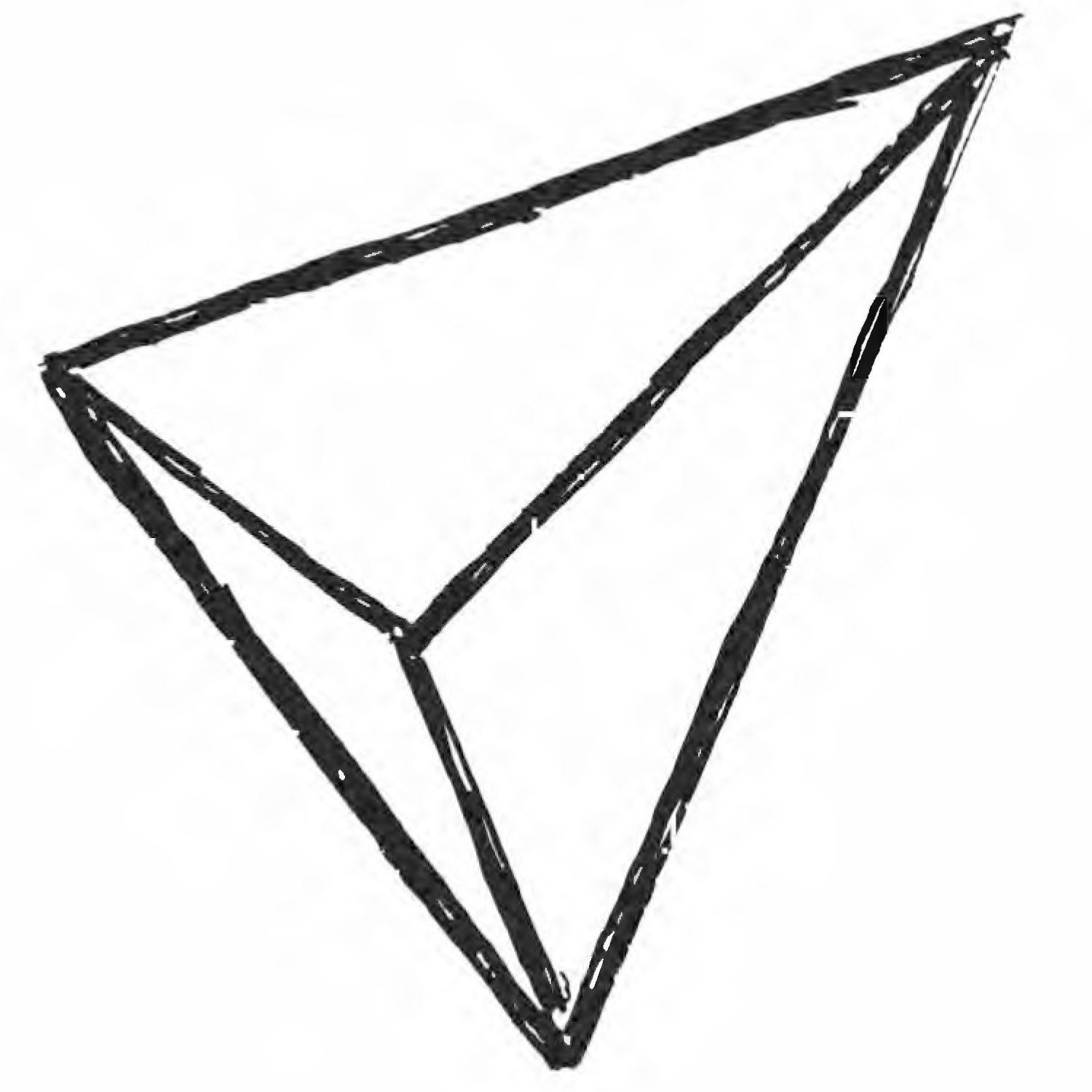
66 Fig. 2.1 is a drawing of a tetrahedron with its four vertices, four triangular faces, and six edges.
67 There are only three structural (omnitriangulated) systems in Universe. Of these three primitive structural systems, only in the tetrahedron are the vertexes free to plunge through their opposite triangle. In the other two innate structural systems, the octahedron and the icosahedron, the vertexes are prevented from plunging through to the opposite side of their structures by the existence of opposite structural components. But each vertex of the tetrahedron is exactly opposite a wide open triangular window.
69 At this stage in my exploration, I discovered that neither physics nor engineering had a description or definition of what they meant by the word structure. Structure in their fields of expertise has always been axiomatic—in other words, obvious for millennia. Obvious to physicists and engineers was, for example, the solidity of a block of marble or the rigidity of stone. I sought to discover how nature structures things.
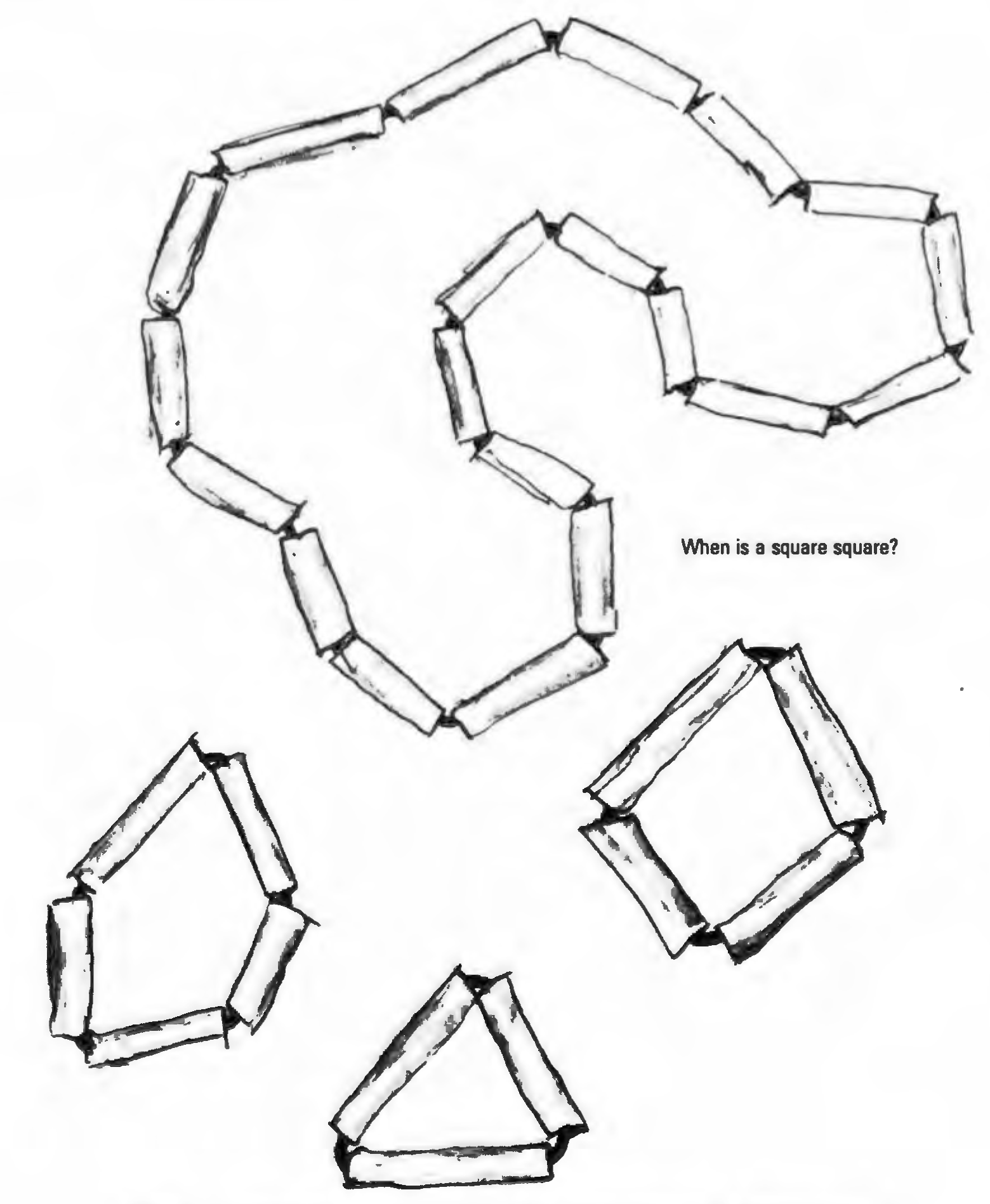
71 In my search for a definition of structure I developed operational exercises that would eventually lead me to the experientially formulated generalization of tensegrity1. I constructed a necklace consisting of many 12-inch-long, 1 ⁄ 2-inch-diameter aluminum tubes strung on a Dacron cord (see Fig. 2.3). I found that the more tubes included, the more fluidly flexible was the overall necklace. Flexing this necklace neither altered its length nor bent any of the tubes. Clearly, flexibility was provided entirely by the tension joints. Because the tubes were not providing flexibility, I progressively eliminated them one by one, and the necklace became progressively more prominently angular. Finally, I had only three tubes remaining, and for the first time the necklace would no longer flex. It was a triangle with a triangular hole in it, the hole being larger than my neck. This experiment clearly demonstrated that the triangle is the only many-sided figure (polygon) that holds its shape, despite its three completely flexible corners. There was no two-tube necklace: it would not provide a hole for my neck to penetrate. The triangle was clearly the terminal case of polygon formation. Since I found the pattern of my triangular necklace to be stable and since the triangular necklace that holds its shape consists of three separate push-pull, firmly shaped aluminum tubes and three flexible Dacron-cord corner-angle coherers, I formulated my definition of structure as ‘‘a complex of events interacting to produce a stable pattern.’’ Amplifying that interaction, I described ‘‘a system whose component events are persistently interpositioned by a balance of forces of interrepulsion and interattraction.’’ I found the necklace structure to be just such a complex of push-pull coherence integrity. I thus concluded that triangulation is essential to structure and that no necklace of more than three push-pull tubes is stable.
75 Since the minimum system in Universe, the tetrahedron, is entirely embraced by exactly four triangles and since the triangle alone produces a stable pattern, I concluded that the tetrahedron is the minimum and simplest structural system in Universe.
76 No wonder the tetrahedron and its contained octahedron (Fig. 2.7), together with its eternal, allspace-filling complementary octahedra, are the structural components of diamonds. No wonder Jacobus van’t Hoff was the first chemist ever to receive the Nobel Prize, for his optical proof of the tetrahedral configuration of carbon. No wonder Paul MacCready’s Gossamer Albatross was light enough to be human-muscle-pedaled in its trans-English Channel flight; its structural components were formed of tetrahedrally stabilized carbon fibers, making it tensionally so strong for its weight that the 90-foot craft could be held up in one hand. The greatest wonder, however, is that tetrahedra and their significance are not included in college preparatory school curricula.
77 I NEXT UNDERTOOK TO DISCOVER why the three-aluminum-tubed, Dacroncord-cohered triangle held its shape.
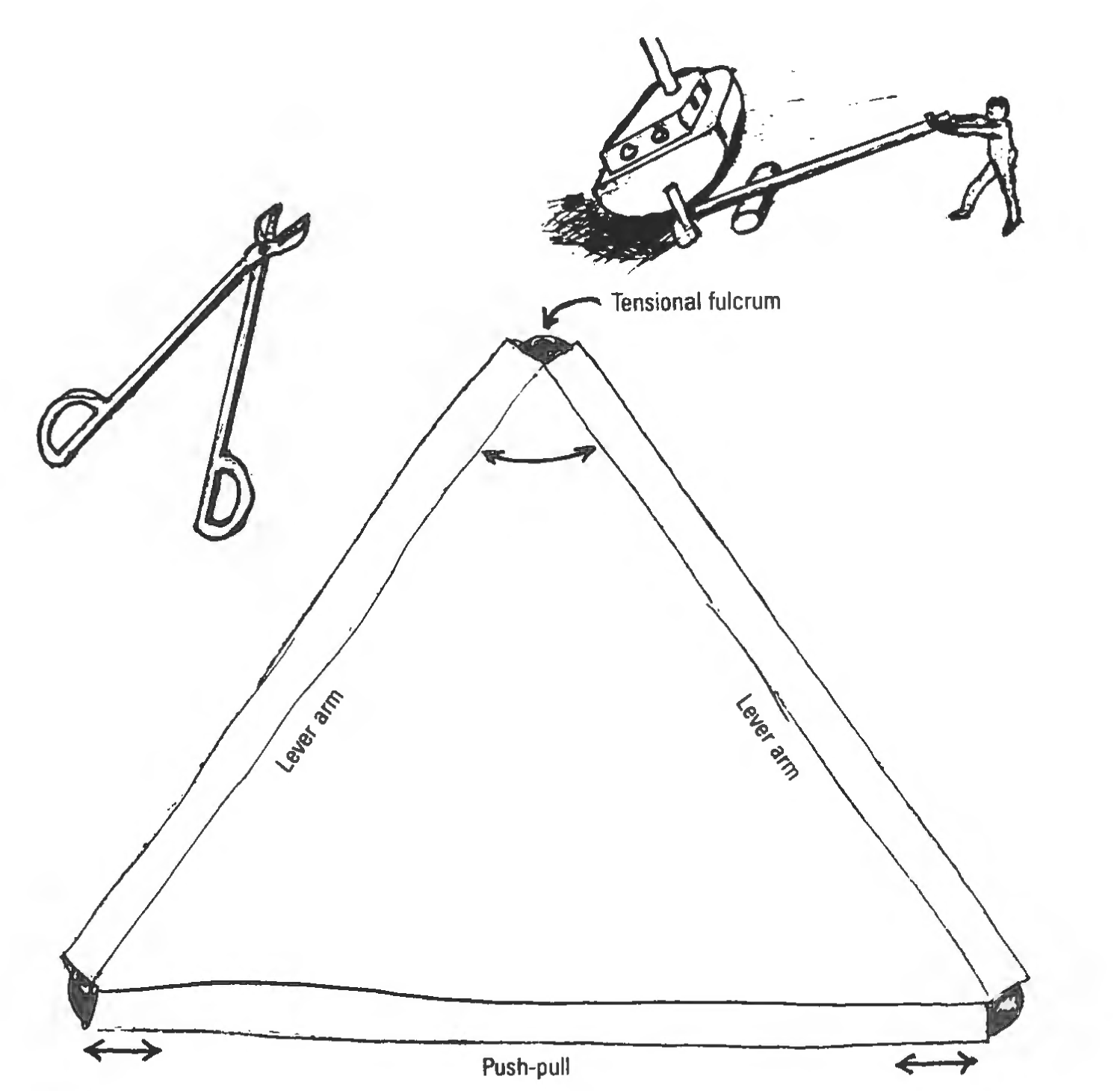
78 We discover that a pair of scissors consists of two edge-sharpened levers pin-fulcrumed one on another and that the longer the lever arms, the more powerfully they can cut. We discover that any two sides of our necklace triangle that are tensilely cohered are joined to one another at one end. We then discover that on the third side of the triangle we have a push-pull tube that is firmly seizing the outer ends of the two other tubes of the triangle, stabilizing the angle opposite it with minimum leverage effort. Thus does each push-pull side of the triangle stabilize its opposite angle with minimum effort (see Fig. 2.4). We find this minimum-effort characteristic to be consistent with all behaviors in nature, which always accomplish their patterning work with minimum effort.
79 The necklace triangle illustrates the principle of leverage advantage holding a complex of events motionless, in contradistinction to levers being used to move objects with minimum effort.
80 The reasons are many for the failure of physicists to include the tetrahedron and its component triangles in their exploratory strategy. Prime among these reasons is that physics has divorced itself completely from geometrically conceptual models, restricting expression of its explorations and findings exclusively to algebraically expressed formulae, with the assumption that calculations could always be translated into physical technology through the XY Z (axes) and c-g-s (centimeter-gram-second) coordinates of analytic geometry.
81 Being a science that is nonsystemic and committed to discovering only parts and guessing at the parameters that may be involved in their exploration, physics is intractably nonsynergetic.
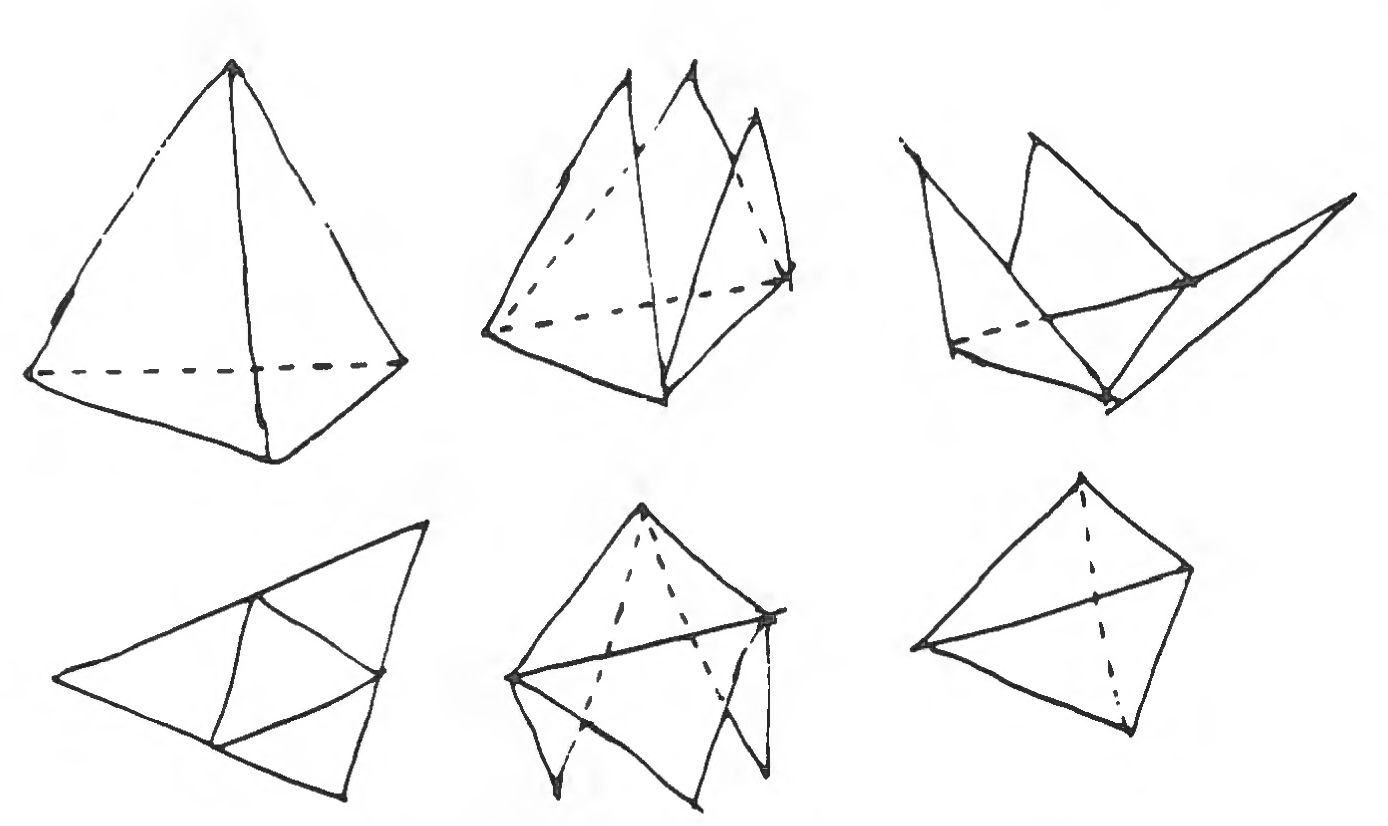
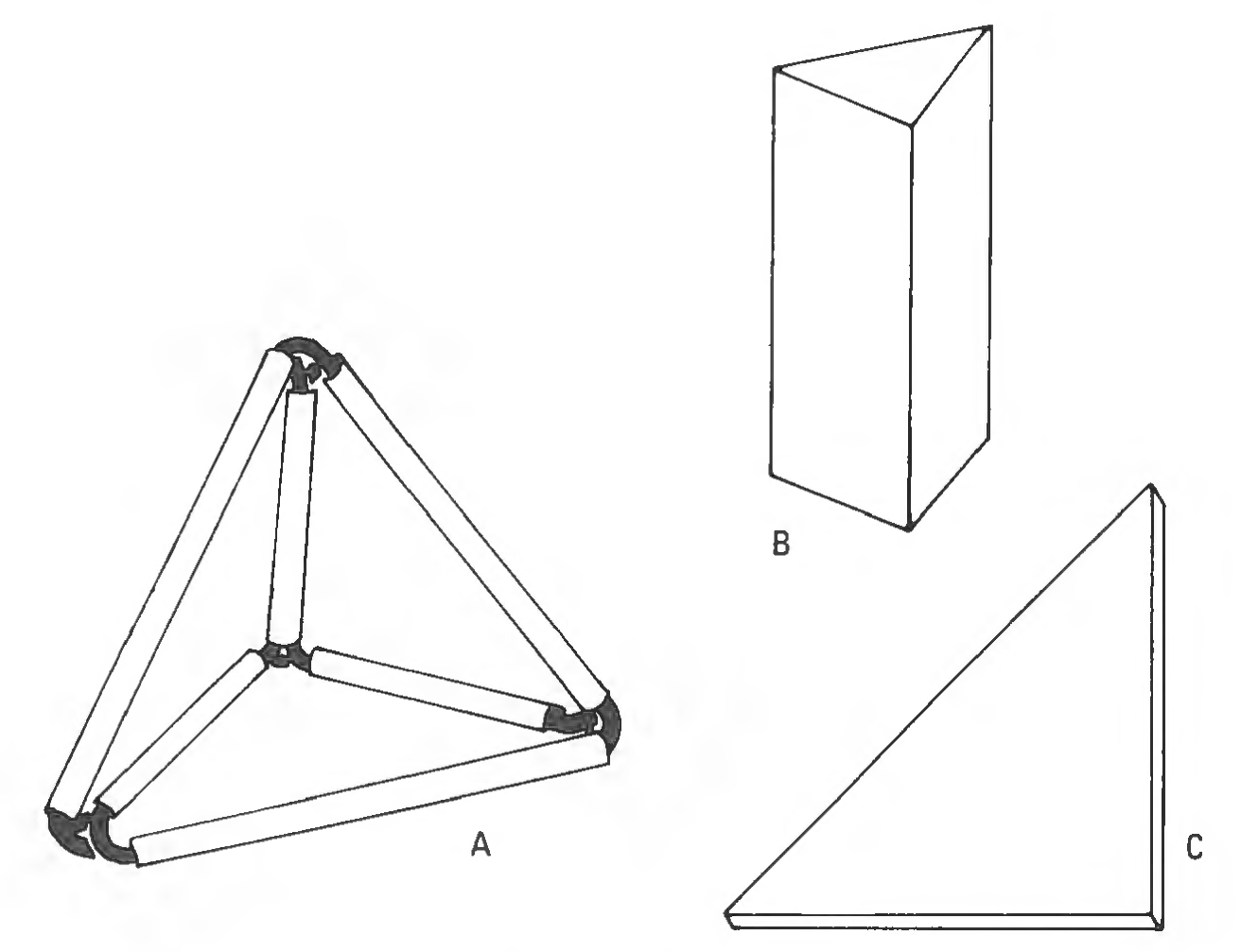
82 Repeating ourselves for emphasis and confirming our experimental evidence with a different set of physical items, we note the following: As our two hands manipulate the ends of a pair of tied-together sticks (the sticks representing two vectors)2, our hand motions flex the tied-together corner angle. A pair of sticks joined at one end articulate in the same pattern as a pair of scissors. By the principle of leverage, the longer a pair of scissors’ handles, the more powerfully they cut. The scissors’ corner-in serves as the common fulcrum of the two levered-together handle extensions of the scissors’ cutting knives. If a pair of scissor handles is open to an angle of 60∘ and if we then take a stick about the length of the scissor handles and fasten it to the handles’ outer ends, the cross-tied stick (vector) will prevent the scissors from further flexing. This is accomplished with minimum effort because the ends of the cross-tied stick are tied to the outermost ends of the levers, thereby producing with the least effort the greatest leverage advantage in stabilizing the opposite shear angle. The stick holding the two lever ends apart thus produces a closed polygonal pattern—a three-flex-cornered triangle. The triangle is therefore demonstrated to be the minimum flex-cornered polygon (there being no two- or one-vector-edged polygons). We have therefore demonstrated that each of any triangle’s sides always stabilizes its opposite angle with minimum effort. The triangle is the only flex-cornered polygon that holds its shape; ergo, it alone accounts for all structural shaping in Universe. Triangles do not, however, exist independently of systems. In synergetic geometry, the triangle is necessarily a very flat tetrahedron polyhedron, one with an almost negligible altitude (see Fig. 2.5C). The minimum system—the tetrahedron—has four flex-corners, four triangles (‘‘windows’’), and six vector-edge lines. Systems are independent in Universe and are therefore rotatably considerable. Systems always have two corners to serve as poles of system spin and other nonpolar com corners in sets of two. For every set of two nonpolar corners, all structurally stable systems always have triangular windows in sets of four opposite the four corners and vector edges in sets of six—with no exceptions.
84 Of all polyhedra, only the tetrahedron can be turned inside out to become its own mirror image, or complementary opposite. To picture this, imagine any point of a flexible tetrahedron being pushed through its triangular base. The resulting figure is a mirror image of the initial tetrahedron, just the way a rubber glove turned inside out becomes its own mirror image. In this way, the tetrahedron demonstrates the inherent twoness of a system. Tetrahedra can be experimentally demonstrated to be the optimally economic, most comprehensive structurally integrated systems in Universe.
85 In time, the existence will be acknowledged of both the special-case physical, systemically considered Universe and the generalized metaphysical, comprehensive tetrahedron-Universe. synergetics [synergetics], the comprehensive geometry I have systematized, unlike all other systems of geometry, incorporates both the physical and metaphysical. (The metaphysical involves that which can be experienced but is independent of size and is weightless and energyless, i.e., qualititative rather than quantitative.)
87 Inherent twoness is all-pervasive in Universe. We recognize that concave and convex always and only co-occur. Because concave surfaces concentrate, while convex surfaces diffuse, reflectively impinging radiation, we find demonstrated at conceptual outset that concave and convex produce different energy effects, wherefore it is experimentally evident that unity is plural and at minimum two. There can be no oneness, for it would be undifferentiated from its background; it could be neither conceptualized nor described; it would have neither insideness nor outsideness.
88 There is another way to demonstrate the at-minimum-twoness of the Universe (universe means toward union, not toward isolatable oneness).
89 There is no such phenomenon as ‘‘oneness’’ possible in Universe. One always presumes an other, in the same way that inside presumes outside and concave presumes convex.
90 The other at-minimum twoness of unity is the observer and the observed, and their union is the realization of life—in pure principle.
91 We can make a true model illustrating how the extra syntropic A Quanta Modules (which I shall describe shortly) produce the highfrequency interpulsing of the positive into the negative phase of Universe.
92 First, we make a triangle by welding together the ends of three 24-inch-long, 3 ⁄ 16 -inch-diameter steel rods. We next take three high tensile-strength, high-resiliency, interwoven-rubber-and-nylon-thread shock-cords and fasten one of each of their ends to the three corners of the steelrod triangle. Then, taking out all loose slack, we fasten the three inner ends of the shock-cords together at the triangle’s center of area.
93 Lifting the assembly and holding it before us with the triangular plane perpendicular to the floor, we now grasp the vertex formed by the knotted-together center of the three shock-cords (see Fig. 2.6).
94 We then thrust our hand forward and jerk it backward in swiftly alternating, successive movements. The inertia of the steel triangle keeps it in the same vertical position, while the shock-cords’ flexibility permits us to push our swift forward-and-back motion of our fist in ever-deeper plunges and draws. This will be seen to be producing a succession of positive and negative tetrahedra. This means the tetrahedron is successively transforming its inside-out positive phase into its outside-in negative phase.
96 Geometrically, this is exactly what physicists find some atoms are doing as a constant characteristic of their existence. This phenomenon became the basis for the first atomic clock. Also this is precisely the way, in pure principle, time is introduced into an otherwise eternally timeless Universe.
97 Both recreational and academic mathematics have long been fascinated with what has been called four-dimensional geometry. Much speculation and puzzlement has centered on its amazing properties, such as exercises in magically crossing seemingly impenetrable surface boundaries or rotating such exotic forms as the hypercube. But difficulties have arisen in trying to model three-dimensional objects in the higher dimension by analogy. synergetics [synergetics] models such figures with ease. The tetrahedron is inherently four-dimensional, with four mutually related axes. Giving up our ages-old attachment to the right angle, we can now model four-dimensional figures and demonstrate their properties, thus showing that the fourth dimension is ordinary rather than exotic.
98 Where there is insideness and outsideness, there is a four-dimensional system. A flat paper triangle has insideness of the paper and outsideness. There is no surface apart from the object it bounds. There is no experimentally demonstrable one-, two-, or three-dimensionality. The tetrahedron, with its four planes of symmetry, is inherently four-dimensional. Four-dimensionality is the minimum: anything less is not a system and therefore cannot be conceptually considered.
99 There are only three primitive (i.e., pre-time, pre-size, pre-frequency of modular subdividing), most symmetrical structural systems in Universe:
- A.
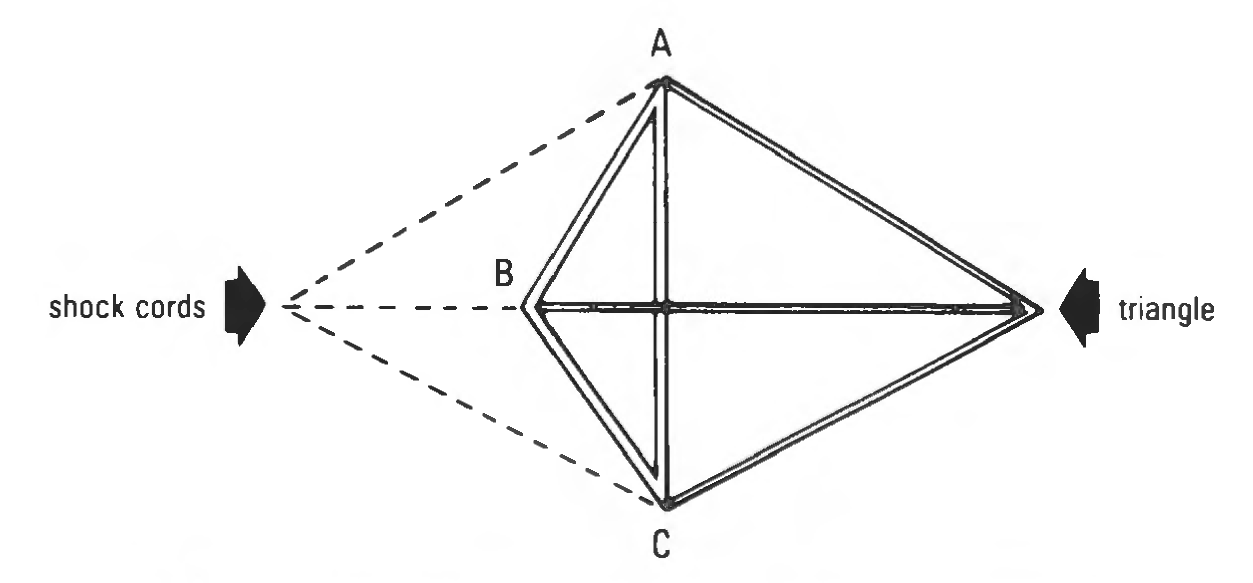
- The tetrahedron, with three equiangular triangles around each corner
(four triangles total) - B.
- The octahedron, with four equiangular triangles around each corner
(eight triangles total) - C.
- The icosahedron, with five equiangular triangles around each corner
(twenty triangles total)
100 There cannot be demonstrated to exist a structural system with six equiangular triangles about each corner, because these six 60∘ angles add up to 360∘, as do the angles around a point on a plane extending in all lateral directions to ‘‘infinity.’’ Such a figure with six ‘‘equilateral’’ triangles around each point could only produce a plane forever unable to turn back upon itself to form a closed system dividing Universe into all Universe outside the system and all Universe inside the system, which is in fact the unique function of a system.
101 As a consequence, there are only three omnisymmetrical, triangularly structured systems in Universe: the tetrahedron, octahedron, and icosahedron. The Greeks revered these objects. Present-day engineers, academics, and physicists virtually ignore them. In developing my design science strategies, I sought to discover practical application of the design principles these systems embody and to design the way nature designs: with pristine logic and economy.
102 Life begins with awareness of otherness. All the other othernesses are always systems that have their own unique insidenesses and outsidenesses.
103 By this book’s conclusion the reader shall have discovered the tools with which cosmologists, physicists, and mathematicians today confront the very biggest of questions in fields as abstruse as cosmology, quantum mechanics, and crystallography.
104 The reader will discover that the inexorable course of the gradual running down of the energy of the Universe—that is, entropy—is only part of the picture. Entropy has a complementary phase, which we designated syntropy. The reader will not only recognize these two phases of Universe but further will note and acknowledge that convex and concave modes are one way of picturing these phases. Convex may be viewed as the multiplication by division essential to quantum mechanics; in other words, from unity comes diversity. This convex phase represents the vectorially diffusive, entropic disintegration phase of Universe. Concave, on the other hand, is illustrated by simple multiplication and represents the syntropically integrative phase of only sum-totally regenerative Universe.
105 We recognize the tetrahedron, being simultaneously both convex and concave, to be thereby further qualified to serve as the comprehensive conserver of eternally regenerative Universe.
106 Reiterating, we note that tension and compression always and only coexist. Further, we have determined conclusively that gravity and radiation are this always-and-only-coexisting tension and compression functioning in their most inclusive macro- and micro-cosmic states. Central to the age-old search for a unified field theory has been the until-now-unsuccessful endeavor to reconcile gravity and radiation.
107 Of all that we classify as primitive (pretime and presize) imaginable closed systems, only the tetrahedron can be turned, or can turn itself, inside out. (See my definitive reference on the whole subject, synergetics [synergetics], Secs. 618.10 and 624.12.)
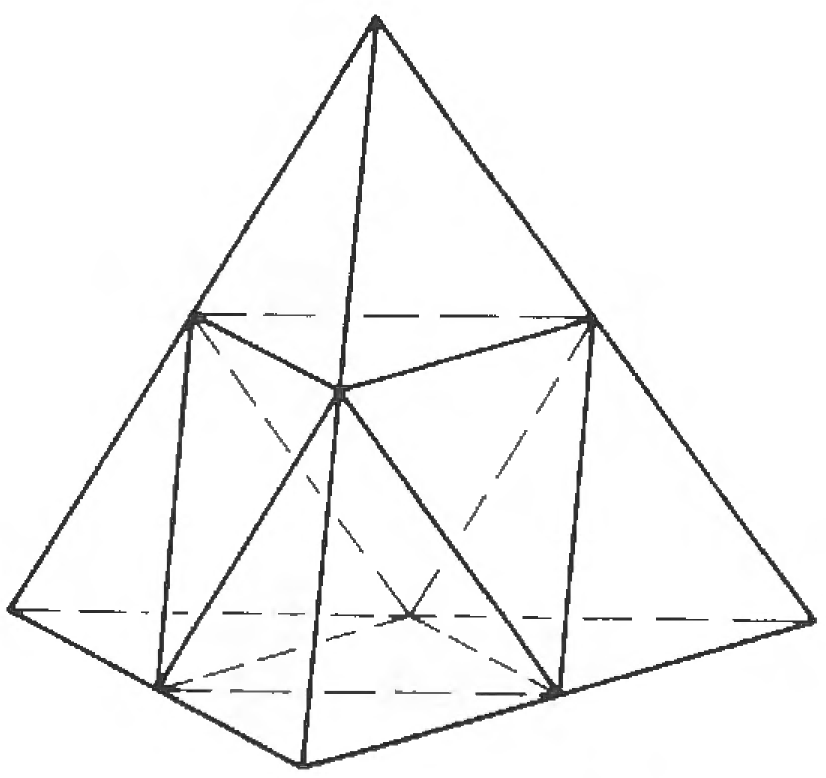
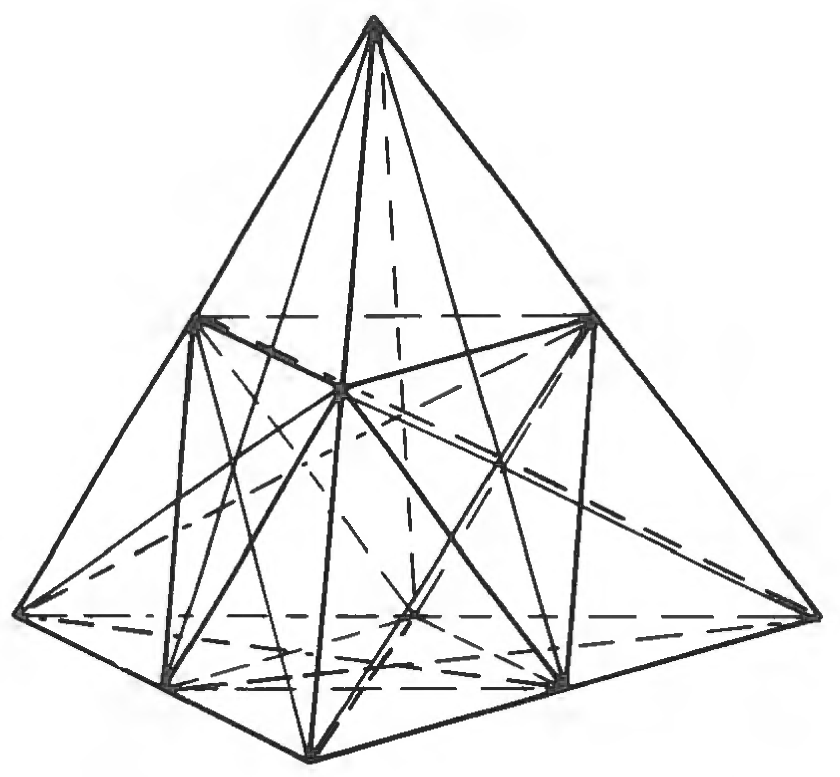
108 In synergetics2 (1979) [synergetics2], I continued my exploration of quantum mechanics’ multiplication by division and by the inherent seven unique great circles of spinnability of all crystal systems and of all isotropic matrix embracements of symmetrical subsystems, and their successive multiplication by subdivision to produce not only the A and B modules but also what I call the S, T, and E modules. These great circles are also the same seven unique great circles of symmetry that are foldable into local-circuitry great-circle ‘‘bow ties’’, which are reassemblable into omnisymmetrical spheric systems, complexedly interweaving their spinning in great circles.3 Although I shall later provide a sensorial demonstration (see Fig. 3.3), to prove to myself that gravity is the inherent syntropic conserver of integrity in Universe, being twice as efficient as radiation and using only logic and the operational tools of synergetic geometry, I traced the following steps:4 Multiplying only by division, 5 we proceed to bisect the six edges of the tetrahedron and most economically (that is, geodesically) interconnect those six bisection points (see Figs. 2.7 and 2.8). We then use those six symmetrically interrelated points as the three sets of poles of the three initial axes of rotation of the tetrahedron. All systems have cosmically inherent independent rotatability or spinnability. As we can clearly see in Fig. 2.8, these three rotations describe the octahedron as the first multiplication by division into one equi-vector-edged octahedron and four identical equi-vector-edged tetrahedra, with the central octahedron exactly equaling the sum of the volumes of the four corner-situate tetrahedra.
113 For as long as can be remembered academic science has embraced a cubical rather than a tetrahedron-based coordinate system. One thing nice about the cube is that it neatly accounts allspace , without any other device. If we assess space as modern physicists do, with the cube as the measure of unit volume, we are using three times as much volume as necessary. If, on the other hand, we use the tetrahedron as the unit measure, we are practicing the economy that nature always follows in her designs.
114 When we use a cubical coordination system, we are being threefold inefficient. Because we are always dealing with physical experience and because physical experience in synergetics is nothing but structural systems whose edges consist of energy events whose actions, reactions, and resultants consist of one basic energy vector, the cube therefore requires three times the energy to structure it than the tetrahedron does. We thus understand why nature must use the tetrahedron as the unit of energy, as its energy quantum—because it is three times as efficient. All the experiments in physics show that nature always employs the most energy-economical tactics.
115 When we attempt to use tetrahedra as the ‘‘building blocks’’ of a coordinate system, we quickly discover that they will not fill allspace. The octahedra and tetrahedra must pack together to fill allspace, with no intervening pockets of space.
116 Tetrahedra and octahedra agglomerate to fill allspace: they complement one another. To the individual looking for a monological explanation, this synergetic model would be unsatisfying. To the physicist, who recognizes complementarity as a basic principle, this method of accounting would be rational and very satisfying indeed. The complementary, allspace-filling grid of tetrahedra and octahedra is given the name isotropic vector matrix in synergetics because of the unique property of the grid being composed of equal length elements and being everywhere the same. The grid may be thought of as a schematics of the contact points when spheres are closest-packed.
118 In synergetic geometry, this allspace provides a rational, numerical, and geometric framework upon which to model nature’s own most economical coordinate system. This framework I identify as the isotropic vector matrix, which fills allspace with a grid composed of tetrahedra and octahedra.
119 The elegantly simply structure upon which I base this system is composed of tetrahedra and the octahedra formed inside each tetrahedron by connecting the midpoints of the six edges of the tetrahedron. Rational, numerical, and geometrical values derive from (a) parallel and (b) perpendicular halving. The thirding and physical isolation of the prime number three and its multiples is only an inadvertent consequence of the three-way, symmetry-imposed, perpendicular bisecting of each of the tetrahedron’s four triangular faces. The parallel method of tetrahedral bisecting has three axes of spin and ergo three equators of halving; and the perpendicular method of tetrahedral bisecting has six axes of spin and ergo six equators of halving. Halving and its inadvertent thirding introduces the twenty-four A Quanta Modules.6 This discussion leads us to the A and B Quanta Modules, which, I intend to show, become the rational, numerical, and geometrical units of all geometries and of all crystallography. To reiterate this most important discovery, the tetrahedron is spinningly fractionable in several ways:
- 1.
- The successive spinning of each of three great circles fractionates the tetrahedron into an internal octahedron of volume 4 surrounded by four small tetrahedra each of volume I. How do we know that? Because, when the edge module of a system is 2, its triangularly modulated surface is N2 − 22 = 4 and the system’s tetrahedral volume is N3 − 23 = 8; therefore, a tetrahedron with edge module 2 has a volume of eight regular tetrahedra. Subtract the four corner tetrahedra from the overall tetrahedron volume of 8 and the octahedron that remains is 8 − 4 = 4 volumes;
- 2.
- i.e., the octahedron has a volume of four tetrahedra of the same vector-length edge modules (see Fig. 2.7).
- 3.
- The six great circles fractionate the tetrahedron into twenty-four A modules. The six great circles are the extensions of the tetrahedron’s six edges over and downward beyond the vertexes as the perpendicular bisectors of the two successively encountered equiangular triangles (see Fig. 2.8). The six great circles are spun on two sets of three axes each, running between the three half-altitude points of the two adjacent pairs of triangular faces of the tetrahedron (see Fig. 2.7).
- 4.
- Finally, four great circles are spun about the four axes provided by the perpendiculars
from the tetrahedron’s four apexes, impinging perpendicularly upon the center of
area of their four opposite triangular faces. The three and the four and the six great
circles taken all together fractionate the original omnienergy quantum tetrahedron
of physical Universe into ninety-six A modules and forty-eight B modules—i.e., two
A modules for every B module in Universe. These modules are the two basic units
from which, I contend, all rational, numerical, and geometrical values derive, as well
as all phenomena of crystallography.
121Synergetics provides an alphabet of working units with which diverse fields of study can be reconciled without resorting to awkward, irrational, or fractional values. Because the A modules are foldable into their tetrahedral form from only one whole triangle, energies entering them inherently bounce reflectively around within them. For this reason, A modules conserve their energy receipts (see synergetics [synergetics], Sec. 913). Because the B modules’ tetrahedra are each folded together from four different triangles, the energies entering the B modules are reflectively dispersed from them (see synergetics [synergetics], Sec. 916).
- 5.
- Algebraically described, we have:
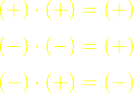
(2.1) 122The A Quanta Module occurs in nonnestable pairs: the syntropically conserved, self-regenerative energy of the A+ module (+) and the syntropically conserved, self-regenerative A− module [(−) ⋅ (+) = (−)]. The two A's have a constant in Universe (−), whereas the alternative left and right winging of the inherently entropic B modules operate singly, left-handedness producing a negative proclivity, and right-handedness, a positive proclivity.
123Therefore,
(2.2) 124Therefore,
(2.3) 125Therefore,
(2.4) 126Therefore,
(2.5) 127Therefore,
(2.6) 128Therefore, we have twice as much gravity (i.e., coherence) as we have radiation.
(2.7) 129Therefore, the Universe is twice as powerfully integrating as disintegrating (i.e., twice as powerfully syntropic as entropic).






130 Extrapolating from this demonstration, we can surmise that one-half of the integrative forces of physical Universe rule over the disintegrative forces. The other (excess) half of the integrative forces are invested in a constant oscillation between the positive and negative modes of the tetrahedron.
131 For the first time humans have been able to have a conceptual picture of a local electromagnetic wave disturbance. Unlike other attempts at linear or planar models of this phenomenon, synergetics provides a multidimensional wave-propagation model (the ‘‘jitterbug’’) and its description of the rotation of the tetrahedron between its two phases within a cubical framework.
132 This phenomenon generates all electromagnetic wave motions, effecting both a positive and negative phase of Universe. The negative phases, being disconnects of eternity, produce both time and eternal evolutionary transformation.
133 Time intervals, thus, are split-second black-hole glimpsings of the negative phases of Universe. The second set of A Quanta Modules permits time to stretch out diverse, overlapping episodes into the nonsimultaneity of eternally regenerative Universe. It is this time-lapsing capability of the syntropic A modules that permits the momentarily ‘‘negative’’ lapse that we human, time-embraced phenomena think and speak of as life. Without time, there is no what-we-think-of-as-life.
134 Life begins as a special-case episode of our awareness progressively discovering the always-present otherness of ‘‘plural-unity’’7 and its multiplication by further dividing into a complex of overlappingly episoded experiences always terminating daily with sleep, from which we emerge each time to start a new set of awareness-of-otherness dreams. No one has ever been able to prove that the human who awakened was the same human (who may always be dreaming) who went to sleep yesternight. Experienceable unity is plural and at minimum two. The system’s inherent insideness and outsideness, its concavity of insideness and convexity of outsideness, coexist in pure principle, where we cannot have one without the other. Since concave concentrates impinging radiation and convex diffuses the same radiation, concave and convex do not perform the same function; ergo, the minimum otherness experience of life’s awareness is a system unto itself whose insideness and outsideness demonstrate that unity is always plural and at minimum two. Zero corners plus zero faces equals zero edges plus two.8 Universe is two.
138 IN SEARCH OF THE PRINCIPLES UPON which nature structures Universe, I further identify what I call the coupler as the uniquely asymmetric (or only polarly symmetric) octahedron, which is comprised of the many in-the-same-space-reorientable combinations of the quarks. I shall return to the coupler after I describe how I arrived at its discovery.
139 Nature’s coordinate system, I determined, fundamentally consists of a matrix of tetrahedra and octahedra, which together fill allspace. To model this isotropic vector matrix , I first observed how spheres stack. I pictured identical cannon balls stacked in the way by nature they tend to stack most economically.
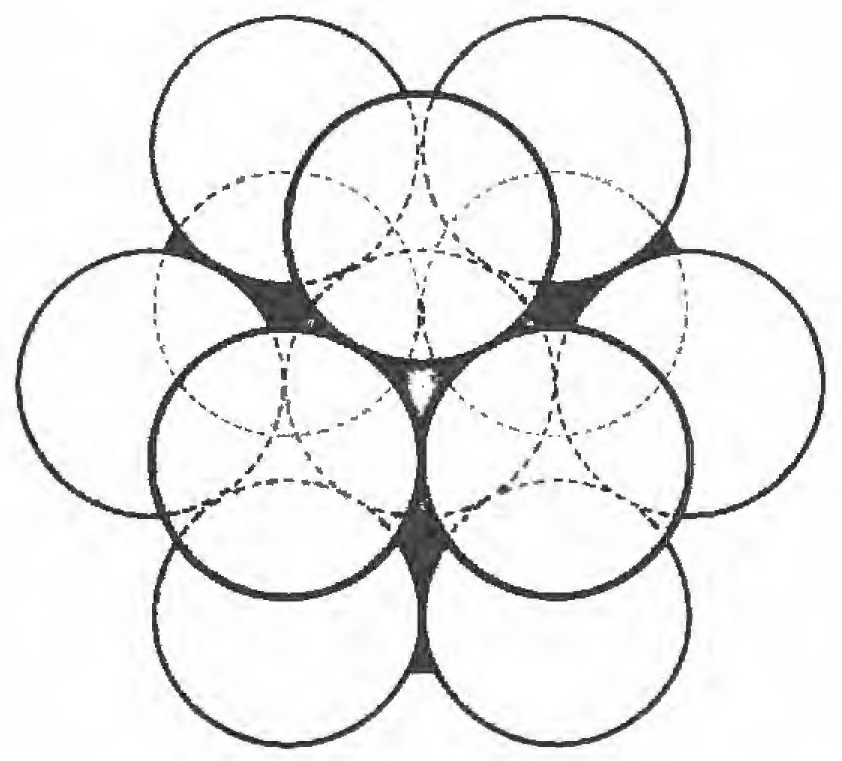
140 Spheres always and only closest pack tangentially with twelve spheres around one (see Fig. 2.9).
141 When spheres of unit radius are closest-packed, there are two kind of spaces intervening: the concave octahedron and the concave vector equilibrium spaces. These two can be assembled edge to edge with one another to produce a ‘‘continuum’’ of all space-embracing, closest-packed, unit-radius spheres. Such an assembly will not have whole spheres on the outer surface of the assemblage, but instead will have only concave surfaces with the appearance of a mass of hardened clay covered by the concave impressions of half-shells of long-dead clams.
142 There exists a polyhedron with twelve diamond faces. It is called a rhombic dodecahedron (see Fig. 2.10). Structurally stable rhombic dodecahedra closest pack with one another and, in doing so, actually fill allspace, as do the nonstructurally stable cubes only theoretically. (Theoretical means ‘‘assuming you are God and are playing the game of inventing the rules of the game of the experience called life.’’)
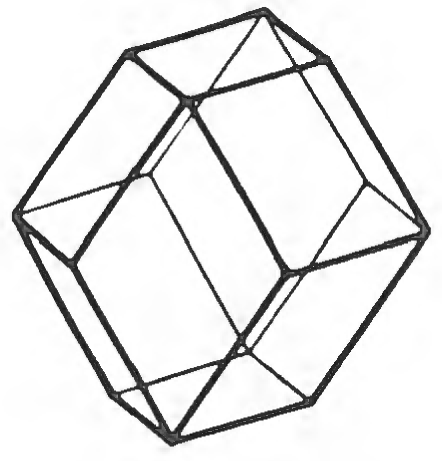
144 The centers of volume of the closest-packed rhombic dodecahedra are congruent with the centers of volume of the closest-packed unit-radius spheres whose radii are the same as the twelve radii of the rhombic dodecahedra, which radii are the perpendiculars to the twelve mid-diamond faces’ centers of the allspace-filling rhombic dodecahedra.
145 We thus discover that the twelve diamond-faced, allspace-filling rhombic dodecahedra are the allspace-filling ‘‘domains’’ of each of the closest-packed unit-radius spheres whose closest packing is also that of all atoms. A sphere fits neatly inside the rhombic dodecahedron, with each of the dodecahedron’s twelve mid-diamond faces tangent to the enclosed sphere at the same twelve points of tangency of the twelve spheres closest packing around one another. Since the rhombic dodecahedra fill allspace while containing the spheres when closest packing together in the same twelve-around-one pattern of the spheres that are each tangent to the mid-diamond faces’ centers, we can understand why rhombic dodecahedra are the domains of spheres.9 When the vector-edged regular tetrahedron’s volume is 1 (i.e., unity), the vector-edged octahedron’s volume is exactly 4, the symmetrically inter-joined, positive-negative tetrahedron’s eight-cornered overall cube aspect has a volume of exactly 3, and the rhombic dodecahedron has a volume of exactly 6; i.e., the volumetric unit of allspace filling is exactly 6. Allspace unity equals 6. Unity is plural and volumetrically at minimum 6.
| Polyhedron | Volume |
| Tetrahedron | 1 |
| Octahedron | 4 |
| Cube | 3 |
| Rhombic dodecahedron | 6 |
148 Synergetics’ constant unit of length is the edge of the tetrahedron and, therefore, of the isotropic vector matrix, which, we recall, identifies the allspace-filling, omnidirectional grid composed of alternating tetrahedra and octahedra, neither of which fills allspace without its complement (more precisely, its dual).
149 To make a cube with a volume of exactly 3 hold its shape, a tetrahedron must be inserted into it. The tetrahedron’s edges form the diagonals of the square faces of the cube. In conventional academic science’s XY Z, 90∘, square- and cube-coordinated system with its N2 squaring and N3 cubing, the cube’s edge N is unity. In synergetics the tetrahedron’s edge N is unity. When we use synergetics’ vector constant as the edge of the cube instead of as the diagonal of its faces, the volume is 3.5339 versus the volume 3 of synergetics’ vector diagonal cube.
150 The vector-edged cube’s volume is the irrational number 3.5339+. This 3.5339 + cube is the vector-edged cube that physics illogically, encumberingly, and slavishly uses and has always used as the unit volume in the centimeter-gram-second and XY Z-coordinate system of academia’s energetic mensuration. Using its volume as the standard unit volume for the entire hierarchy of primitive symmetric polyhedra makes them all awkward, irrational values. The measuring system used by business and industry and taught in every university science department is thus a mishmash of awkward, cumbersome values. Aesthetically inclined students are repelled by the irregularity and disorder.
151 When allspace-filling rhombic dodecahedra are closest packed and the long diagonal of their diamond faces is vector-lengthed, there are exactly twelve around any one. Any two closest-packed rhombic dodecahedra have their respective common diamond faces congruent with one another.
152 If we interconnect the centers of volume of any two adjacent rhombic dodecahedra with the four corners of their common diamond interfaces, we produce the only polarly symmetric octahedron (see Fig. 2.11). It is this figure that I named the coupler, for it couples not only the centers of volume and centers of energy of the closest-packed, allspace-filling rhombic dodecahedra but also the centers of all the closest-packed unit-radius spheres and thereby of all closest-packed atoms. Couplers intercouple centers of energy-the nuclei-of all closest-packed unit-radius (i.e., equiwavelengthed) atoms.
153 Consisting of twenty-four modules, the coupler’s volume is identical to the volume of the tetrahedron. It is here that we identify what nuclear physicists have named quarks, theoretical subatomic particles that carry fractional charges and such fanciful characteristics as ‘‘upness,’’ ‘‘downness,’’ ‘‘strangeness,’’ and ‘‘charm.’’ The coupler always consists of eight mites, or quarks—the three right-angled isosceles tetrahedra consisting of two energy-conserving A modules, one of which is inside out of the other, and one energy-dispensing B module of either the inside-outness or outside-inness phase.
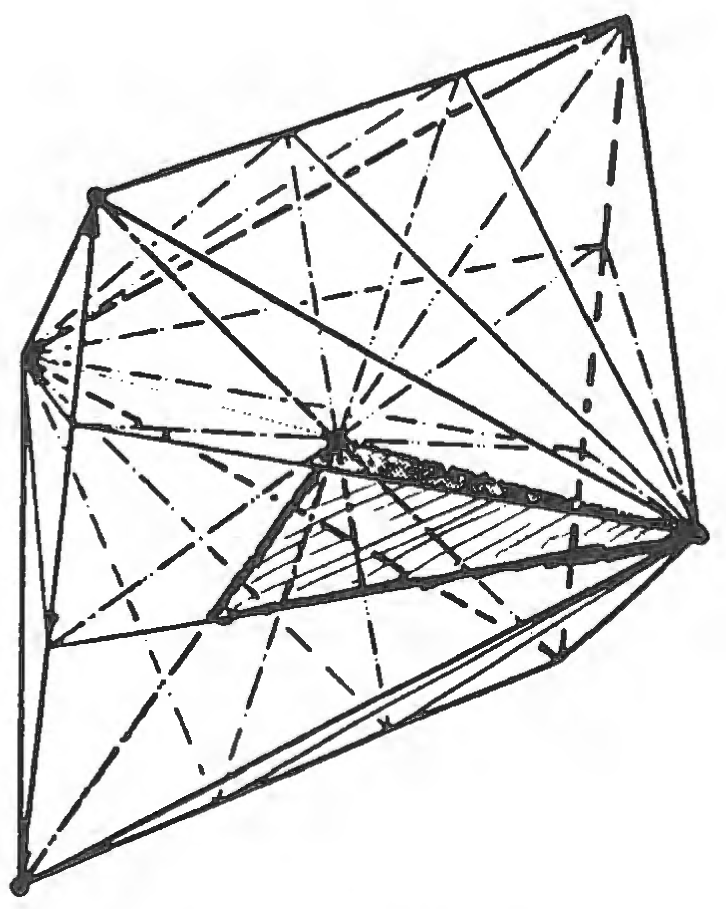
155 There are all together two internal alternative interarrangeabilities of the mites’ two A modules and one B module—A+ , A− , B+ left wing; or A+, A− , B−, right wing—all within the same overall, allspace-filling, right-isosceles tetrahedron.
156 These two interchangeable energy-conserving and -dispersing behaviors correspond exactly to those that nuclear physicists attribute to quarks. The mite’s geometrical space domain has two noteworthy internal module arrangements producing two uniquely different energy-conserving effects and one energy-dispersing effect, as does, also and exactly, the quark’s.
157 The number of different interrearrangements of the mites within the coupler’s 8 tetrahedral receptacles is:
| (2.8) |

158This 28 we multiply by the twoness of internal mite rearrangeability of the mite’s 2A and 1B modules, giving us 56 rearrangements of the same total energies inter-energy-proclivities of each coupler. Each spherical atom has twelve couplers linking its center to the centers of its surrounding neighbors:
| (2.9) |

160 Ergo, we have 66 × 56 = 3,696 different energy-holding and -dispersing proclivity variants of interassociatability of each atom always within identical, superficially static, atomically closest-packed array space. With 3,696 potentially unique interrelationships within the first shell, and (422 − 42) ÷ 2 = 86, I multiplied by 3,696 for the second shell, and (922 − 92) ÷ 2 = 4,186 multiplied by 3,696 for the third unique shell of any nucleus, and (1622 − 162) ÷ 2 = 13,041 multiplied by 3,696 for the outermost shell of closest-packed limit uniqueness of any given unit-radius, symmetrical, closest-packed, nucleated system, then 3,696 + 861 + 4,186 + 13,041 = 21,784. Further,
| (2.10) |

161This number is the number of unique subnuclear componentations of each nucleus with which you have to play.
162 Synergetics provides real-world understanding of interarrangeabilities of subatomic particles, which is to say, a more sophisticated understanding of subatomics than that of the nuclear physicist whose favorite tool is the atom smasher.
163 ALTHOUGH I HAVE GONE INTO THIS subject in a certain amount of detail, what I have intended to demonstrate is simply that the framework of synergetic geometry makes possible the discovery of many varieties of subatomics all within the same seemingly static space.
164 Through the use of synergetic geometry, then, particle physics, which is one of the more abstruse and esoteric areas of frontier theorizing in science, falls within the grasp of the ordinary individual, allowing him or her to consider, to model, and to puzzle over it. Synergetics uses simple models based on a few basic modules that fit together in the most logical possible ways. Synergetics uses whole numbers, completely eliminating all irrational, imaginary, and irresolvable numbers and complex formulae. It is amazing that technology has been able to produce what it has, considering the obstacle presented by current scientific conventions in the field of geometry and measurement. The scientific and academic establishment still cowers in the Dark Ages imposed by human power structures many centuries ago. The dawn of scientific civilization is yet at hand.
165 In recent correspondence with a nuclear physicist, I urged him to continue his intensive study of synergetics as presented in my two volumes on synergetics. I gave him, however, a strong warning that I could not guarantee that other physicists would accept his inferential deductions and identification of them with the findings of the conventional XY Z, c-g-s calculus of academia’s subatomic explorers.
166 I told him it would be a multi-billion-dollar savings to society each time he successfully identified one of the millions of now ‘‘colorful’’ and ‘‘strange’’ subatomic particles through use of synergetics’ A,B,S,T,E modules and the myriads of their extendabilities.
167 Government-financed, private-enterprise-exploited atomic accelerators and their kindred producers spend about a billion dollars per subatomic particle discovered, whereas I have firmly established and classified all that they have or ever will soon discover, and vastly more, only at the cost of living expenses for self and family during my fifty-four-year program.
168 These are my own half-century-ago discoveries, comprehensively published together for the first time in synergetics [synergetics]. As discoverer, original graphic illustrator, and namer, I ask all explorers in the field of synergetic geometry for respectful use of my system of naming when setting out to identify the significant interrelationships of the vast variety of sub-nuclear rearrangement arrays.
169 I HAVE OFTEN STATED THAT BY Universe I mean the aggregate of all humanity’s consciously apprehended and communicated (to self or others) experiences. All the individual experiences in this aggregate of omniexperiences cannot be simultaneously recalled. They can be recalled only in systemic increments. The individual, systemic recallability from memory of many experiences—some rapidly, some slowly—suggests possible omnirecallability in extended time of the entire memory-banked collection of the majority of individuals’ unique experiences.
170 Among the total accumulation of special-case experiences of all humanity we sometimes discover interrelationships existing which display a mathematical orderliness which always and forever demonstrates absolute consistency in its mathematical interrelationship. These exquisite interrelationships we identify as only mathematically expressible generalized principles. An example of such a generalized principle is the discovery that the number of unique interrelationships of any given number of entities is always (N2 − N) ÷ 2 (see synergetics [synergetics], Sec. 227). Another example is the law of similitude , which showed shipbuilders that doubling the length of their freighter allowed them to carry eight times as much cargo.
171 The aggregate of generalized principles derived from the aggregate of all humanity’s consciously apprehended and communicated special-case experiences can be said to express most exactly and economically what we mean by Universe.
172 Eternally regenerative scenario Universe is an aggregate of principles.
173 To qualify as principles, they must be exceptionless . When stated positively, exceptionless means eternal.
174 The synergetic complex of omniinteraccommodative eternal principles is inherently weightless and changeless, ergo metaphysical.
175 Metaphysical Universe and its component principles are omni weightless and only metaphysically expressible. The metaphysical principles are one and all so absolute that their interoperative behaviors become mathematically tune-in-able and tune-out-able.
176 A very small range of this vast spectrum of tune-in-ableness becomes sensorial to humans. The sensorially apprehensible principles are what we call the physical aspects of omnimetaphysical Universe.
177 What distinguishes the physical from the metaphysical is not what both the casual and trained observer might note: solidity, opacity, hardness, or heaviness.
178 The physical is either the tune-in-able or interferable, coincidental, interceptible, special-case, sympathetic resonance of substances and/or electromagnetic frequency ranges of the human senses within the comprehensive metaphysical frequency and wavelength spectrum. Solids are themselves only wave complexes. They are the superficially deceptive microaggregates which defy differentiating resolution into their myriad separate parts by the unaided eye.
179 EVERY ONCE IN A WHILE IN THE 1950s and 1960s, philosophy scholars and others in the academic world would say to me, ‘‘If you are ever confronted by Professor Weiss at Yale, some of your basic theories are liable to be dismantled.’’ On my appointment in 1968 to a Hoyt fellowship at Yale, Professor Weiss and I were encouraged by the students to appear together on the Yale University television station. Though we had not as yet met, we accepted the invitation readily and independently.
180 Professor Weiss was a widely known, distinguished professor. I met him for the first time in the television broadcasting studio. The station program director seated us opposite one another at a stout wooden table. On the director’s signal that the recording of the program was commencing, Weiss thumped the table resoundingly with his fist, saying, ‘‘Don’t tell me that this table is not solid.’’
181 I replied, ‘‘How can you see me over here, defiantly glaring through what are obviously solid spectacles?’’ To which the professor opened his lips to reply—his mouth fell open—but no words came.
182 I proceeded to explain that glass is an aggregate of very high frequency atomic events and that a good analogy would be an alignment between Weiss and me of a number of rows of airplane propellers rotating so fast that none of their blades can be seen. If he reached his fist toward me, an invisible solid, like his eyeglasses, would thump his fist or cut it off.
183 Because the speed of the propellers is directly coupled to their controlled-speed motors, it is possible using gears to time and aim a battery of machine guns to shoot bullets between the spinning blades, as I described in Chapter 1 of this book. I explained to him that the speed of light is so swift that it can readily pass through the circular-motion patterns of his glasses’ whirring electrons. By making the glass lenses a little thicker, the distance the photons of light must travel (at 186,000 miles per second) is increased enough to permit mild interference with the gyrations of the electrons of the atomic components of the glass. As a baseball is angularly redirected just a bit by a batter’s foul-tip, this refractive direction-changing of the light-photon passage makes possible lens correction of our physical vision equipment.
184 Professor Weiss asked the studio to cancel the program and walked out. Thus, we discover how seemingly ‘‘hard realities’’ may be only mathematical differentiations of frequency and angle, operative in pure principle.
185 synergetics [synergetics], alone among generalized system theories, models Universe in its many-splendored effulgence so completely and pristinely using only frequency and angle.
186 Since there are no things, no solids—only events operating in pure principle—and since no events touch other events in Universe, Universe is coordinatingly cohered, formed, and transformed only tensionally, repulsively, electromagnetically, and gravitationally; even the event ‘‘electron’’ is as remote from its nucleus as the Earth is from the Moon, in terms of these regenerative systems’ respective diameters.
187 The term solid has come in recent years to mean subvisible behaviors, as in the development of solid-state physics. Science evolved the name solid-state physics when, immediately after World War II , the partial conductors and partial resistors—later termed transistors—were discovered. The phenomena were called ‘‘solid-state’’ because without human devising of the electronic circuitry, certain traces of metallic substances accidentally disclosed electromagnetic pattern-holding, shunting, route-switching, and frequency-valving regularities, assumedly produced by the invisible-to-humans atomic complexes constituting those substances.
188 Further experiment disclosed unique electromagnetic circuitry characteristics of various substances without any conceptual model of the ‘‘subvisible apparatus.’’ Ergo, the whole development of the use of these invisible behaviors was conducted as an intelligently resourceful trial-and-error strategy in exploiting invisible and uncharted-by-humans natural behavior within the commonsensically solid substances. The addition of the word state to the word solid implied regularities in an otherwise assumedly random conglomerate.
189 What I have discovered goes incisively and conceptually deeper than the blindfolded (Dark Ages) assumptions and strategies of solid-state physics—whose transistors’ solid-state regularities seemingly defied discrete conceptuality, scientific generalization, and kinetic schematizing. Synergetics provides the subatomic explorer with a roadmap leading to discrete conceptuality, scientific generalization, and a schematic for further exploitation.10 [synergetics] discloses the seven sets of great circles (four on the vector equilibrium and three on the icosahedron) that produce all the fractionating and polyhedral facetings of all crystallography.
191 synergetics [synergetics] also shows that all four of the great circles of the Vector Equilibrium (VE) transverse the twelve vertexes of the VE and that those vertexes are the same points of interconnection of unit-radius spheres in closest-packing. I later point out that energy charges always follow the convex surfaces of spheres and that ergo those four sets of great circles constitute the Universe’s only ‘‘railroad tracks’’ for energy transmission via atomic agglomeration. I also show that the twelve vertexes of the icosahedron could be pump phased (‘‘jitterbugged’’) into congruence with the VE's twelve vertexes.11 synergetics [synergetics] also discloses the foldability of each of these seven great circles into local bow-tie-like patterns, which act as local-circuit shunts and are reassemblable into whole-sphere integrities. Totally assembled, they reconstitute the whole great-circles patterning of the completed spheres. They demonstrate thereby that these great circles may act as local information-shunting and -holding circuits. I also show that the icosahedron and its three sets of great circles may serve as a comprehensive information shunter-holder of even greater capacity. The icosahedron’s system of thirty-one great circles is capable of releasing and routing its information most economically in uniquely preferred contact directions, hinting at the possibility of molecular-level computer technology. My studies show that it is possible to understand the discrete energy shunting and holding patterns at the molecular level.
193 synergetics [synergetics], further, discusses such new-era computers latent in the atomic world now to be mathematically reached and employed at the most exquisitely microcosmic minitude.
194 synergetics [synergetics] discusses the secondary sets of great circles of both the vector equilibrium and the icosahedron and the part they can play in computer systems. Getting back to my counsel to subatomic explorers and my nuclear physicist correspondent in particular, I recommended that they study all the tables of calculations of spherical and planar triangular subdivisioning of all the secondary great circlings of Universe—with the dimensions being given of all the central angles (arcs and chords) and surface angles both polyhedronally and spherically, in the Appendix of Tables starting at page 477 of synergetics2 [synergetics2]. These tables comprise one key to my strategy of eventually arriving at an entire cosmic system that accommodates all possible transformations through only-whole-number accounting.
195 In addition to the subjects already discussed, I submitted to him another important extension of my material on comprehensive strategies for mathematically generalizing and both omnirationally and only whole-number accounting of the entire cosmic system to accommodate any and all of the nonsimultaneous intertransformings and interexchangings of finite but nonunitarily conceptual Universe. I had no qualms about the importance of pursuing this strategy because I innately knew that nature only worked with whole-number, rational accounting in her myriad designs.
196 In this connection—that of a comprehensive all-embracing whole-number accounting system—I asked him please to read and study synergetics [synergetics].
197 Just before synergetics [synergetics] went to press in 1975, I discovered what I call the Scheherazade Number, of which this seventy-one-integer number is the latest version:
198 212 ⋅ 38 ⋅ 56 ⋅ 76 ⋅ 116 ⋅ 136 ⋅ 174 ⋅ 193 ⋅ 233 ⋅ 293 ⋅ 313 ⋅ 373 ⋅ 413 ⋅ 433 ⋅ 473 = 616, 494, 535, 0, 868, 49, 2, 48, 0, 51, 88, 27, 49, 49, 00, 6996, 185, 494, 27,898, 13, 35, 17, 0, 25, 22, 73, 66, 0, 864, 000, 000
199 This supreme seventy-one-integer Scheherazade Number can also be presented in columnar form in order to disclose a surprising number of symmetries. This number embraces a minimum n3 number of all the prime numbers involved in evolving all trigonometric functions and all the surface and volumetric spherical system intertransformings of synergetics.
200 Using this number as the number of divisions of circular unity, with the comprehensivity and speed of computers, it is possible to rework the calculations of all the trigonometric functions. If, as I predict, all the results are in whole-rational-number increments (without any decimal fractions), we can then assume that all scientific calculations could be reworked with this comprehensive dividend base.
201 As noted before, quantum mechanics is founded on the assumption of the total of energy in Universe being unincreasable, wherefore all multiplications of its investments in physical work can only be accomplished by division of the finite whole—what I call ‘‘multiplication by division.’’ If our seventy-one-integer Scheherazade Number is employed as the comprehensive dividend, all calculations should always be resolvable in whole rational integers.
202 The last set of references introduces you to what I am confident are the cosmically primitive properties of number that govern all physical behaviors. Thus, we have an octave system consisting of four positive and four negative numbers and one empty, twixt octaves zero: 1 adds 1, 2 adds 2, 3 adds 3, 4 adds 4, 5 subtracts 4, 6 subtracts 3, 7 subtracts 2, 8 subtracts 1, 9 neither adds nor subtracts (its effect is zero).
203 The last set of references also introduces you to the fact that the product of multiplying the fourth, fifth, and sixth prime numbers—7, 11, 13, which superstition has stigmatized as the ‘‘bad luck’’ numbers produces the 1,001 of the historic thousandandone [thousandandone]. As these last references also show, these particular numbers continue to produce left and right half-mirror symmetry and, when compounded with the first three primes, produce very impressively rememberable patterns of numbers.
204 If you use the seventy-one integer Scheherazade Number as the number of subdivisions of a great circle, you can recalculate the sines and cosines only for each degree of a circle of 360∘. Having done so, if you find all the resulting 1∘ increments to be whole (fractionless) numbers, needing no ‘‘rounding off,’’ then we may assume that our seventy-one integer divided may quite possibly accommodate holistically and rationally our scientific calculation at the extreme reaches (both micro and macro) of humanity’s instrumental search.
205 Nature employs only whole atoms. Nature employs only whole systems.
206 Of course, the Scheherazade integer increments will be too big for ordinary use, but they may well be reduced in size by first lopping off the same number of zero tails from each and all of the results and thereafter reducing them all by successive common divisors. All of the foregoing can be computer-remembered and may lead to a whole new world of scientific discovery of absolute interproportioning.
207 We may well find a much lower comprehensive dividend than the Scheherazade Number to be adequate to all cosmic-energy behavior accounting in whole rational increments. But, in any case, only rational numbers need be used—in other words, numbers that can be expressed as ratios of whole numbers. For example, nowhere in synergetics [synergetics] is it necessary to introduce irrational numbers such as π, which is approximately 3.14159265+ and irresolvable. Rather than futilely carrying π out to ever more million decimal places and wondering when nature decides to ‘‘round off’’ her calculations, I assert and maintain my strategy of only calculating with rational, whole numbers—confident that my strategy is the one by which nature abides.
208 In all my thinking which I have been sharing with you, it has been my working premise that:
- 1.
- Life begins with independent individual awareness of otherness.
- 2.
- Independent individual awareness must have its own unique outsideness and insideness which makes it an individual system.
- 3.
- Awareness occurs always and only within the physical brain.
- 4.
- Image-I-nation is always and only stimulated from outside the brain by information supplied through the nervous system by the feeling of internally or externally located pain, touching, tasting, smelling, hearing, seeing, or possibly by other infra- or ultra-sensorially tunable electromagnetic frequency receptors.
209 All the evidence of all science’s experiential findings, whether read from invisible-magnitude evidence instruments or from comprehensive visual observations of complexes of facts, must ultimately be apprehended always and only within the human brain’s image-I-nation , the omniscience-coordinating and systematically omniframeless, TV-like systemic conceptualizing.
210 We may therefore say with scientific certitude that all of science’s experienceable evidence is always and only an imaginative experience. All experiences are imaginable only as conceptual systems and are always geometrically, topologically, and vectorially expressible as generalized or special-case system experiences.
211 All generalizations are metaphysical and eternal—i.e., independent of time. All special-case experiences begin and end and are therefore temporal. Brains always and only deal with special-case temporal phenomena. Minds alone deal with the only mathematically expressible eternal interrelationships of Universe.
212 Mathematicians speak of numerical generalizations as ‘‘empty sets’’; thus, an empty set of five is the generalized prime number ‘‘fiveness’’, whereas five people or five fingers are special cases. Even more specialized cases are you and me and our very special individual cases of five personal right- and five left-hand fingers.
213 Employing only four imagination-experienceable (i.e., physically evidencible) cosmic-event loci and only six structural, push-pull vectors to omniintegratingly interposition those four event loci, thereby omniempoweringly and embracingly employing all the available energy of Universe in the fewest and simplest ways, the primitive tetrahedron accomplishes the conceptual defining of the simplest omniclosed system configuration of Universe, which system quantumwise inherently divides all the Universe into:
- 1.
- All of the Universe outside the special-case, tuned-in, four-corner-event loci defining the considered special-case tetrahedral convexity system
- 2.
- All of the Universe inside the special-case, tuned-in four-corner-event loci of the considered 12 special-case tetrahedron’s concavity
- 3.
- All of the untuned-in, generalized Universe outside, ultrafrequenced and ultrairrelevant to the special-case, tuned-in considered Universe
- 4.
- All of the untuned-in, generalized Universe infrafrequenced and infrarelevant to the considered special-case tuned-in Universe
- 5.
- All the remainder of the for-the-moment, special-case, tuned-in, and exclusively considered Universe, which does the dividing of the macrocosm from the microcosm
- 6.
- All the remainder of the generalized Universe dividing the generalized macrocosm from the generalized microcosm
- 7,
- 8, 9, 10, 11, and 12. The six negative Universe phases of the tetrahedron’s inherent transformability from its outside-outness to its inside-outness
214 All twelve of the above quantum-multiplying-only-by-dividing are further quantum divisible by the purely metaphysical principles of topological aspect abundance-inventories of vectors, and time-occasioned angle and frequency interference actions, reactions, and resultants.
216 Because the most economical tetrahedron accomplishes definition of the simplest, omniconsidered, omni-Universe differentiating and integrating structural principles capable of demonstrating closed withinness and withoutness system-integrity, we thereby conceive of the individual episodes of the only-overlappingly-episoded scenario Universe as being minimally structured, ergo, with the tetrahedron, because it is the simplest conceptually primitive structural system able to define a closedepisode withinness and withoutness system integrity.
217 The tetrahedron is the simplest minimally componented metaphysical generalization of systematically thinkable conceptualization.
218 A synergetic system inherently and conceptually divides all Universe into all of the Universe outside the system, all of the Universe inside the system, and the small portion of the Universe that constitutes the system that does the dividing. That part of the Universe outside the system is itself divided into all that is inherently relevant to the dividing system and all that is irrelevant to the tuned-in, considered system. Also, that part of the Universe inside the system is divided into that which is relevant to the system considered and all that which is not presently tuned-in as relevant to the system considered. As we approach a system, we come from the macroirrelevant into the macrorelevant and then into the system itself. Next we penetrate into the microrelevant zone and then into the microirrelevant.
219 The system considered could be the discretely tunable nucleus and its family of microcosmic, allspace-filling particles, which themselves are frequency modulatable and ergo subject to discrete system tune-in-ableness. The nuclear system is the turnabout phase of the Universe, at which the inbound considerations terminate and the outbound considerations ensue.
220 The most recently exposited quantum mechanics is predicated on the most updated concept of nonsimultaneous, complexedly overlapped, only special-case beginnings and endings of individualized occurrences within the unique episodes of scenario Universe. In such a Universe, beginnings and endings are only local-in-time inceptions of syntropic gatherings overlapped with terminal entropic dwindlings of systemic entities—for instance, of the progressive, always mathematically orderly gatherings of electrons in atoms, and of the mathematically orderly gathering of atoms in molecules, and the gathering of molecules in protoplasmic cells, and the gathering of cells in biological fibers, and the gathering of separately begun and ended fibers into threads, and the gathering of only-overlapped-separately-begun-and-ended threads in the strands, and the gathering of strands in ropes, and of the various ropes interspersed in the complex events of human environments, and so on.
221 Moreover, it can be scientifically demonstrated that all physical systems are continually giving off energies—a process we call entropy. Owing to each of the local Universe system’s unique periodicities, these energies are randomly expended in respect to other systems. Thus, various localities of the physical Universe are expanding and expending energies in an increasingly disorderly manner. But fundamental complementarity requires that there must be other localities and phases of Universe wherein the Universe is reconvening, collecting, and concentrating in an increasingly orderly manner as a complementary regenerative conservation phase of Universe, thus manifesting a turnaround from increasing local disorder to locally increasing order, from entropy to syntropy .
222 The surface of the planet Earth seems to be just such a place.
223 Scenario Universe involves only a constant sum total of non-simultaneous energy events and an only overlappingly aggregated complex of syntropic systems, which in the case of the photosynthesizing biology of planet Earth are predominantly recovering the entropically lost energy of predominantly entropic systems, such as those of all the stars. With the inherent syntropy of the planet Earth’s biological photosynthesizing of orderly molecules out of the random, entropically broadcast energy receipts, and the consequent photosynthetically evolved biological hydrocarbons, which combine in an orderly manner with other orderly organic atoms of the stardust and other celestial entity receipts, altogether integrating in a planetary aggregation, the Earth’s ecology further syntropically organizes into the omniintercomplementary, ecobiological complex of orderly designed biological species and special-case, individual biological organisms, all together depositing energy into fossil fuels against a multibillions-of-years-from-now, star-igniting functioning. The stored-up fossil fuels on Earth, in other words, will someday enable this planet to become a star. And likewise, as humans reach the Moon and beyond, lifeless spheres may someday become more Earth-like.
224 Uniquely syntropic amongst the biological species are the minds of humans, which have the semidivine capability of discovering and objectively employing the only-mathematically-expressible, thus-far-in-history-discovered aggregate of generalized principles.
225 The significance of terrestrial ecology’s antientropic functioning was coincidentally discovered and independently published individually by myself and Norbert Wiener as constituting the most comprehensive and incisive antientropy manifest in Universe. In 1951 I rechristened the negatively expressed ‘‘antientropy’’ syntropy . This observation should have, but did not, terminate the assumption of astrophysicists that there exists no reversing of the star-manifest entropy (or ‘‘heat death’’) of Universe. Scientists and philosophers alike have continued to ponder and search afar for the possible existence of ‘‘entropy violations’’—missing here, close at hand, our obviously regenerative Earth, a virtual terra incognita.